
MATH 201 Exam 2, Fall 2014
American University of Beirut · Calculus and Analytical Geometry III · 11 pages




Showing the first 10 of 11 pages. Download the PDF to see all of it.
More MATH 201 files
Show the text of this exam
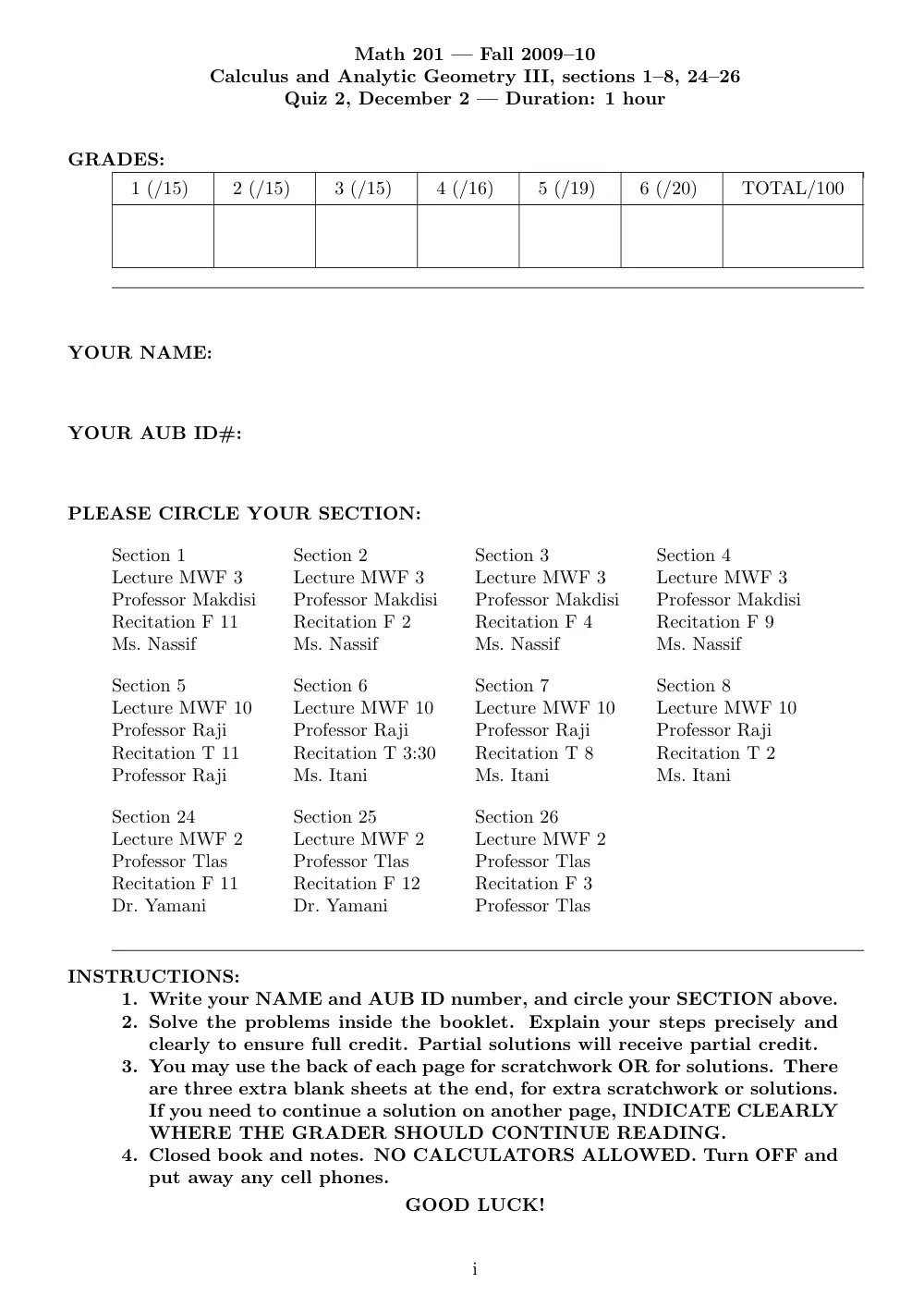
Math 201 — Fall 2009–10
Calculus and Analytic Geometry III, sections 1–8, 24–26
Quiz 2, December 2 — Duration: 1 hour
GRADES:
1 (/15)
2 (/15)
3 (/15)
4 (/16)
5 (/19)
6 (/20)
TOTAL/100
YOUR NAME:
YOUR AUB ID#:
PLEASE CIRCLE YOUR SECTION:
Section 1
Section 2
Section 3
Section 4
Lecture MWF 3
Lecture MWF 3
Lecture MWF 3
Lecture MWF 3
Professor Makdisi
Professor Makdisi
Professor Makdisi
Professor Makdisi
Recitation F 11
Recitation F 2
Recitation F 4
Recitation F 9
Ms. Nassif
Ms. Nassif
Ms. Nassif
Ms. Nassif
Section 5
Section 6
Section 7
Section 8
Lecture MWF 10
Lecture MWF 10
Lecture MWF 10
Lecture MWF 10
Professor Raji
Professor Raji
Professor Raji
Professor Raji
Recitation T 11
Recitation T 3:30
Recitation T 8
Recitation T 2
Professor Raji
Ms. Itani
Ms. Itani
Ms. Itani
Section 24
Section 25
Section 26
Lecture MWF 2
Lecture MWF 2
Lecture MWF 2
Professor Tlas
Professor Tlas
Professor Tlas
Recitation F 11
Recitation F 12
Recitation F 3
Dr. Yamani
Dr. Yamani
Professor Tlas
INSTRUCTIONS:
1. Write your NAME and AUB ID number, and circle your SECTION above.
2. Solve the problems inside the booklet. Explain your steps precisely and
clearly to ensure full credit. Partial solutions will receive partial credit.
3. You may use the back of each page for scratchwork OR for solutions. There
are three extra blank sheets at the end, for extra scratchwork or solutions.
If you need to continue a solution on another page, INDICATE CLEARLY
WHERE THE GRADER SHOULD CONTINUE READING.
4. Closed book and notes. NO CALCULATORS ALLOWED. Turn OFF and
put away any cell phones.
GOOD LUCK!
i
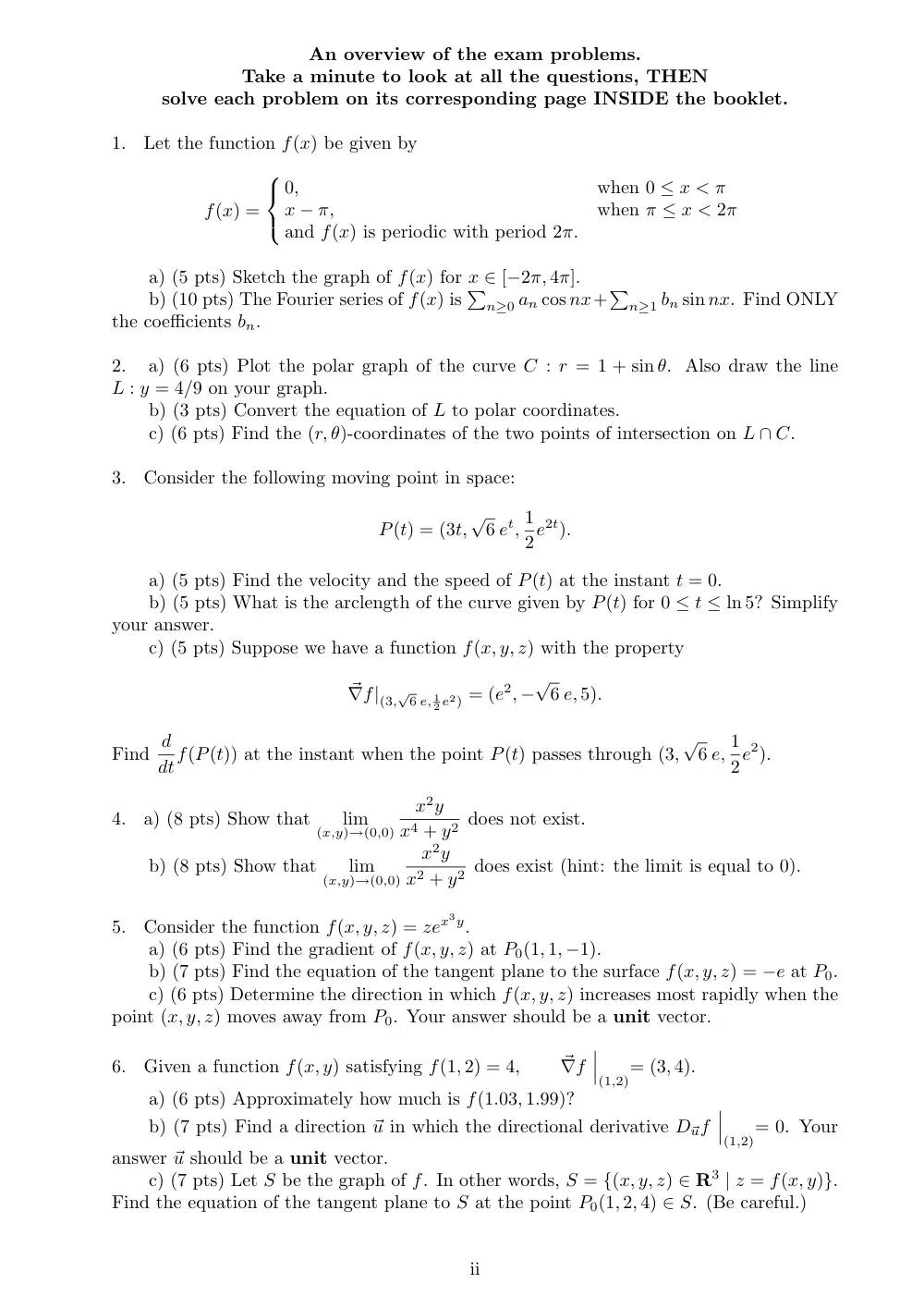
An overview of the exam problems.
Take a minute to look at all the questions, THEN
solve each problem on its corresponding page INSIDE the booklet.
1.
Let the function f(x) be given by
f(x) =
0,
when 0 ≤ x < π
x − π,
when π ≤ x < 2π
and f(x) is periodic with period 2π.
a) (5 pts) Sketch the graph of f(x) for x ∈ [−2π, 4π].
b) (10 pts) The Fourier series of f(x) is �
n≥0 an cos nx+�
n≥1 bn sin nx. Find ONLY
the coefficients bn.
2.
a) (6 pts) Plot the polar graph of the curve C : r = 1 + sin θ. Also draw the line
L : y = 4/9 on your graph.
b) (3 pts) Convert the equation of L to polar coordinates.
c) (6 pts) Find the (r, θ)-coordinates of the two points of intersection on L ∩ C.
3.
Consider the following moving point in space:
P(t) = (3t,
√
6 et, 1
2e2t).
a) (5 pts) Find the velocity and the speed of P(t) at the instant t = 0.
b) (5 pts) What is the arclength of the curve given by P(t) for 0 ≤ t ≤ ln 5? Simplify
your answer.
c) (5 pts) Suppose we have a function f(x, y, z) with the property
⃗∇f|(3,
√
6 e, 1
2 e2) = (e2, −
√
6 e, 5).
Find d
dtf(P(t)) at the instant when the point P(t) passes through (3,
√
6 e, 1
2e2).
4.
a) (8 pts) Show that
lim
(x,y)→(0,0)
x2y
x4 + y2 does not exist.
b) (8 pts) Show that
lim
(x,y)→(0,0)
x2y
x2 + y2 does exist (hint: the limit is equal to 0).
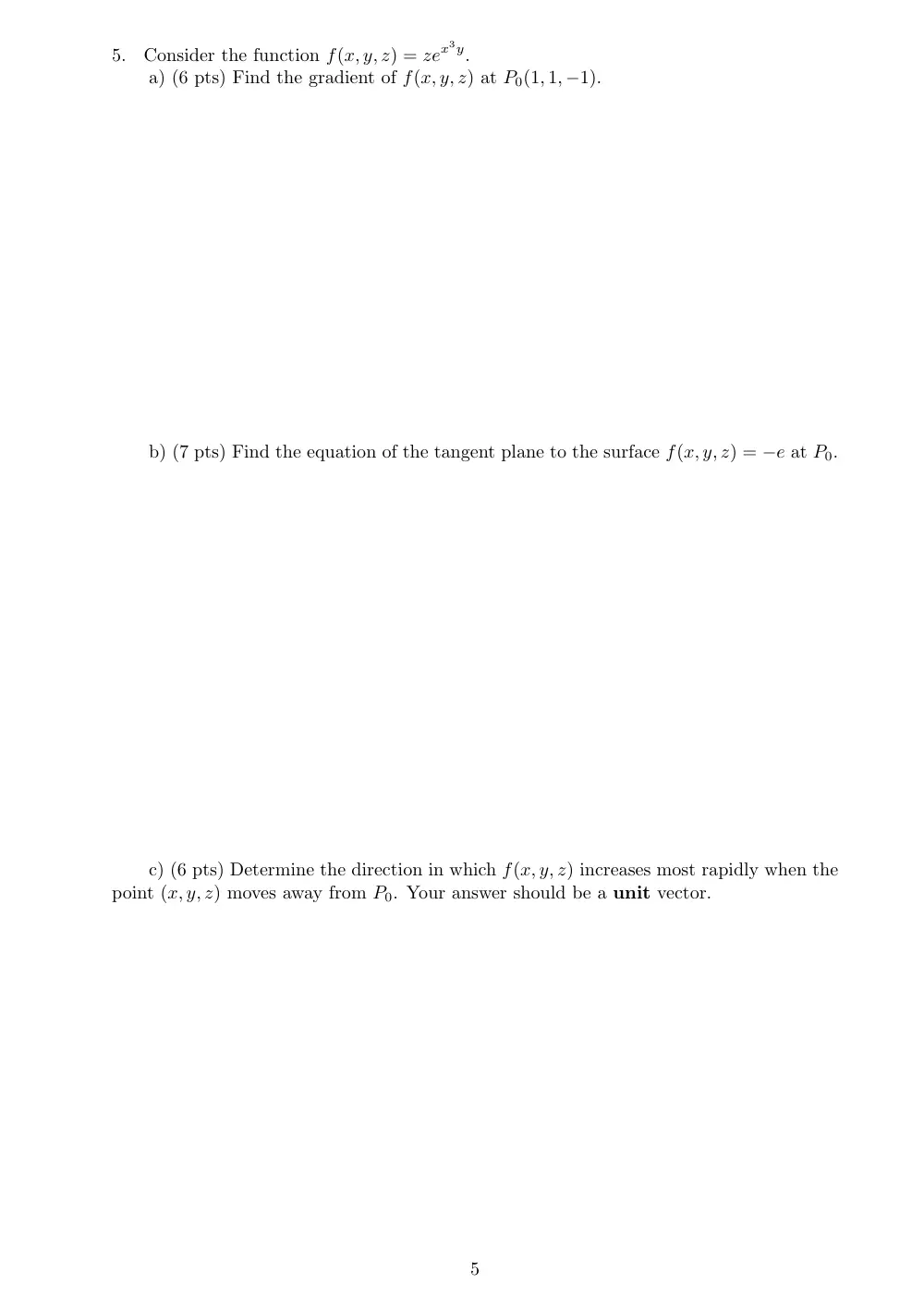
5.
Consider the function f(x, y, z) = zex3y.
a) (6 pts) Find the gradient of f(x, y, z) at P0(1, 1, −1).
b) (7 pts) Find the equation of the tangent plane to the surface f(x, y, z) = −e at P0.
c) (6 pts) Determine the direction in which f(x, y, z) increases most rapidly when the
point (x, y, z) moves away from P0. Your answer should be a unit vector.
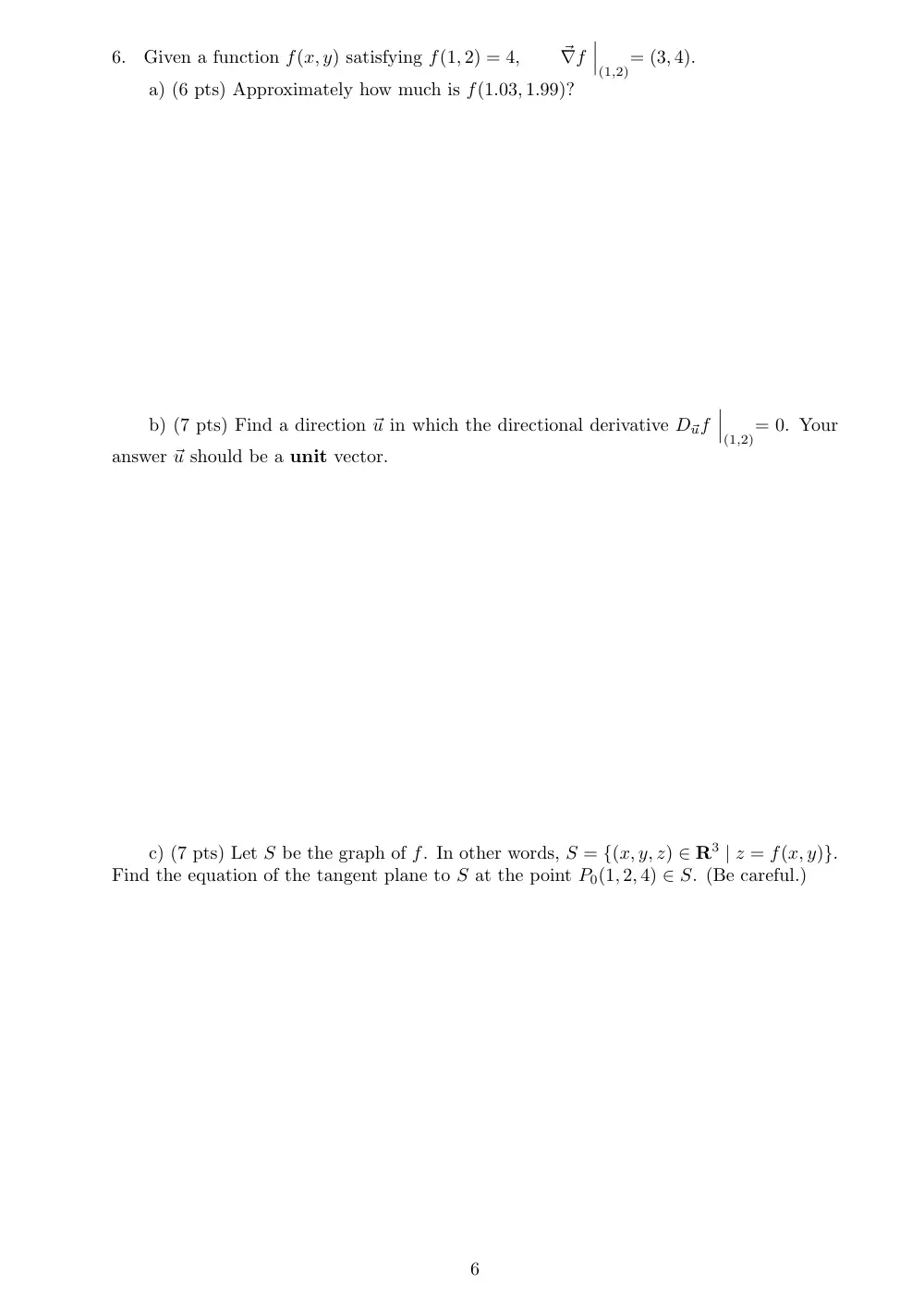
6.
Given a function f(x, y) satisfying f(1, 2) = 4,
⃗∇f
���
(1,2)= (3, 4).
a) (6 pts) Approximately how much is f(1.03, 1.99)?
b) (7 pts) Find a direction ⃗u in which the directional derivative D⃗uf
���
(1,2)= 0. Your
answer ⃗u should be a unit vector.
c) (7 pts) Let S be the graph of f. In other words, S = {(x, y, z) ∈ R3 | z = f(x, y)}.
Find the equation of the tangent plane to S at the point P0(1, 2, 4) ∈ S. (Be careful.)
ii
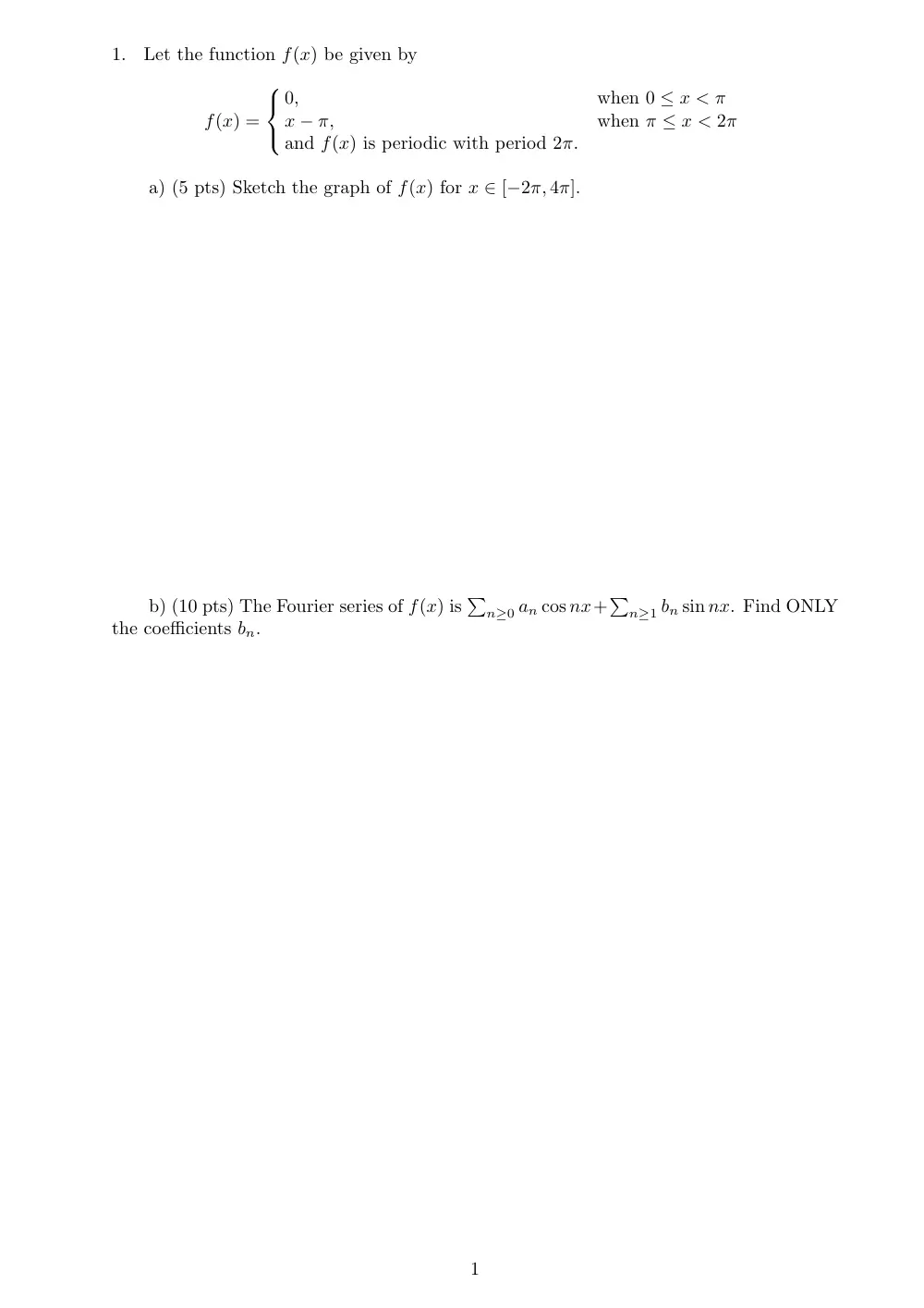
1.
Let the function f(x) be given by
f(x) =
0,
when 0 ≤ x < π
x − π,
when π ≤ x < 2π
and f(x) is periodic with period 2π.
a) (5 pts) Sketch the graph of f(x) for x ∈ [−2π, 4π].
b) (10 pts) The Fourier series of f(x) is �
n≥0 an cos nx+�
n≥1 bn sin nx. Find ONLY
the coefficients bn.
1
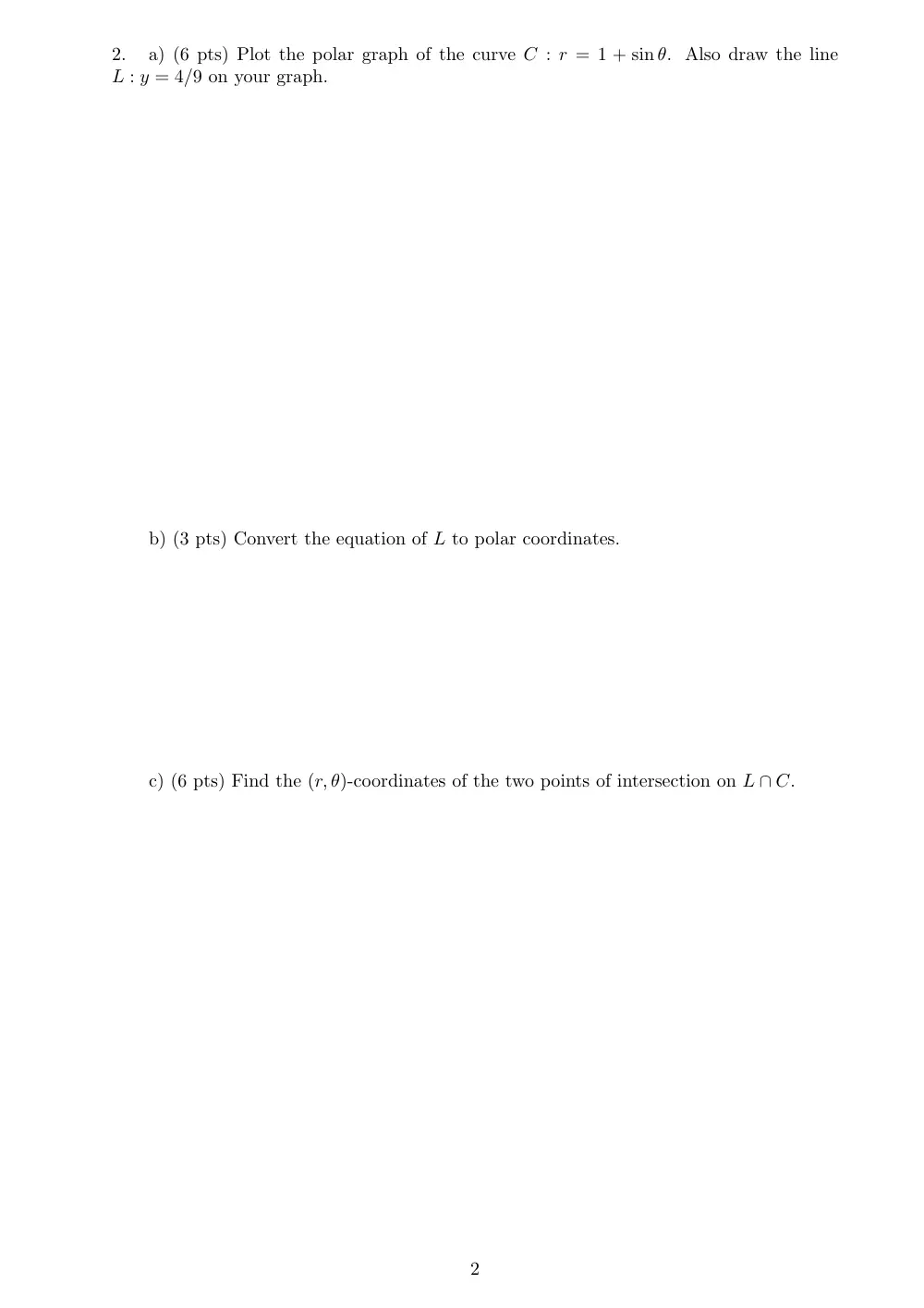
2.
a) (6 pts) Plot the polar graph of the curve C : r = 1 + sin θ. Also draw the line
L : y = 4/9 on your graph.
b) (3 pts) Convert the equation of L to polar coordinates.
c) (6 pts) Find the (r, θ)-coordinates of the two points of intersection on L ∩ C.
2
3.
Consider the following moving point in space:
P(t) = (3t,
√
6 et, 1
2e2t).
a) (5 pts) Find the velocity and the speed of P(t) at the instant t = 0.
b) (5 pts) What is the arclength of the curve given by P(t) for 0 ≤ t ≤ ln 5? Simplify
your answer.
c) (5 pts) Suppose we have a function f(x, y, z) with the property
⃗∇f|(3,
√
6 e, 1
2 e2) = (e2, −
√
6 e, 5).
Find d
dtf(P(t)) at the instant when the point P(t) passes through (3,
√
6 e, 1
2e2).
3
4.
a) (8 pts) Show that
lim
(x,y)→(0,0)
x2y
x4 + y2 does not exist.
b) (8 pts) Show that
lim
(x,y)→(0,0)
x2y
x2 + y2 does exist (hint: the limit is equal to 0).
4
5.
Consider the function f(x, y, z) = zex3y.
a) (6 pts) Find the gradient of f(x, y, z) at P0(1, 1, −1).
b) (7 pts) Find the equation of the tangent plane to the surface f(x, y, z) = −e at P0.
c) (6 pts) Determine the direction in which f(x, y, z) increases most rapidly when the
point (x, y, z) moves away from P0. Your answer should be a unit vector.
5
6.
Given a function f(x, y) satisfying f(1, 2) = 4,
⃗∇f
���
(1,2)= (3, 4).
a) (6 pts) Approximately how much is f(1.03, 1.99)?
b) (7 pts) Find a direction ⃗u in which the directional derivative D⃗uf
���
(1,2)= 0. Your
answer ⃗u should be a unit vector.
c) (7 pts) Let S be the graph of f. In other words, S = {(x, y, z) ∈ R3 | z = f(x, y)}.
Find the equation of the tangent plane to S at the point P0(1, 2, 4) ∈ S. (Be careful.)
6
Blank sheet.
7
Blank sheet.
8
Blank sheet.
9