
MATH 201 Exam 2, Fall 2015
American University of Beirut · Calculus and Analytical Geometry III · 1 page · Dr. Michel Egeileh
Stuck on a question? A tutor can walk you through it.
More MATH 201 files
Show the text of this exam
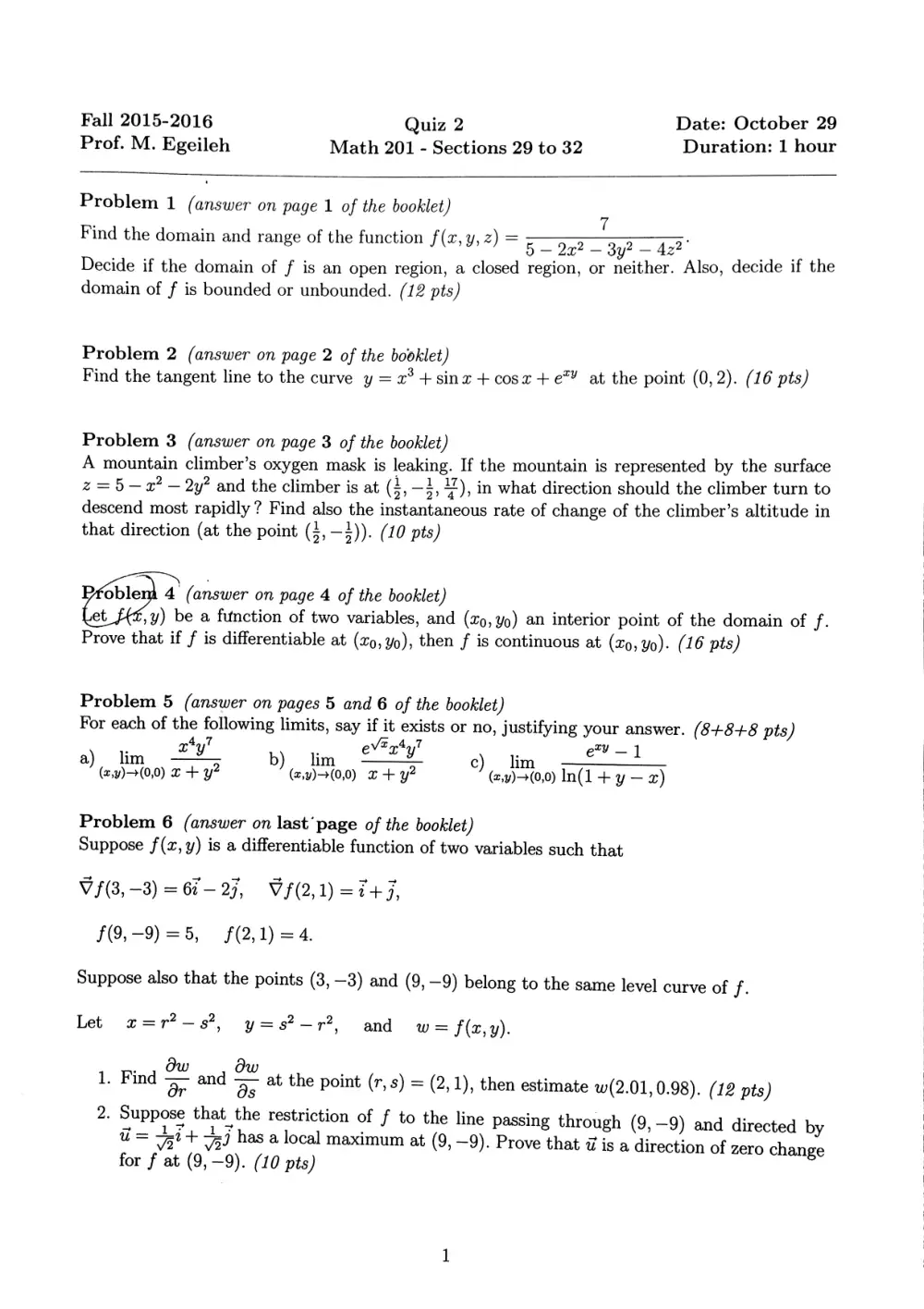
Fall 2015-2016 Quiz 2 Date: October 29
Prof. M. Egeileh Math 201 - Sections 29 to 32 Duration: 1 hour
Problem 1 (answer on page 1 of the booklet) 7
5 — 2x? — By? — 42?" —
Decide if the domain of f is an open region, a closed region, or neither. Also, decide if the
domain of f is bounded or unbounded. (12 pts)
Find the domain and range of the function f(z, y, z) =
Problem 2 (answer on page 2 of the booklet)
Find the tangent line to the curve y = 2° +sinz +cosx+e™ at the point (0,2). (16 pts)
Problem 3 (answer on page 3 of the booklet)
A mountain climber’s oxygen mask is leaking. If the mountain is represented by the surface
i 1 17
z=5-— 2? — 2y? and the climber is at ($,—3) “¢), in what direction should the climber turn to
descend most rapidly? Find also the instantaneous rate of change of the climber’s altitude in
that direction (at the point (3,—3)). (10 pts)
Problem 4 ( answer on page 4 of the booklet)
et ,y) be a futnction of two variables, and (zo, yo) an interior point of the domain of f.
Prove that if f is differentiable at (x, yo), then f is continuous at (xo, yo). (16 pts)
Problem 5 (answer on pages 5 and 6 of the booklet)
For each of the following limits, say if it exists or no, justifying your answer. (8+8+8 pts)
4,,7 VE p47 cy
a) tim =% b) lim 2 7 c) lim —S->1
(zy)>(0,0) & + Y (zw)3(0,0) r+ y (zy)+(0,0) In(1 + y — z)
Problem 6 (answer on last’ page of the booklet)
Suppose f(z, y) is a differentiable function of two variables such that
Vf(3,-3) = 61-27, VF (2,1) =74+J,
f(9,-9) =5, f (2,1) =4.
Suppose also that the points (3, —3) and (9, —9) belong to the same level curve of f.
Let c=r?—s?, y=s?-r?, and w= f(z,y).
. , Ow Ow .
1. Find or and 3s at the point (r,s) = (2,1), then estimate w(2.01, 0.98). (12 pts)
2. Suppose that the restriction of f to the line passing through (9,—9) and directed by
a= Ft + Jai has a local maximum at (9, —9). Prove that @ is a direction of zero change
for f at (9,—9). (10 pts)