
MATH 201 Exam 2, Fall 2015
American University of Beirut · Calculus and Analytical Geometry III · 1 page · Prof. Bassam Shayya
Stuck on a question? A tutor can walk you through it.
More MATH 201 files
Show the text of this exam
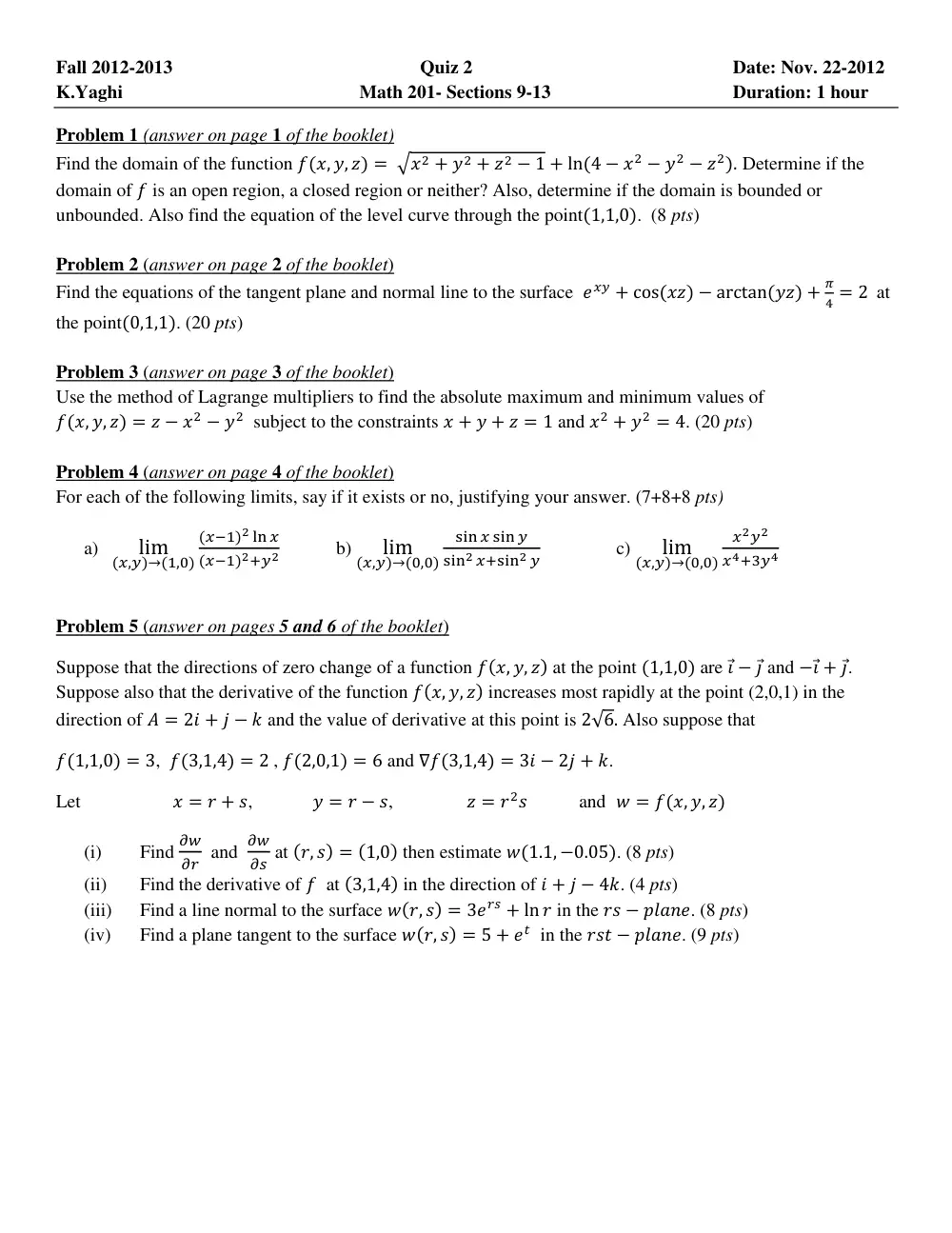
Fall 2012-2013
Quiz 2
Date: Nov. 22-2012
K.Yaghi
Math 201- Sections 9-13
Duration: 1 hour
Problem 1 (answer on page 1 of the booklet)
Find the domain of the function 𝑓(𝑥, 𝑦, 𝑧) = √𝑥2 + 𝑦2 + 𝑧2 − 1 + ln(4 − 𝑥2 − 𝑦2 − 𝑧2). Determine if the
domain of 𝑓 is an open region, a closed region or neither? Also, determine if the domain is bounded or
unbounded. Also find the equation of the level curve through the point(1,1,0). (8 pts)
Problem 2 (answer on page 2 of the booklet)
Find the equations of the tangent plane and normal line to the surface 𝑒𝑥𝑦 + cos(𝑥𝑧) − arctan(𝑦𝑧) +
𝜋
4 = 2 at
the point(0,1,1). (20 pts)
Problem 3 (answer on page 3 of the booklet)
Use the method of Lagrange multipliers to find the absolute maximum and minimum values of
𝑓(𝑥, 𝑦, 𝑧) = 𝑧 − 𝑥2 − 𝑦2 subject to the constraints 𝑥 + 𝑦 + 𝑧 = 1 and 𝑥2 + 𝑦2 = 4. (20 pts)
Problem 4 (answer on page 4 of the booklet)
For each of the following limits, say if it exists or no, justifying your answer. (7+8+8 pts)
a)
lim
(𝑥,𝑦)→(1,0)
(𝑥−1)2 ln 𝑥
(𝑥−1)2+𝑦2
b)
lim
(𝑥,𝑦)→(0,0)
sin 𝑥 sin 𝑦
sin2 𝑥+sin2 𝑦
c)
lim
(𝑥,𝑦)→(0,0)
𝑥2𝑦2
𝑥4+3𝑦4
Problem 5 (answer on pages 5 and 6 of the booklet)
Suppose that the directions of zero change of a function 𝑓(𝑥, 𝑦, 𝑧) at the point (1,1,0) are 𝑖⃗ − 𝑗⃗ and −𝑖⃗ + 𝑗⃗.
Suppose also that the derivative of the function 𝑓(𝑥, 𝑦, 𝑧) increases most rapidly at the point (2,0,1) in the
direction of 𝐴 = 2𝑖 + 𝑗 − 𝑘 and the value of derivative at this point is 2√6. Also suppose that
𝑓(1,1,0) = 3, 𝑓(3,1,4) = 2 , 𝑓(2,0,1) = 6 and ∇𝑓(3,1,4) = 3𝑖 − 2𝑗 + 𝑘.
Let
𝑥 = 𝑟 + 𝑠,
𝑦 = 𝑟 − 𝑠,
𝑧 = 𝑟2𝑠 and 𝑤 = 𝑓(𝑥, 𝑦, 𝑧)
(i)
Find
𝜕𝑤
𝜕𝑟 and
𝜕𝑤
𝜕𝑠 at (𝑟, 𝑠) = (1,0) then estimate 𝑤(1.1, −0.05). (8 pts)
(ii)
Find the derivative of 𝑓 at (3,1,4) in the direction of 𝑖 + 𝑗 − 4𝑘. (4 pts)
(iii)
Find a line normal to the surface 𝑤(𝑟, 𝑠) = 3𝑒𝑟𝑠 + ln 𝑟 in the 𝑟𝑠 − 𝑝𝑙𝑎𝑛𝑒. (8 pts)
(iv)
Find a plane tangent to the surface 𝑤(𝑟, 𝑠) = 5 + 𝑒𝑡 in the 𝑟𝑠𝑡 − 𝑝𝑙𝑎𝑛𝑒. (9 pts)