
MATH 201 Exam 2, Fall 2016
American University of Beirut · Calculus and Analytical Geometry III · 2 pages · Prof. Nazih Nahlus
More MATH 201 files
Show the text of this exam
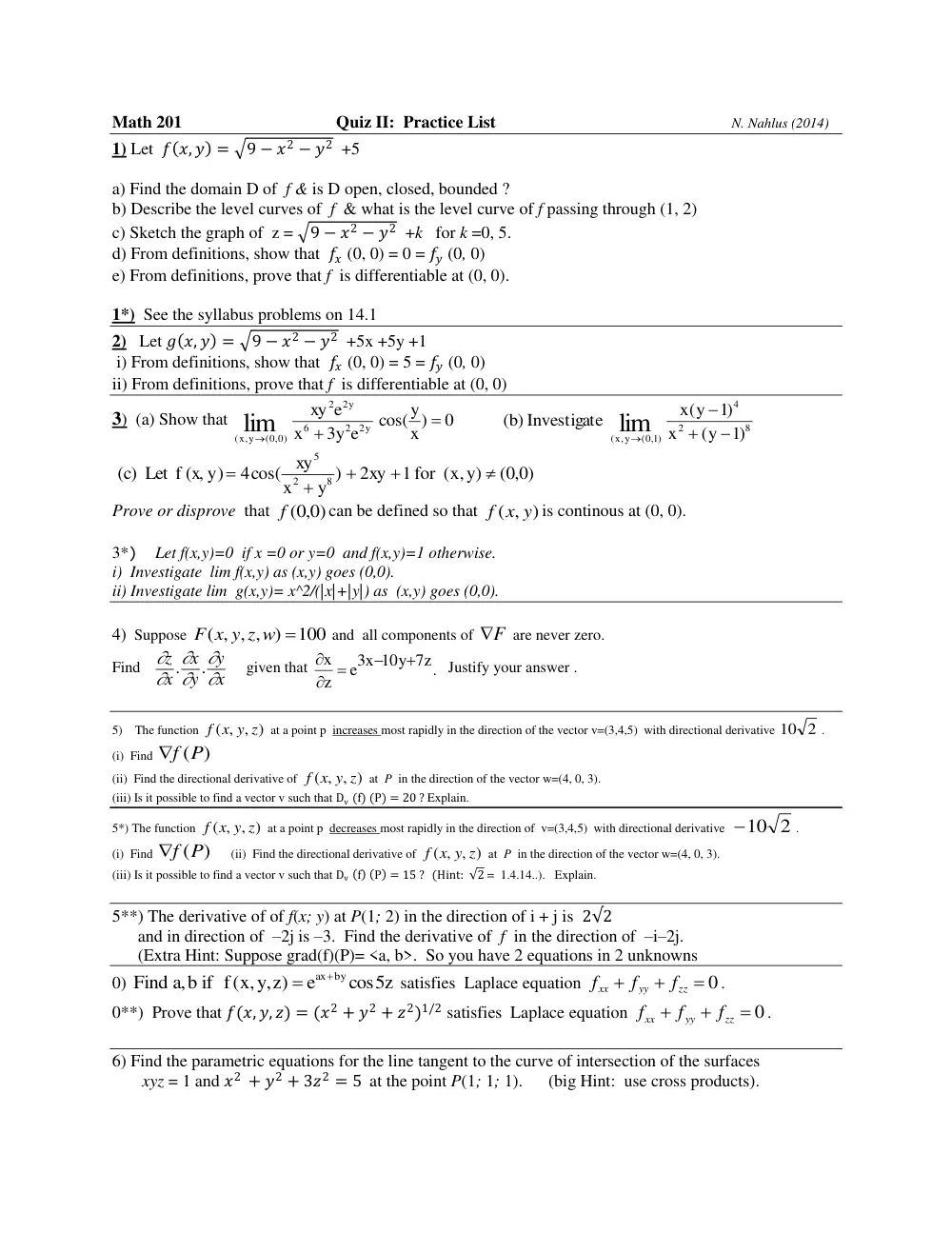
Math 201
Quiz II: Practice List
N. Nahlus (2014)
1) Let 𝑓 𝑥, 𝑦 = 9 − 𝑥2 − 𝑦2 +5
a) Find the domain D of f & is D open, closed, bounded ?
b) Describe the level curves of f & what is the level curve of f passing through (1, 2)
c) Sketch the graph of z = 9 − 𝑥2 − 𝑦2 +k for k =0, 5.
d) From definitions, show that 𝑓𝑥 (0, 0) = 0 = 𝑓𝑦 (0, 0)
e) From definitions, prove that f is differentiable at (0, 0).
1*) See the syllabus problems on 14.1
2) Let 𝑔 𝑥, 𝑦 = 9 − 𝑥2 − 𝑦2 +5x +5y +1
i) From definitions, show that 𝑓𝑥 (0, 0) = 5 = 𝑓𝑦 (0, 0)
ii) From definitions, prove that f is differentiable at (0, 0)
3) (a) Show that
8
2
4
( 1,0 )
x,y
(
2y
2
6
2y
2
( ,0 0)
(x,y
)1
(y
x
)1
x(y
(b) Investigate
0
x)
cos(y
3y e
x
xy e
lim
lim
( 0,0 )
1 for ( ,x y)
2xy
y )
x
xy
4cos(
(c) Let f (x, y)
8
2
5
Prove or disprove that
f ( 0,0 )
can be defined so that
( , )
f x y
is continous at (0, 0).
3*) Let f(x,y)=0 if x =0 or y=0 and f(x,y)=1 otherwise.
i) Investigate lim f(x,y) as (x,y) goes (0,0).
ii) Investigate lim g(x,y)= x^2/(|x|+|y|) as (x,y) goes (0,0).
4) Suppose
100
( , , , )
F x y z w
and all components of F are never zero.
Find
x
y
y
x
x
z
.
.
given that
e3x 10y 7 .z
z
x
Justify your answer .
5) The function
( , , )
f x y z
at a point p increases most rapidly in the direction of the vector v=(3,4,5) with directional derivative
2
10
.
(i) Find
f (P)
(ii) Find the directional derivative of
( , , )
f x y z
at P in the direction of the vector w=(4, 0, 3).
(iii) Is it possible to find a vector v such that Dv f P = 20 ? Explain.
5*) The function
( , , )
f x y z
at a point p decreases most rapidly in the direction of v=(3,4,5) with directional derivative
10 2
.
(i) Find
f (P)
(ii) Find the directional derivative of
( , , )
f x y z
at P in the direction of the vector w=(4, 0, 3).
(iii) Is it possible to find a vector v such that Dv f P = 15 ? (Hint: 2 = 1.4.14..). Explain.
5**) The derivative of of f(x; y) at P(1; 2) in the direction of i + j is 2 2
and in direction of –2j is –3. Find the derivative of f in the direction of –i–2j.
(Extra Hint: Suppose grad(f)(P)= <a, b>. So you have 2 equations in 2 unknowns
0)
cos5z
e
)z,y
Find a,b if f( ,x
axby
satisfies Laplace equation
0
zz
yy
xx
f
f
f
.
0**) Prove that 𝑓 𝑥, 𝑦, 𝑧 = (𝑥2 + 𝑦2 + 𝑧2)1/2 satisfies Laplace equation
0
zz
yy
xx
f
f
f
.
6) Find the parametric equations for the line tangent to the curve of intersection of the surfaces
xyz = 1 and 𝑥2 + 𝑦2 + 3𝑧2 = 5 at the point P(1; 1; 1). (big Hint: use cross products).
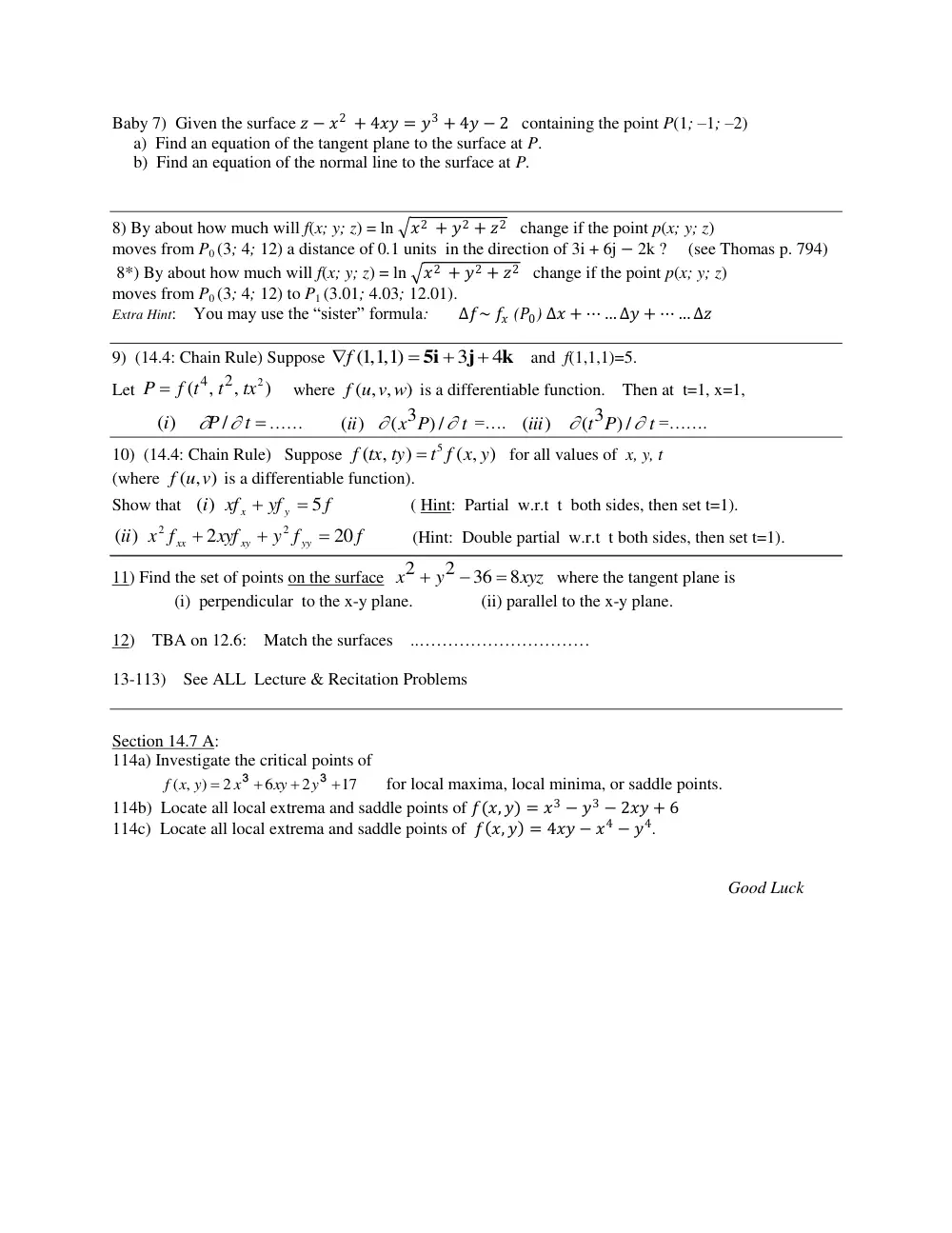
Baby 7) Given the surface 𝑧 − 𝑥2 + 4𝑥𝑦 = 𝑦3 + 4𝑦 − 2 containing the point P(1; –1; –2)
a) Find an equation of the tangent plane to the surface at P.
b) Find an equation of the normal line to the surface at P.
8) By about how much will f(x; y; z) = ln 𝑥2 + 𝑦2 + 𝑧2 change if the point p(x; y; z)
moves from P0 (3; 4; 12) a distance of 0.1 units in the direction of 3i + 6j − 2k ? (see Thomas p. 794)
8*) By about how much will f(x; y; z) = ln 𝑥2 + 𝑦2 + 𝑧2 change if the point p(x; y; z)
moves from P0 (3; 4; 12) to P1 (3.01; 4.03; 12.01).
Extra Hint: You may use the “sister” formula: ∆𝑓~ 𝑓𝑥 (𝑃0) ∆𝑥 + ⋯ … ∆𝑦 + ⋯ … ∆𝑧
9) (14.4: Chain Rule) Suppose
k
j
5i
4
3
)1,1,1(
f
and f(1,1,1)=5.
Let
)
,
,
(
2
2
4
tx
t
P f t
where
( , , )
f u v w
is a differentiable function. Then at t=1, x=1,
t
P
i
/
( )
……
t
x P
ii
/)
( 3
( )
=….
t
t P
iii
/)
( 3
)
(
=…….
10) (14.4: Chain Rule) Suppose
( , )
)
,
(
5
t f x y
f tx ty
for all values of x, y, t
(where
( , )
f u v
is a differentiable function).
Show that
f
yf
xf
i
y
x
5
( )
( Hint: Partial w.r.t t both sides, then set t=1).
f
y f
xyf
x f
ii
yy
xy
xx
20
2
)
(
2
2
(Hint: Double partial w.r.t t both sides, then set t=1).
11) Find the set of points on the surface
xyz
y
x
8
36
2
2
where the tangent plane is
(i) perpendicular to the x-y plane. (ii) parallel to the x-y plane.
12) TBA on 12.6: Match the surfaces ..…………………………
13-113) See ALL Lecture & Recitation Problems
Section 14.7 A:
114a) Investigate the critical points of
17
2
6
2
( , )
3
3
y
xy
x
f x y
for local maxima, local minima, or saddle points.
114b) Locate all local extrema and saddle points of 𝑓(𝑥, 𝑦) = 𝑥3 − 𝑦3 − 2𝑥𝑦 + 6
114c) Locate all local extrema and saddle points of 𝑓 𝑥, 𝑦 = 4𝑥𝑦 − 𝑥4 − 𝑦4.
Good Luck