
MATH 201 Exam 2, Spring 2015
American University of Beirut · Calculus and Analytical Geometry III · 8 pages · Prof. Tamer Tlas




More MATH 201 files
Show the text of this exam
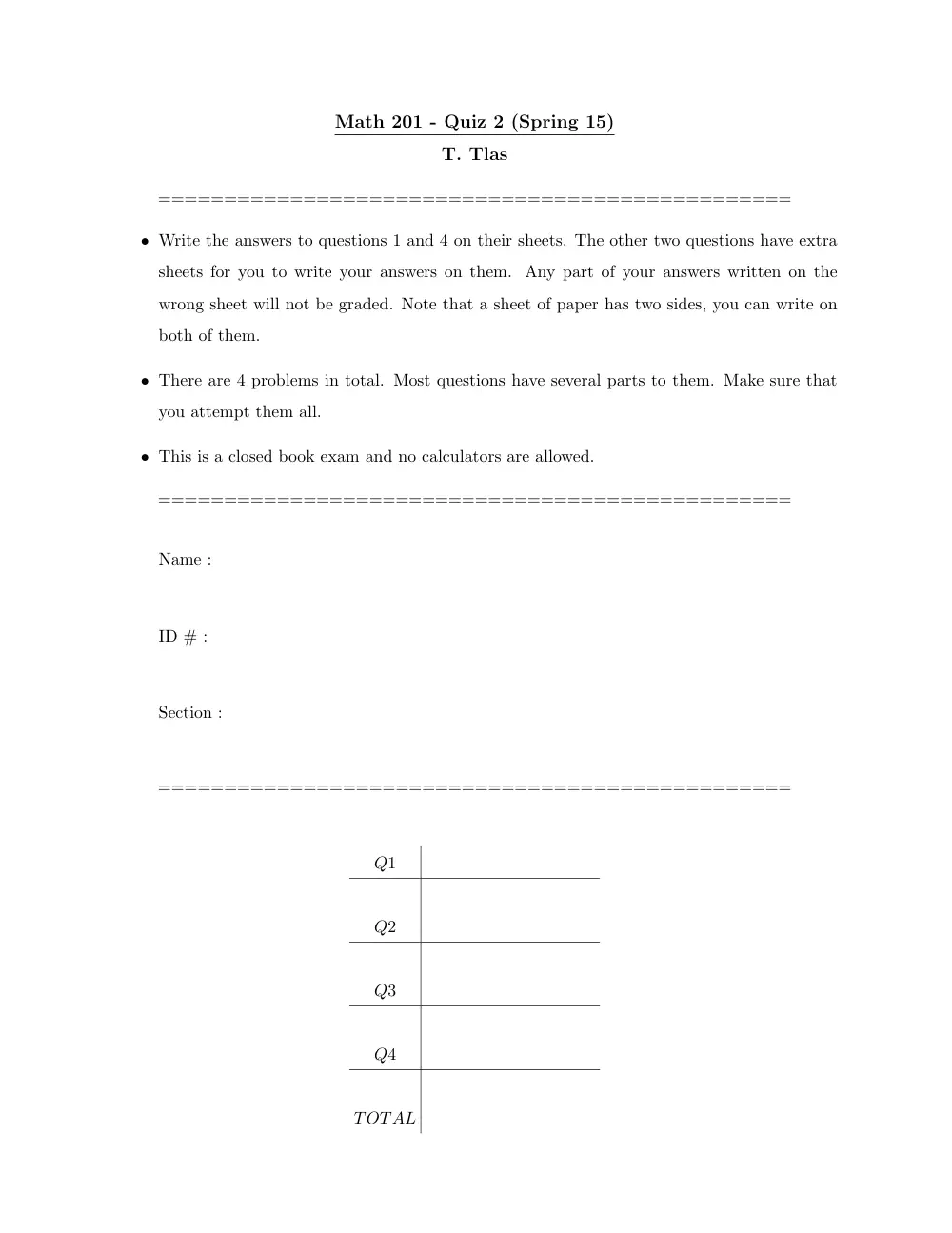
Math 201 - Quiz 2 (Spring 15)
T. Tlas
================================================
• Write the answers to questions 1 and 4 on their sheets. The other two questions have extra
sheets for you to write your answers on them. Any part of your answers written on the
wrong sheet will not be graded. Note that a sheet of paper has two sides, you can write on
both of them.
• There are 4 problems in total. Most questions have several parts to them. Make sure that
you attempt them all.
• This is a closed book exam and no calculators are allowed.
================================================
Name :
ID # :
Section :
================================================
Q1
Q2
Q3
Q4
TOTAL
Problem 1
(12 points each) For each of the functions below, either find its limit as (x, y) → (0, 0) or show that
the limit doesn’t exist:
i-
f(x, y) =
x3y2
x2 + y2
ii-
g(x, y) =
x|y|
3
2
x2 + y2
================================================
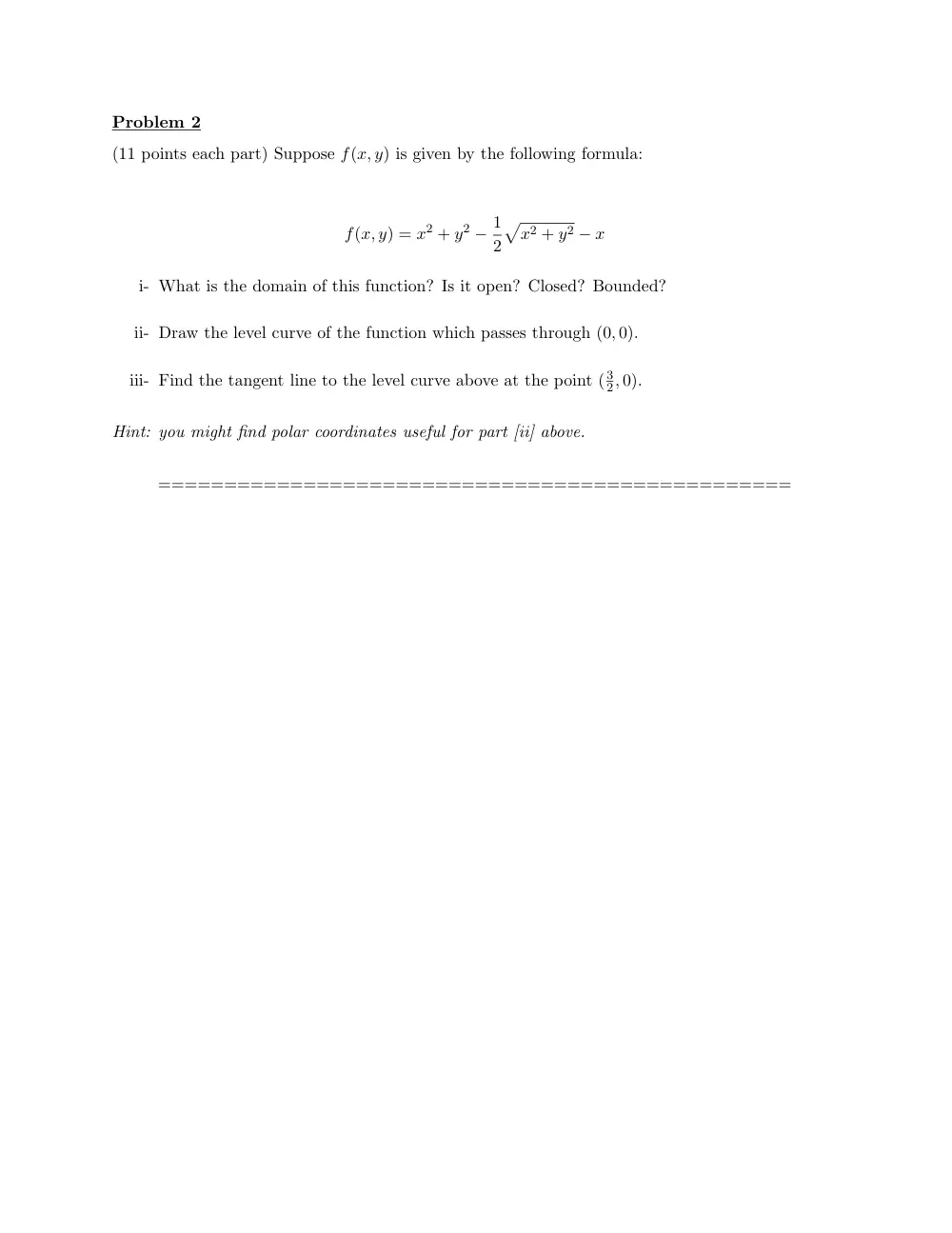
Problem 2
(11 points each part) Suppose f(x, y) is given by the following formula:
f(x, y) = x2 + y2 − 1
2
�
x2 + y2 − x
i- What is the domain of this function? Is it open? Closed? Bounded?
ii- Draw the level curve of the function which passes through (0, 0).
iii- Find the tangent line to the level curve above at the point (3
2, 0).
Hint: you might find polar coordinates useful for part [ii] above.
================================================
ADDITIONAL SHEET FOR PROBLEM 2 ANSWER
ADDITIONAL SHEET FOR PROBLEM 2 ANSWER
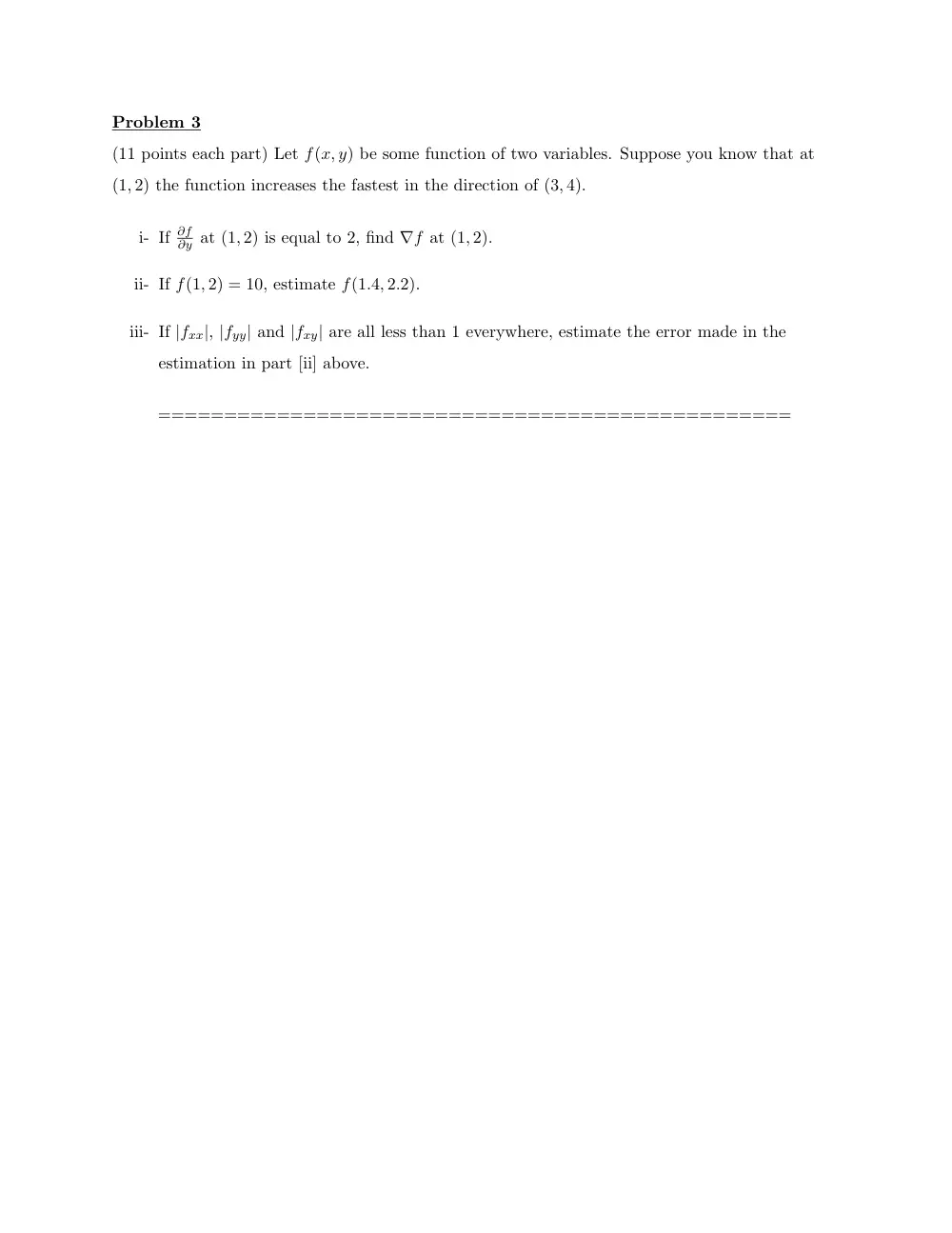
Problem 3
(11 points each part) Let f(x, y) be some function of two variables. Suppose you know that at
(1, 2) the function increases the fastest in the direction of (3, 4).
i- If ∂f
∂y at (1, 2) is equal to 2, find ∇f at (1, 2).
ii- If f(1, 2) = 10, estimate f(1.4, 2.2).
iii- If |fxx|, |fyy| and |fxy| are all less than 1 everywhere, estimate the error made in the
estimation in part [ii] above.
================================================
ADDITIONAL SHEET FOR PROBLEM 3 ANSWER
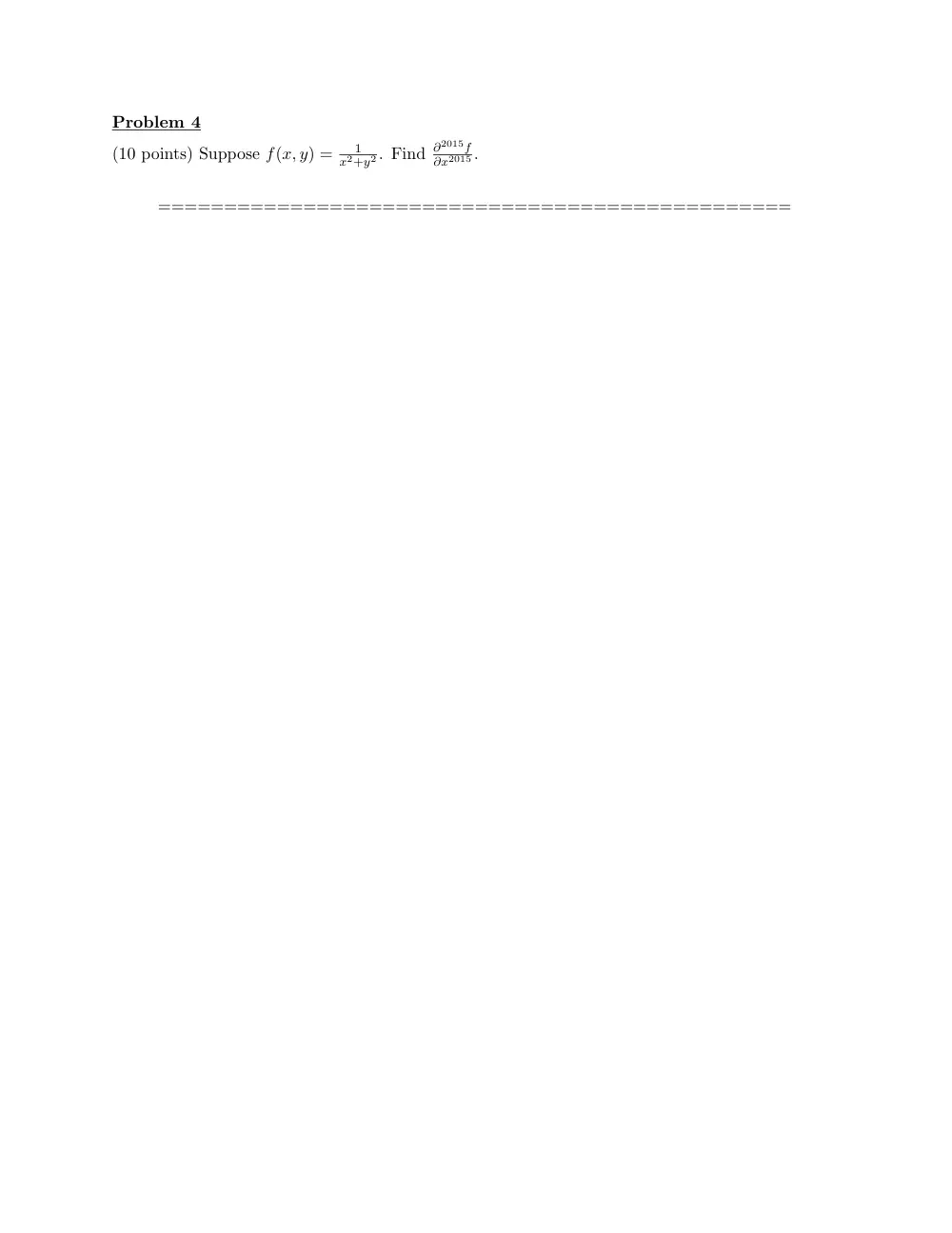
Problem 4
(10 points) Suppose f(x, y) =
1
x2+y2 . Find ∂2015f
∂x2015 .
================================================