
MATH 201 Exam 2 With Solution, Fall 2008
American University of Beirut · Calculus and Analytical Geometry III · 8 pages · Prof. Kamal Makdisi · with solution
More MATH 201 files
Show the text of this exam
Math 201 — Fall 2008-09
Calculus and Analytic Geometry III,-sections 21-23
Quiz 2, December 2 — Duration: 70 minutes
GRADES (each problem is worth 12 points):
1 2 3 4 5 6 TOTAL/72
YOUR NAME:
YOUR AUB ID#:
PLEASE CIRCLE YOUR SECTION:
Section 21 Section 22 Section 23
Recitation M 11 Recitation M 9 Recitation M 1
Ms. Itani Professor Makdisi Ms. Itani
INSTRUCTIONS;
1. Write your NAME and AUB ID number, and circle your SECTION above.
2. Solve the problems inside the booklet. Explain your steps precisely and clearly to
ensure full credit. Partial solutions will receive partial credit.
You may use the back of each page for scratchwork OR for solutions. There are
three extra blank sheets at the end, for extra scratchwork or solutions. If you
need to continue a solution on another page, INDICATE CLEARLY WHERE
THE GRADER SHOULD CONTINUE READING.
3.
any cell phones.
GOOD LUCK!
. Open book and notes. NO CALCULATORS ALLOWED. Turn OFF and put away
An overview of the exam problems. Each problem is worth 12 points.
Take a minute to look at all the questions, THEN
solve each problem on its corresponding page INSIDE the booklet.
1. Let f(z,y,z) =e" — az.
(2 pts) a) Find the gradient Vf.
(5 pts) b) Let P(t) be a moving point with position 7(t) and velocity a(t). Assume we know
that at time t = 0, we have (0) = (1, 1,2) and #(0) = (—1,3, 1). Find < re).
(5 pts) c) Let S = {(z,y,z) € R°| f(x, y,z) = —1} be the level set of f passing through the
point Po(2,0,1). Find the equation of the tangent plane to S at Pp.
2. (5 pts) a) Sketch the curve r = sin? @ in polar coordinates.
(2 pts) b) Write a parametrization of your curve in the form 7(@) = (x(@), y(@)), for 0 < @ < 27.
(Yes, I want you to use @ instead of t as the time variable.)
(5 pts) c) When @ = 77/4, find the position vector F|,_ jq and the velocity vector 7|,_, je
Use U to deduce the speed of the moving point at @ = 7/4.
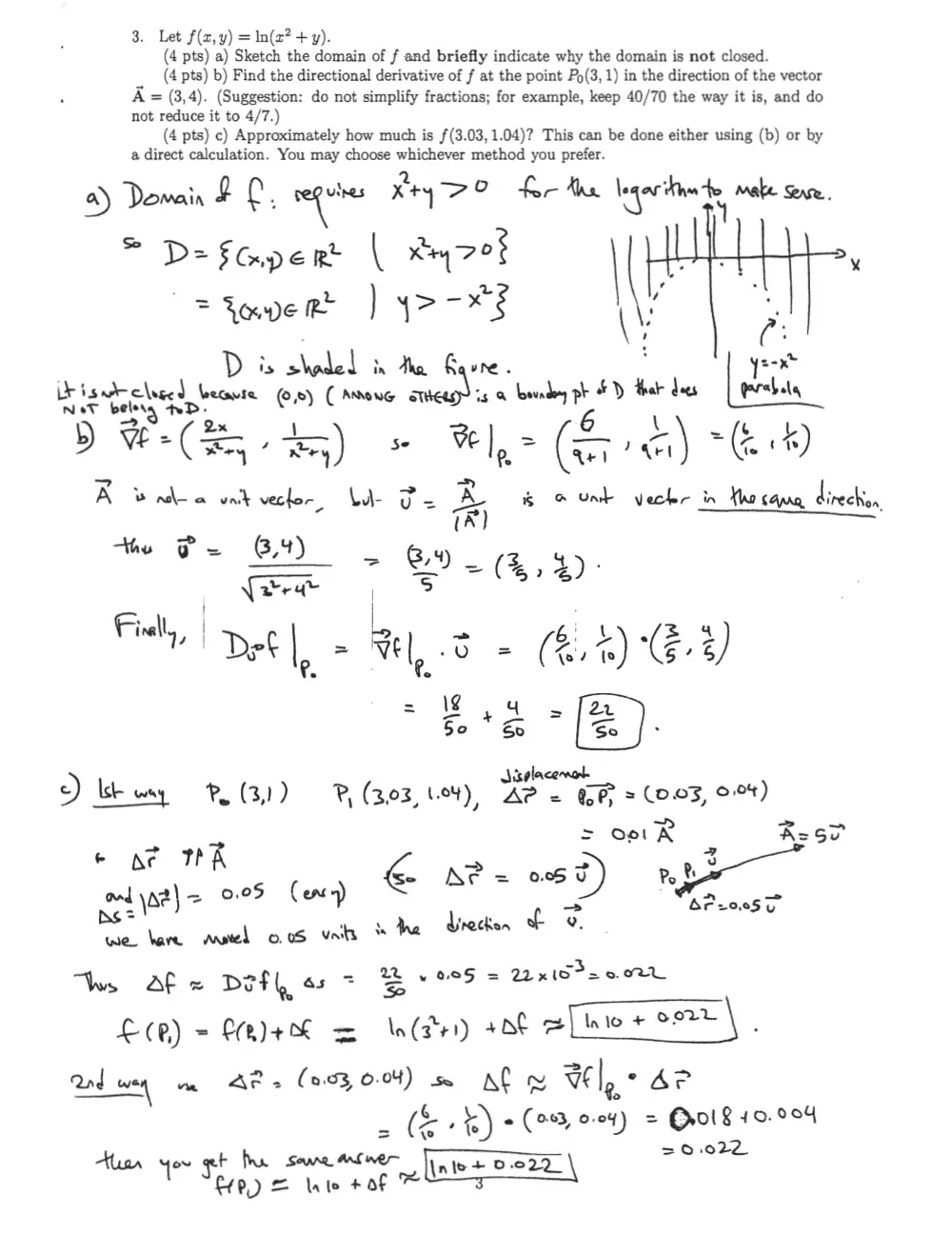
3. Let f(2,y) = In(z? + y).
(4 pts) a) Sketch the domain of f and briefly indicate why the domain is not closed.
(4 pts) b) Find the directional derivative of f at the point Po(3, 1) in the direction of the vector
A= (3,4). (Suggestion: do not simplify fractions; for example, keep 40/70 the way it is, and do
not reduce it to 4/7.)
(4 pts) c) Approximately how much is f (3.03, 1.04)? This can be done either using (b) or by
a direct calculation. You may choose whichever method you prefer.
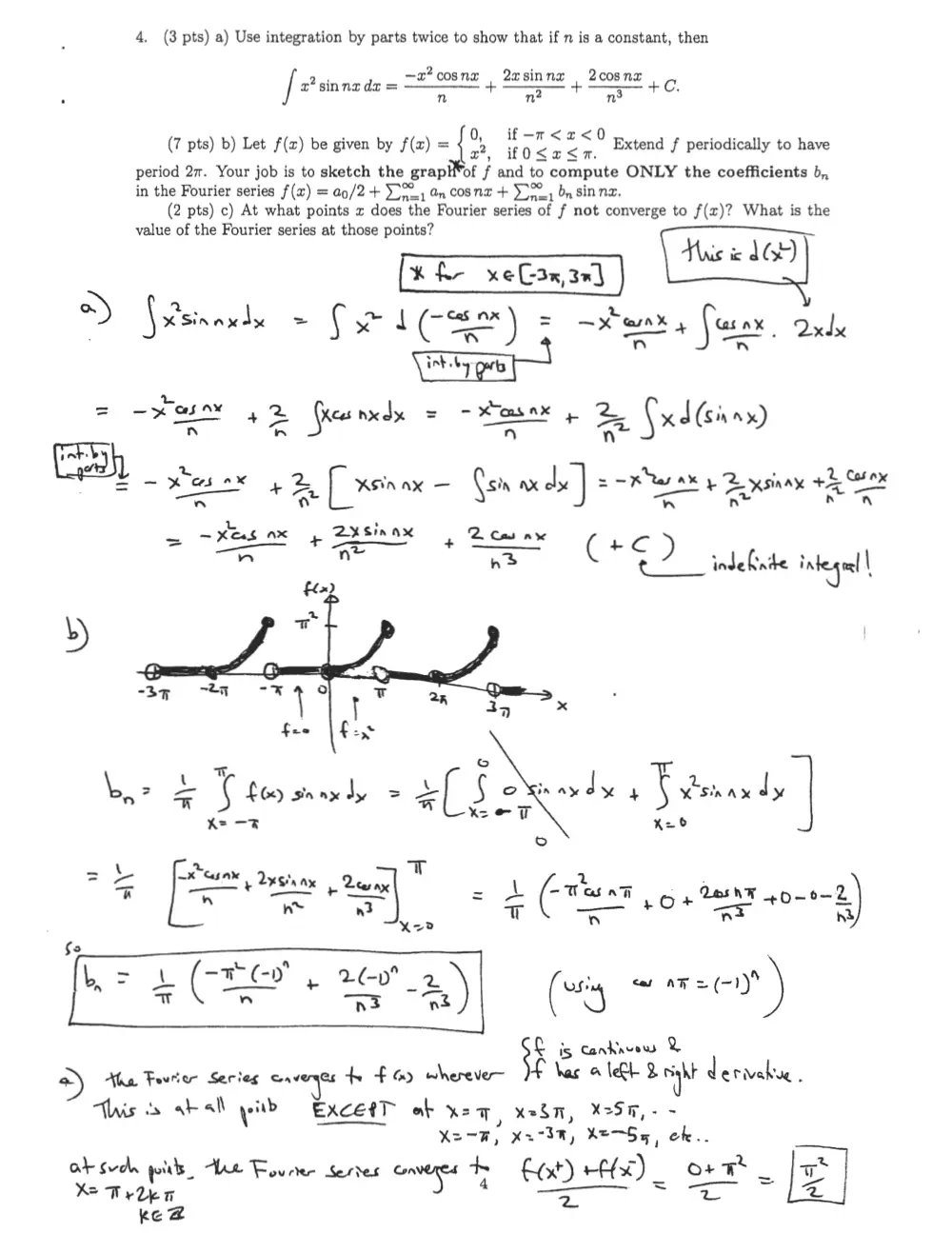
4, (3 pts) a) Use integration by parts twice to show that if n is a constant, then
2: —z*cosnz 2zsinnz 2cosnz |
xz sinnaz dz = + + +C. i
n n? n3
(7 pts) b) Let f(z) be given by f(z) = 5 i Dee - 0 Extend f periodically to have
period 27. Your job is to sketch the graph'of f and to compute ONLY the coefficients bn .
in the Fourier series f(a) = a9/2+ °°, an cosna + >, basinna. [wefee xe C= 3, Fey
(2 pts) c) At what points 2 does the Fourier series of f not converge to f(x)? What is the
+ D value of the Fourier series at those points?
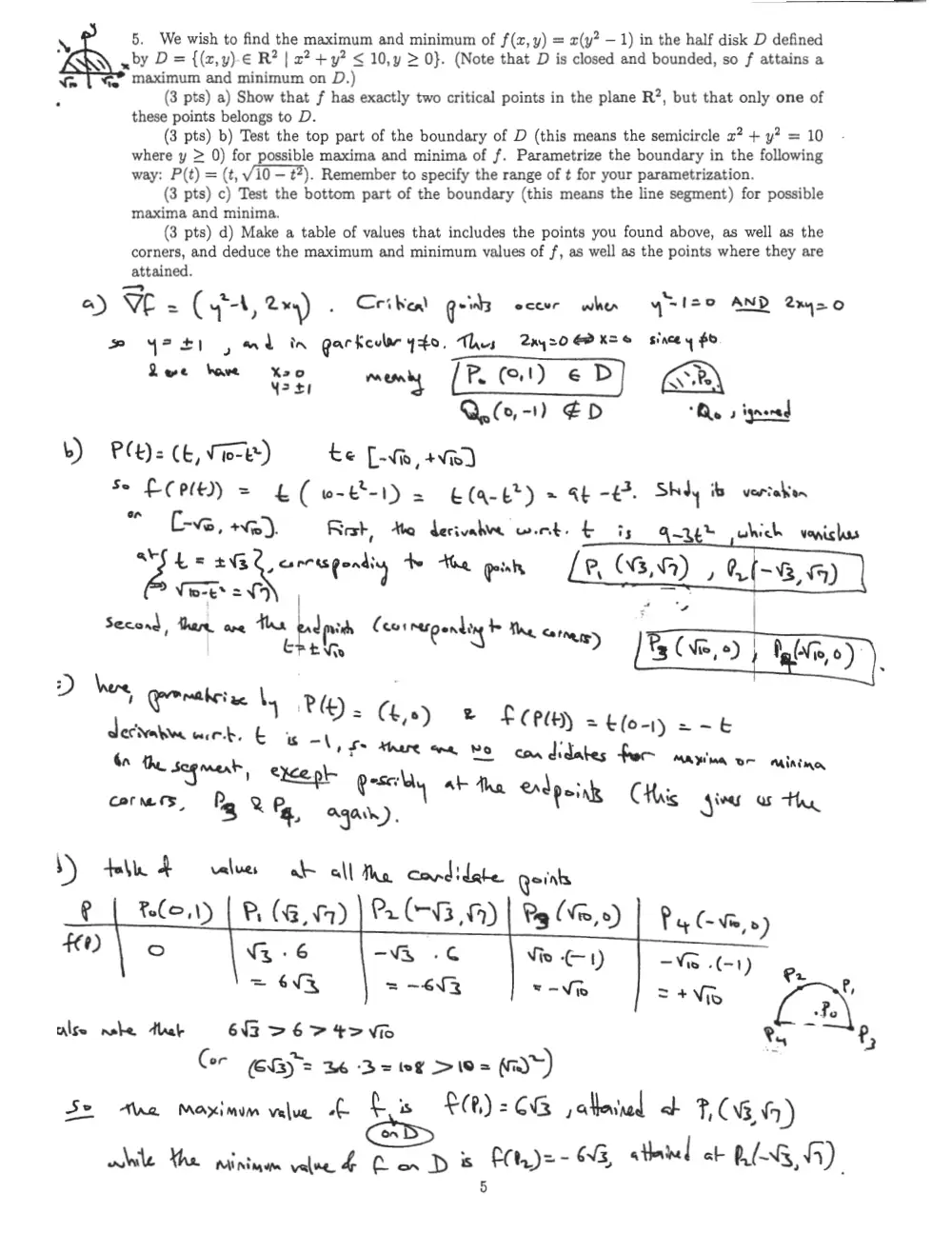
« 5. We wish to find the maximum and minimum of f(z,y) = z(y? — 1) in the half disk D defined
fel ‘ew by D={(z,y) € R? | 22 +y? < 10,y > 0}. (Note that D is closed and bounded, so f attains a
maximum and minimum on D.)
(3 pts) a) Show that f has exactly two critical points in the plane R?, but that only one of
these points belongs to D.
(3 pts) b) Test the top part of the boundary of D (this means the semicircle x? + y? = 10
where y > 0) for possible maxima and minima of f. Parametrize the boundary in the following
way: P(t) = (t, /10 — ?). Remember to specify the range-of t for your parametrization.
(3 pts) c) Test the bottom part of the boundary (this means the line segment) for possible
maxima and minima.
(3 pts) d) Make a table of values that includes the points you found above, as well as the
corners, and deduce the maximum and minimum values of f, as well as the points where they are
attained.
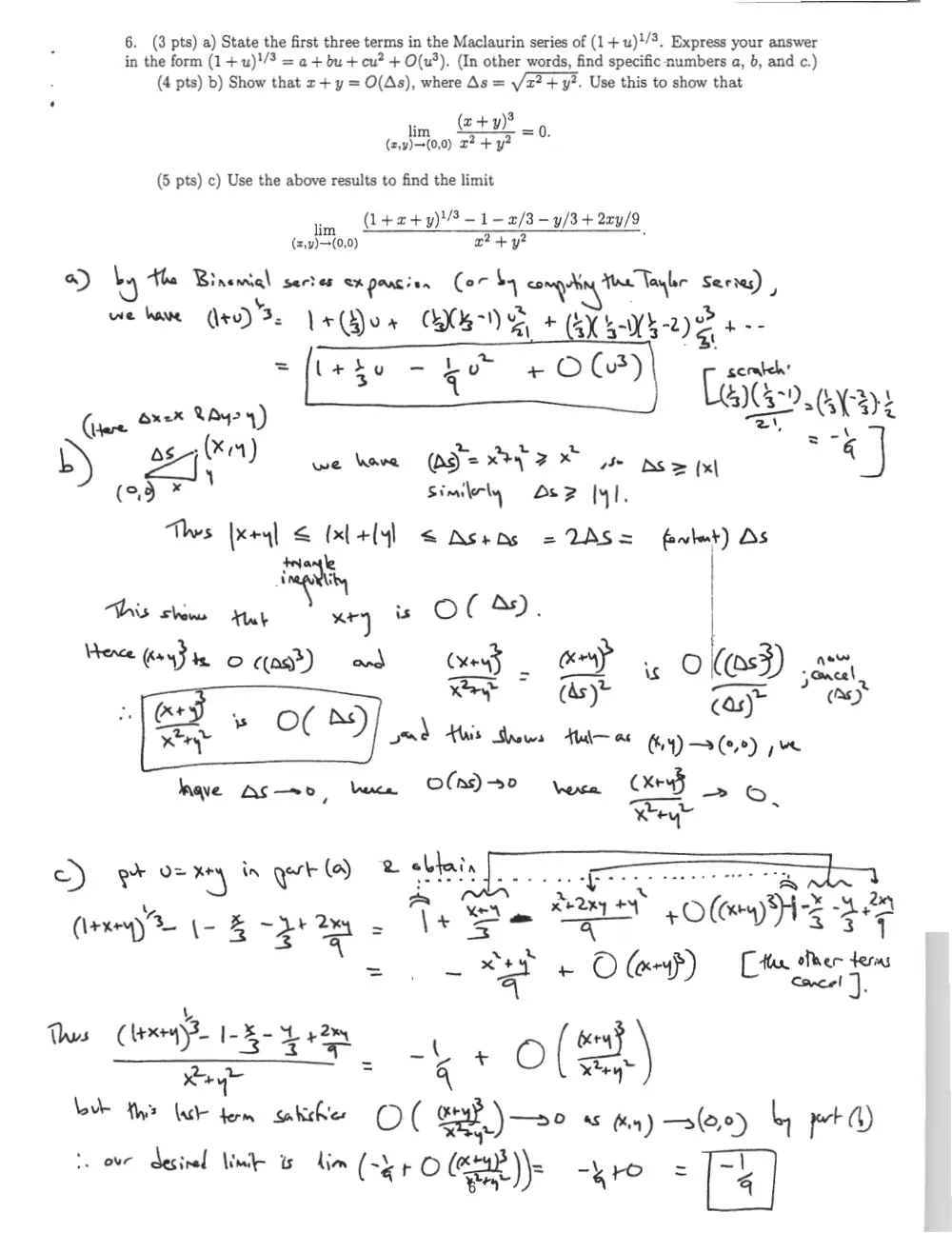
6. (3 pts) a) State the first three terms in the Maclaurin series of (1+1)!/?. Express your answer
in the form (1+ u)!/3 = a+ bu + cu? + O(u3). (In other words, find specific numbers a, b, and c.)
(4 pts) b) Show that z+ y = O(As), where As = \/x? + y?. Use this to show that
(c+y)> _
lim =0.
(x,y)+(0,0) x? + y?
(5 pts) c) Use the above results to find the limit
lim (l+24+y)¥3 —1—2/3—y/3+2zy/9
(z,y)+(0,0) v+y? :
ii
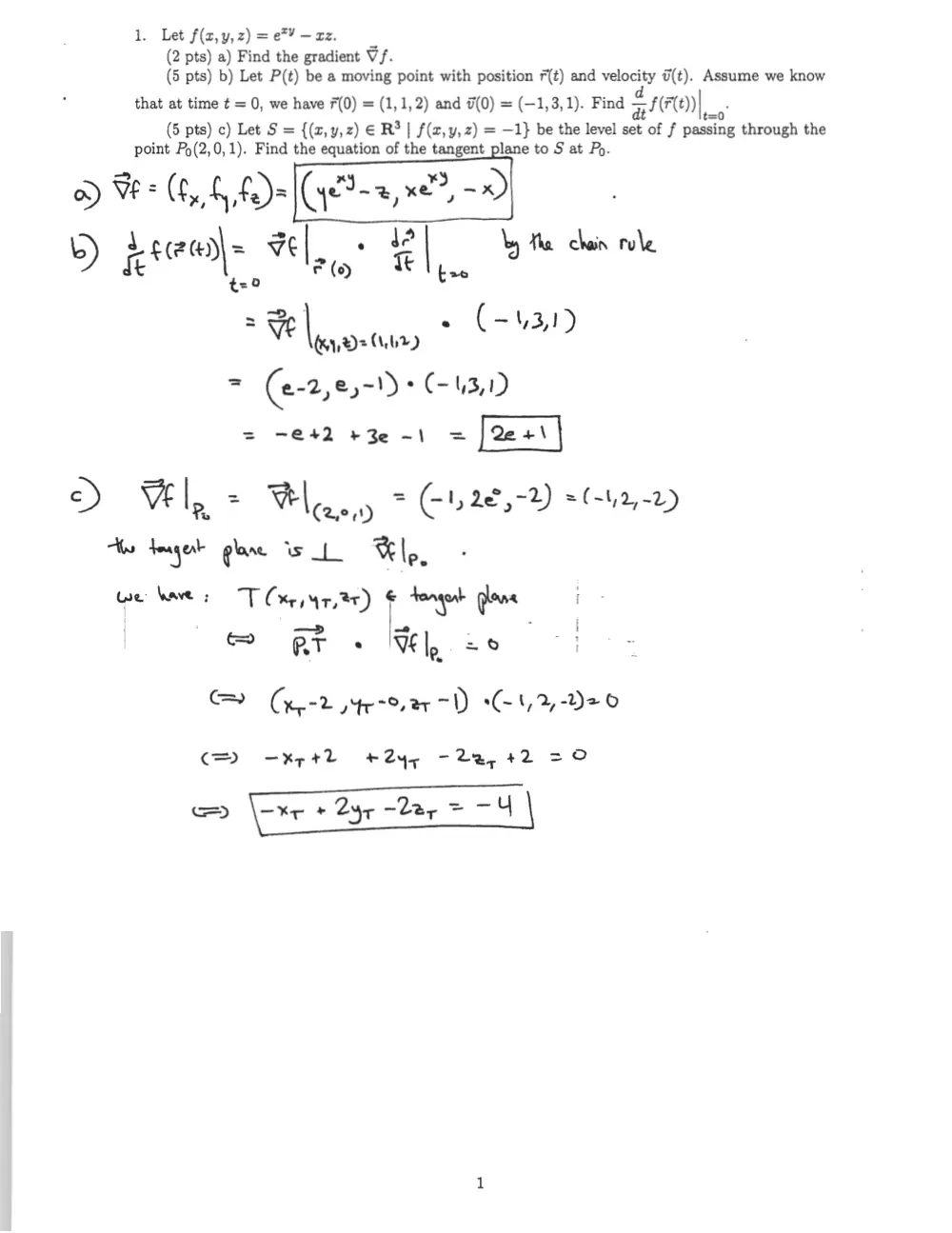
1. Let f(z,y,z) = e*4 — xz,
(2 pts) a) Find the gradient Vf.
(5 pts) b) Let P(t) be a moving point with position F(t) and velocity a(t). Assume we know
that at time t = 0, we have 7(0) = (1,1,2) and 0(0) = (-1,3,1). Find < HC) to’
(5 pts) c) Let S = {(z,y,z) € R° | f(z,y,z) = —1} be the level set of f passing through the
point Po(2,0,1). Find the equation of the tangent plane to S at Po.
a) Ve = (t,4 f2)= (4? -2, xe, ~x)
b) i t@e)\= or c
t= a a)
=» |
* VE lensing
= (e-2,e5-!) + (43,1)
>) VE le = Hee = (-4 2 ,-2) = (~1,2,-2)
aw teagent glare ws [ Kle.
(ne: lave ; T Cer, er) € < om i
= er ig YE le 7
. (= 3,1)
=> Gq-2 4078 er ~) *(-1,2,-2D20
C=] —-xX%et2e +24, -2a, +2 = 0
we \-xr + 2y7 -2e, = -U
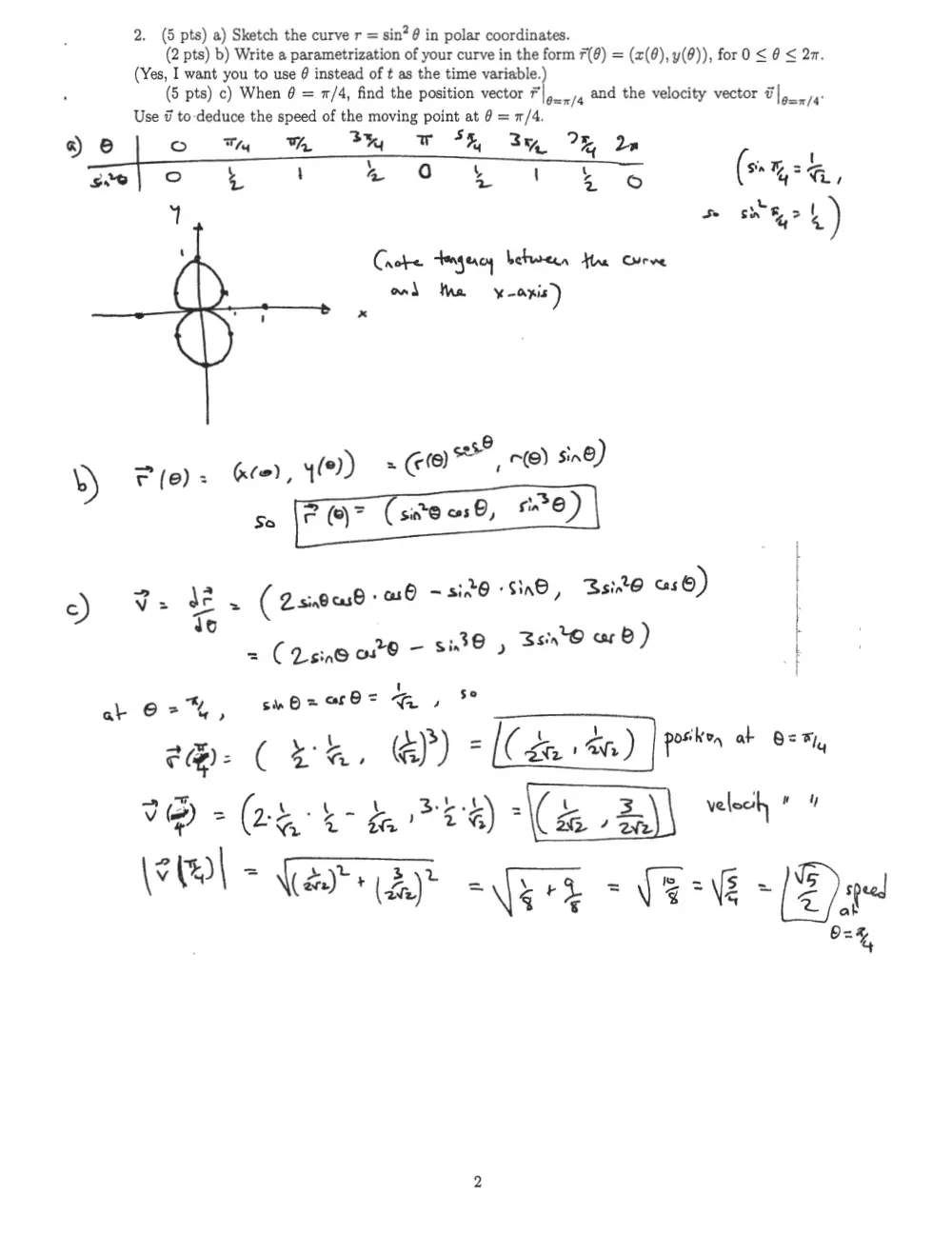
2. (5 pts) a) Sketch the curve r = sin? @ in polar coordinates.
(2 pts) b) Write a parametrization of your curve in the form 7(@) = (x(@), y(@)), for 0 < 6 < 2n.
(Yes, I want you to use @ instead of t as the time variable.)
(5 pts) c) When @ = 7/4, find the position vector 7| g=n/4 nd the velocity vector # | o=n/4"
Use v to-deduce the speed of the moving point at @ = 7/4.
@) © oO ™% A My Ww *% 3m 7% Le ;
\ ‘~ iy =
se) oO & ' 4 9 4S ' & 6 ( 4° Gy
4 se Ss
‘ Croke tong ency bekween Hr, Curne
od Me ¥-onis)
6
= (Lsin@ oO — si3Q , Bsn cr 8)
= tn
ab e>%, suQ = asO= ts se
at s
em) ( be, ()°) = (dy 1) posiken at 6 Bey
3. Let f(x,y) = n(x? + y).
(4 pts) a) Sketch the domain of f and briefly indicate why the domain is not closed.
(4 pts) b) Find the directional derivative of f at the point Po(3, 1) in the direction of the vector
A = (3,4). (Suggestion: do not simplify fractions; for example, keep 40/70 the way it is, and do
not reduce it to 4/7.)
(4 pts) c) Approximately how much is f(3.03, 1.04)? This can be done either using (b) or by
a direct calculation. You may choose whichever method you prefer.
a) Domain g C, reqs Xty oO Lor Nhs \eaar “® make Sense.
"= D= Sayer? ( ny 70 § |
= Rowe | yr 8 \
D is s\odel in Mo Gav :
Ly iswh cleecd lecavia (0,5) ( AMONG me ayn 3@ "eundey ae) Hat dees
“S “Se. 72 6 Leia
DW-(R ee) Rhee (Git) “a4
Kb alea unk veefor lw Oa & — & Unk yechr ih Tho rang direckon
iR
toe Pe BN) Ley,
a 4
(Great | a _ (% 4
4
. e
= W@W y4 5 fa
eo & Se
Sisglacemol
c) lt wy P31) P (3.03, 14) AP = OF = (O03, O-)
> oot Resv
© ac TR - > 3
A A ; : & AZ = 0.05 ?) pe
eed ae] = 0:05 Cenc) bPr005 o
=
Ie Uredien Fv,
we. have mel 005 vai +
Ais Abe DOP as 7 He 88s = WriwFe oer
£(P) = Cp )+ OK = \n (3*¥1) ant >| In lo + os7t |
(= , é)° 2 (063, 0-04) = O01 8 49.004
Alan you gt Pa Sone, ln 2 0022. = 0.022
He) = wer: “eles 22 \
4, (3 pts) a) Use integration by parts twice to show that if n is a constant, then
+C.
2 .
. -z*cosnz 2zrsinnz 2cosnz
z’ sinnz dz = + 3 + 3
n n n
(7 pts) b) Let f(x) be given by f(x) = {3s ‘ 0 oes - 0 Extend f periodically to have
period 27. Your job is to sketch the graph of f and to compute ONLY the coefficients b,
in the Fourier series f(z) = a9/2+ 07°; an cosnz + 0°, ba sinna.
(2 pts) c) At what points x does the Fourier series of f not converge to f(x)? What is the
value of the Fourier series at those points?
Feta] LEE
2) | sesin ned > C ~ i CS mx \ = ~x ain Fes, Qxdx
=
ase +2 Gree mcd = "en + E VxdGirew)
M
|
x
i]
w
>
x
uw ‘
SZ -yes ox 4 2 | xsinax — (sin wxdy | = wee AB xsinay + capes
n
C * ¢ ) inde Cnde inte pal |
Keo
\ Tv
=e -x Gane Iy6)
a fae cal < Wes a7 + WENT 40- 0-2
Ww n3 z= pn? ni
L (-tey cas _)\8
a7 ( nO a AD (oe re ”
Y; is CanWnves Q
a Nha Fourier Series eeaveryes +. f G& whereve— t les @ eb 2 riaht derivahve .
ss abst pith Exceth ob x2 T, x28m, X5m,- -
Xe-F, x2-34) HEWSy, ok.
Ob sudy pols At Esuner Serdes Gn tH £4) +x) ore _ lat
Teen vv ~ a “Le
ke a
\ 5. We wish to find the maximum and minimum of f(z, y) = z(y? — 1) in the half disk D defined
. wby D = {(z,y)-€ R? | x? +y? < 10,y > O}. (Note that D is closed and bounded, so f attains a
Ne | “Ge maximum and minimum on D.)
(3 pts) a) Show that f has exactly two critical points in the plane R?, but that only one of
these points belongs to D.
(3 pts) b) Test the top part of the boundary of D (this means the semicircle 2? + y? = 10
where y > 0) for possible maxima and minima of f. Parametrize the boundary in the following
way: P(t) = (t, /10 — t?). Remember to specify the range of t for your parametrization.
(3 pts) c) Test the bottom part of the boundary (this means the line segment) for possible
maxima and minima.
(3 pts) d) Make a table of values that includes the points you found above, as well as the
corners, and deduce the maximum and minimum values of f, as well as the points where they are
attained.
a) we = (4-4, 2a) . Cribea) qr eceur whe yalee AND 2xy> 0
PYF t1 , wd in gackcul yto, Thes 2nysO PSO since y fo
Lee have ¥22, roeeny [P. (2!) e€ D RY
Qe -1) ED Bes ignored
b) Plt): (b, Vek) te [-ve, +ve)
Se £CpIt)) = £(w-1) 2 E(Q-bt) = a -E Shy i vertaken
a C-vo, + No). Rit, +e devivabva wont. £ is — wlich vanishes
at L = 2V3 carts pondi +. Ag hk rR (NG am NG
NN - °c
a « 4 ee : B09)
Second, there Ms d Cows endin & t
° “ man corresponding Te cron
2) Wer, Geren
i Grnaleine by RL) C °)
decal, weeks & ad £cPiyy = (0-1) 2-&
“Ns. there ene Bo con didates te
i es ; \ ~ MAM Ma OM MAlAiMa,
x2 pt Qrserla 4 ab Aho end poink Ckrig Sivas os tH
Cornet) Pag Q a, aga).
BY) tale A talus ak all ha Cordele geiats
P| felon) | Pi (G.07) | 0-3.) | Pg We) | Py ems)
#0) \ 6 WR .6 -V& CG Vie (1) “VE 1) 9
= 6VR = -61R = -Vie >4+Vio x P,
Po
alse nate tet 6IR >b>4>VE Rm PS
Cor (683) = BO Bz eK S1O= «y~)
Se ‘he Maximum value «6 f is £08) =6B sated at 7.03 49)
=
wile the Mintaunn value & CaDds C(t,)=- ONS, ateahel ab BINS, a)
5
6. (3 pts) a) State the first three terms in the Maclaurin series of (1+ u)!/3. Express your answer
in the form (1+ 1u)!/3 = a+ bu+cu? + O(u). (In other words, find specific numbers a, b, and c.)
(4 pts) b) Show that + y = O(As), where As = \/z? + y?. Use this to show that
lim (e+uy wy =0.
(2,y)+(0,0) 2? + y?
(5 pts) c) Use the above results to find the limit
im & ta+y)3 — =2/3- y/3 + 2xy/9
(z,y)—(0,0) i + y?
a) by Tha Binewtal Serkes OH Pansien (or by ) comet te Tar Series) ,
we hove (rs)"3. Le QJox OK * (&X Ws2E + ~
= [lege - qo TOG) serateh'
en ;
(we 2% OH) IE. RY
an
Dy Beg oe vane BST es ce i &
(2.9 * Sinailerly Os? yl.
“Tws \x+yl < (xl+lyl < Assos =2AS= fawkat) As
rence. (43 4s fo) (as) ond Cxeny _ oy \s O ((os3) ‘ aoe
z
jad AAs Grows thal ac (64) —s (2,2) ypVe
Leica OCD) 22 Ween CX 6
od
rey
~ KESKY + t
[4 Se a Oey HS racy
=e “st + O Cersp) [ta sther tera
Corcel |).
v
Ths (berg <a 0 ( ee \
= ~ U
Daye = q xtey
Neh hit i form sakichen O( Gath) —s0 SS (4) —s(2,°) Ly pet)
ad OY tn (ORE) ogre =