
MATH 201 Exam 2 with Solution, Fall 2009
American University of Beirut · Calculus and Analytical Geometry III · 2 pages · with solution
More MATH 201 files
Show the text of this exam
American University of Beirut
MATH 201
Calculus and Analytic Geometry III
Fall 2009-2010
quiz # 2 - solution
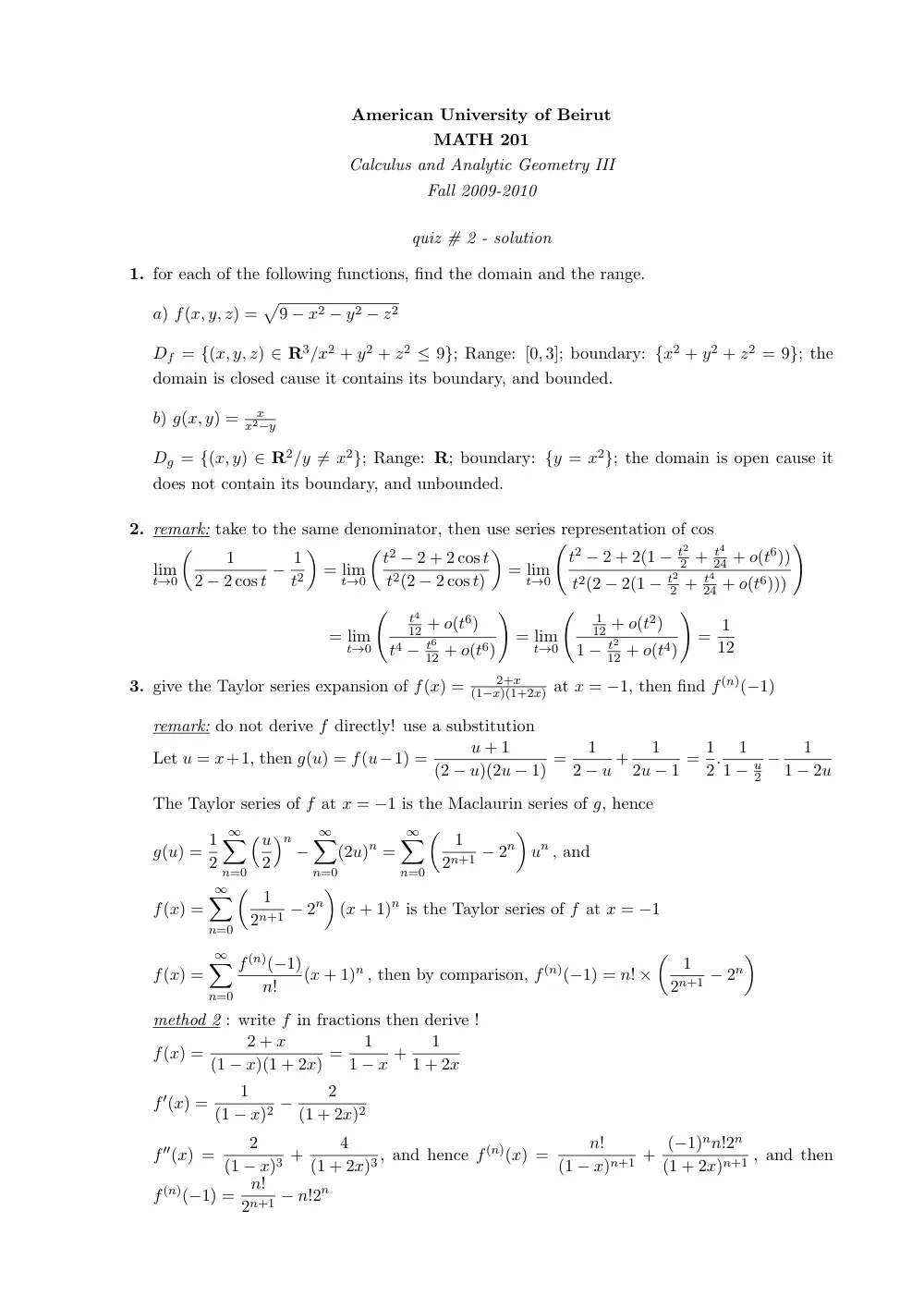
1. for each of the following functions, find the domain and the range.
a) f(x, y, z) =
√
9 − x2 − y2 − z2
Df = {(x, y, z) ∈ R3/x2 + y2 + z2 ≤ 9}; Range: [0, 3]; boundary: {x2 + y2 + z2 = 9}; the
domain is closed cause it contains its boundary, and bounded.
b) g(x, y) =
x
x2−y
Dg = {(x, y) ∈ R2/y ̸= x2}; Range: R; boundary: {y = x2}; the domain is open cause it
does not contain its boundary, and unbounded.
2. remark: take to the same denominator, then use series representation of cos
lim
t→0
(
1
2 − 2 cos t − 1
t2
)
= lim
t→0
(t2 − 2 + 2 cos t
t2(2 − 2 cos t)
)
= lim
t→0
(
t2 − 2 + 2(1 − t2
2 + t4
24 + o(t6))
t2(2 − 2(1 − t2
2 + t4
24 + o(t6)))
)
= lim
t→0
(
t4
12 + o(t6)
t4 − t6
12 + o(t6)
)
= lim
t→0
(
1
12 + o(t2)
1 − t2
12 + o(t4)
)
= 1
12
3. give the Taylor series expansion of f(x) =
2+x
(1−x)(1+2x) at x = −1, then find f(n)(−1)
remark: do not derive f directly! use a substitution
Let u = x+1, then g(u) = f(u−1) =
u + 1
(2 − u)(2u − 1) =
1
2 − u +
1
2u − 1 = 1
2.
1
1 − u
2
−
1
1 − 2u
The Taylor series of f at x = −1 is the Maclaurin series of g, hence
g(u) = 1
2
∞
∑
n=0
(u
2
)n
−
∞
∑
n=0
(2u)n =
∞
∑
n=0
(
1
2n+1 − 2n
)
un , and
f(x) =
∞
∑
n=0
(
1
2n+1 − 2n
)
(x + 1)n is the Taylor series of f at x = −1
f(x) =
∞
∑
n=0
f(n)(−1)
n!
(x + 1)n , then by comparison, f(n)(−1) = n! ×
(
1
2n+1 − 2n
)
method 2 : write f in fractions then derive !
f(x) =
2 + x
(1 − x)(1 + 2x) =
1
1 − x +
1
1 + 2x
f′(x) =
1
(1 − x)2 −
2
(1 + 2x)2
f′′(x) =
2
(1 − x)3 +
4
(1 + 2x)3 , and hence f(n)(x) =
n!
(1 − x)n+1 + (−1)nn!2n
(1 + 2x)n+1 , and then
f(n)(−1) =
n!
2n+1 − n!2n
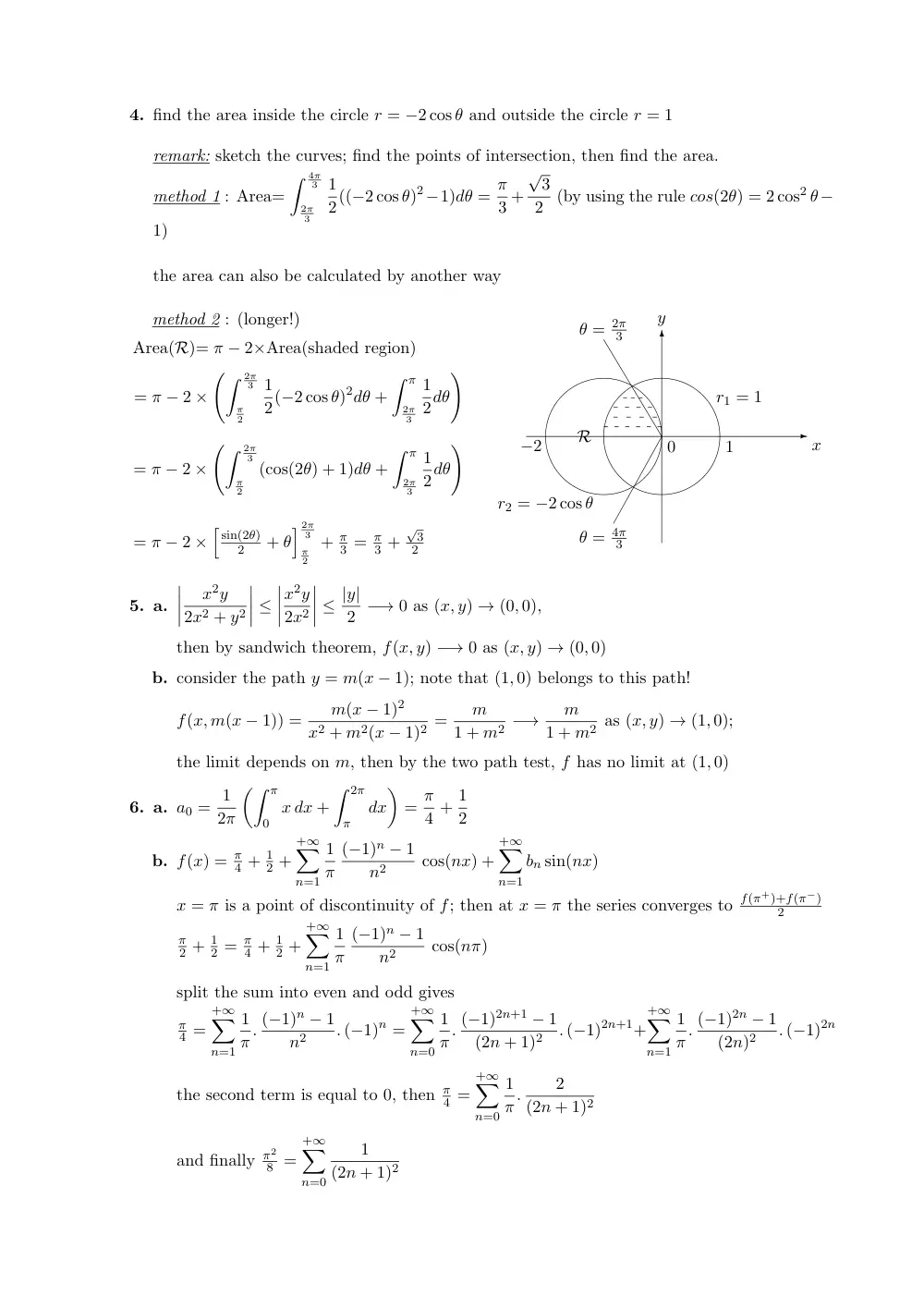
4. find the area inside the circle r = −2 cos θ and outside the circle r = 1
remark: sketch the curves; find the points of intersection, then find the area.
method 1 : Area=
∫
4π
3
2π
3
1
2((−2 cos θ)2−1)dθ = π
3 +
√
3
2 (by using the rule cos(2θ) = 2 cos2 θ−
1)
the area can also be calculated by another way
6
- x
y
r1 = 1
r2 = −2 cos θ
−2
0
1
R
method 2 : (longer!)
Area(R)= π − 2×Area(shaded region)
= π − 2 ×
(∫
2π
3
π
2
1
2(−2 cos θ)2dθ +
∫ π
2π
3
1
2dθ
)
= π − 2 ×
(∫
2π
3
π
2
(cos(2θ) + 1)dθ +
∫ π
2π
3
1
2dθ
)
= π − 2 ×
[
sin(2θ)
2
+ θ
] 2π
3
π
2
+ π
3 = π
3 +
√
23
θ = 4π
3
θ = 2π
3
5. a.
����
x2y
2x2 + y2
���� ≤
����
x2y
2x2
���� ≤ |y|
2 −→ 0 as (x, y) → (0, 0),
then by sandwich theorem, f(x, y) −→ 0 as (x, y) → (0, 0)
b. consider the path y = m(x − 1); note that (1, 0) belongs to this path!
f(x, m(x − 1)) =
m(x − 1)2
x2 + m2(x − 1)2 =
m
1 + m2 −→
m
1 + m2 as (x, y) → (1, 0);
the limit depends on m, then by the two path test, f has no limit at (1, 0)
6. a. a0 = 1
2π
(∫ π
0
x dx +
∫ 2π
π
dx
)
= π
4 + 1
2
b. f(x) = π
4 + 1
2 +
+∞
∑
n=1
1
π
(−1)n − 1
n2
cos(nx) +
+∞
∑
n=1
bn sin(nx)
x = π is a point of discontinuity of f; then at x = π the series converges to f(π+)+f(π−)
2
π
2 + 1
2 = π
4 + 1
2 +
+∞
∑
n=1
1
π
(−1)n − 1
n2
cos(nπ)
split the sum into even and odd gives
π
4 =
+∞
∑
n=1
1
π. (−1)n − 1
n2
. (−1)n =
+∞
∑
n=0
1
π. (−1)2n+1 − 1
(2n + 1)2
. (−1)2n+1+
+∞
∑
n=1
1
π. (−1)2n − 1
(2n)2
. (−1)2n
the second term is equal to 0, then π
4 =
+∞
∑
n=0
1
π.
2
(2n + 1)2
and finally π2
8 =
+∞
∑
n=0
1
(2n + 1)2