
MATH 201 Exam 2 With Solution, Fall 2010
American University of Beirut · Calculus and Analytical Geometry III · 8 pages · Prof. Kamal Makdisi · with solution

More MATH 201 files
Show the text of this exam
GRAD
Math 201, Fall 2010-11
Calculus and Analytic Geometry ITI, sections 1-4
Quiz 2, November 27 — Duration: 60 minutes _
ES:
1(/i2z) | 2(/14) | 3(/12) | 4(/14) | 5 (/22) 6 (/14) | TOTAL/78
YOUR
YOUR
Qroe sd ERG | x
(orce ch ory
NAME:
AUB ID#:
PLEASE CIRCLE YOUR SECTION:
Section 1 Section 2 Section 3 Section 4
Lecture MWF 3 Lecture MWF 3 Lecture MWF 3 Lecture MWF 3
Pr
ofessor Makdisi Professor Makdisi Professor Makdisi Professor Makdisi
Recitation F 11 Recitation F 5 Recitation F 4 Recitation F 10
Ms. Mroue Ms. Mroue Ms. Mroue Ms. Mroue
INSTRUCTIONS:
1
2.
3.
. Write your NAME and AUB ID number, and circle your SECTION above.
Solve the problems inside the booklet. Explain your steps precisely and
clearly to ensure full credit. Partial solutions will receive partial credit.
Each problem on this exam counts for 12 or 14 points. THE TOTAL
NUMBER OF POINTS ON THE EXAMIS 78.
You may use the back of each page for scratchwork OR for solutions. There
are three extra blank sheets at the end, for extra scratchwork or solutions.
If you need to continue a solution on another page, INDICATE CLEARLY
WHERE THE GRADER SHOULD CONTINUE READING.
Closed book and notes. NO CALCULATORS ALLOWED. Turn OFF and
put away any cell phones.
GOOD LUCK!
An overview of the exam problems.
THE TOTAL NUMBER OF POINTS ON THIS EXAM IS 78.
Take a minute to look at all the questions, THEN
solve each problem on its corresponding page INSIDE the booklet.
1. (12 pts total) Two UNRELATED questions about polar coordinates.
a) (2 pts) Given the curve C = {(x,y) € R? | zr?+y* =32+4y}. Write the equation
of Cin polar coordinates. (Cultural note: C is a circle.)
b) (10 pts) Let C’ be the curve in polar coordinates whose equation is r = 1+¥2 cosé.
Make a table of values, and draw the curve C’. Make sure to label: (i) the intercepts
on both «- and y-axes, (ii) the tangent lines at the origin.
2. (14 pts total) Consider the moving point in space given by the position vector
P(t) = yt pt |.
3" 3°
a) (8 pts) Find the arclength for the parametrized curve P(t) between t = 0 and¢ = 1.
Hint: Vat? + bt? = tat? +0.
b) (4 pts) Give an approximation for the displacement Af and the distance As
traveled by the point P(t) in the short time interval between t = 1 and ¢ = 1.01.
c) (2 pts) Is your approximation for As from part (b) larger or smaller than the true
distance traveled between t = 1 and t = 1.01? Explain why.
3. (12 pts total) Given the function f(z, y,2) = aV1t y? + 22°.
a) (2 pts) Find the gradient Vi.
b) (6 pts) A point moves in R3 with position vector 7(¢). We know that the position
iF
and velocity of the point at time ¢ = 0 are r(t) | = (1,1,1) and a = (3,4,5). Your
t=0 dt lt=o
job is to find —firt .
c) (4 pts) Starting from the point Py = (1,1,1), in which direction does f decrease
most rapidly? Your answer should be a unit vector.
4. (14 pts total) Consider the function f : R* — R and its level set 5, given by
f(a,y,2) = 2? +42", S={(2,y,z) € RB? | 2? +42 = 8}.
a) (3 pts) Sketch the surface S.
b) (6 pts) Find the equation of the tangent plane to S at the point Po(2,—1, 1).
c)
pts) Starting from the point Po above, we move 0.1 units in the direction of the
= (3, 4,0). Approximately how much is the resulting change in f?
5. (12 pts) Find the maximum and minimum values of the function f(z, y) = ry on the
elliptical disk D = {(z,y) € R? | x? + 2y? < 1}.
6. (14 pts total) Suggestion for both parts: use Taylor series and O(-) notation.
1
a) (7 pts) Show that — lim In(1 + zy) does NOT exist.
(ay) (0,0) 2? + y?
24,2
b) (7 pts) Show that Jim G+ 2'y")
(@y)—(0,0) 22+ y? DOES exist.
ij
1. (12 pts total) Two UNRELATED questions about polar coordinates.
a) (2 pts) Given the curve C = {(z,y) € R? | a2+y? = 32+ 4y}. Write the equation
of C in polar coordinates. (Cultural note: C is a circle.)
b) (10 pts) Let C’ be the curve in polar coordinates whose equation is r = 1+ V2 cos 6.
Make a table of values, and draw the curve C’. Make sure to label: (i) the intercepts
on both z- and y-axes, (ii) the tangent lines at the origin.
RY) X= COsO
> J =o gn ce SrasO * tro ee
7
Saye 6 ™ can cancel in this ense +o aek ips SesO+4s ©
>» 6 ag ce lyitcerO he
~ ‘ “ay 1 her. on
9) 1 jata eo 24 “eagle te
4 & 2 at, Cs V2
“45 *% ° \ ig r20 yo AS O=% ure
3 ~% wre ane 6:34 5621
A a o — wk lines oe)
v= 4% -\ IVa 4 ae origin
S$ _u w 9.3%
“a TL o <___/ oO: 53,
Ba A
BOR \ Cogerly
ot 2 wee me
2n5 ny her
~)
eyed ;
bine
Ona A
aN
\
\
va
oa
i
i a
mA 4 ~
angt Vine .
Ox sy
H
!
2. (14 pts total) Consider the moving point in space given by the position vector
a) (8 pts) Find the arclength for the parametrized curve P(t) between t = Oandt=1.
Hint: Vat? + bt? = tV/at? +d.
b) (4 pts) Give an approximation for the displacement Ar’ and the distance As
traveled by the point P(¢) in the short time interval between = 1 andt = 1.01.
c) (2 pts) Is your approximation for As from part (b) larger or smaller than the true
distance traveled between t = 1 and t= 1.01? Explain why.
> fal 3 = med a
P(E eee) 0. oe (me wee 2b)
veloc: 4
Tt
b) t=, Ak 0,01 ar x ve Ak = (reset ut 8] Ak
= (31,2).00' + loa sa, oO. 201)
As =(n7\ ro \s ., \ot = \ (3,42 | (0.01) =(Wiy)(o wl) = [Fe |oenay
joo PVPs
c) Ks \ “ncrenses Peons \ 4o Lot, He speed \O\- (zea zee increases
Lom roe via at f=) + Sond slat \
Ph ae
“ws over the 0.c\ seconde a Avene speed ta s\i ary _loeger er than iy
QA fre dichnce davelel ig salts leer tan Vat: Vik
Too
3. (12 pts total) Given the function f(x,y, 2) = a/1+y? + 22%.
a) (2 pts) Find the gradient Vf.
b) (6 pts) A point moves in R® with position vector 7(t). We know that the position
dr’
and velocity of the point at time t = 0 are 7(¢) | = (1,1,1) and ail = (3,4,5). Your
d t=0 dt leo™
job is to find 5 (Fé) |,
c) (4 pts) Starting from the point Py = (1,1, 1), in which direction does f decrease
most rapidly? Your answer should bea unit vector.
J4
DW (GGG) = OS, oR Boa os
-|(Raw, Pe =e)
rey at
a the og wl, . 2
‘ \ ie) x ad vo =o Sten a
|
(xn 2, os (3.4.5) - AB bavess Cotes of]
We kaw Atak £ deckERsES Most rapi ay
c) " uher we MEE tn a creck ©
Pe oeos te to VE»
his iu becuse
peklp= Vel 3 AMI, |) os
uid 16 moet nage ha dem Beca= -1,)
Ts G2 — MeL Lak) Lak
(Sely,| fee ea
Ww
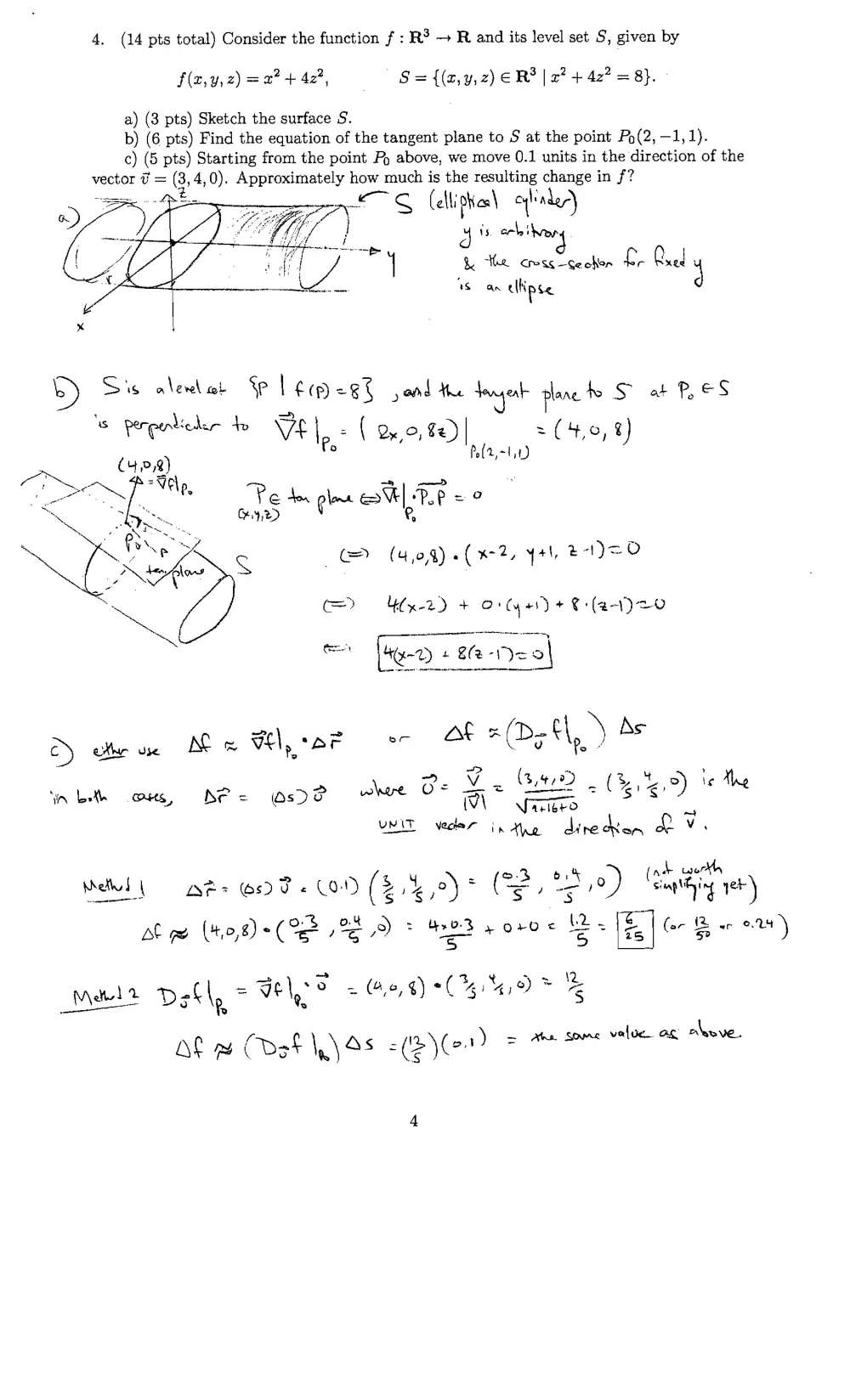
4. (14 pts total) Consider the function f :R° — R and its level set S, given by
F(z, yz) = 2 + 427, S = {(z,y,2) € R? | 2? + 42? = 8}.
a) (3 pts) Sketch the surface S.
b) (6 pts) Find the equation of the tangent plane to S at the point Po(2, —1, 1).
c) (5 pts) Starting from the point Py above, we move 0.1 units in the direction of the
v ]
= (3.4, 4,0). Approximately how much i l the resulting change in f?
oo c [ alli thes\ oy Kader)
| 7) jf oh
: iw ~y be he cresg Ce chen L. Qred 4
| ls a WS oan lkpse
b) Sis alerel ot <p | cep = oe ond Mua Tengen ah lane. bo S ot PLES
‘s pereuieder tv VF |, = ( & 9, fe) | TO, )
Po{2,-1,4)
“Pe ton gl ev Pp =o
; 7 yD e,
; . ies ae =) oO e -2, 441, z4)cO
RN ON
= x2) + OKs + Cato
Sy
> enw use .
inet ons, Ss Ose wwe C= Sit GER = are)
UMIT vedere inthe dinedion dt Y
Wet ae eo 0 (SEs) OR) AP)
AC pe (40,8) * (SF St) 423 5 oro 2 a) (or & we 0s)
= .S aft yo M2
“mela DeGle = HELP = Gas CeO” 6
faye ie (dst \, Ss (2) = Atk Soe value a olwove.
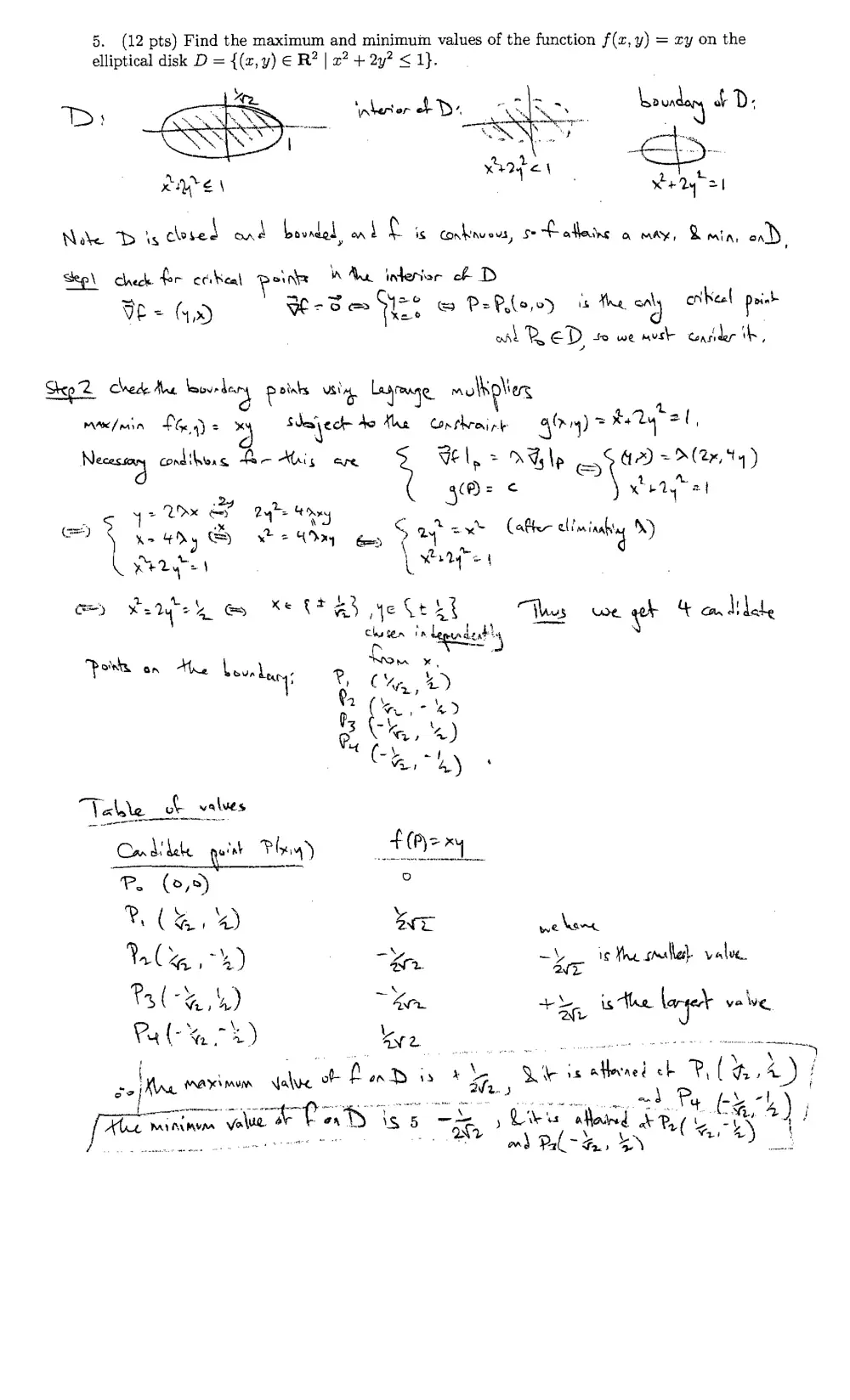
5. (12 pts) Find the maximum and minimuin values of the function f(z, y) = zy on the
elliptical disk D = {(2,y) € R? | 2? + 2y? < 1}.
\yo wrdany & D
MS ea 24 & \ <5
L
RS | ede =|
Note D is closed ond bovnded ad c is Conkinv ews, ge atlas a May, Q min, onl)
Sep\ Check. for cc Kea| pene we Aa intenor ff B
Ve = A) yee v rs ar oe ce Pez Pe (o, v) ‘s Ang, oy en keel peiak
ot R eD to we must Cons ‘ber ih,
Step “2 Checde Ang foovedary points VS Lejroang. moliplierg .
man /min Loe aj 2 »\ s yer 4 he Con thrari nb along) = He Dy 2,
Necessary condthwas, Ae Mais are r Vl, - > O%Gle Sees ~ (Zp, 4 4)
@: c x bay af
cet a OT Cae a
(=) i 4 & wee 4x4 kms 5 2y ot Cathe elimina S)
eae) \ ade |
ce *F tte} ye St sy “Thus we ah & cardilale
ersten |e leguderty
ot, on Gon *,
? Me Level, m4: % a »
p Cf Be)
Pa (-s 4
“i AY
Telsde of valves
Cad hohe aa Phew) FM aoe
Ps (a, ») °
Re, 4) Wo we bo
Vl %& ; ~y Ker See ig Ye smaed valve.
Pr ( “HD ~ he the isthe lar \ va Wwe.
. \ ae I
Pale 74) re. te ee 8 ttn i
1 . , wo . . , 1 \ x é
; are praximum yale ot a on Das * es Ye os atberned ch P, ( Kh: a) ;
° ee om om a4 Pe [-& et
[Al mareinvnn velue HEAD Is: iS 5 5 oe Wikia allatned oR, oa 4)
od Pal ~ 3 Fos SN set
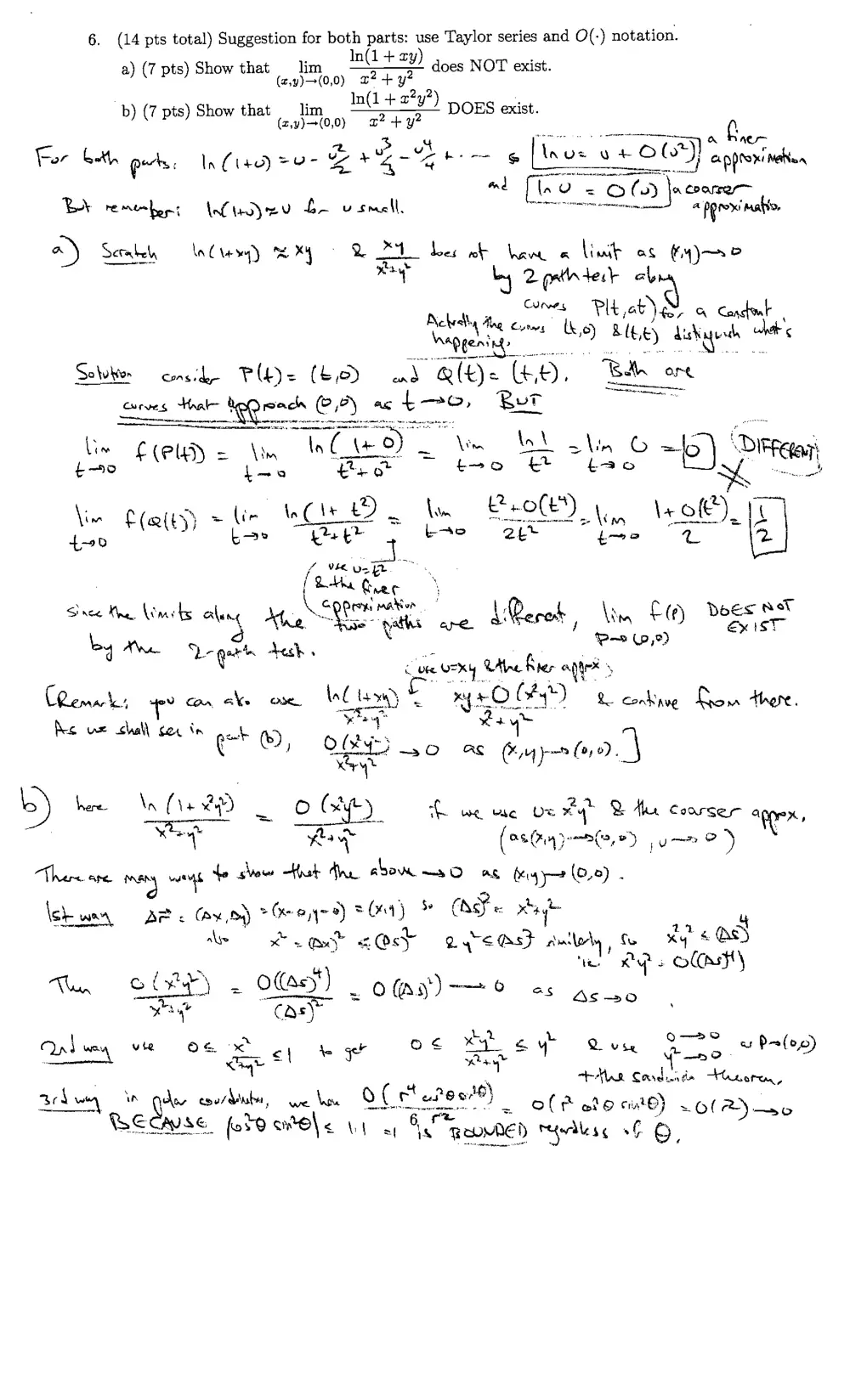
6. (14 pts total) Suggestion for both parts: use Taylor series and O(-) notation.
a) (7 pts) Show that — lim n(l + u) does NOT exist.
(ey) (0,0) £2 + y?
b) (7 pts) Show that — lim In(l + 2°y?) DOES exist.
(z,y)7(0,0) oe + y¥
% 4 are a Crem
Vor GoM, gets: In (tae 0-7 Beeb — ‘Anus sto) cippten’ Nehian
w hv - Ot (a \s coarrer—
Beh remebont (atte BA uv smell. (Ine conan 4 pprox!mabio,
AN Sermbel, Un Crergh XY WMD hee ch am a limi os Fiy)—re
ey Ly 2 2 ers “ba
Cones lt ,at ia k
Brelvely Ae cyny
wapen ° / lk 2 Te &) ddd het’
Selb cme Pls (EO) ad le (HO, BA ore
——— ee
Curves thal 3 racy eC, PY ac to, Ber
. : q i makts ne
Sree Ke Wimasts clang deta Rte are. \@erok Mm (0) dogs ss
P-9 (9,9) ;
ra ve fe ORY | Bre Ries apir® s
Remarks rs Con ake ase, Gen S yx 0 (A) & conkinne Gon there
< + 4
oh), "
e ar h.3Q @E (rp por (0 0). \
) vere \n noes rr) _ io) (it) a We Me Os ot 2 Mus Coarse “PRT
oe Keay (os Gy yemn(o, 2) juan e )
There. ape may sgt te show Huet Ane show 2 0 as fy yj lo, o) .
lek wan At Ca , Da) = (hte @ ayn a) = OA) Se CAs & age
Me eh OsS 2S ASH anllory, % BP OS)
. 4 te ys olasy
TA, © Cyt) = Oss) . 0 (ai) wu! Gas
a ae - or = o Aso
Sf COs)
Lk xh 2 L Qo—2o os
Ons wen, vite o«¢. oe et it oO€ ao 4 Q. use fe as (ee)
rl : is\ aie Cordinda hore,
er wy Aw eu/ Mists, we Woe O(c us roe _ (Peto cist) =o ze) _——
wedase (o¥® one < WY sy ree BOME rewtlese 96 O,