
MATH 201 Exam 2 with Solution, Fall 2011
American University of Beirut · Calculus and Analytical Geometry III · 8 pages · Prof. Kamal Makdisi · with solution
More MATH 201 files
Show the text of this exam
Math 201 -
Fall 2011-12
Calculus and Analytic Geometry III, all sections
Quiz 2, November 19 -
Duration : 80 minutes
GRADES·
1 (121)
2 (/12)
3 (/16)
4 (/12)
5 (/1 5)
6 (/12)
7 (/12)
TOTAL
GRADE
YOUR NAME:
YOUR AVE ID#:
PLEASE CIRCLE YOUR SECTION:
Section 1
MWF 3, Kobeissi
Recitation F 11
Section :5
MWF 10, Abi-Khuzam
Recitation T 11
Section 9
MWF 11 , Brock
Recitation T 12:30
Section 13
MWF 2, Nahlus
Recitation Tb 11
Section 17
MWF 8, Makdisi
Recitation F 2
Section 21
MWF 1, Raji
Recitation M 8
Section 24
MWF 10, Egei1eh
Recitation F 11
Section 2
MWF 3, Kobeissi
Recitation F 5
SectioD 6
MWF 10, Abi-Khuzam
Recita.tion T 3:30
Section 10
MWF 11 , Brock
Recitation T 2
Section 14
MWF 2, Nablu,
Recitation Th 3:30
Section 18
MWF 8, Makdisi
Recitation Th 8
Section 22
MWF 1, Raji
Recitation M 9
Section 25
MWF 10, Egeileh
Recitation F 2
Section 3
MWF 3, Kobeissi
Red tation F 4
Section 7
MWF 10, Abi-Khuzam
Recitation T 5
Section 11
MWF 11 , Brock
Recitation T 11
Section 15
MWF 2, Nablu,
Recitation Th 8
Section 19
MWF 8, Makdisi
Reci tatioo Th 2
Section 23
MWF 1, Raji
Recitation M 4
Section 26
MWF 10, Egeileh
Recitatjon F 3
Section 4
MWF 3, Kobeissi
Recitation F 10
Section 8
MWF 10, Abi·Khuzam
Reeita.tion T 2
Section 12
MWF 11 , Brock
Recitation T 3:30
Section 16
MWF 2, Nahlu,
Recitation Th 5
Section 20
MWF 8, Makdisi
Recitation Th 3:30
INSTRUCTIONS:
1. Write your NAME and AUB ID number, and circle your SECTION above.
2. Solve the problems inside this white booklet. Explain your steps precisely and
clearly to ensure full credit. Partial solutions will receive partial credit.
3. You may also use the back of any page for solutions. If you need to continue a solu
tion on another page, INDICATE CLEARLY WHERE THE GRADER SHOULD
CONTINUE READING.
4. Closed book and notes. NO CALCULATORS ALLOWED. Turn OFF and put
away any cell phones.
GOOD LUCK!
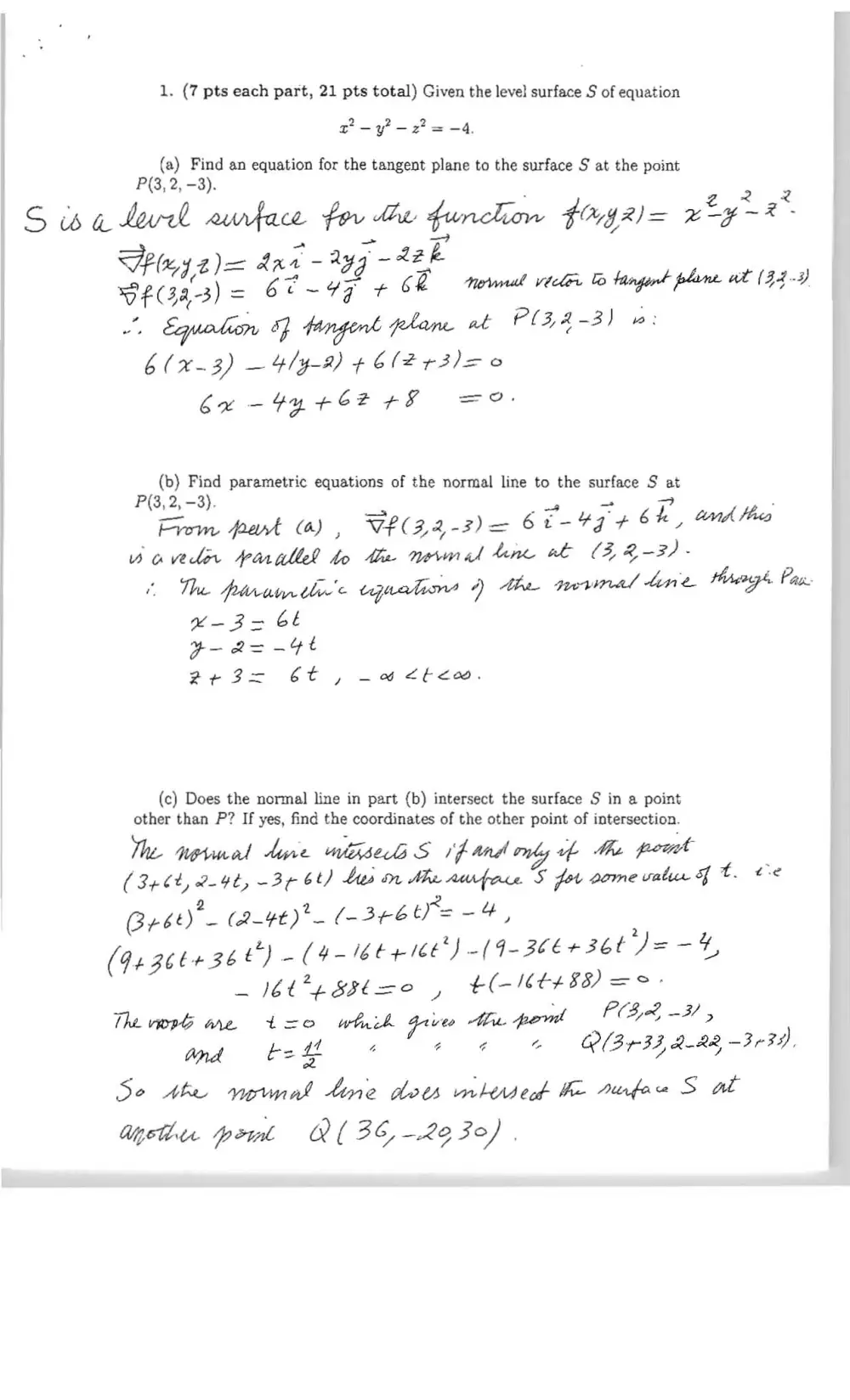
1. (7 pts each part, 21 pts total) Given the level surface S of equation
, , ,
x - y - z = -4.
(a) Find an equation for the tangent plane to the surface S at the point
P(3 , 2, -3),
II./J
'
~ <
-<
S Go cL.K1I.N1)(.. ~U- ~ uCtl1.' fwn-clWw i (;t-//t:?} = ;<; -;y - R '
~f(:Y, Ji)~ J.(t: - -;.~i-~i! r
'i7f(~~:-.3) -= 6 1 -'Il-t {l
~v/~COh~~d(H ,J)
_', ~ 0; ~~ d
P[3/~-3) "'.
b (X-3) - LtIJj-p) f b (~1'3)=
(>
6 ?"- 't'J -r (, r j- 5'
= 0
,
(b) Find parametric equations of the norma.l line to the surface S at
P(3 , 2, -3),
.....
~
-1
h-u-m-~ (~) ,
V-f(3/~-3) = 6i -'fJ -t 6k/ t01AIIu"
,,; c. Vi ~ rM rdid,to -ik-
n-~Wl J kM., d
( 3,. ~ - 3 ) .
'fI,.... PM-MV'-t£,..,'<- Uf'~ ') Ak -n.--.'wwJ kL ~r p"""
'X-3 -= c;,l
-Y--:l=--It t
~ r 3~ ct / _ '"'r'"'''''''
ad
(c) Does the normal line in part (b) intersect the surface S in a point
other than P? If yes, find the coordinates of the other point of intersectioD.
'rh& ~w.tU 4",- ~M ,S /{ ~ ~ 4 ,g::. f:W'P;",
(3rtt/ .:l_ '1t/ _3,6/) )W.rn. ~~ S h .(J<7mevatw.-sj t . , .e
(3f t /)
Q _ {;l-Ift/- ( _3-{-6tJ < =- _4/
L
(91- 3etl- 3 (, t )_ ( If - itt- -(- let ')- (1- 3tt: db! ') ='" - t
/(,{2+8!t.=o "
{- (_ICf-I-U) =0 ,
i = 0 ~J
t'~" ,...fk ~
P(~ ':; _3/ >
L- _ :li-
'
,<
.,.
Q(31'"3.J/ .:<- J<..f< -
1/).
3,.. '
c..-"z
/
5.. A~ 'YUJW/1~ ke r:ivu ~H.MecJ- u;;.. /)~~ S td
a?j.rl/,u ~>rd & ( 3&/ -..2<) 3 0 )
,
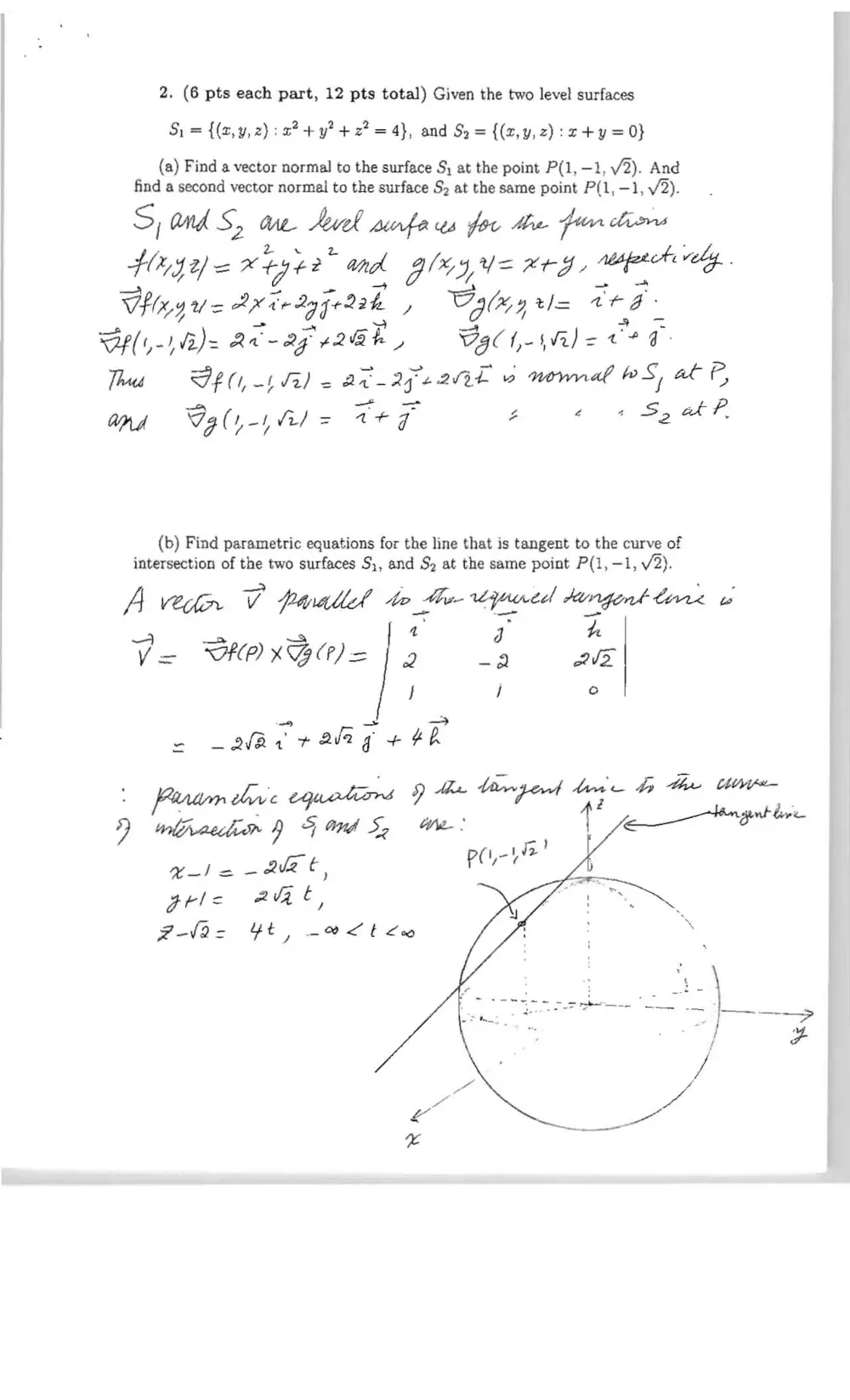
2. (6 pts each part, 12 pts total) Given the two level surraces
S, ~ {(x, y, z) : x' + y' + z, ~ 4}, and S, = {(x, y , z) : x + y = OJ
(a) Find a vector normal to the surrace S, at the point P( I , - I, 12). And
find a second vector normal to the surrace S, at tbe same point P( I, - I , 12).
S{ C1MJ 52 cw.. hef ~ ~ ~ At;... -fw' ~
-/(7;:t t/ -:; 7 ~.'J ~ i '- tl?Iti
g (~). V ~ 7 r :J / ~(.kvdg..
~
~ P
I
_
<J-I(~1'1/-:;: ,:2i"<"'.:2Ji"'~'''- /
c7J(/>/.!J t./.=. :tf- 8 ~
W('1- ~ Ii.)=.:<;;-.$/".2.tii t ./
08((1- I, Ii) -= /'.. {
7J..<u
~.f(I, _ ~ 17./ ~ .;2;;: _:I~j:'... .2.tl-/... '" '1MYWvI.af wSj aJ- ~
rA?tA
'3~ (~ _ ~ fL/ ".
-:;+- i
~
<, .52 cd P.
(b) Find parametric equations for the line that is tangent to the curve of
intersection or the two surfaces S" and S, at tbe same point P(1 , - 1, 12).
A ~ V p.tt;t4dd 4z, 4"1"- ~(.J k(/~d-~ '"'
-
"-
-'>
--"
1 .
J
-h
-'l
V=
-of(p) '/. VJ (f) :;:;,2
_ .:l
.:;.J2
I
i
o
"-
--"
~
_ :){?>. t 7' ti.,J;; a" + I; {!.
i) Al...- -Uw.~ -tw,.',- j;1 ~
Uf4-!N'-
~kcUJ~
ti'JI,z..'
11 ~iJ.ft..>,-
~90~~
p(I,_ ~.r,: ,
_ ,2./£ I: )
'X _ I "" ;;lit
J rl "'
1
;i'-I:J =
- . - ~ j::"-. .-~-:: ~ "-~-
-
.- ----7
. ":- .--:
~
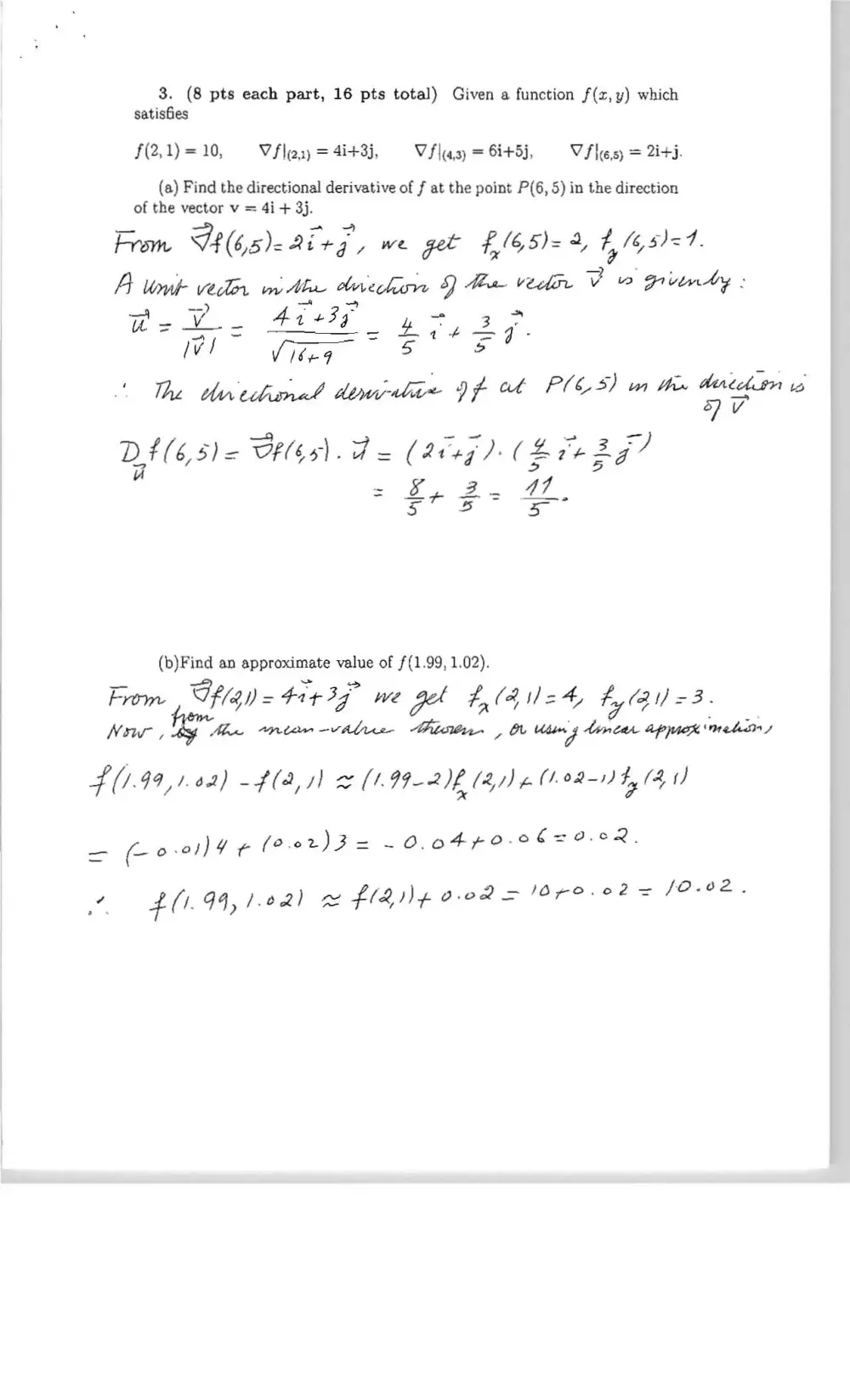
3. (8 pts each part, 16 pts total) Given a function f(x, y) which
satisfies
1(2,1) = 10,
"/1(2,1) = 4i+3j,
"/1(.,3) = 6i+5j,
"fi(6,5) = 2i+j .
(8.) Find the directional derivative of f at the pOint P(6, 5) in the direction
of the vector v = 4i + 3j.
/-I"orn- :;)..f(6,S)=fii+/"
p
[,.({,/S)= ~/ 1~ !6/"-)-::1.
Wl.
It U/n1i- Vt~ ";'Alfv...- ~e~ S) .4h- "uWt- ~ ",, ' :rvw,--?" .'
_)
-7"
-.J)
rt--""---
4t./- 3{
b.
~
3
~
-
~ -
-= L..,-i---:=3
/ V I
.f/i';:1
5
'"
T7u. dM.~ dtw;-JCv--
~f cd PI(- 5-) WI I£,
(b)Find an approximate value of 1(1.99, 1.02).
rY'fnrl-
-ef!~/) = 4-::1" 3/ M P
1/1 (~ J! :,4/ I,,!,;; 1/ =- 3.
IVn. , ~~
....,.,.~ _v~ ~
/ ttL w-j -t..:.""", "f'JI4"l"';"..t.,;n; /
-f(iQQ/d.2) _j(.:J,I) Z (1.9r-~)~(:l,/)f-(IO~-')-&(-}I)
(_o .OJ)'Ir (0 .0>-)3= _°.04-".0 . 0 (",,0. 0 ::(.
/0 _02 .
.f (I. q"I) 1 . • ,2} 'Z -f(~ J) I- 0 , <>:; -= J0 r 0
. 0 2 -=
. .
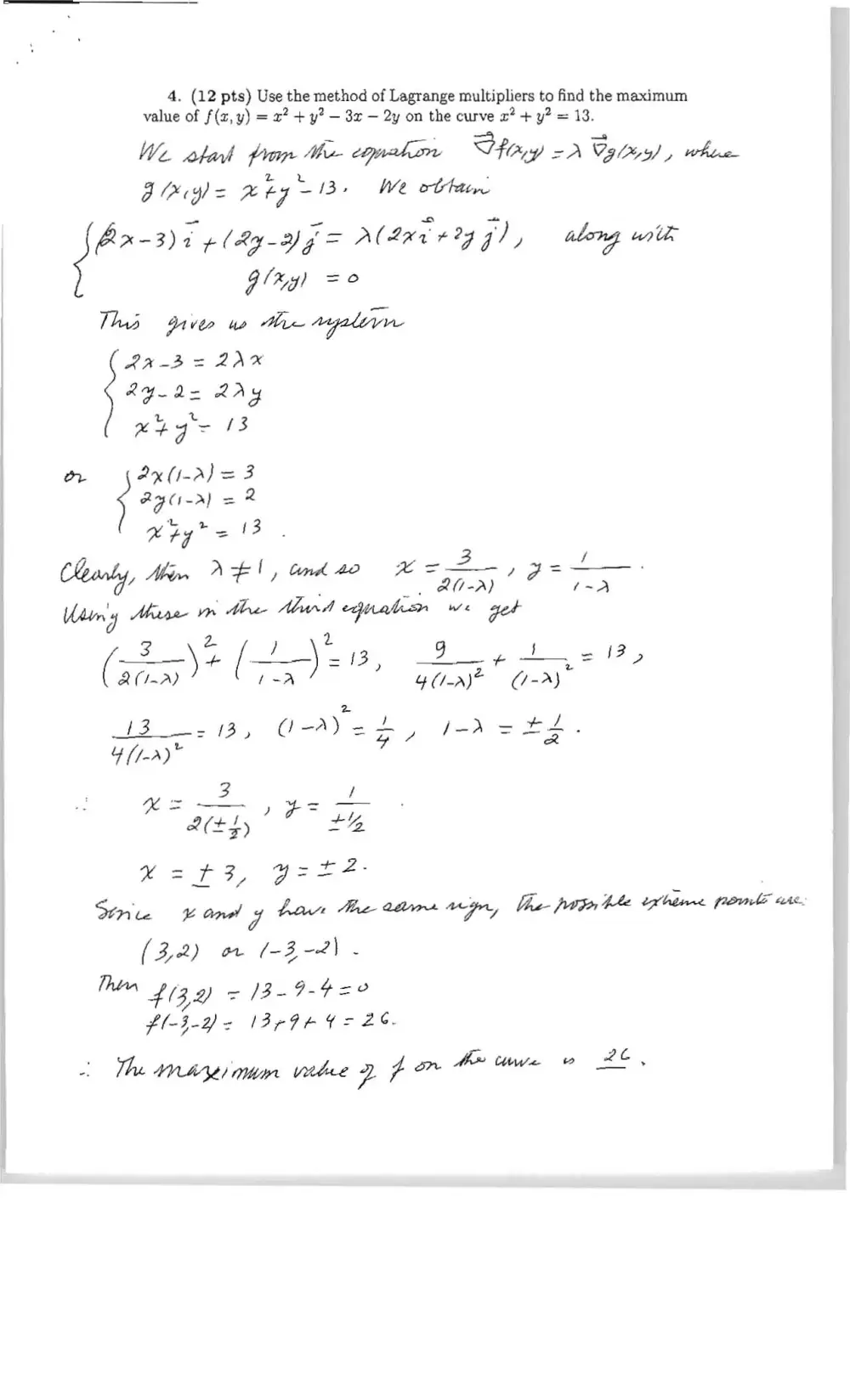
4. (12 ptS) Use the method of Lagrange multipliers to find the ma.'(jmum
value of J(x ,y) ~ x' + y' - 3x - 2y on the curve x' + y' ~ 13.
Wt.- ~ ~ 41~?p)p~ Q.ffrt,Y! : ~ ~J'tx/~) / ~
d (;> (7)} =- ;:t
"Z-f-l
L - 13 '
We rrU1a,"~
!
!?< - "3) i f (.?:;--o/; ~ )I (.27;'" 2lj-":) )
~ w;U;
j ( ;>/;;1
'" D
ThM
;h-t> v ~ ~vv
~;x _3 =- 2). 'X
:l.--;_ (l=. :v.;:;
1.
1.
3
:X+(J-=-
I
"'-
) ~?< (1-;>') =' 3
I .9if (I -).) ~ :I
';ift '-."./3
(f. ".I. ,/ ~
J\ 1= ' I ~ 4V
;:<: =- 3 -
I
;;; :
.....:/_
~~-iJ
,:((1 -;>' )
(--'\
fM.v ';; ~ ",,' ~ ~,1 ~ P
hI<
n
..,
2
)L
~
') -f-
( . 1 _
_ 13
9
f-
'- -
13.)
( ,P,(I-A)
1-;:>'
-
)
'I (I-A) 2.
(I- A)
/ -), -
+ .1.
13
= 13,
- - .x.
'i(p.) L
I
x = t i
~1"1l.G
')? -~
/
;
/..a,v, #-u- ~ M-r/ fL- /Wl?> 4--& ¥~ fW»,{b '<A.'-.
(3/ .2)
M-
I-~ _.2) -
TJwv. -I (~.2) -=- /3 - '} - 4' ::: "
1(-}-2)~ 131'91-'( =-2' .
71u. ~/fmvfrt ~ 11 ",.. b
U'W~ .,
.pC.
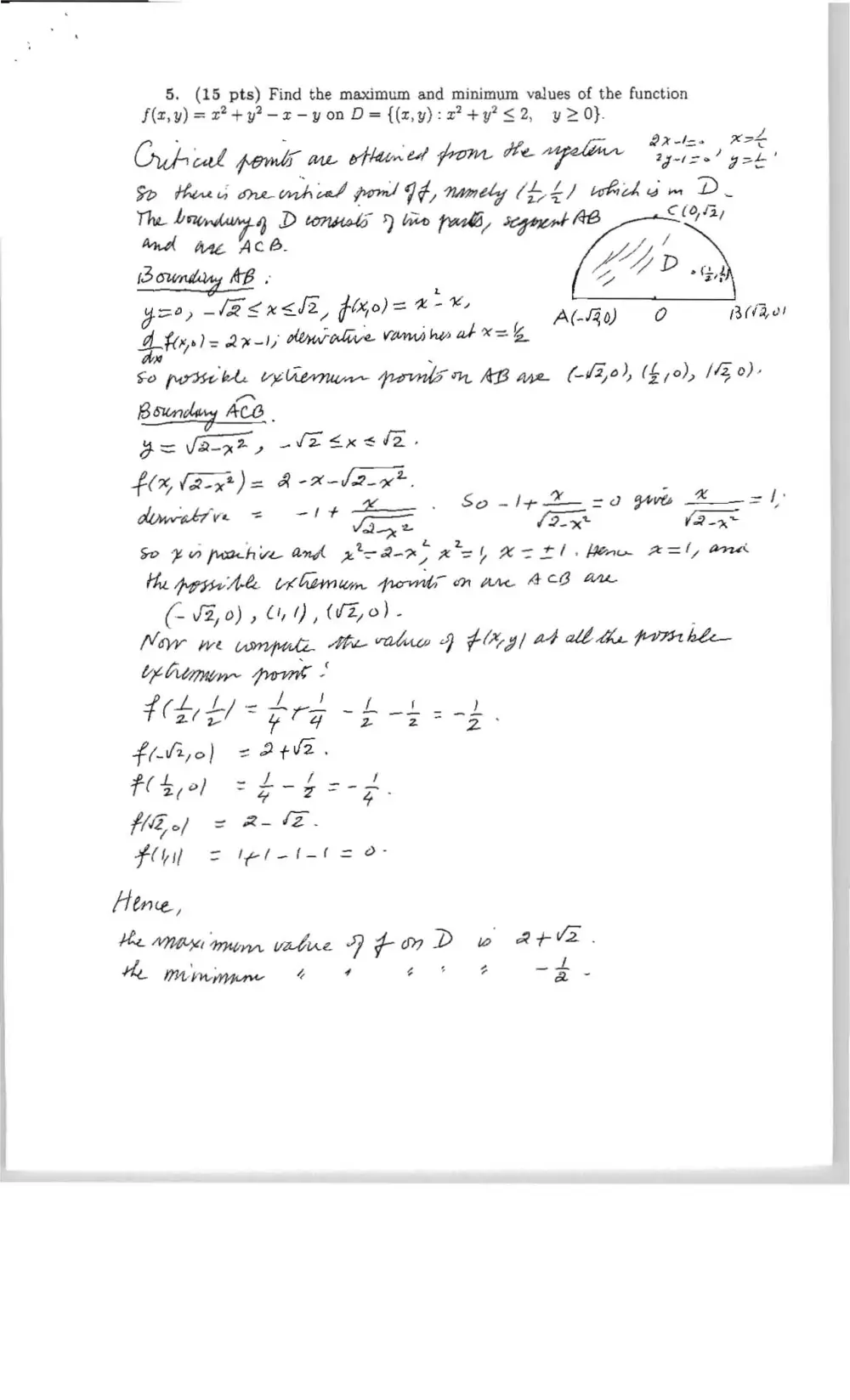
5. (15 pts) Find the maximum and minimum values of the function
f(x,y)=x2+y2 -x-yonD={(x,y):x'+y':S2,
y~O},
1'.
~
.
.
'-I~A tJ{,
A4-r"'';';;;~
~".I_.
;><7 ~
V'iif1 C-.t.l ~. Mt- o1/.tv..,.e4 T'v,"v
"- " ;--- - -
'J"~" :;~!:: .
~ ~.;, Oh.<-~;..J ~11/ 'llA?nd-;' /fA! w/?d. 'd.... v.
Th<.. .i~'l J) ~ ') ~ ~/ ~M3
C(o, li,
~
oW. ACiO.
'/~ /
(3 ow"'7 kf. .
,
'/ '/ J) • ''''~
~::;o ; -6sx -<:n/ I(x,o}~ ':I: -
')C,
A(.f),o)
0
liJ<,," ~ ~ ".1, ~ti<lW<. V'~ h<->.J x= ~
do"
•
so" ~' k-I.... vy;~~ ...... A:8 ML (·0 b ), fLo); Irz; o}.
/"
861W1~ AW..
:J.:::: Vi> .?< ;:-' - /2: '" )< '<i J2. .
-f(~ fe2-,,- )=, JI-?<-j.'2-~.
~d-1'v<
~
-
I +
1(
•
.1.2
;:,
.'
"""?c"
L
2.
$v ~ V) J"-«kh v<- tl.".,I -,,'7 .:1-')<-, /< '" ~ ~ -:: !: I . /#-~~ ".. = 1/ tv>u(
flu. ~;1..~ v,rf1#y,/VM. ~." ;IA<.. ,4 cO M.I...
(- J"i,o)
(I, I), (n>,,) .
f'I~ W< ~ 4tV- ~ '1 I (~jl tt4 44... fw.'h,i0.
(//~""" ~.'
=f(J... 1/ - fr
I
q
I
_ L ,
2-
}
2-(;::
-
2-
z.
-{(.,(i,o)
'=' ,:lfV2·
fr -&1"I
= ~ - ; := - f
I(~ 0/
.
.:<. IZ .
f f ~II
-
- I. I = <>.
1f'1
He.n<e.-,
14. ~I ~YVL vd,M.
~ /JI'VJ""~
•
,
,
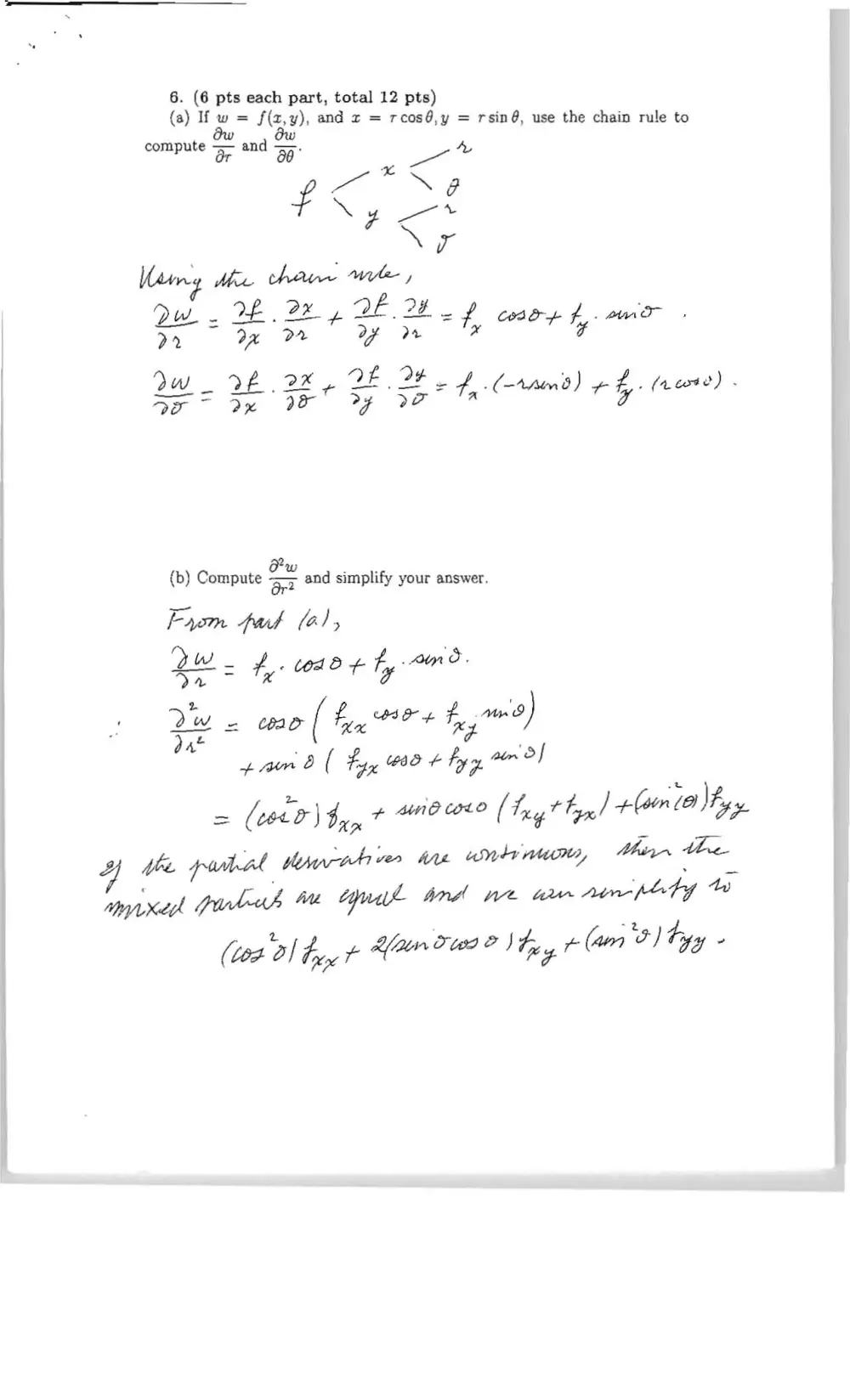
6. (6 p ts each p art , total 12 p ts)
(a) If ~ = !({j,];)' and x = TCOSs , y = rsiDs, use the chain rule to
compute -
fh and -
80'
?w
-
8'w
(b) Compute fh' and simplify your answer.
F¥"h- 1>Mi !t?},
?JW _ ', ''''' b -"-.I .A>0'!'J-.
') 'I.
-
'rX
<N~I ~
, .
WtT (
l;KfM>-'&)
f';! -
l;tx c.M 8' +
+ ffih" b ( '1J' ~ lJ f- I~7- "",,'~/
(~IT ) ix?' ~ &418C<Y<lO (11''8- l' f1'X-/ +{#" {tJ} )~)'
1 !~ t~ . ~rJ,;""" ~
bt.f>1,hi#(.(JJt/>,t ~~
fIIJn.1.)(4I. ~ Mt P/fl4.tJ- MvI J1/L ~ /U'Yv'j-hf'l -1.v
(tp;;t it1f7?J ,R(aM-Ut¢ t7 ) 1;.,:r r- ~ ',)') f~!!
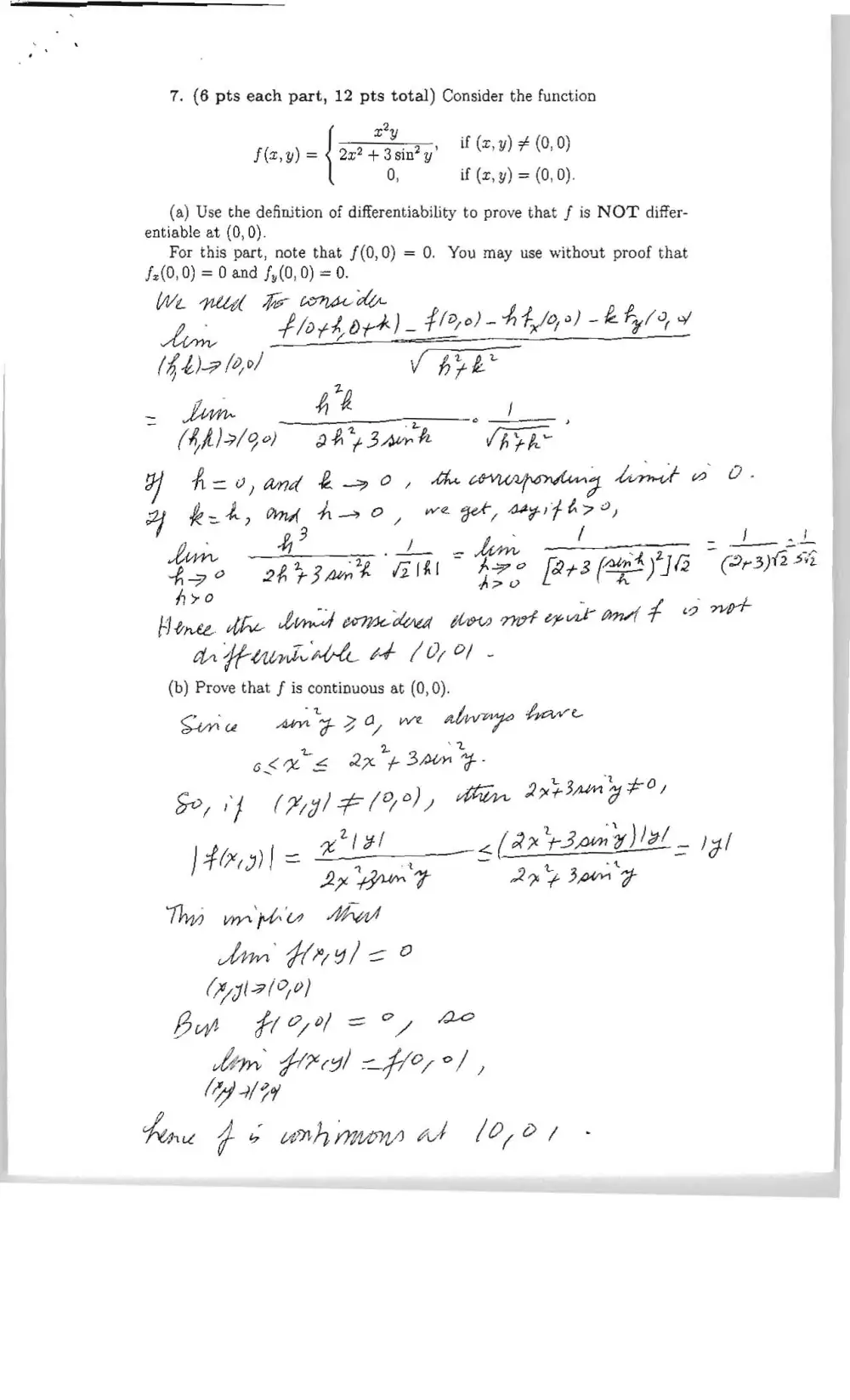
7, (6 pts each part, 12 pts total) Consider the function
x'y
I(x,y) =
2x' +3 sin' y'
if(x, y) # (0, 0)
{
0,
if (x, y) = (0, 0) .
(a) Use the defin.ition of differentiability to prove that I is NOT d'~ r
entlable at (0,0).
I e
For this part, note that 1(0,0) = 0, You may use without proof that
1,(0,0) = 0 and 1,(0, 0) = 0,
WL 1'ItId $F ~~
~ -!1f)f~!)f'J.) _ :{(D/ o) - M'/0°) - ~ f-r/ vr :
(f£)-?/~ .I
.; nfl:. L
p .~
-
fot.n.-
_11~_-:L"_. I
(9)"119")
/) t, ',t3~LA
(-;:~==f==t..=--
IJj
A. =- () I Mid ~ -';> 0
,
A;f."" ~J ~f
I/>
0 ,
'1 -k ~ -Ie, ~
-It -"" 0 I
PI .M1' 'f to '? oJ)
",,'l.
.1~
-fJ3
,..L.~~
I
.
-t. -7 0
21. 't- J,()V~'I. Ii.' I~ I
.;.f-or <7 P~3 (~!:/J(j
11'70
?
V
rJ{-n.<e,. vCk- J~ tWm<-~ t~ '7'i'tP o/-j anA f ,,,?VP+
fi-, ift1.hJv~ 1-1- IOf 0/
(b) Prove that J is continuous at (0,0),
~. u
......,,; 'if- ~ ll/
iN< atw7 ~<-
t...
2..
'1.
6~< 1L ~ :2:x f- 3,w.-. if-'
&-v/ ,'/
17/:;/:(:1%)/ ~
.2?'f-3MM~:FO )
2/ !f f
!4f7rJ) I:::: ~,
!2?'~7
1hn
VW''r-? '01 4/Vvf
Jrw, ' lIl'/!1! ~ 0
(~JI4 ( ~(})
130f1
1-1°/ vi :::: '"/
/.l-O
b m' jI?«';j/ ~o/ 0/ !
11/ .;1';'1
~w: f; uf)lh~ tV