
MATH 201 Exam, Spring 2008
American University of Beirut · Calculus and Analytical Geometry III · 7 pages
More MATH 201 files
Show the text of this exam
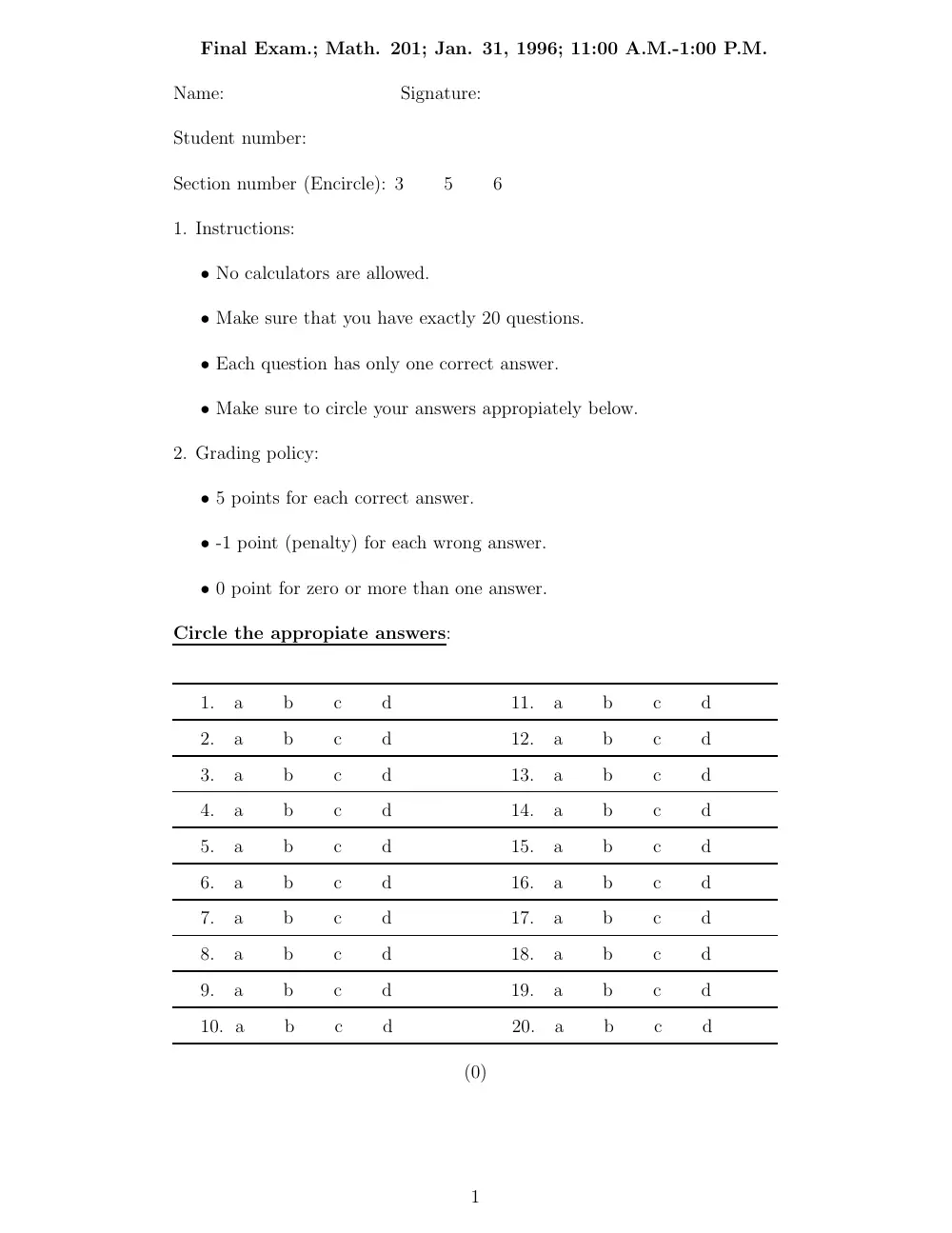
Final Exam.; Math. 201; Jan. 31, 1996; 11:00 A.M.-1:00 P.M.
Name:
Signature:
Student number:
Section number (Encircle): 3
5
6
1. Instructions:
• No calculators are allowed.
• Make sure that you have exactly 20 questions.
• Each question has only one correct answer.
• Make sure to circle your answers appropiately below.
2. Grading policy:
• 5 points for each correct answer.
• -1 point (penalty) for each wrong answer.
• 0 point for zero or more than one answer.
Circle the appropiate answers:
1.
a
b
c
d
11.
a
b
c
d
2.
a
b
c
d
12.
a
b
c
d
3.
a
b
c
d
13.
a
b
c
d
4.
a
b
c
d
14.
a
b
c
d
5.
a
b
c
d
15.
a
b
c
d
6.
a
b
c
d
16.
a
b
c
d
7.
a
b
c
d
17.
a
b
c
d
8.
a
b
c
d
18.
a
b
c
d
9.
a
b
c
d
19.
a
b
c
d
10. a
b
c
d
20.
a
b
c
d
(0)
1
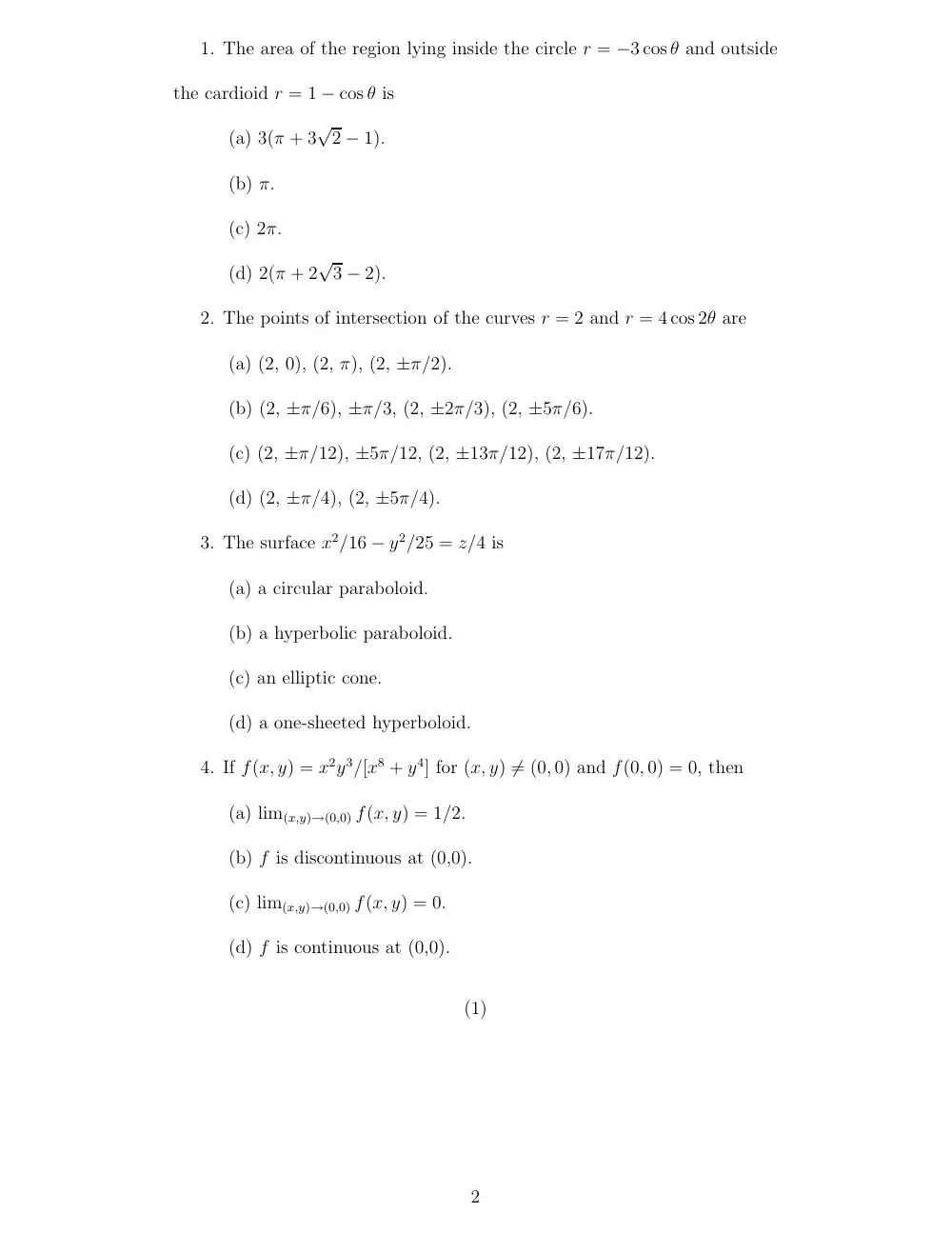
1. The area of the region lying inside the circle r = −3 cos θ and outside
the cardioid r = 1 − cos θ is
(a) 3(π + 3
√
2 − 1).
(b) π.
(c) 2π.
(d) 2(π + 2
√
3 − 2).
2. The points of intersection of the curves r = 2 and r = 4 cos 2θ are
(a) (2, 0), (2, π), (2, ±π/2).
(b) (2, ±π/6), ±π/3, (2, ±2π/3), (2, ±5π/6).
(c) (2, ±π/12), ±5π/12, (2, ±13π/12), (2, ±17π/12).
(d) (2, ±π/4), (2, ±5π/4).
3. The surface x2/16 − y2/25 = z/4 is
(a) a circular paraboloid.
(b) a hyperbolic paraboloid.
(c) an elliptic cone.
(d) a one-sheeted hyperboloid.
4. If f(x, y) = x2y3/[x8 + y4] for (x, y) ̸= (0, 0) and f(0, 0) = 0, then
(a) lim(x,y)→(0,0) f(x, y) = 1/2.
(b) f is discontinuous at (0,0).
(c) lim(x,y)→(0,0) f(x, y) = 0.
(d) f is continuous at (0,0).
(1)
2
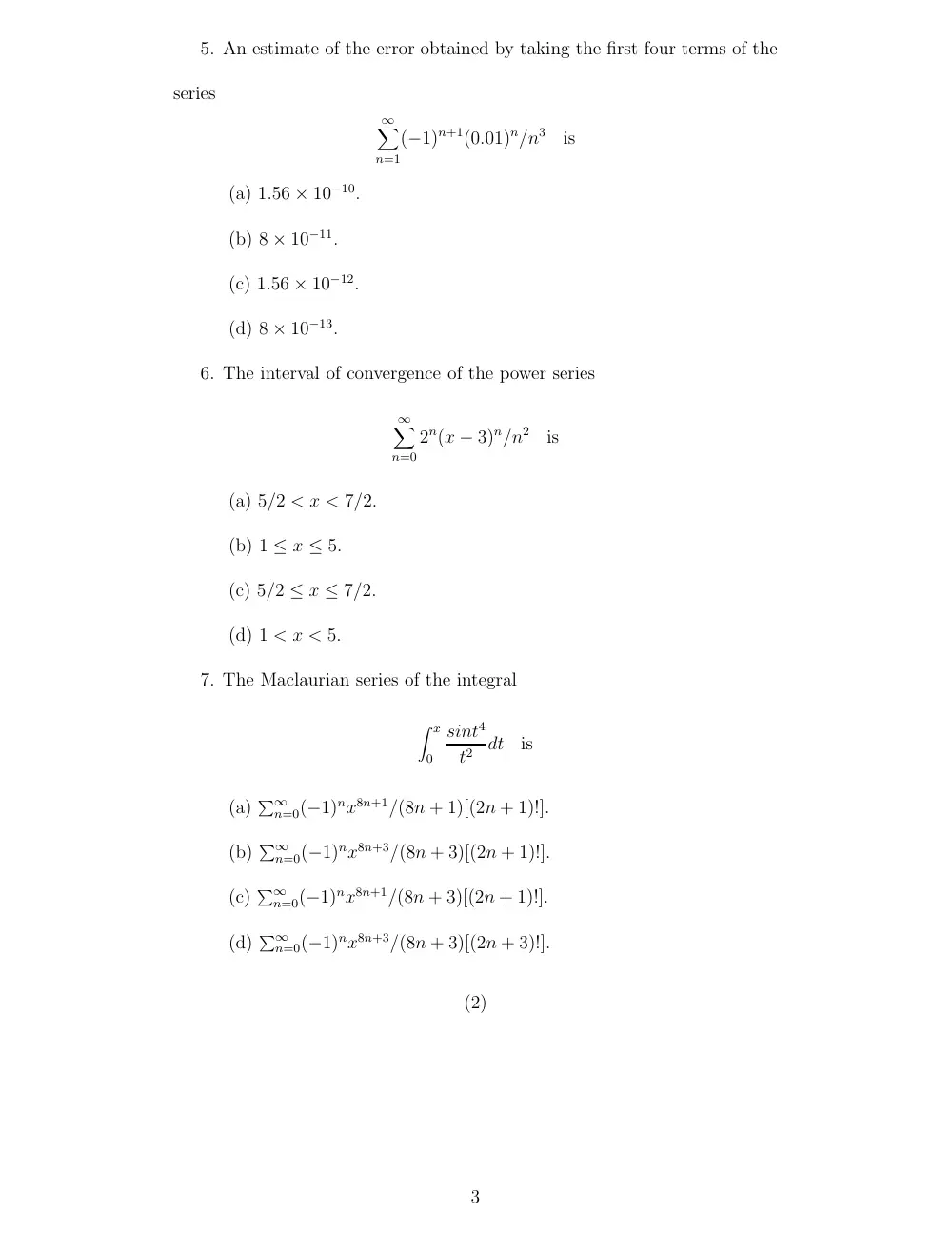
5. An estimate of the error obtained by taking the first four terms of the
series
∞
�
n=1
(−1)n+1(0.01)n/n3
is
(a) 1.56 × 10⁻¹⁰.
(b) 8 × 10⁻¹¹.
(c) 1.56 × 10⁻¹².
(d) 8 × 10⁻¹³.
6. The interval of convergence of the power series
∞
�
n=0
2n(x − 3)n/n2
is
(a) 5/2 < x < 7/2.
(b) 1 ≤ x ≤ 5.
(c) 5/2 ≤ x ≤ 7/2.
(d) 1 < x < 5.
7. The Maclaurian series of the integral
� x
0
sint4
t2
dt
is
(a)
�∞
n=0(−1)nx8n+1/(8n + 1)[(2n + 1)!].
(b) �∞
n=0(−1)nx8n+3/(8n + 3)[(2n + 1)!].
(c) �∞
n=0(−1)nx8n+1/(8n + 3)[(2n + 1)!].
(d) �∞
n=0(−1)nx8n+3/(8n + 3)[(2n + 3)!].
(2)
3
8. If an = ( 3
5)n + 4n
n! and bn = n(e
1
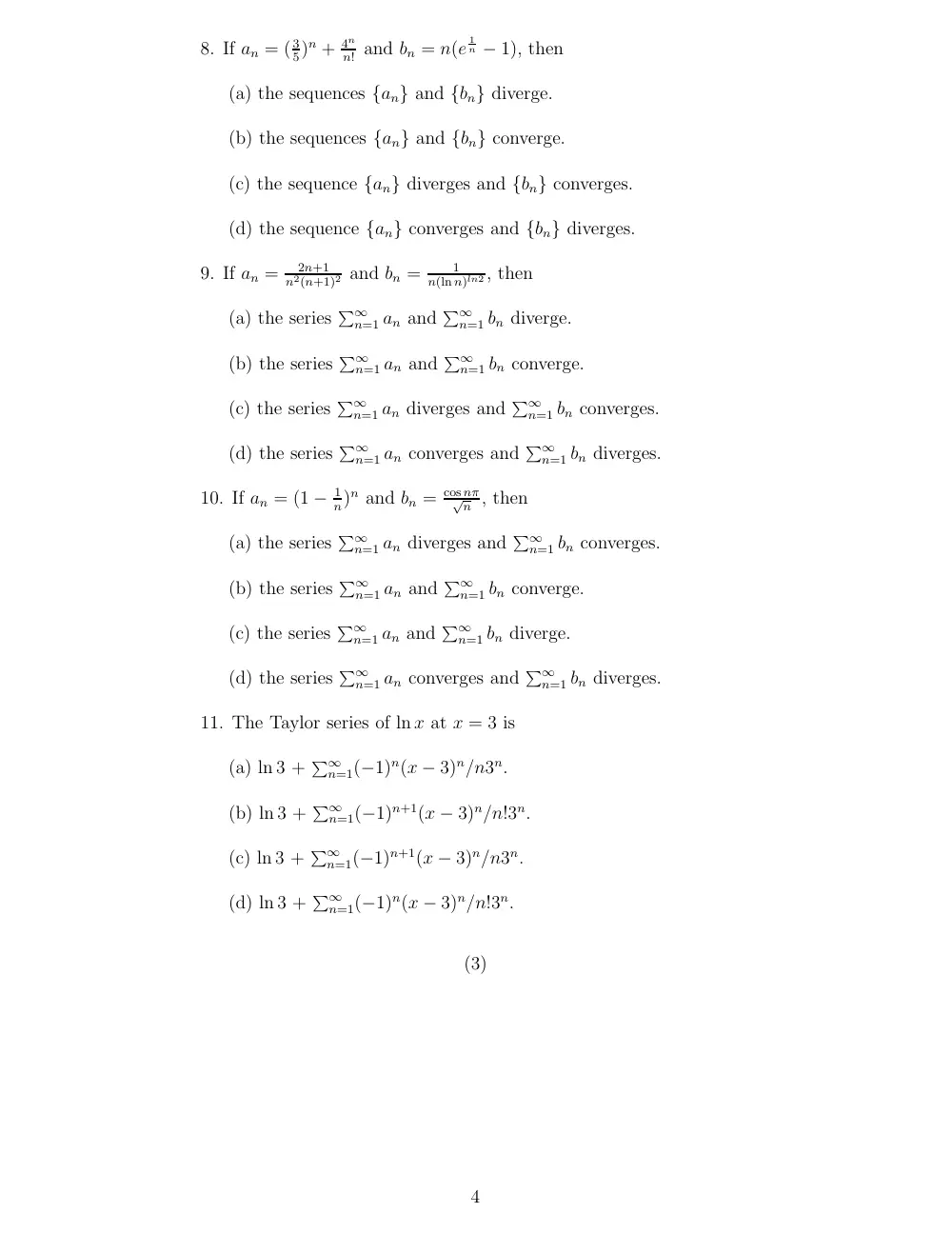
n − 1), then
(a) the sequences {an} and {bn} diverge.
(b) the sequences {an} and {bn} converge.
(c) the sequence {an} diverges and {bn} converges.
(d) the sequence {an} converges and {bn} diverges.
9. If an =
2n+1
n2(n+1)2 and bn =
1
n(ln n)ln2, then
(a) the series �∞
n=1 an and �∞
n=1 bn diverge.
(b) the series �∞
n=1 an and �∞
n=1 bn converge.
(c) the series �∞
n=1 an diverges and �∞
n=1 bn converges.
(d) the series
�∞
n=1 an converges and
�∞
n=1 bn diverges.
10. If an = (1 − 1
n)n and bn = cos nπ
√n , then
(a) the series �∞
n=1 an diverges and �∞
n=1 bn converges.
(b) the series �∞
n=1 an and �∞
n=1 bn converge.
(c) the series
�∞
n=1 an and
�∞
n=1 bn diverge.
(d) the series
�∞
n=1 an converges and
�∞
n=1 bn diverges.
11. The Taylor series of ln x at x = 3 is
(a) ln 3 + �∞
n=1(−1)n(x − 3)n/n3n.
(b) ln 3 +
�∞
n=1(−1)n+1(x − 3)n/n!3n.
(c) ln 3 +
�∞
n=1(−1)n+1(x − 3)n/n3n.
(d) ln 3 + �∞
n=1(−1)n(x − 3)n/n!3n.
(3)
4
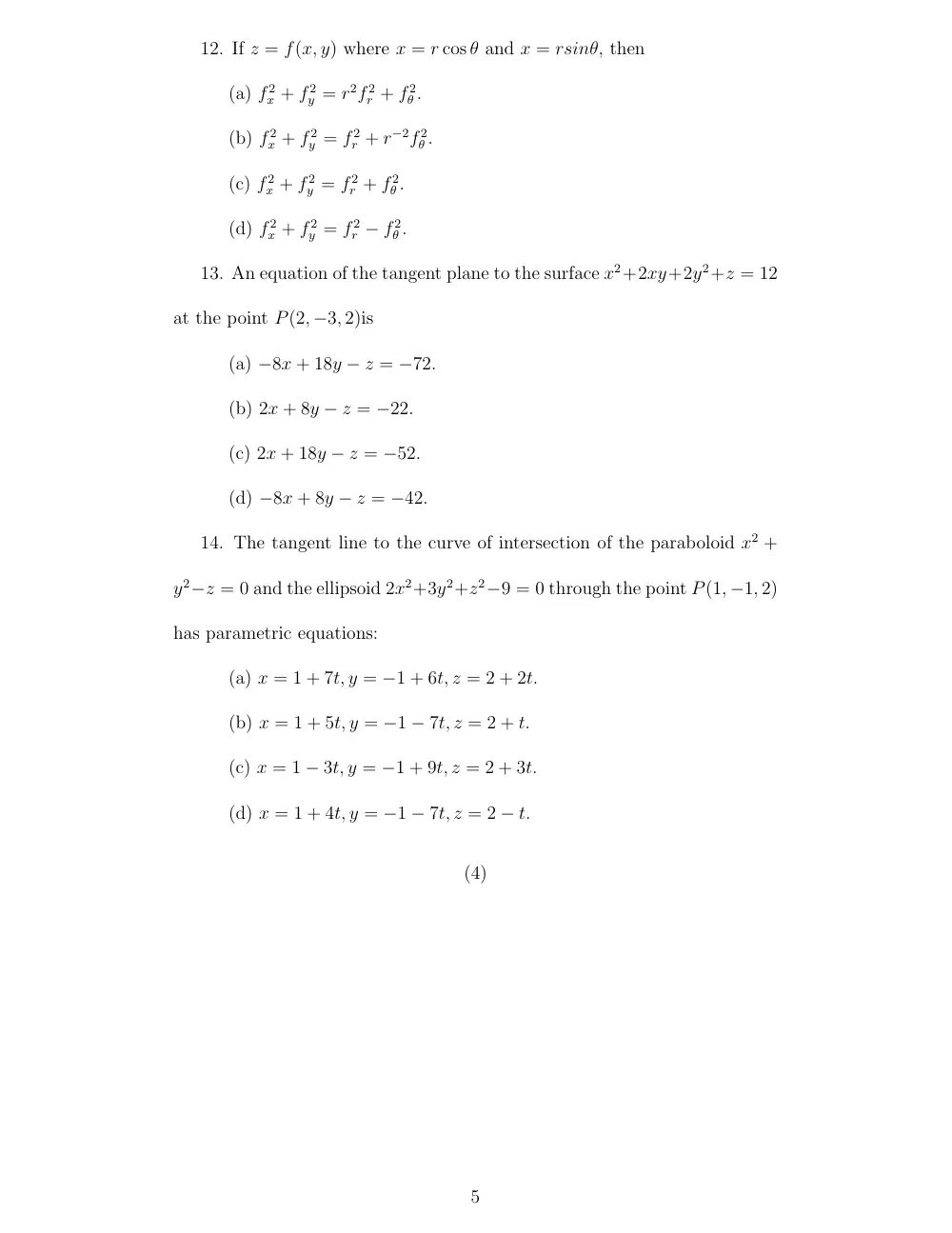
12. If z = f(x, y) where x = r cos θ and x = rsinθ, then
(a) f 2
x + f 2
y = r2f 2
r + f 2
θ .
(b) f 2
x + f 2
y = f 2
r + r−2f 2
θ .
(c) f 2
x + f 2
y = f 2
r + f 2
θ .
(d) f 2
x + f 2
y = f 2
r − f 2
θ .
13. An equation of the tangent plane to the surface x2+2xy+2y2+z = 12
at the point P(2, −3, 2)is
(a) −8x + 18y − z = −72.
(b) 2x + 8y − z = −22.
(c) 2x + 18y − z = −52.
(d) −8x + 8y − z = −42.
14. The tangent line to the curve of intersection of the paraboloid x2 +
y2−z = 0 and the ellipsoid 2x2+3y2+z2−9 = 0 through the point P(1, −1, 2)
has parametric equations:
(a) x = 1 + 7t, y = −1 + 6t, z = 2 + 2t.
(b) x = 1 + 5t, y = −1 − 7t, z = 2 + t.
(c) x = 1 − 3t, y = −1 + 9t, z = 2 + 3t.
(d) x = 1 + 4t, y = −1 − 7t, z = 2 − t.
(4)
5
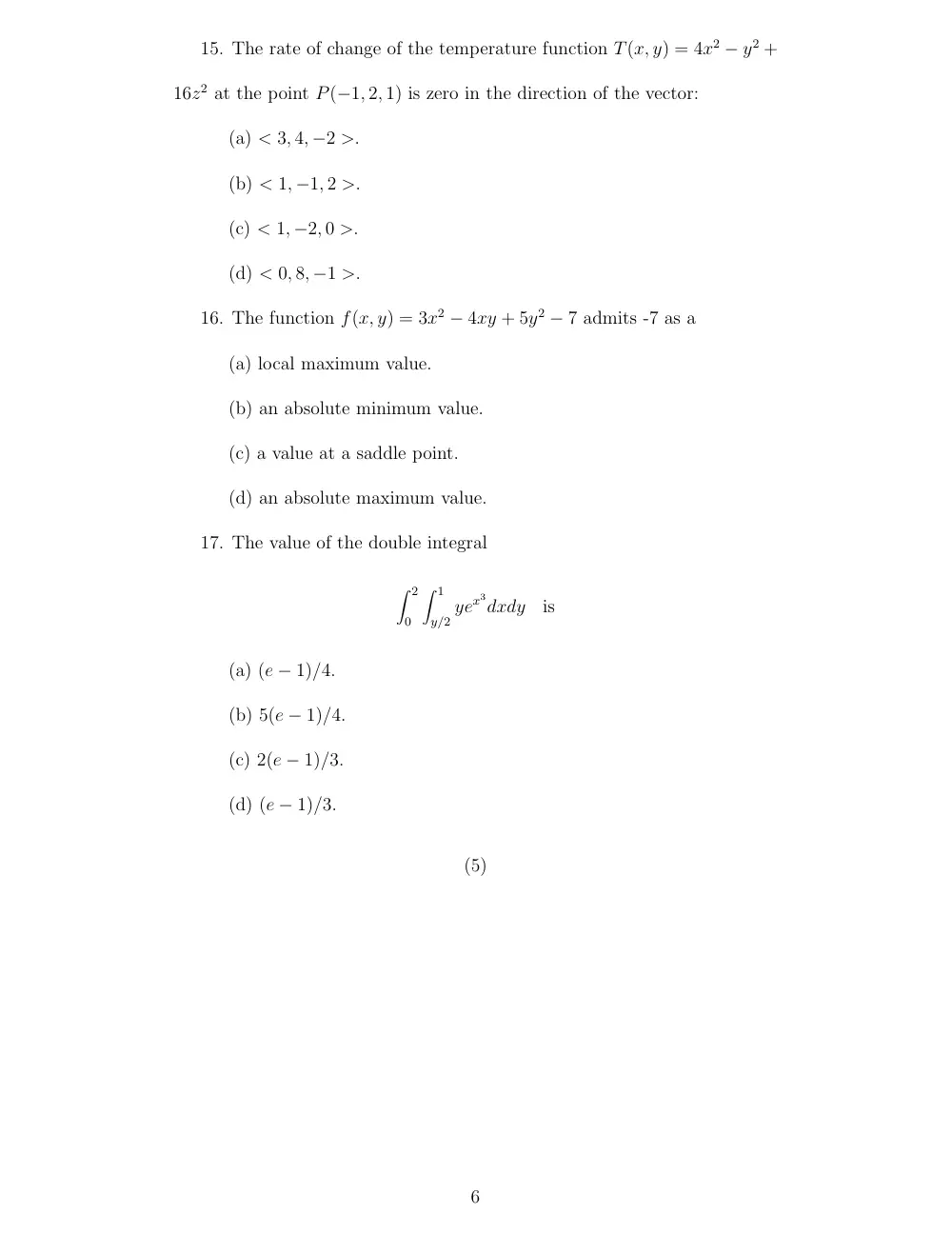
15. The rate of change of the temperature function T(x, y) = 4x2 − y2 +
16z2 at the point P(−1, 2, 1) is zero in the direction of the vector:
(a) < 3, 4, −2 >.
(b) < 1, −1, 2 >.
(c) < 1, −2, 0 >.
(d) < 0, 8, −1 >.
16. The function f(x, y) = 3x2 − 4xy + 5y2 − 7 admits -7 as a
(a) local maximum value.
(b) an absolute minimum value.
(c) a value at a saddle point.
(d) an absolute maximum value.
17. The value of the double integral
� 2
0
� 1
y/2 yex3dxdy
is
(a) (e − 1)/4.
(b) 5(e − 1)/4.
(c) 2(e − 1)/3.
(d) (e − 1)/3.
(5)
6
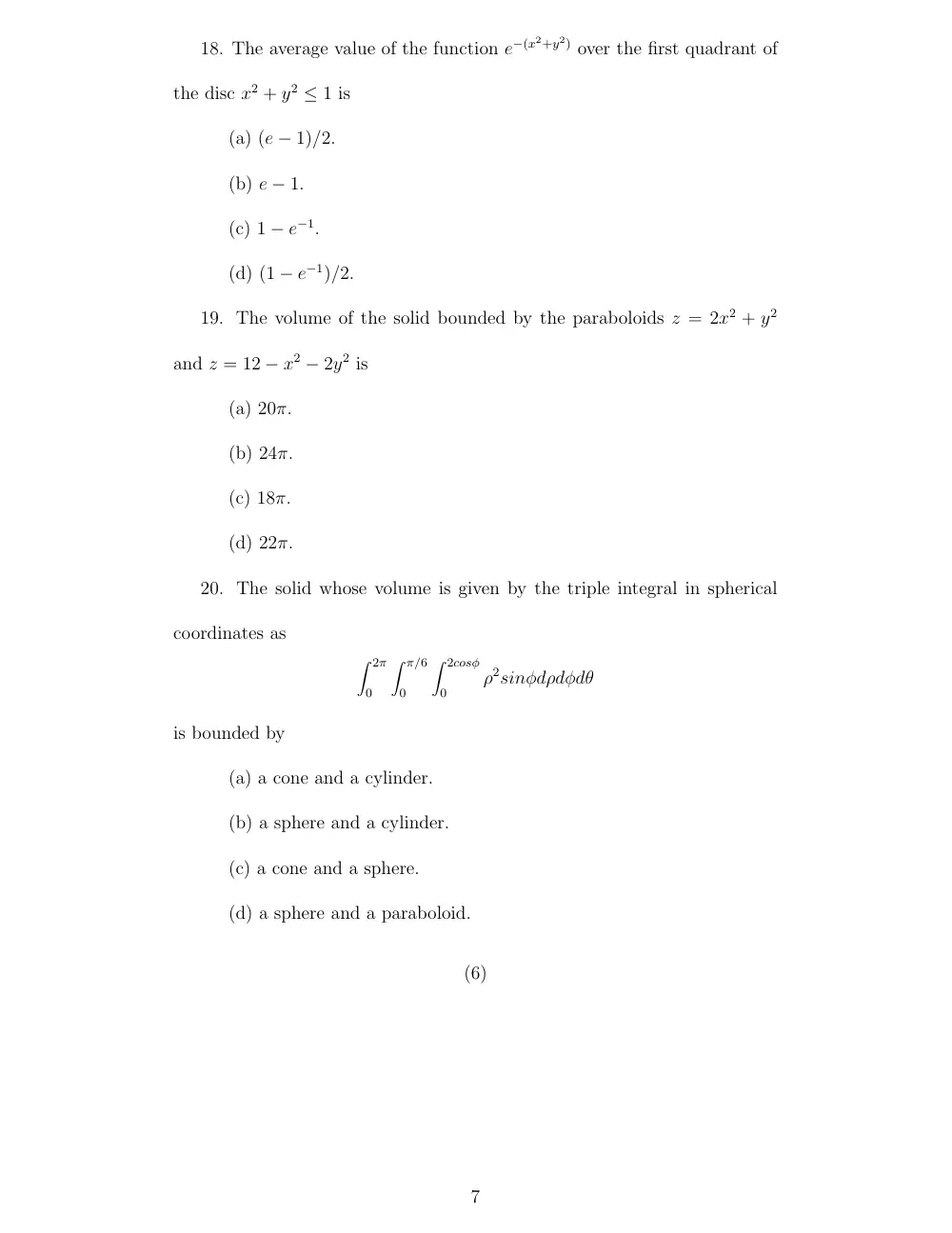
18. The average value of the function e−(x2+y2) over the first quadrant of
the disc x2 + y2 ≤ 1 is
(a) (e − 1)/2.
(b) e − 1.
(c) 1 − e−1.
(d) (1 − e−1)/2.
19. The volume of the solid bounded by the paraboloids z = 2x2 + y2
and z = 12 − x2 − 2y2 is
(a) 20π.
(b) 24π.
(c) 18π.
(d) 22π.
20. The solid whose volume is given by the triple integral in spherical
coordinates as
� 2π
0
� π/6
0
� 2cosφ
0
ρ2sinφdρdφdθ
is bounded by
(a) a cone and a cylinder.
(b) a sphere and a cylinder.
(c) a cone and a sphere.
(d) a sphere and a paraboloid.
(6)
7