
MATH 201 Exam, Spring 2008
American University of Beirut · Calculus and Analytical Geometry III · 9 pages
More MATH 201 files
Show the text of this exam
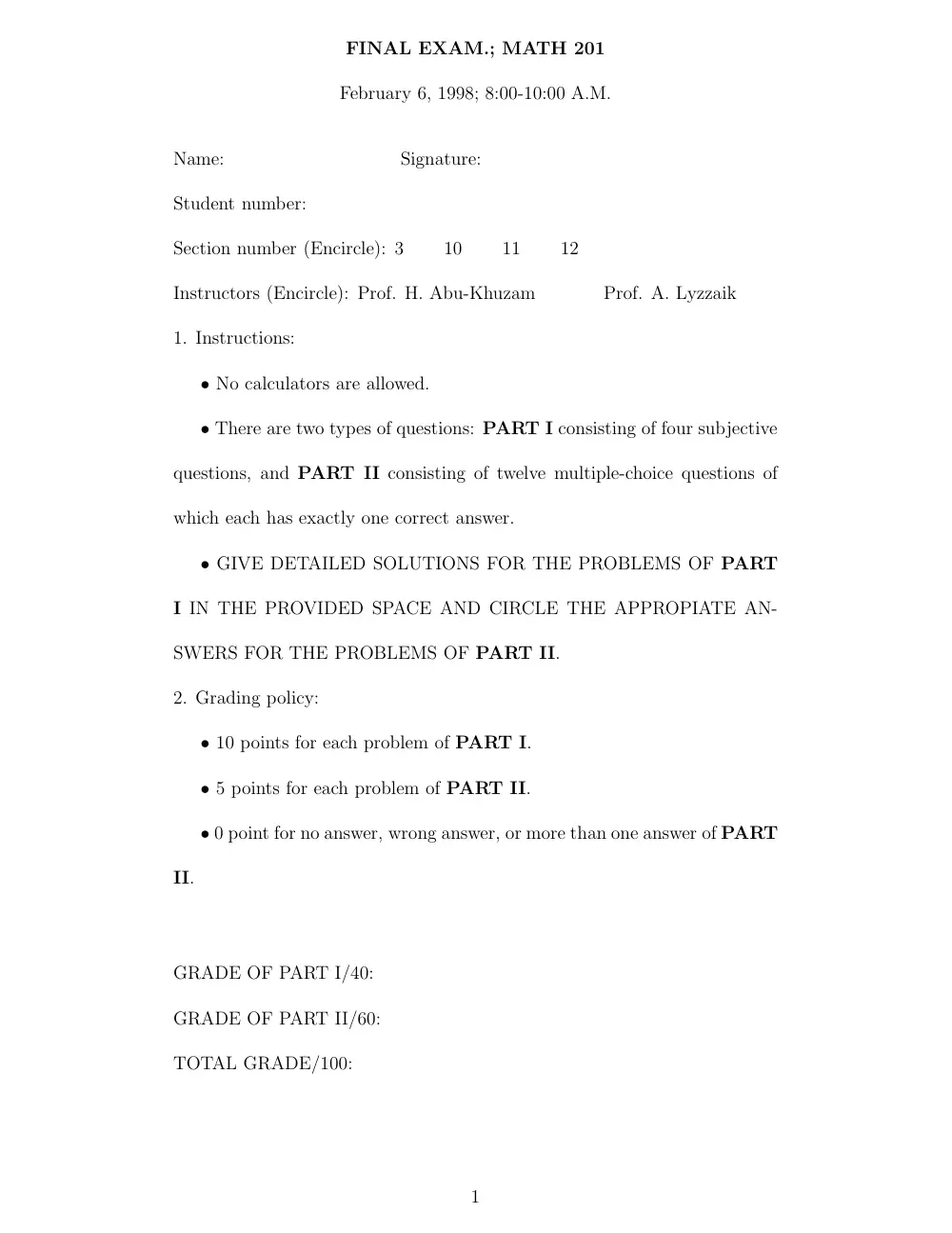
FINAL EXAM.; MATH 201
February 6, 1998; 8:00-10:00 A.M.
Name:
Signature:
Student number:
Section number (Encircle): 3
10
11
12
Instructors (Encircle): Prof. H. Abu-Khuzam
Prof. A. Lyzzaik
1. Instructions:
• No calculators are allowed.
• There are two types of questions: PART I consisting of four subjective
questions, and PART II consisting of twelve multiple-choice questions of
which each has exactly one correct answer.
• GIVE DETAILED SOLUTIONS FOR THE PROBLEMS OF PART
I IN THE PROVIDED SPACE AND CIRCLE THE APPROPIATE AN-
SWERS FOR THE PROBLEMS OF PART II.
2. Grading policy:
• 10 points for each problem of PART I.
• 5 points for each problem of PART II.
• 0 point for no answer, wrong answer, or more than one answer of PART
II.
GRADE OF PART I/40:
GRADE OF PART II/60:
TOTAL GRADE/100:
1
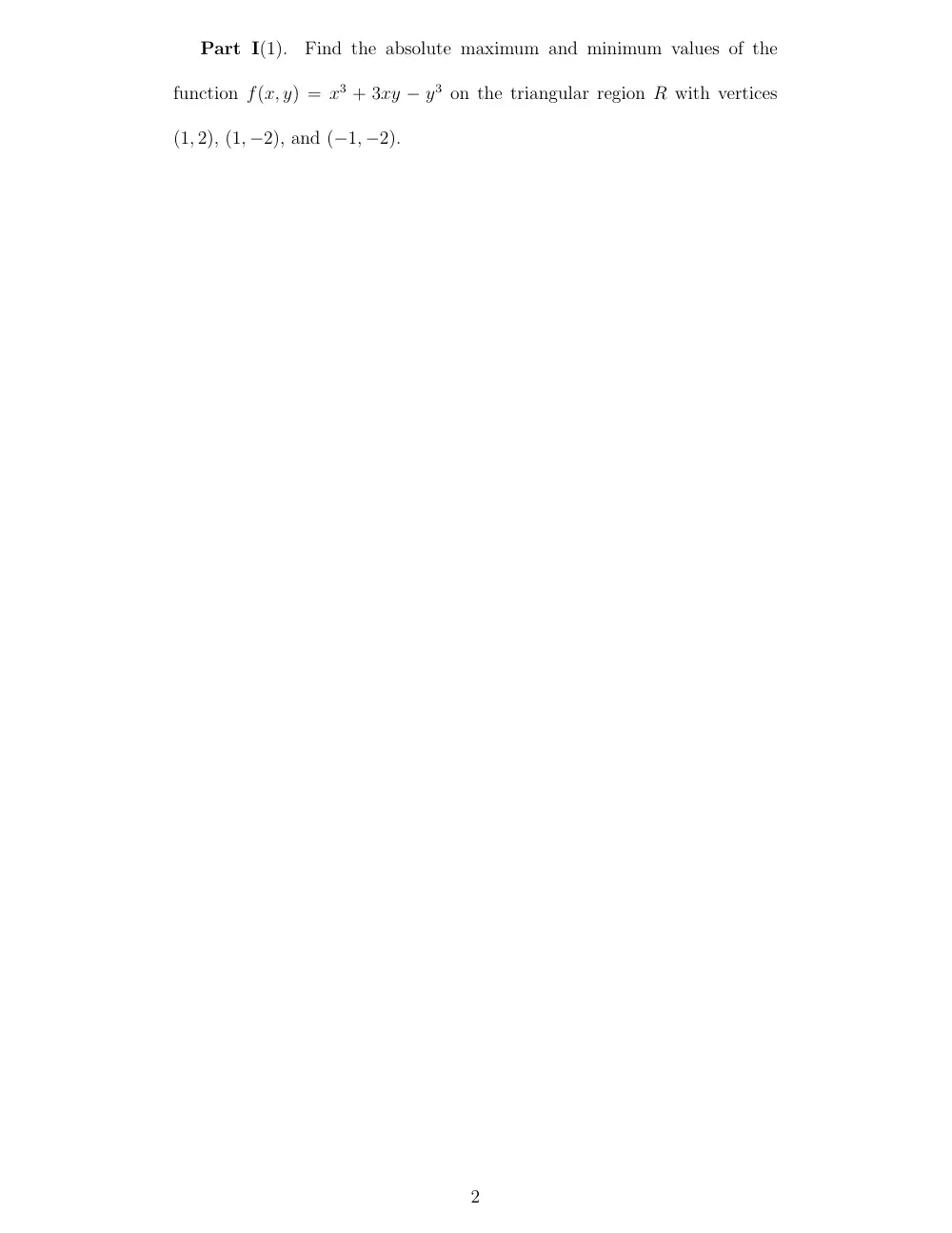
Part I(1).
Find the absolute maximum and minimum values of the
function f(x, y) = x3 + 3xy − y3 on the triangular region R with vertices
(1, 2), (1, −2), and (−1, −2).
2
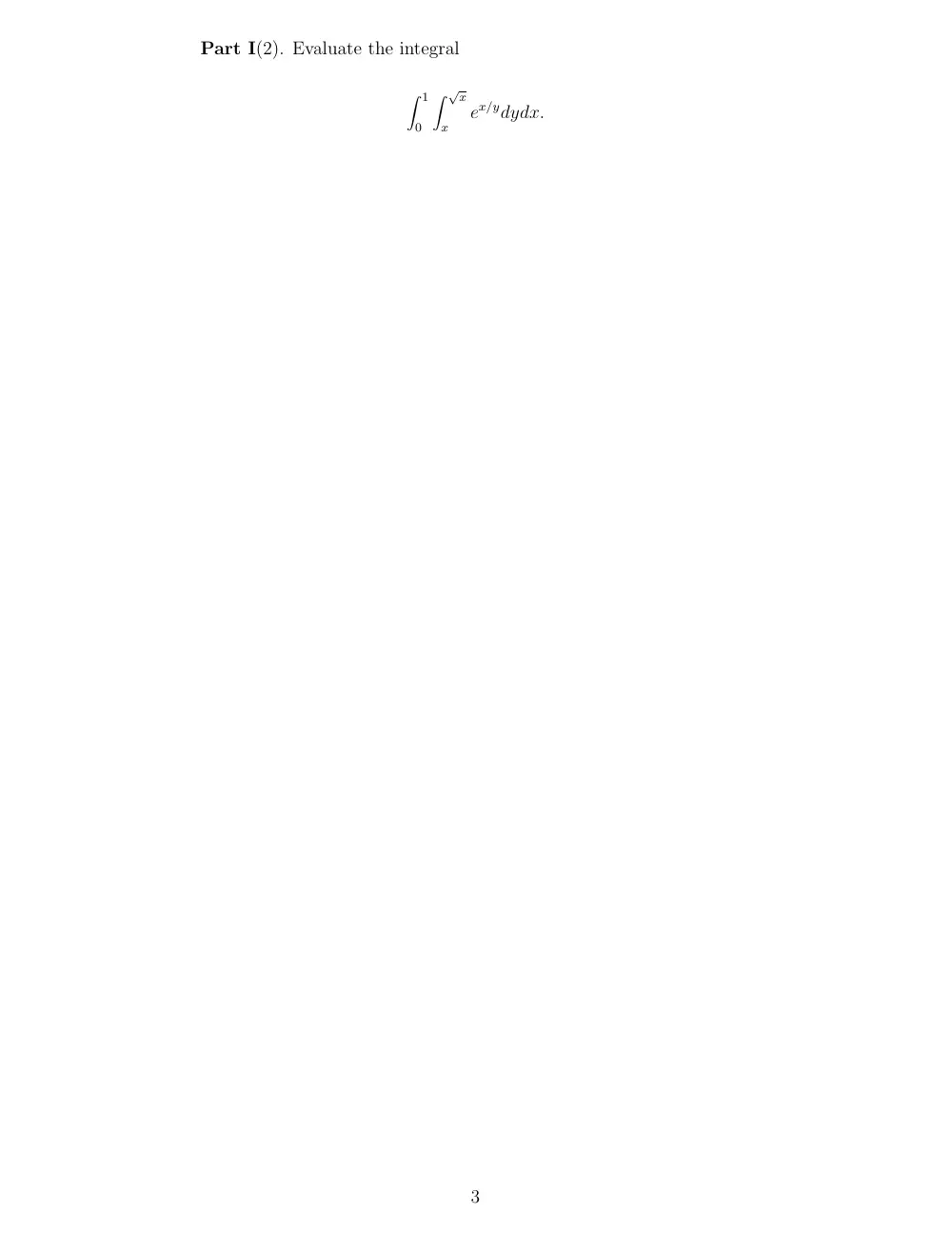
Part I(2). Evaluate the integral
� 1
0
� √x
x
ex/ydydx.
3
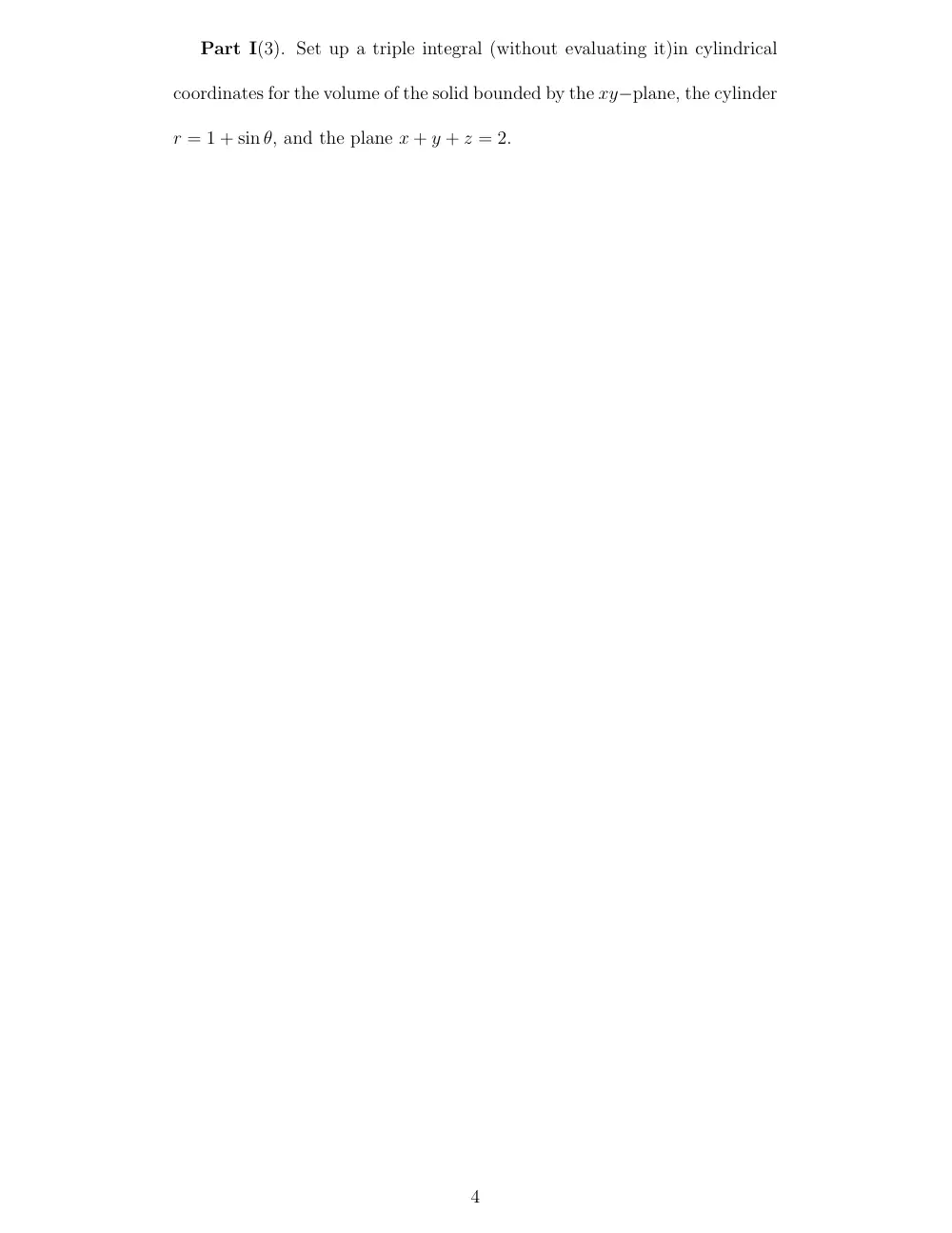
Part I(3). Set up a triple integral (without evaluating it)in cylindrical
coordinates for the volume of the solid bounded by the xy−plane, the cylinder
r = 1 + sin θ, and the plane x + y + z = 2.
4
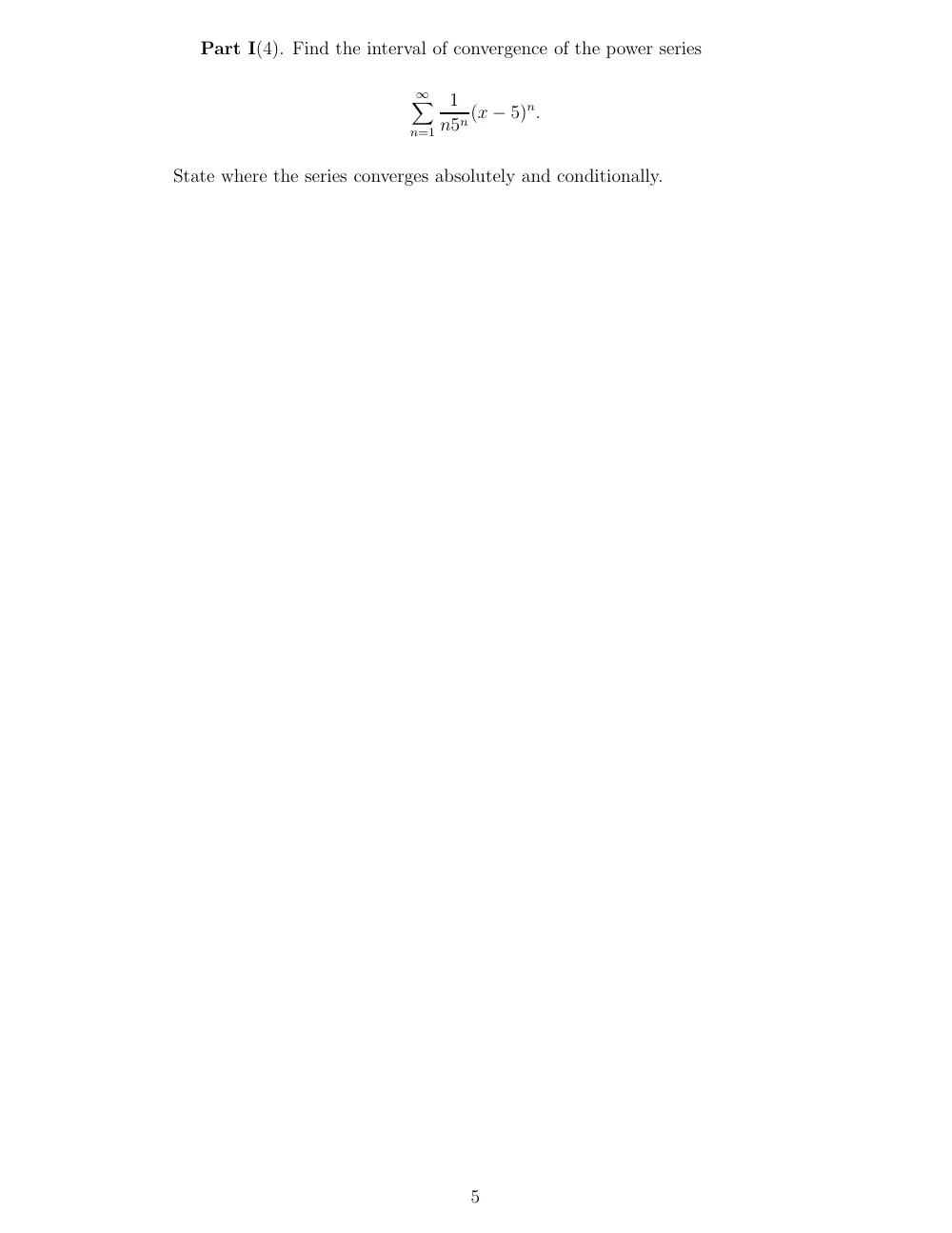
Part I(4). Find the interval of convergence of the power series
∞
�
n=1
1
n5n(x − 5)n.
State where the series converges absolutely and conditionally.
5
Part II
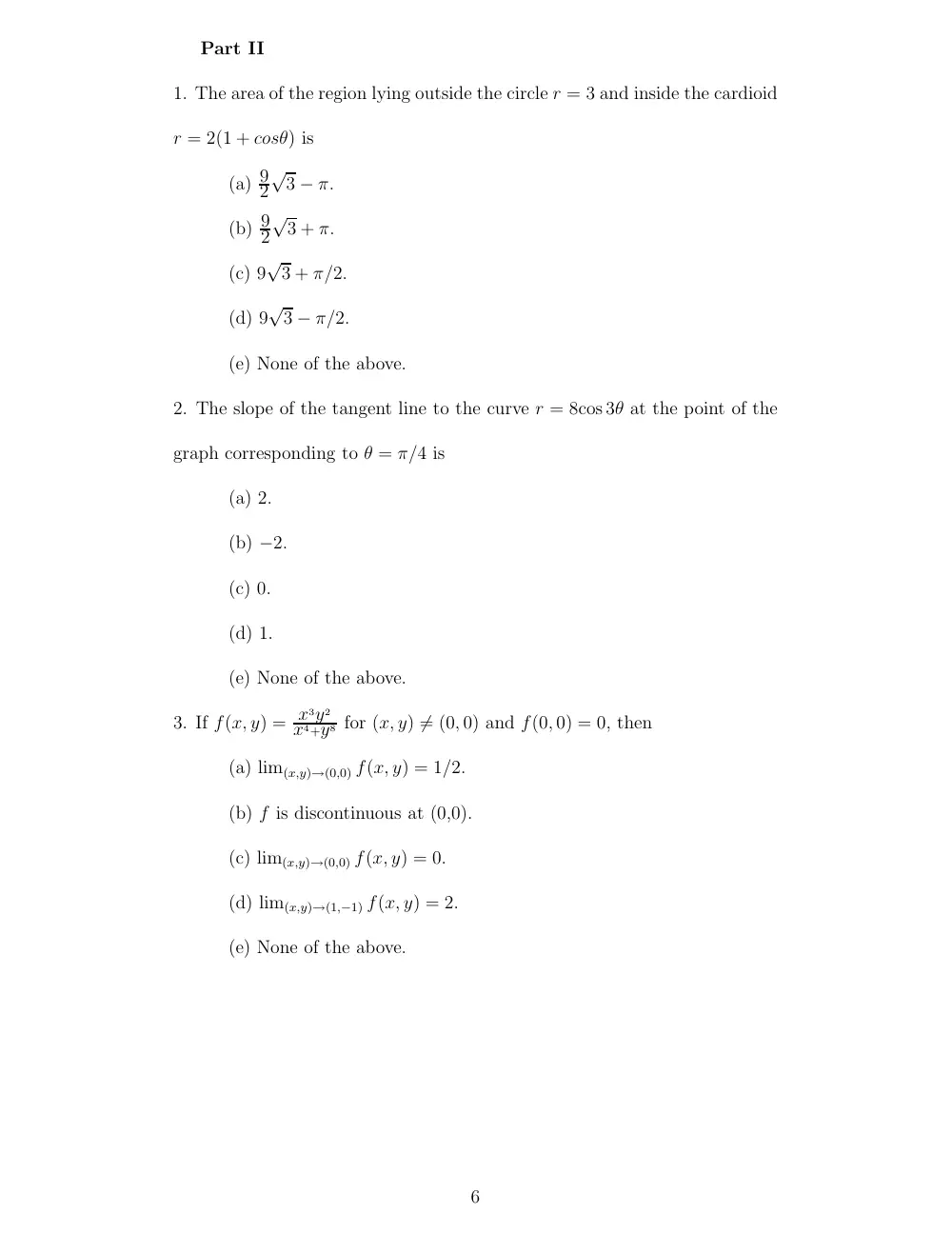
1. The area of the region lying outside the circle r = 3 and inside the cardioid
r = 2(1 + cosθ) is
(a) 9
2
√
3 − π.
(b) 9
2
√
3 + π.
(c) 9
√
3 + π/2.
(d) 9
√
3 − π/2.
(e) None of the above.
2. The slope of the tangent line to the curve r = 8cos 3θ at the point of the
graph corresponding to θ = π/4 is
(a) 2.
(b) −2.
(c) 0.
(d) 1.
(e) None of the above.
3. If f(x, y) = x3y2
x4+y8 for (x, y) ̸= (0, 0) and f(0, 0) = 0, then
(a) lim(x,y)→(0,0) f(x, y) = 1/2.
(b) f is discontinuous at (0,0).
(c) lim(x,y)→(0,0) f(x, y) = 0.
(d) lim(x,y)→(1,−1) f(x, y) = 2.
(e) None of the above.
6
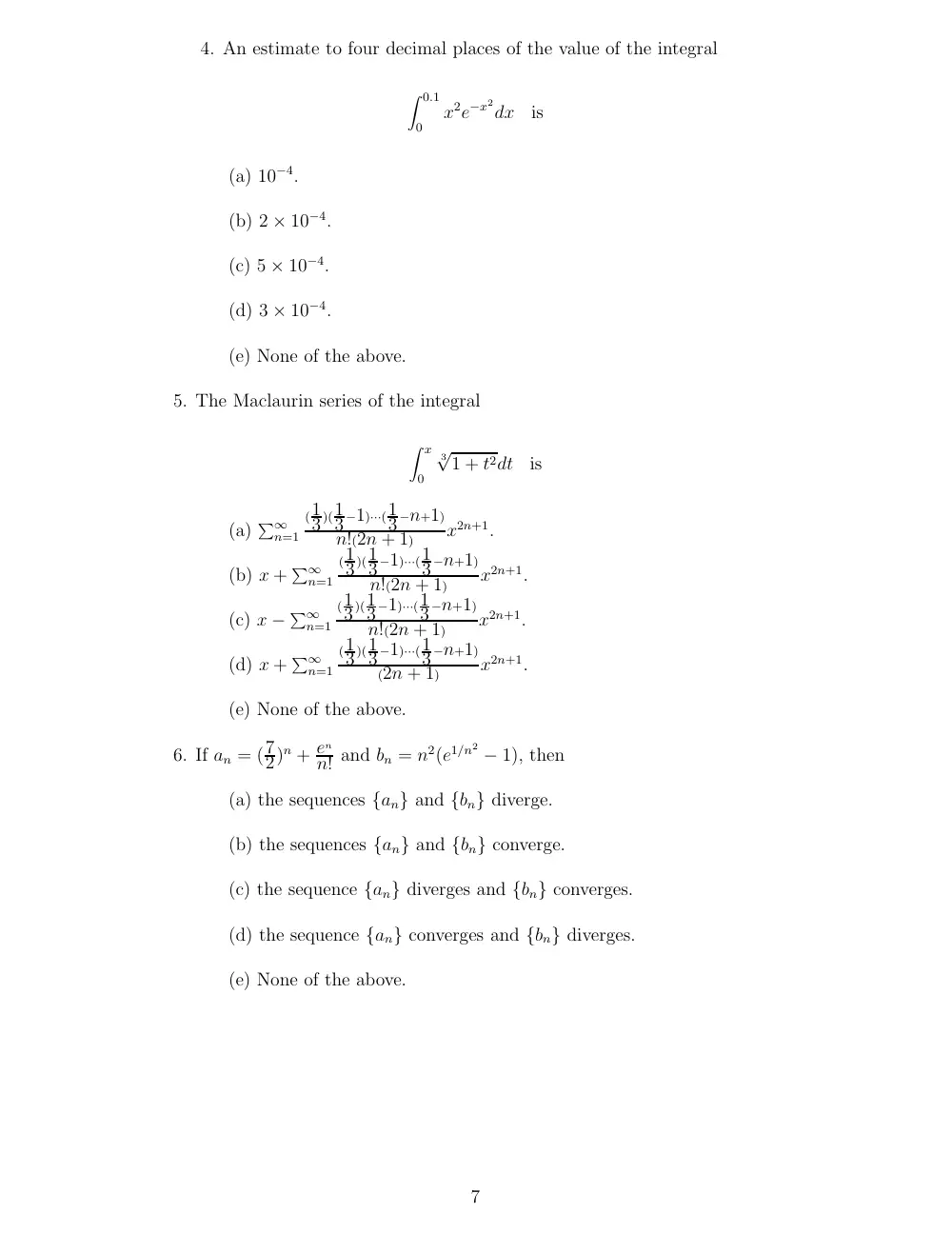
4. An estimate to four decimal places of the value of the integral
� 0.1
0
x2e−x2dx
is
(a) 10−4.
(b) 2 × 10⁻⁴.
(c) 5 × 10⁻⁴.
(d) 3 × 10⁻⁴.
(e) None of the above.
5. The Maclaurin series of the integral
� x
0
3√
1 + t2dt
is
(a) �∞
n=1
(1
3 )(1
3 −1)···(1
3 −n+1)
n!(2n + 1)
x2n+1.
(b) x +
�∞
n=1
(1
3 )(1
3 −1)···(1
3 −n+1)
n!(2n + 1)
x2n+1.
(c) x −
�∞
n=1
(1
3 )(1
3 −1)···(1
3 −n+1)
n!(2n + 1)
x2n+1.
(d) x + �∞
n=1
(13 )(13 −1)···(13 −n+1)
(2n + 1)
x2n+1.
(e) None of the above.
6. If an = (7
2)n + en
n! and bn = n2(e1/n2 − 1), then
(a) the sequences {an} and {bn} diverge.
(b) the sequences {an} and {bn} converge.
(c) the sequence {an} diverges and {bn} converges.
(d) the sequence {an} converges and {bn} diverges.
(e) None of the above.
7
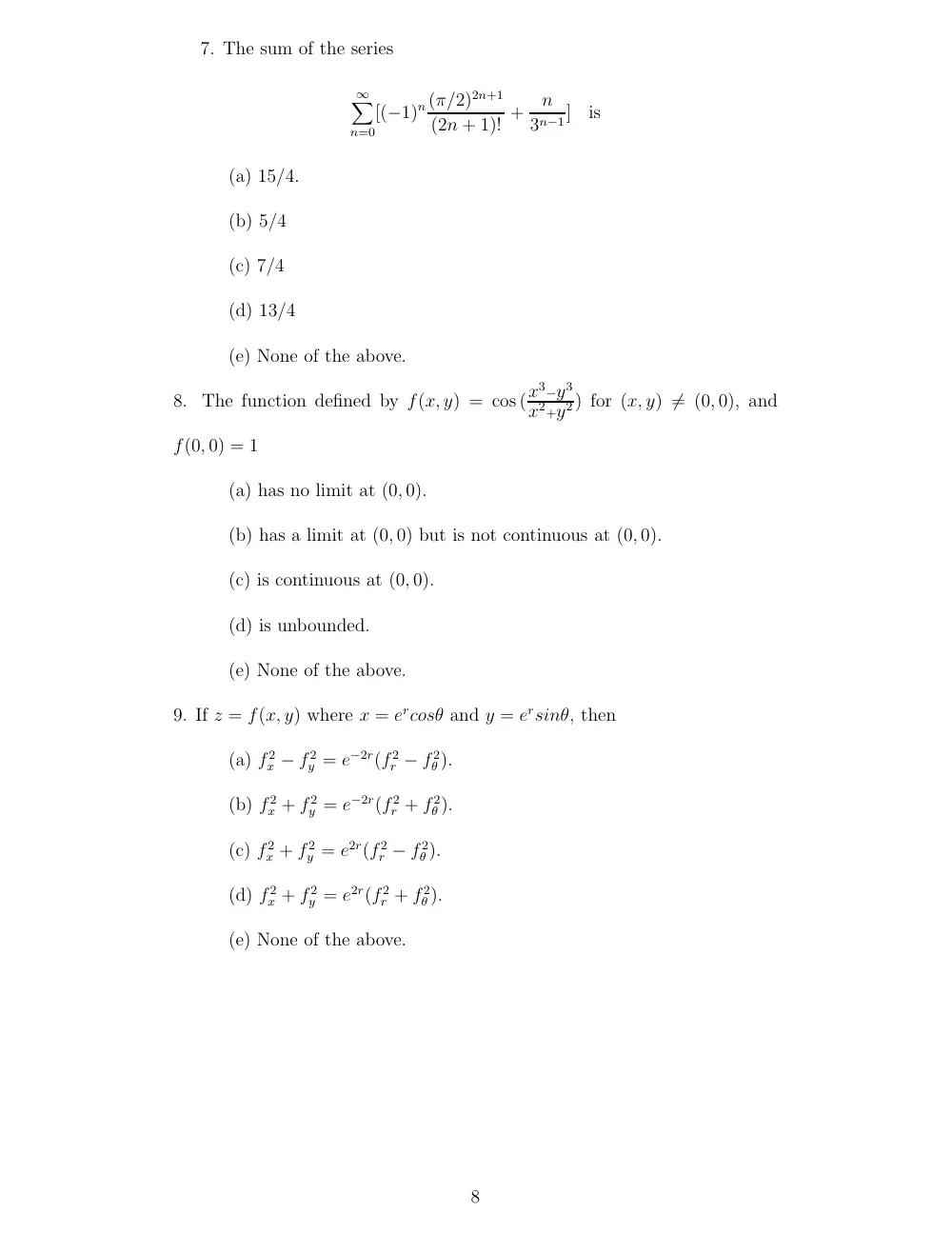
7. The sum of the series
∞
�
n=0
[(−1)n(π/2)2n+1
(2n + 1)! +
n
3n−1]
is
(a) 15/4.
(b) 5/4
(c) 7/4
(d) 13/4
(e) None of the above.
8. The function defined by f(x, y) = cos (x3−y3
x2+y2) for (x, y) ̸= (0, 0), and
f(0, 0) = 1
(a) has no limit at (0, 0).
(b) has a limit at (0, 0) but is not continuous at (0, 0).
(c) is continuous at (0, 0).
(d) is unbounded.
(e) None of the above.
9. If z = f(x, y) where x = ercosθ and y = ersinθ, then
(a) f 2
x − f 2
y = e−2r(f 2
r − f 2
θ ).
(b) f 2
x + f 2
y = e−2r(f 2
r + f 2
θ ).
(c) f 2
x + f 2
y = e2r(f 2
r − f 2
θ ).
(d) f 2
x + f 2
y = e2r(f 2
r + f 2
θ ).
(e) None of the above.
8
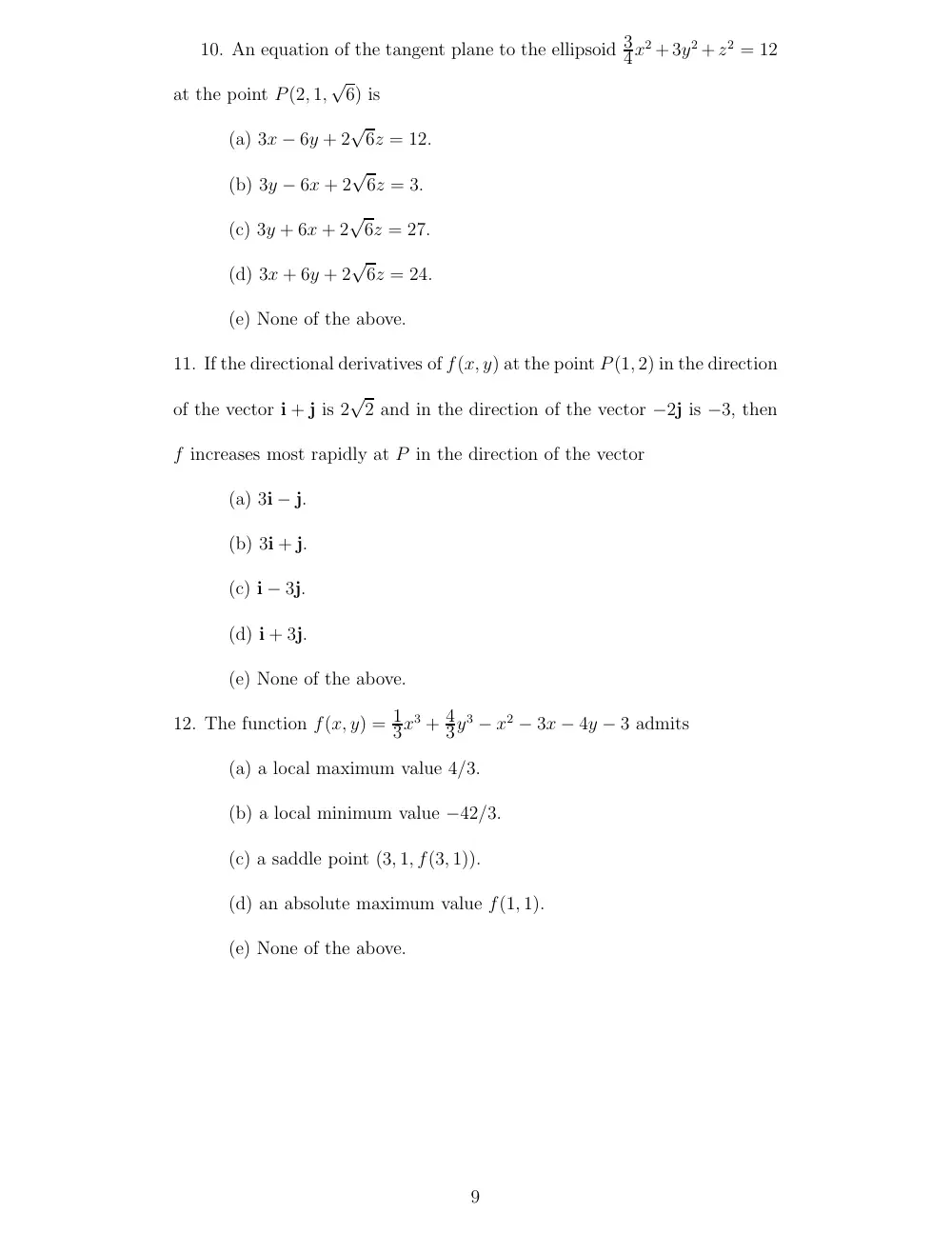
10. An equation of the tangent plane to the ellipsoid 3
4x2 + 3y2 + z2 = 12
at the point P(2, 1,
√
6) is
(a) 3x − 6y + 2
√
6z = 12.
(b) 3y − 6x + 2
√
6z = 3.
(c) 3y + 6x + 2
√
6z = 27.
(d) 3x + 6y + 2
√
6z = 24.
(e) None of the above.
11. If the directional derivatives of f(x, y) at the point P(1, 2) in the direction
of the vector i + j is 2
√
2 and in the direction of the vector −2j is −3, then
f increases most rapidly at P in the direction of the vector
(a) 3i − j.
(b) 3i + j.
(c) i − 3j.
(d) i + 3j.
(e) None of the above.
12. The function f(x, y) = 1
3x3 + 4
3y3 − x2 − 3x − 4y − 3 admits
(a) a local maximum value 4/3.
(b) a local minimum value −42/3.
(c) a saddle point (3, 1, f(3, 1)).
(d) an absolute maximum value f(1, 1).
(e) None of the above.
9