
MATH 201 Final Finals with Solution Collection, Spring 2017
American University of Beirut · Calculus and Analytical Geometry III · 218 pages · with solution
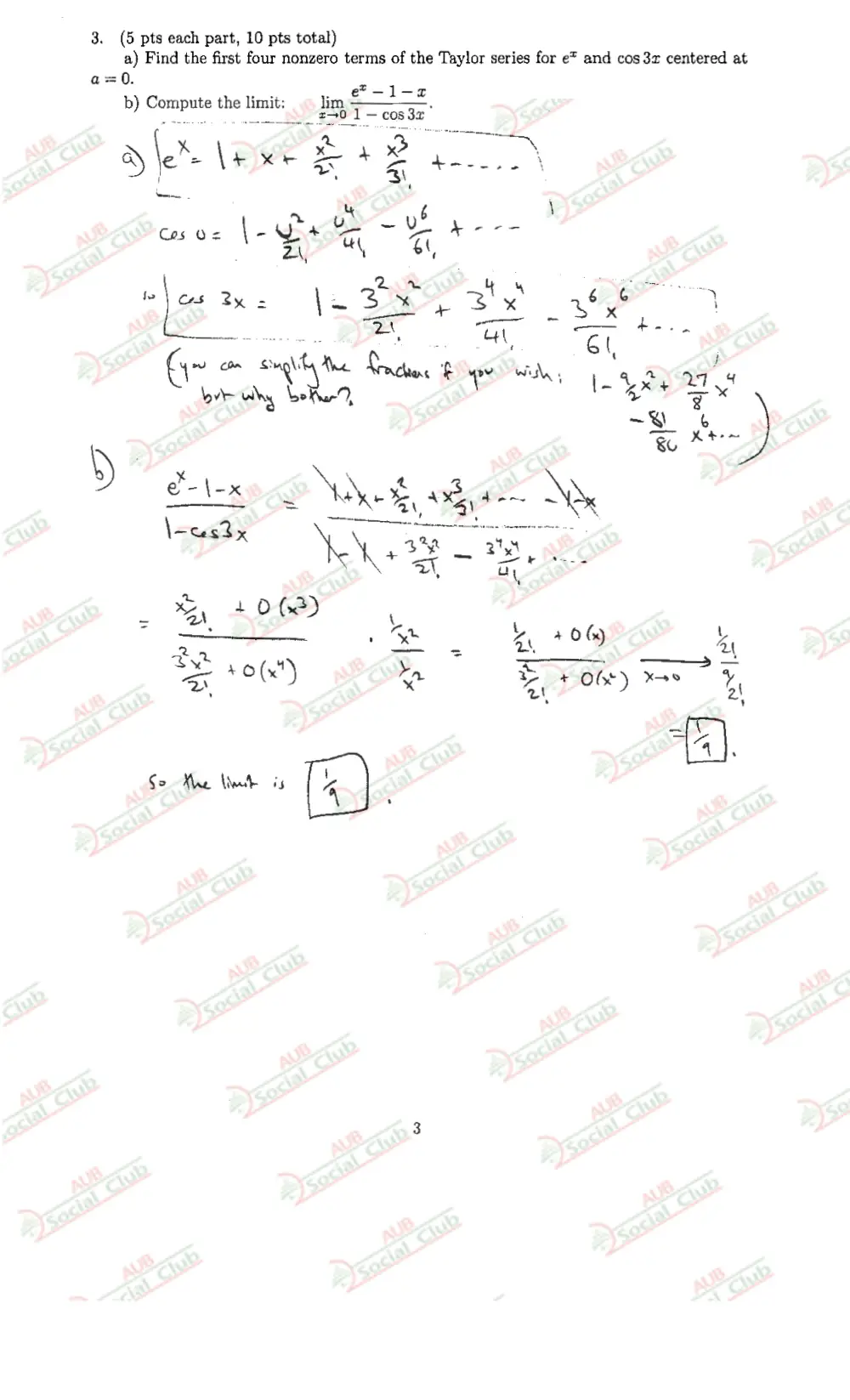
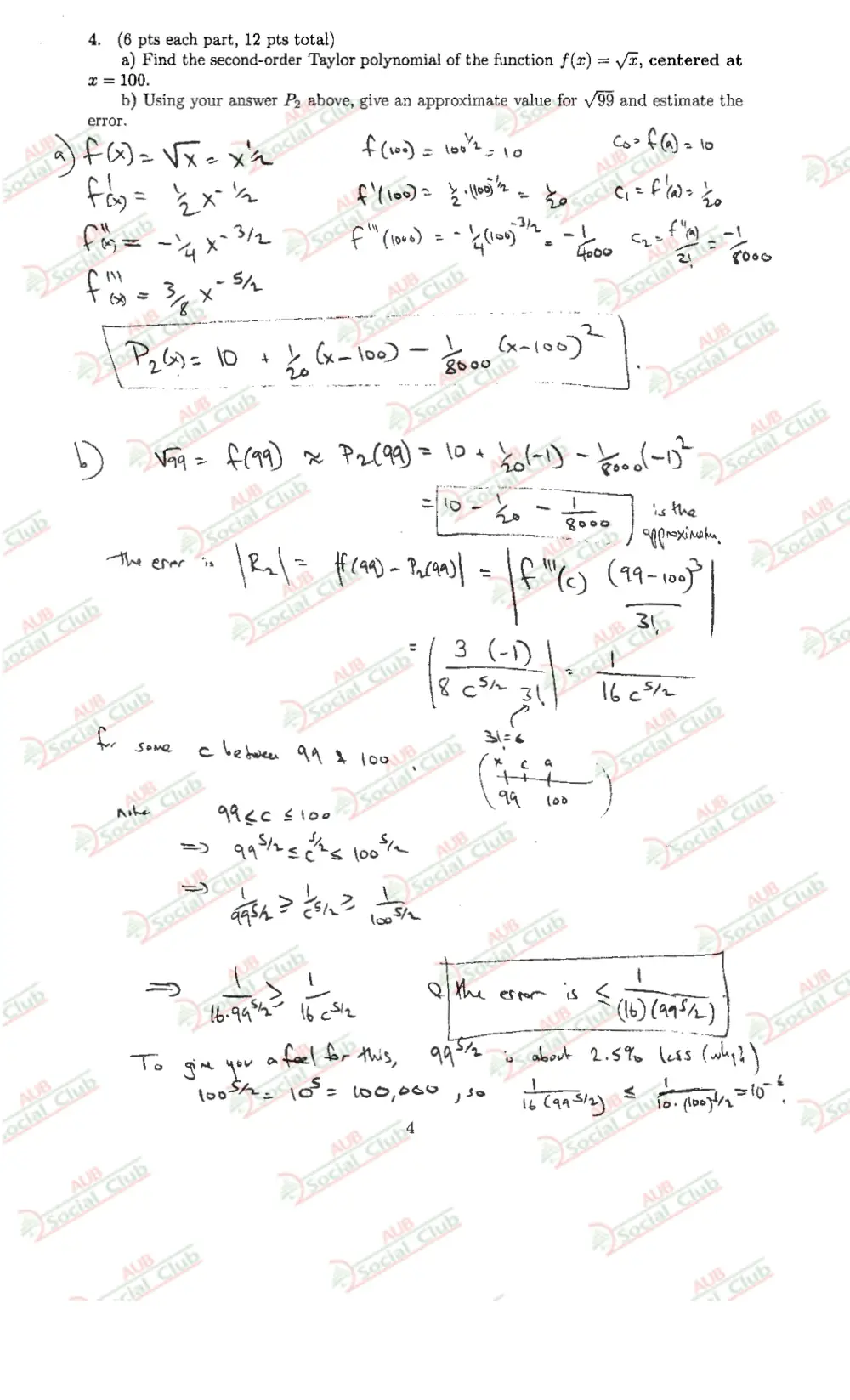
Showing the first 10 of 218 pages. Download the PDF to see all of it.
More MATH 201 files
- Final · Spring 2019Final examView
- Final · Spring 2019Final examView
- Problems Difficult Problem 5 Tlas 2017 Final · Spring 2019Final examView
- Final · Fall 2018Final examView
- Final · Fall 2018Final examView
- Final · Spring 2017Final examView
- Final Finals with Solution Collection · Spring 2017Final exam · with solutionView
- Final · Summer 2017Final examView
Show the text of this final exam
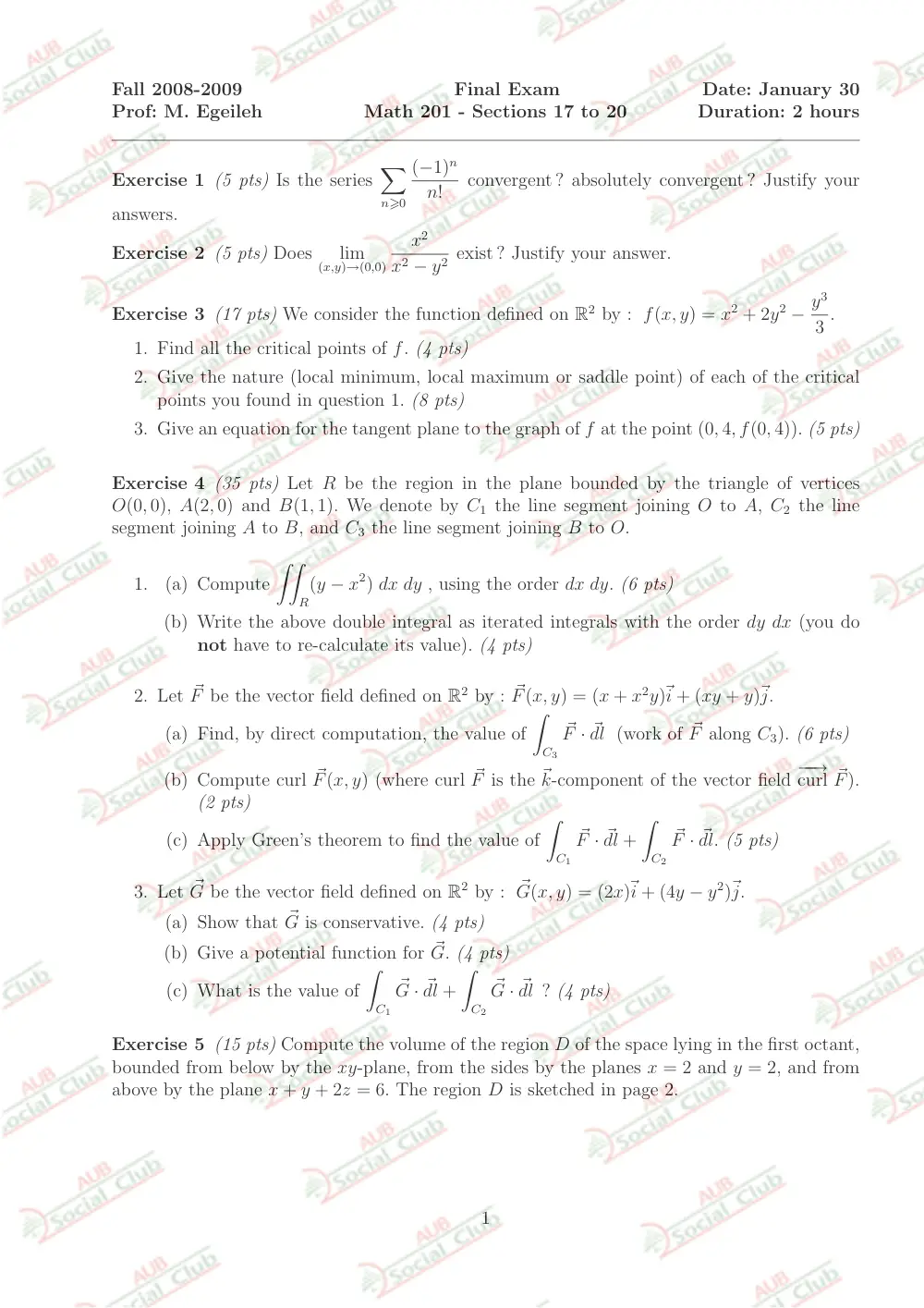
Fall 2008-2009
Final Exam
Date: January 30
Prof: M. Egeileh
Math 201 - Sections 17 to 20
Duration: 2 hours
Exercise 1 (5 pts) Is the series
�
n⩾0
(−1)n
n!
convergent ? absolutely convergent ? Justify your
answers.
Exercise 2 (5 pts) Does
lim
(x,y)→(0,0)
x2
x2 − y2 exist ? Justify your answer.
Exercise 3 (17 pts) We consider the function defined on R2 by : f(x, y) = x2 + 2y2 − y3
3 .
1. Find all the critical points of f. (4 pts)
2. Give the nature (local minimum, local maximum or saddle point) of each of the critical
points you found in question 1. (8 pts)
3. Give an equation for the tangent plane to the graph of f at the point (0, 4, f(0, 4)). (5 pts)
Exercise 4 (35 pts) Let R be the region in the plane bounded by the triangle of vertices
O(0, 0), A(2, 0) and B(1, 1). We denote by C1 the line segment joining O to A, C2 the line
segment joining A to B, and C3 the line segment joining B to O.
1.
(a) Compute
��
R
(y − x2) dx dy , using the order dx dy. (6 pts)
(b) Write the above double integral as iterated integrals with the order dy dx (you do
not have to re-calculate its value). (4 pts)
2. Let ⃗F be the vector field defined on R2 by : ⃗F(x, y) = (x + x2y)⃗i + (xy + y)⃗j.
(a) Find, by direct computation, the value of
�
C3
⃗F · ⃗dl (work of ⃗F along C3). (6 pts)
(b) Compute curl ⃗F(x, y) (where curl ⃗F is the ⃗k-component of the vector field −−→
curl ⃗F).
(2 pts)
(c) Apply Green’s theorem to find the value of
�
C1
⃗F · ⃗dl +
�
C2
⃗F · ⃗dl. (5 pts)
3. Let ⃗G be the vector field defined on R2 by : ⃗G(x, y) = (2x)⃗i + (4y − y2)⃗j.
(a) Show that ⃗G is conservative. (4 pts)
(b) Give a potential function for ⃗G. (4 pts)
(c) What is the value of
�
C1
⃗G · ⃗dl +
�
C2
⃗G · ⃗dl ? (4 pts)
Exercise 5 (15 pts) Compute the volume of the region D of the space lying in the first octant,
bounded from below by the xy-plane, from the sides by the planes x = 2 and y = 2, and from
above by the plane x + y + 2z = 6. The region D is sketched in page 2.
1
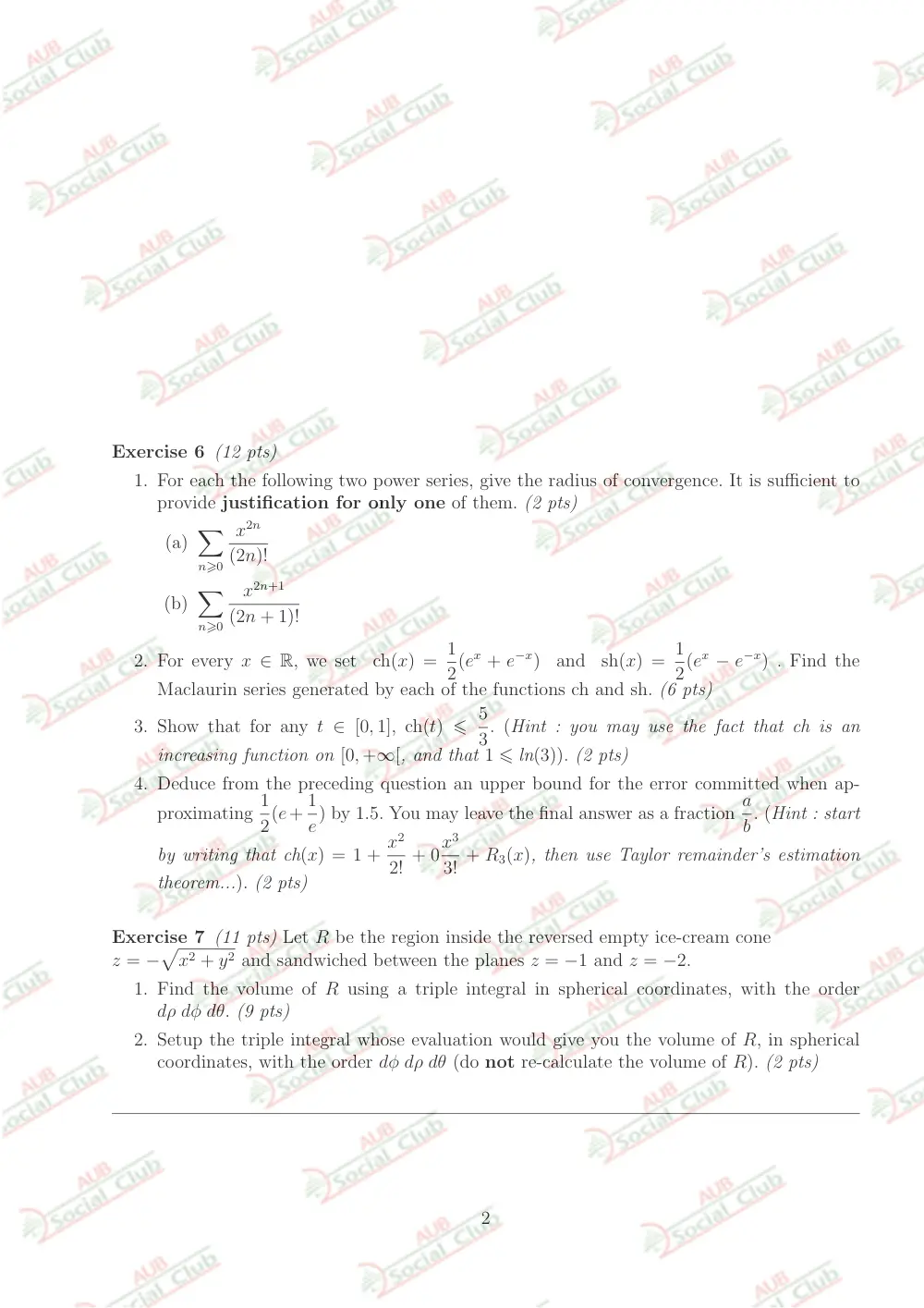
Exercise 6 (12 pts)
1. For each the following two power series, give the radius of convergence. It is sufficient to
provide justification for only one of them. (2 pts)
(a)
�
n⩾0
x2n
(2n)!
(b)
�
n⩾0
x2n+1
(2n + 1)!
2. For every x ∈ R, we set
ch(x) = 1
2(ex + e−x)
and
sh(x) = 1
2(ex − e−x) . Find the
Maclaurin series generated by each of the functions ch and sh. (6 pts)
3. Show that for any t ∈ [0, 1], ch(t) ⩽ 5
3. (Hint : you may use the fact that ch is an
increasing function on [0, +∞[, and that 1 ⩽ ln(3)). (2 pts)
4. Deduce from the preceding question an upper bound for the error committed when ap-
proximating 1
2(e+ 1
e) by 1.5. You may leave the final answer as a fraction a
b. (Hint : start
by writing that ch(x) = 1 + x2
2! + 0x3
3! + R3(x), then use Taylor remainder’s estimation
theorem...). (2 pts)
Exercise 7 (11 pts) Let R be the region inside the reversed empty ice-cream cone
z = −
�
x2 + y2 and sandwiched between the planes z = −1 and z = −2.
1. Find the volume of R using a triple integral in spherical coordinates, with the order
dρ dφ dθ. (9 pts)
2. Setup the triple integral whose evaluation would give you the volume of R, in spherical
coordinates, with the order dφ dρ dθ (do not re-calculate the volume of R). (2 pts)
2