
MATH 201 Lab Report, Fall 2019
American University of Beirut · Calculus and Analytical Geometry III · 3 pages
More MATH 201 files
Show the text of this lab
Data Structures and Analysis of Algorithms
EECE 330, Sections 6, & 7
Final Exam — Crib sheet allowed — Dec 16, 2017
The exam has 10 problems for 120 total possible points with additional 10 bonus points in problem 3.
Points should provide you with good timing hints. You are expected to work against 95 points. The first five
problems cover basic material for (45 pts.) The sixth and seventh problem cover queues and stacks for (20 pts.)
Graph application problem eight is worth (25 pts.) Graph application problems nine and ten together are worth
(30 pts.) More efficient solutions are worth more points across all problems except problem 10.
Sprint for grades. (45 pts.)
Problem 1. Function behavior. (6 pts.)
Order the following functions in terms of their asymptotic behavior.
n
log2 n
log8 n
2n2
n log n
nn
n!
2n
Problem 2. Array behavior. (7 pts.)
Provide the asymptotic behavior of the following 10 classical algorithms given an array of size n. Order them
accordingly.
• Find the median
• Create a binary search tree
• Create a red black balanced binary search tree
• Create a priority queue organized as a binary heap
• Perform binary search on a sorted version of the array
• Find the minimum
• Sort with insertion sort
• Sort with heap sort
• Sort with quick sort
• Sort with merge sort
Problem 3. Binary “search” tree misbehaving. (10 pts.)
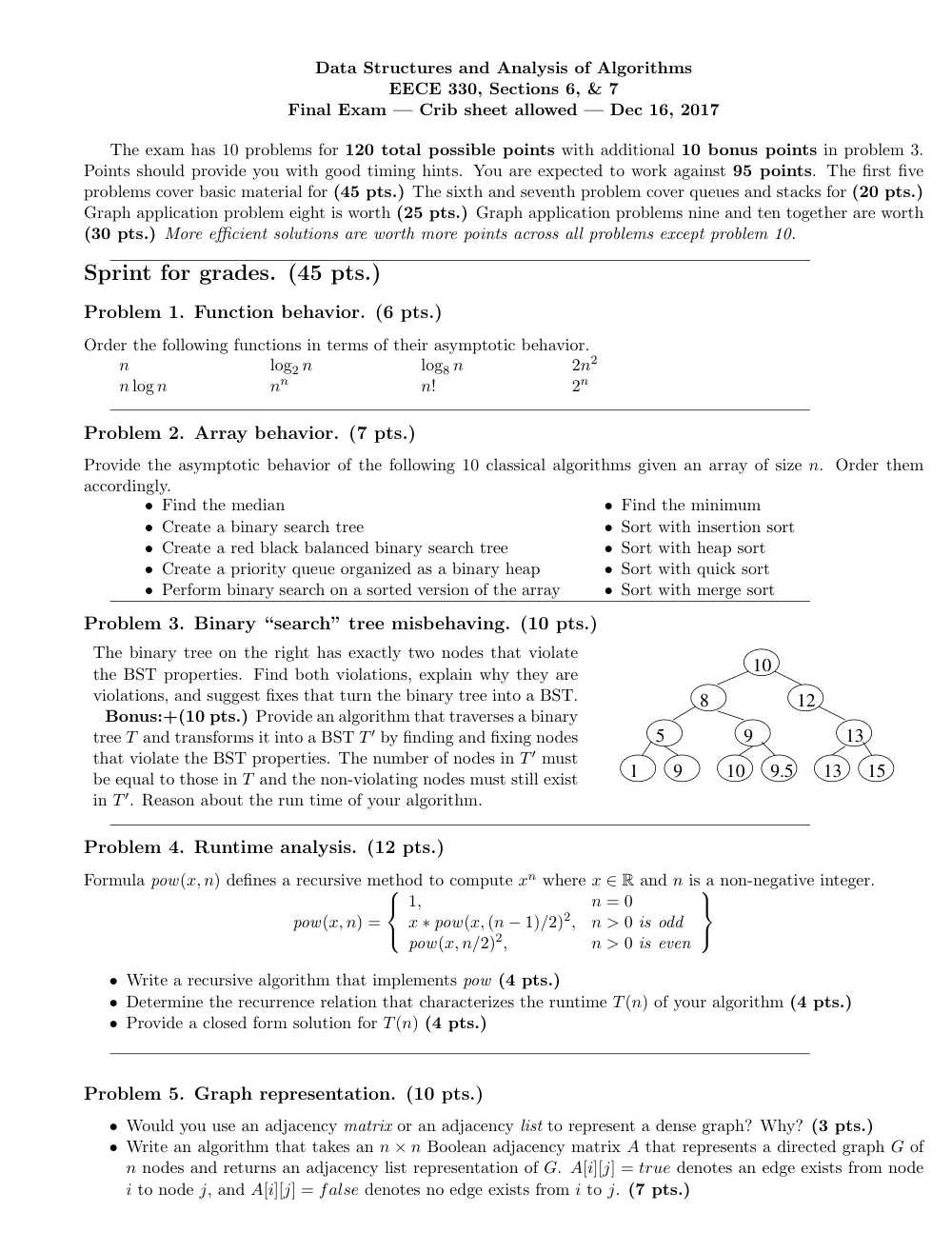
The binary tree on the right has exactly two nodes that violate
the BST properties. Find both violations, explain why they are
violations, and suggest fixes that turn the binary tree into a BST.
Bonus:+(10 pts.) Provide an algorithm that traverses a binary
tree T and transforms it into a BST T ′ by finding and fixing nodes
that violate the BST properties. The number of nodes in T ′ must
be equal to those in T and the non-violating nodes must still exist
in T ′. Reason about the run time of your algorithm.
1
9
9.5
13
15
5
9
8
12
10
10
13
Problem 4. Runtime analysis. (12 pts.)
Formula pow(x, n) defines a recursive method to compute xn where x ∈ R and n is a non-negative integer.
pow(x, n) =
1,
n = 0
x ∗ pow(x, (n − 1)/2)2,
n > 0 is odd
pow(x, n/2)2,
n > 0 is even
• Write a recursive algorithm that implements pow (4 pts.)
• Determine the recurrence relation that characterizes the runtime T(n) of your algorithm (4 pts.)
• Provide a closed form solution for T(n) (4 pts.)
Problem 5. Graph representation. (10 pts.)
• Would you use an adjacency matrix or an adjacency list to represent a dense graph? Why? (3 pts.)
• Write an algorithm that takes an n × n Boolean adjacency matrix A that represents a directed graph G of
n nodes and returns an adjacency list representation of G. A[i][j] = true denotes an edge exists from node
i to node j, and A[i][j] = false denotes no edge exists from i to j. (7 pts.)
Take a breath with stacks and queues. (20 pts.)
Problem 6: Array implementation of a queue. (10 pts.)
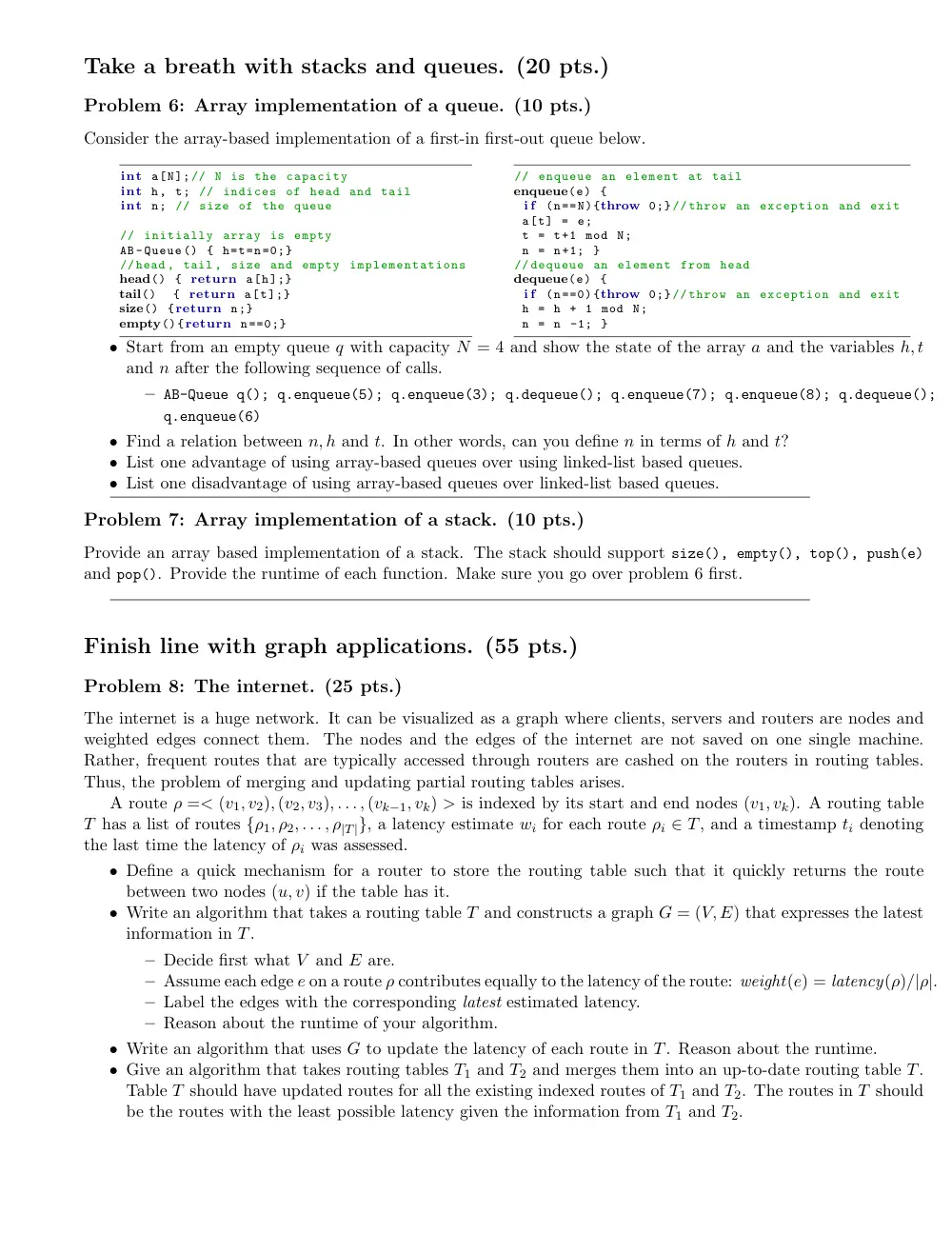
Consider the array-based implementation of a first-in first-out queue below.
int a[N];// N is the
capacity
int h, t; //
indices
of head
and
tail
int n; // size of the
queue
//
initially
array is empty
AB -Queue () { h=t=n=0;}
//head , tail , size
and
empty
implementations
head() { return a[h];}
tail()
{ return a[t];}
size() {return n;}
empty(){return n==0;}
//
enqueue
an
element
at tail
enqueue(e) {
i f
(n==N){throw 0;} // throw an
exception
and
exit
a[t] = e;
t = t+1 mod N;
n = n+1; }
// dequeue
an
element
from
head
dequeue(e) {
i f
(n==0){throw 0;} // throw an
exception
and
exit
h = h + 1 mod N;
n = n
-1; }
• Start from an empty queue q with capacity N = 4 and show the state of the array a and the variables h, t
and n after the following sequence of calls.
– AB-Queue q(); q.enqueue(5); q.enqueue(3); q.dequeue(); q.enqueue(7); q.enqueue(8); q.dequeue();
q.enqueue(6)
• Find a relation between n, h and t. In other words, can you define n in terms of h and t?
• List one advantage of using array-based queues over using linked-list based queues.
• List one disadvantage of using array-based queues over linked-list based queues.
Problem 7: Array implementation of a stack. (10 pts.)
Provide an array based implementation of a stack. The stack should support size(), empty(), top(), push(e)
and pop(). Provide the runtime of each function. Make sure you go over problem 6 first.
Finish line with graph applications. (55 pts.)
Problem 8: The internet. (25 pts.)
The internet is a huge network. It can be visualized as a graph where clients, servers and routers are nodes and
weighted edges connect them. The nodes and the edges of the internet are not saved on one single machine.
Rather, frequent routes that are typically accessed through routers are cashed on the routers in routing tables.
Thus, the problem of merging and updating partial routing tables arises.
A route ρ =< (v1, v2), (v2, v3), . . . , (vk−1, vk) > is indexed by its start and end nodes (v1, vk). A routing table
T has a list of routes {ρ1, ρ2, . . . , ρ|T|}, a latency estimate wi for each route ρi ∈ T, and a timestamp ti denoting
the last time the latency of ρi was assessed.
• Define a quick mechanism for a router to store the routing table such that it quickly returns the route
between two nodes (u, v) if the table has it.
• Write an algorithm that takes a routing table T and constructs a graph G = (V, E) that expresses the latest
information in T.
– Decide first what V and E are.
– Assume each edge e on a route ρ contributes equally to the latency of the route: weight(e) = latency(ρ)/|ρ|.
– Label the edges with the corresponding latest estimated latency.
– Reason about the runtime of your algorithm.
• Write an algorithm that uses G to update the latency of each route in T. Reason about the runtime.
• Give an algorithm that takes routing tables T1 and T2 and merges them into an up-to-date routing table T.
Table T should have updated routes for all the existing indexed routes of T1 and T2. The routes in T should
be the routes with the least possible latency given the information from T1 and T2.
Problem 9: Graphs for traffic, pollution and noise reduction. (15 pts.)
It is believed that turning two-way streets into one-way streets reduces traffic and thus reduces pollution, noise
and fuel consumption. Consider a map of Beirut streets where nodes are intersections and edges are two-way
streets. The map has all its intersections connected through the existing two-way streets.
• Devise an algorithm that selects the maximum number of streets that can be turned into one way streets
without compromising connectivity. Reason about the runtime of your algorithm.
Problem 10: Graphs in communications. (15 pts.)
Consider a communication channel where the transmitter sends a signal from the set S = {a, b, c, d, e} and the
receiver receives a signal from the set {α, β, γ, σ, κ}. Unfortunately, due to noise in the channel, signal a may be
received as α or β, signal b may be received as β or γ, signal c may be received as γ or σ, signal d may be received
as σ or κ, and signal e may be received as κ or α. Consequently, the receiver can not decode the signal accurately.
However, if the transmitter never sends signals b and e, then the receiver can always decode signal a correctly.
• Find out the largest subset of S that the transmitter can send without causing ambiguity at the receiver.
• Consider a set of transmission symbols S, a set of reception symbols Φ and a relation R = {(s, α) : s ∈ S, α ∈
Φ}. R characterises the noise on the channel such that (s, α) ∈ R denotes that s may be received as α.
– Devise an algorithm that finds the largest subset of S that results in non-ambiguous reception. The
algorithm does not have to be efficient.
Finally, some fun with xkcd. Studying for EECE 330:
Good luck!