
MATH 201 Notes, Summer 2001
American University of Beirut · Calculus and Analytical Geometry III · 4 pages
More MATH 201 files
- Notes 10.5 by Tarek Hajj Shehadi · Spring 2019NotesView
- Notes 10.3 by Tarek Hajj Shehadi · Spring 2019NotesView
- Notes 10.2 by Tarek Hajj Shehadi · Spring 2019NotesView
- Notes 10.10 by Tarek Hajj Shehadi · Spring 2019NotesView
- Notes 10.8 by Tarek Hajj Shehadi · Spring 2019NotesView
- Notes 10.6 by Tarek Hajj Shehadi · Spring 2019NotesView
- Notes 10.7 by Tarek Hajj Shehadi · Spring 2019NotesView
- Notes 10.4 by Tarek Hajj Shehadi · Spring 2019NotesView
Show the text of this notes
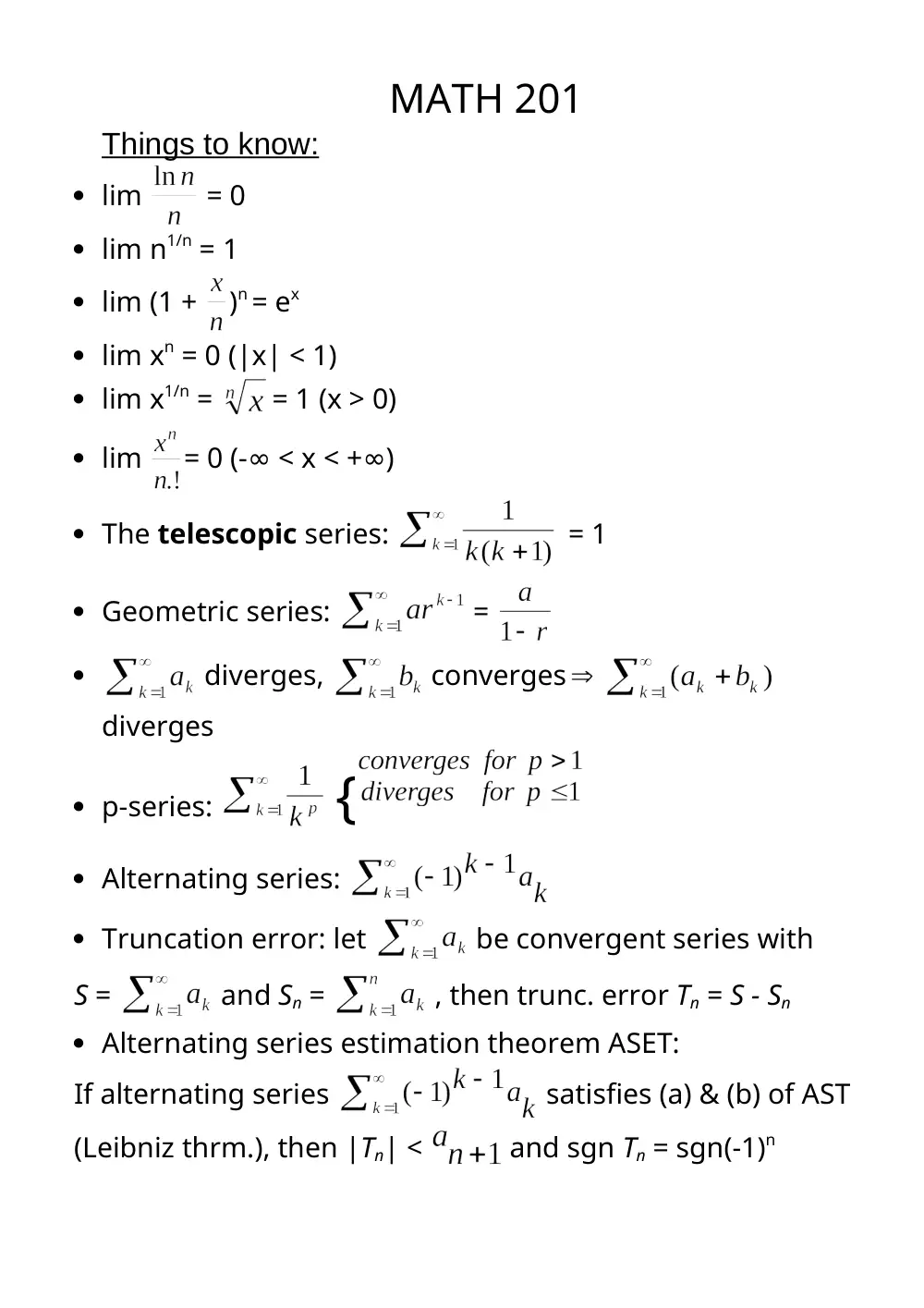
MATH 201
Things to know:
lim
= 0
lim n1/n = 1
lim (1 +
)n = ex
lim xn = 0 (|x| < 1)
lim x1/n =
= 1 (x > 0)
lim
= 0 (-
< x < +
)
∞
∞
The telescopic series:
= 1
Geometric series:
=
diverges,
converges
diverges
p-series:
{
Alternating series:
Truncation error: let
be convergent series with
S =
and Sn =
, then trunc. error Tn = S - Sn
Alternating series estimation theorem ASET:
If alternating series
satisfies (a) & (b) of AST
(Leibniz thrm.), then |Tn| <
and sgn Tn = sgn(-1)n
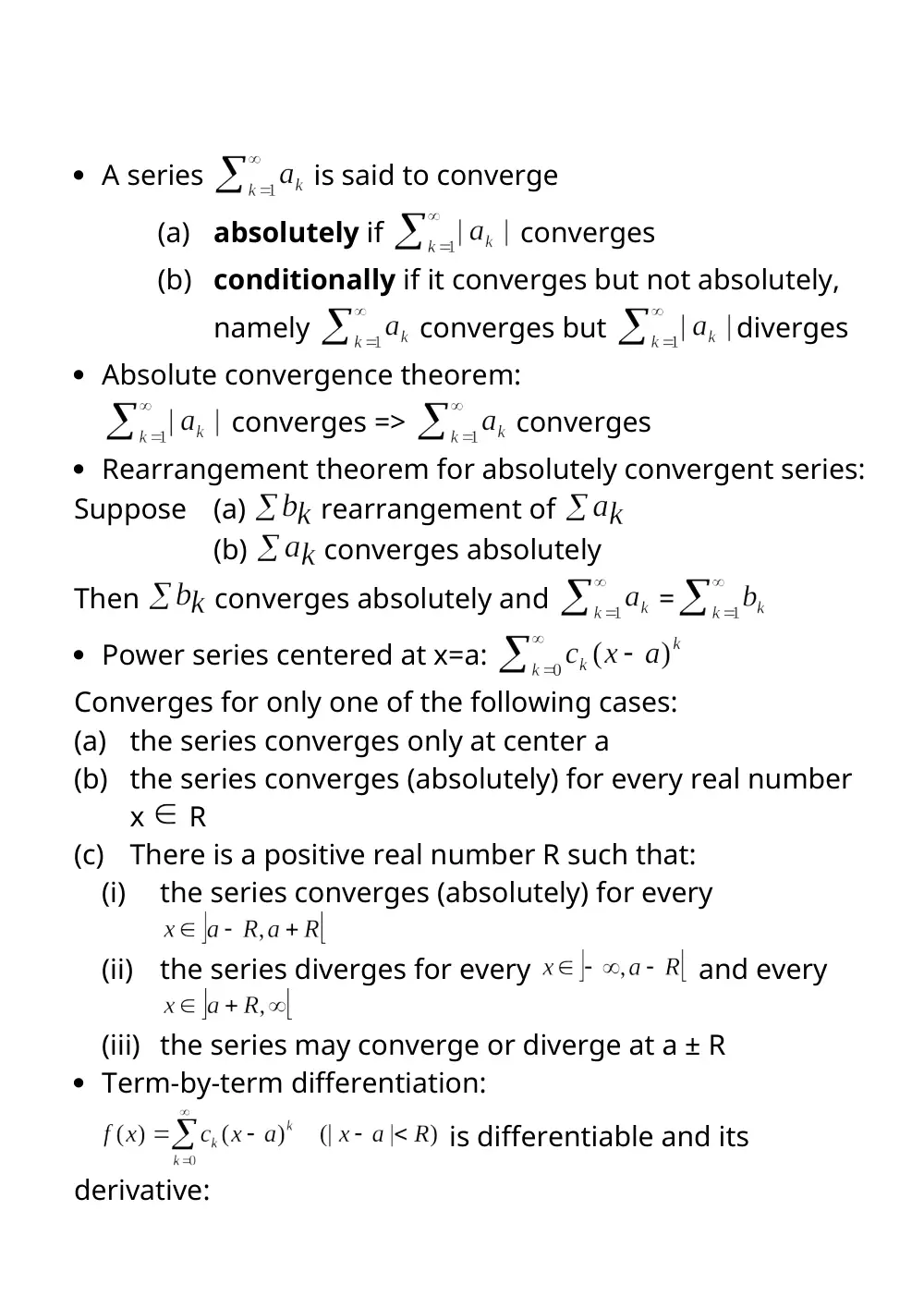
A series
is said to converge
(a)
absolutely if
converges
(b) conditionally if it converges but not absolutely,
namely
converges but
diverges
Absolute convergence theorem:
converges =>
converges
Rearrangement theorem for absolutely convergent series:
Suppose
(a)
rearrangement of
(b)
converges absolutely
Then
converges absolutely and
=
Power series centered at x=a:
Converges for only one of the following cases:
(a)
the series converges only at center a
(b) the series converges (absolutely) for every real number
x
R
(c)
There is a positive real number R such that:
(i)
the series converges (absolutely) for every
(ii)
the series diverges for every
and every
(iii) the series may converge or diverge at a ± R
Term-by-term differentiation:
is differentiable and its
derivative:
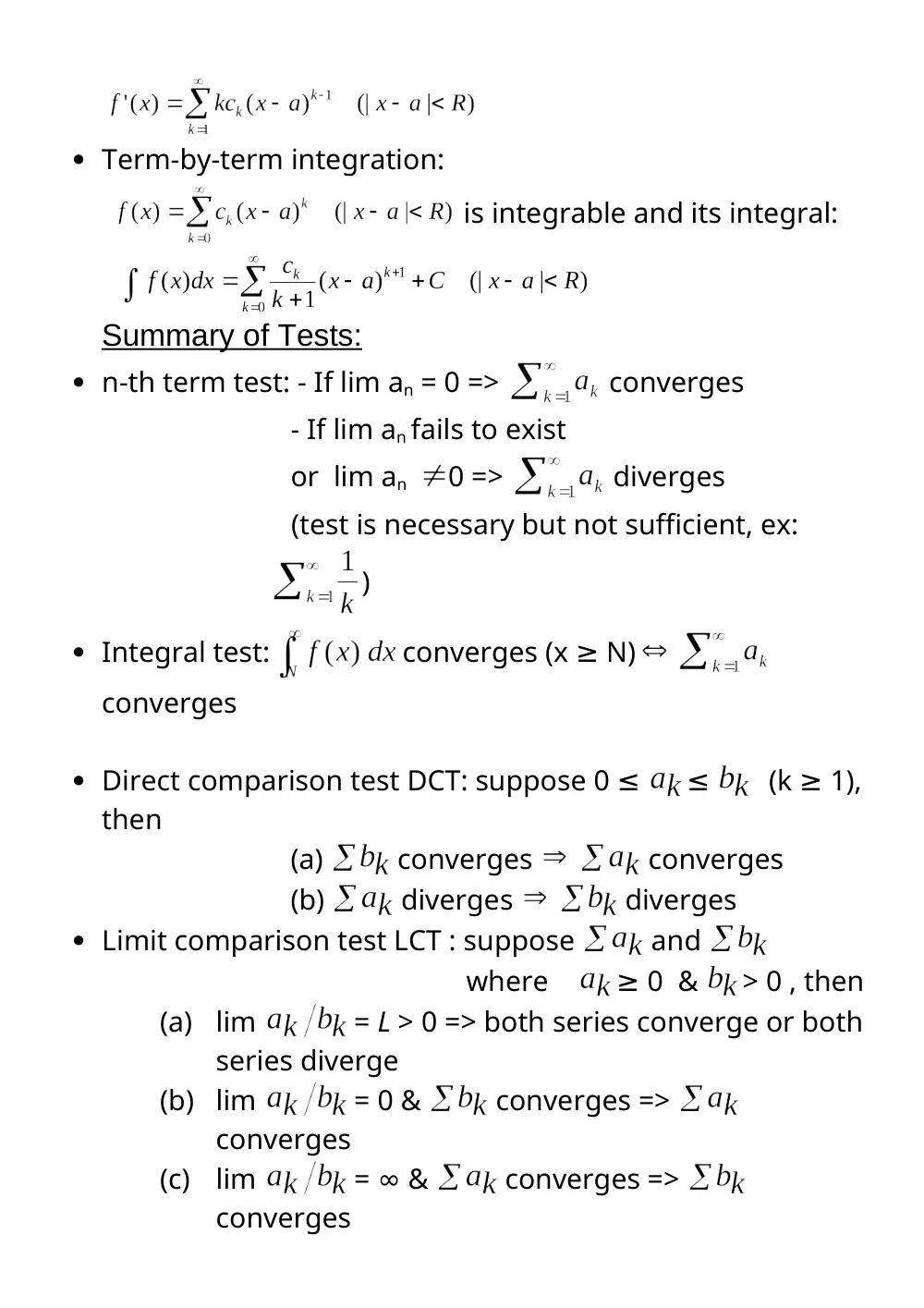
Term-by-term integration:
is integrable and its integral:
Summary of Tests:
n-th term test: - If lim an = 0 =>
converges
- If lim an fails to exist
or lim an
0 =>
diverges
(test is necessary but not sufficient, ex:
)
Integral test:
converges (x
N)
≥
converges
Direct comparison test DCT: suppose 0
≤
≤
(k
1),
≥
then
(a)
converges
converges
(b)
diverges
diverges
Limit comparison test LCT : suppose
and
where
≥ 0 &
> 0 , then
(a)
lim
= L > 0 => both series converge or both
series diverge
(b) lim
= 0 &
converges =>
converges
(c)
lim
=
∞ &
converges =>
converges
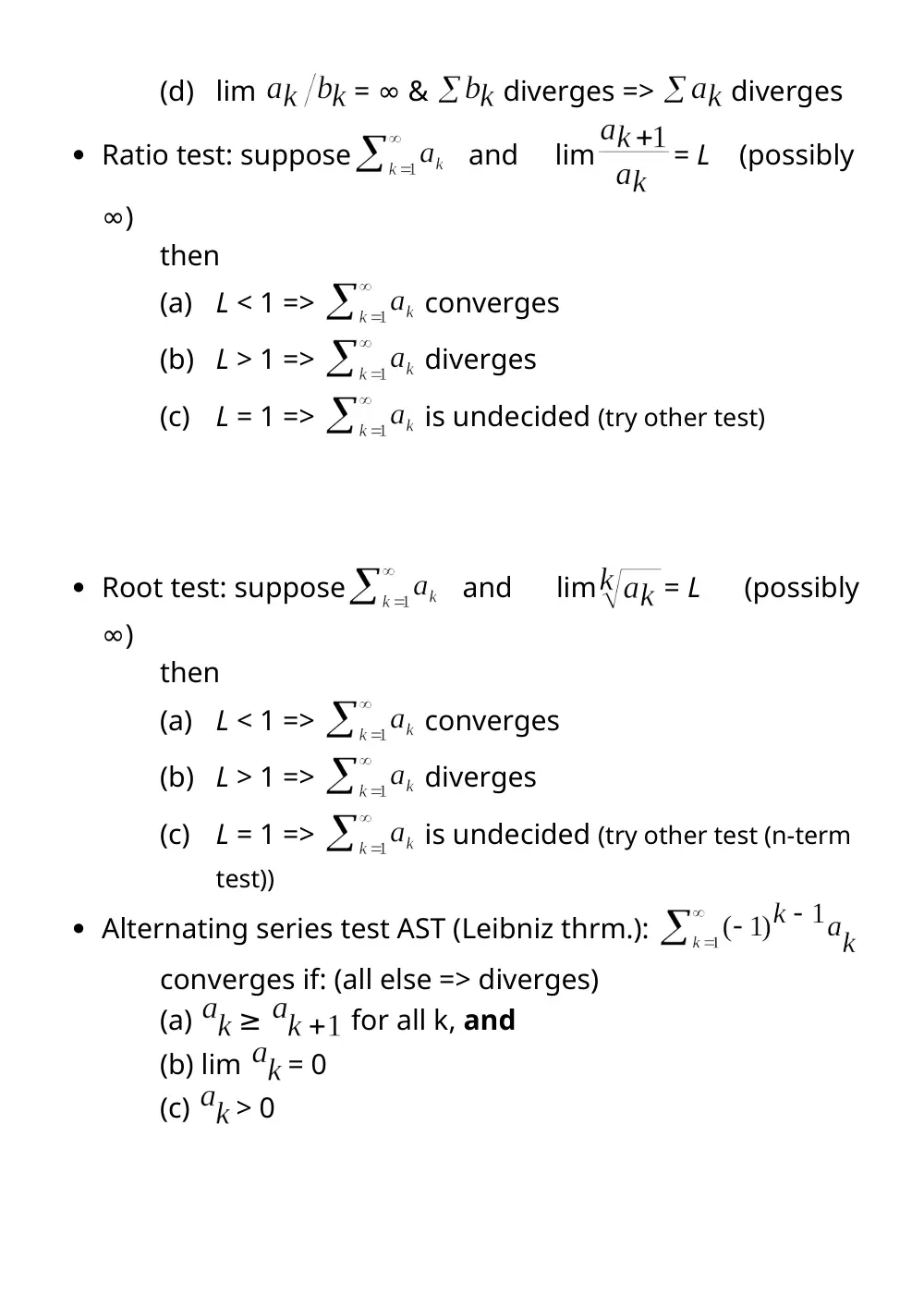
(d) lim
=
∞ &
diverges =>
diverges
Ratio test: suppose
and lim
= L (possibly
)
∞
then
(a)
L < 1 =>
converges
(b) L > 1 =>
diverges
(c)
L = 1 =>
is undecided (try other test)
Root test: suppose
and lim
= L (possibly
)
∞
then
(a)
L < 1 =>
converges
(b) L > 1 =>
diverges
(c)
L = 1 =>
is undecided (try other test (n-term
test))
Alternating series test AST (Leibniz thrm.):
converges if: (all else => diverges)
(a)
≥
for all k, and
(b) lim
= 0
(c)
> 0