
MATH 201 Other Solution for Math 201 Exercises, Spring 2018
American University of Beirut · Calculus and Analytical Geometry III · 439 pages · with solution


Showing the first 10 of 439 pages. Download the PDF to see all of it.
More MATH 201 files
- Useful File Guide for Taylor Series - Problems · Spring 2019FileView
- Other Solution for Math 201 Exercises · Spring 2018File · with solutionView
- Useful File Good to Know for Math 201 · Fall 2018FileView
- Useful File Practice Quiz 2 · Spring 2017FileView
- Useful File Practice Quiz 2 · Spring 2017FileView
- Useful File Integral · Spring 2016FileView
- Useful File Integral · Spring 2016FileView
- Other Thomas Calculus Book 12th Edition · Summer 2015FileView
Show the text of this file
INSTRUCTOR’S
SOLUTIONS MANUAL
MULTIVARIABLE
WILLIAM ARDIS
Collin County Community College
THOMAS’ CALCULUS
TWELFTH EDITION
BASED ON THE ORIGINAL WORK BY
George B. Thomas, Jr.
Massachusetts Institute of Technology
AS REVISED BY
Maurice D. Weir
Naval Postgraduate School
Joel Hass
University of California, Davis
The author and publisher of this book have used their best efforts in preparing this book. These efforts
include the development, research, and testing of the theories and programs to determine their
effectiveness. The author and publisher make no warranty of any kind, expressed or implied, with regard to
these programs or the documentation contained in this book. The author and publisher shall not be liable in
any event for incidental or consequential damages in connection with, or arising out of, the furnishing,
performance, or use of these programs.
Reproduced by Addison-Wesley from electronic files supplied by the author.
Copyright © 2010, 2005, 2001 Pearson Education, Inc.
Publishing as Pearson Addison-Wesley, 75 Arlington Street, Boston, MA 02116.
All rights reserved. No part of this publication may be reproduced, stored in a retrieval system, or
transmitted, in any form or by any means, electronic, mechanical, photocopying, recording, or otherwise,
without the prior written permission of the publisher. Printed in the United States of America.
ISBN-13: 978-0-321-60072-1
ISBN-10: 0-321-60072-X
1 2 3 4 5 6 BB 14 13 12 11 10
PREFACE TO THE INSTRUCTOR
This Instructor's Solutions Manual contains the solutions to every exercise in the 12th Edition of THOMAS' CALCULUS
by Maurice Weir and Joel Hass, including the Computer Algebra System (CAS) exercises. The corresponding Student's
Solutions Manual omits the solutions to the even-numbered exercises as well as the solutions to the CAS exercises (because
the CAS command templates would give them all away).
In addition to including the solutions to all of the new exercises in this edition of Thomas, we have carefully revised or
rewritten every solution which appeared in previous solutions manuals to ensure that each solution
ì conforms exactly to the methods, procedures and steps presented in the text
ì is mathematically correct
ì includes all of the steps necessary so a typical calculus student can follow the logical argument and algebra
ì includes a graph or figure whenever called for by the exercise, or if needed to help with the explanation
ì is formatted in an appropriate style to aid in its understanding
Every CAS exercise is solved in both the MAPLE and
MATHEMATICA computer algebra systems. A template showing
an example of the CAS commands needed to execute the solution is provided for each exercise type. Similar exercises within
the text grouping require a change only in the input function or other numerical input parameters associated with the problem
(such as the interval endpoints or the number of iterations).
For more information about other resources available with Thomas' Calculus, visit http://pearsonhighered.com.
Copyright © 2010 Pearson Education Inc. Publishing as Addison-Wesley.
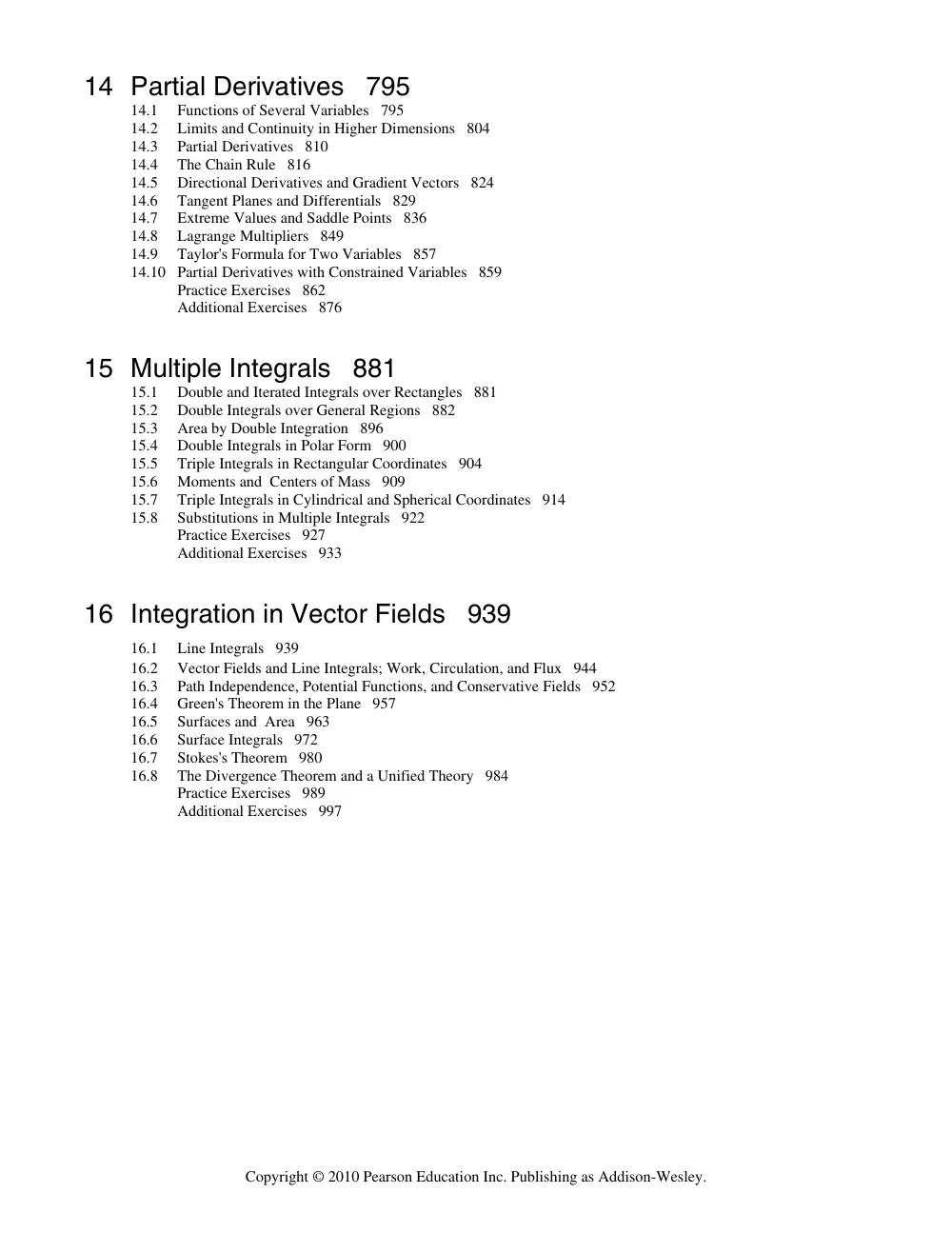
TABLE OF CONTENTS
10 Infinite Sequences and Series 569
10.1 Sequences 569
10.2 Infinite Series 577
10.3 The Integral Test 583
10.4 Comparison Tests 590
10.5 The Ratio and Root Tests 597
10.6 Alternating Series, Absolute and Conditional Convergence 602
10.7 Power Series 608
10.8 Taylor and Maclaurin Series 617
10.9 Convergence of Taylor Series 621
10.10 The Binomial Series and Applications of Taylor Series 627
Practice Exercises 634
Additional and Advanced Exercises 642
11 Parametric Equations and Polar Coordinates 647
11.1 Parametrizations of Plane Curves 647
11.2 Calculus with Parametric Curves 654
11.3 Polar Coordinates 662
11.4 Graphing in Polar Coordinates 667
11.5 Areas and Lengths in Polar Coordinates 674
11.6 Conic Sections 679
11.7 Conics in Polar Coordinates 689
Practice Exercises 699
Additional and Advanced Exercises 709
12 Vectors and the Geometry of Space 715
12.1
Three-Dimensional Coordinate Systems 715
12.2
Vectors 718
12.3
The Dot Product 723
12.4
The Cross Product 728
12.5
Lines and Planes in Space 734
12.6
Cylinders and Quadric Surfaces 741
Practice Exercises 746
Additional Exercises 754
13 Vector-Valued Functions and Motion in Space 759
13.1
Curves in Space and Their Tangents 759
13.2
Integrals of Vector Functions; Projectile Motion 764
13.3
Arc Length in Space 770
13.4
Curvature and Normal Vectors of a Curve 773
13.5
Tangential and Normal Components of Acceleration 778
13.6
Velocity and Acceleration in Polar Coordinates 784
Practice Exercises 785
Additional Exercises 791
Copyright © 2010 Pearson Education Inc. Publishing as Addison-Wesley.
14 Partial Derivatives 795
14.1
Functions of Several Variables 795
14.2
Limits and Continuity in Higher Dimensions 804
14.3
Partial Derivatives 810
14.4
The Chain Rule 816
14.5
Directional Derivatives and Gradient Vectors 824
14.6
Tangent Planes and Differentials 829
14.7
Extreme Values and Saddle Points 836
14.8
Lagrange Multipliers 849
14.9
Taylor's Formula for Two Variables 857
14.10 Partial Derivatives with Constrained Variables 859
Practice Exercises 862
Additional Exercises 876
15 Multiple Integrals 881
15.1
Double and Iterated Integrals over Rectangles 881
15.2
Double Integrals over General Regions 882
15.3
Area by Double Integration 896
15.4
Double Integrals in Polar Form 900
15.5
Triple Integrals in Rectangular Coordinates 904
15.6
Moments and Centers of Mass 909
15.7
Triple Integrals in Cylindrical and Spherical Coordinates 914
15.8
Substitutions in Multiple Integrals 922
Practice Exercises 927
Additional Exercises 933
16 Integration in Vector Fields 939
16.1
Line Integrals 939
16.2
Vector Fields and Line Integrals; Work, Circulation, and Flux 944
16.3
Path Independence, Potential Functions, and Conservative Fields 952
16.4
Green's Theorem in the Plane 957
16.5
Surfaces and Area 963
16.6
Surface Integrals 972
16.7
Stokes's Theorem 980
16.8
The Divergence Theorem and a Unified Theory 984
Practice Exercises 989
Additional Exercises 997
Copyright © 2010 Pearson Education Inc. Publishing as Addison-Wesley.
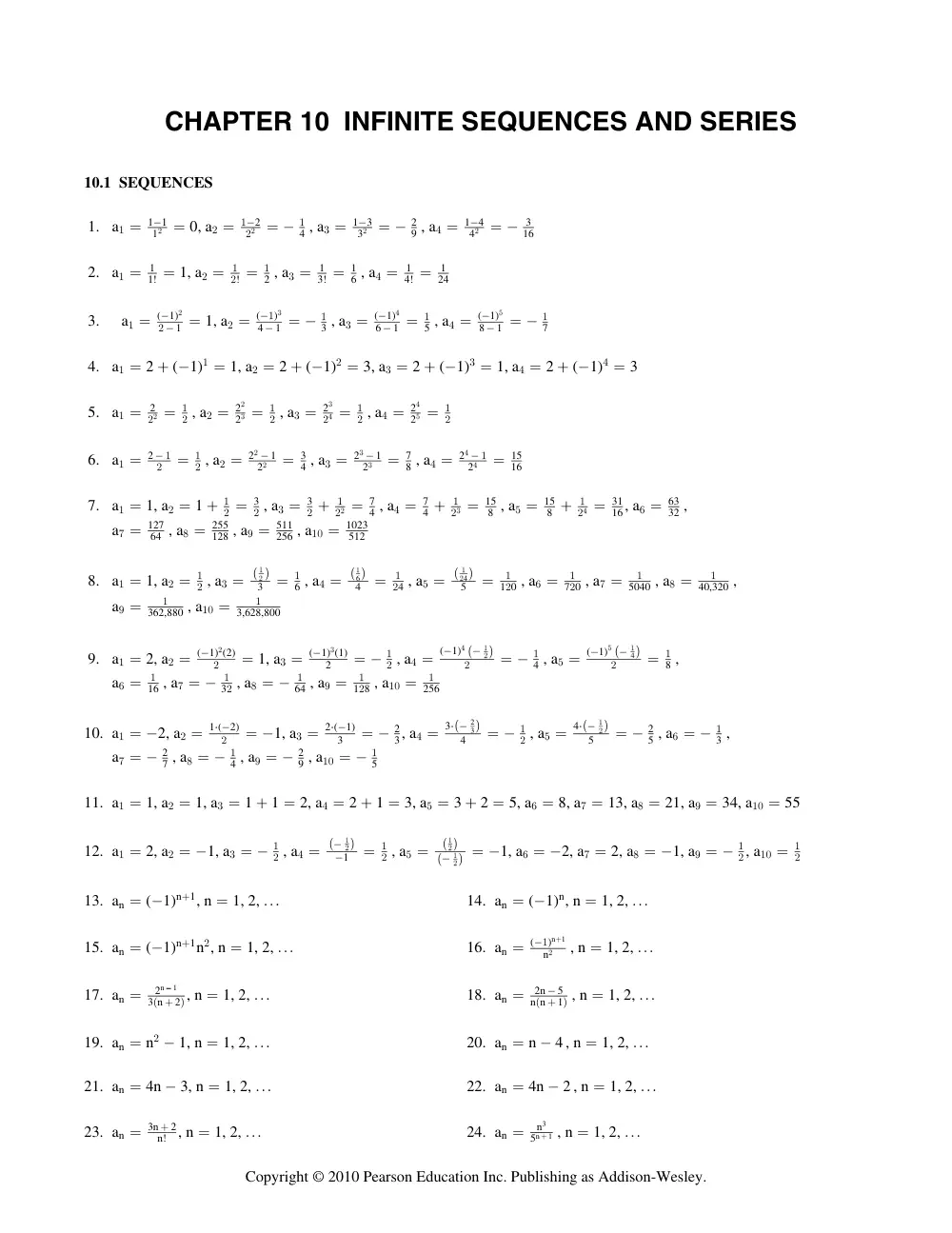
CHAPTER 10 INFINITE SEQUENCES AND SERIES
10.1 SEQUENCES
1. a
0, a
, a
, a
"
#
$
%
�
"�
"
�
�
#
œ
œ
œ
œ �
œ
œ �
œ
œ �
1 1
2
1 3
2
1 4
3
1
4
3
9
4
16
#
#
#
#
2. a
1, a
, a
, a
"
#
$
%
"
"
#
œ
œ
œ
œ
œ
œ
œ
œ
1
1
1
1
1
1!
!
2
3!
6
4!
24
3.
a
1, a
, a
, a
"
#
$
%
�
�"
�
�
# �
�
�
�
"
"
"
œ
œ
œ
œ �
œ
œ
œ
œ �
( 1)
(
)
( 1)
( 1)
1
4
1
3
6
1
5
8
1
7
#
$
%
&
4. a
2
( 1)
1, a
2
( 1)
3, a
2
( 1)
1, a
2
( 1)
3
"
#
$
%
"
#
$
%
œ
� �
œ
œ
� �
œ
œ
� �
œ
œ
� �
œ
5. a
, a
, a
, a
"
#
$
%
#
#
#
#
#
"
"
"
"
#
œ
œ
œ
œ
œ
œ
œ
œ
2
2
2
2
2
2
#
$
&
#
$
%
%
6. a
, a
, a
, a
"
#
$
%
� "
"
�
�
� "
#
#
œ
œ
œ
œ
œ
œ
œ
œ
2
2
1
3
2
1
7
2
15
2
4
2
8
16
2
#
$
%
#
$
%
7. a
1, a
1
, a
, a
, a
, a
,
"
#
$
%
&
'
"
"
"
"
#
#
#
#
#
#
œ
œ
�
œ
œ
�
œ
œ
�
œ
œ
�
œ
œ
3
3
7
7
15
15
31
63
4
4
8
8
16
32
#
$
%
a
, a
, a
, a
(
)
*
"!
œ
œ
œ
œ
127
255
511
1023
64
128
256
512
8. a
1, a
, a
, a
, a
, a
, a
, a
,
"
#
$
%
&
'
(
)
"
"
"
"
"
"
"
#
#
#
#
œ
œ
œ
œ
œ
œ
œ
œ
œ
œ
œ
ˆ ‰
ˆ ‰
ˆ
‰
"
"
"
#
#
3
6
4
4
5
1 0
7 0
5040
40,320
6
4
a
, a
*
"!
"
"
œ
œ
362,880
3,628,800
9. a
2, a
1, a
, a
, a
,
"
#
$
%
&
�
�
#
#
#
#
"
"
"
�
�
�
�
œ
œ
œ
œ
œ �
œ
œ �
œ
œ
( 1) (2)
( 1) (1)
2
4
8
( 1)
( 1)
#
$
%
"
#
&
"
ˆ
‰
ˆ
‰
4
a
, a
, a
, a
, a
'
(
)
*
"!
"
"
"
"
"
#
#
œ
œ �
œ �
œ
œ
16
3
64
1 8
256
10. a
2, a
1, a
, a
, a
, a
,
"
#
$
%
&
'
�
�
#
#
�
�
"
"
œ �
œ
œ �
œ
œ �
œ
œ �
œ
œ �
œ �
1 ( 2)
2 ( 1)
3
3
4
5
5
3
2
2
3
4
†
†
†
†
ˆ
‰
ˆ
‰
2
3
"
#
a
, a
, a
, a
(
)
*
"!
"
"
œ �
œ �
œ �
œ �
2
2
7
4
9
5
11. a
1, a
1, a
1
1
2, a
2
1
3, a
3
2
5, a
8, a
13, a
21, a
34, a
55
"
#
$
%
&
'
(
)
*
"!
œ
œ
œ
�
œ
œ
�
œ
œ
�
œ
œ
œ
œ
œ
œ
12. a
2, a
1, a
, a
, a
1, a
2, a
2, a
1, a
, a
"
#
$
%
&
'
(
)
*
"!
"
"
"
"
#
�
#
#
#
�
�
œ
œ �
œ �
œ
œ
œ
œ �
œ �
œ
œ �
œ �
œ
ˆ
‰
ˆ ‰
ˆ
‰
"
"
#
#
"
#
1
13. a
( 1)
, n
1, 2,
14. a
( 1) , n
1, 2,
n
n
n 1
n
œ �
œ
á
œ �
œ
á
�
15. a
( 1)
n , n
1, 2,
16. a
, n
1, 2,
n
n
n 1
(
)
n
œ �
œ
á
œ
œ
á
�
#
�" n 1
�
#
17. a
, n
1, 2,
18. a
, n
1, 2,
n
n
2
2n
5
3 n
2
n n
1
œ
œ
á
œ
œ
á
n
� 1
a
b
a
b
�
�
�
19. a
n
1, n
1, 2,
20. a
n
4 , n
1, 2,
n
n
œ
�
œ
á
œ
�
œ
á
#
21. a
4n
3, n
1, 2,
22. a
4n
2 , n
1, 2,
n
n
œ
�
œ
á
œ
�
œ
á
23. a
, n
1, 2,
24. a
, n
1, 2,
n
n
3n
2
n
n!
5
œ
œ
á
œ
œ
á
�
3
n
1
�
Copyright © 2010 Pearson Education Inc. Publishing as Addison-Wesley.
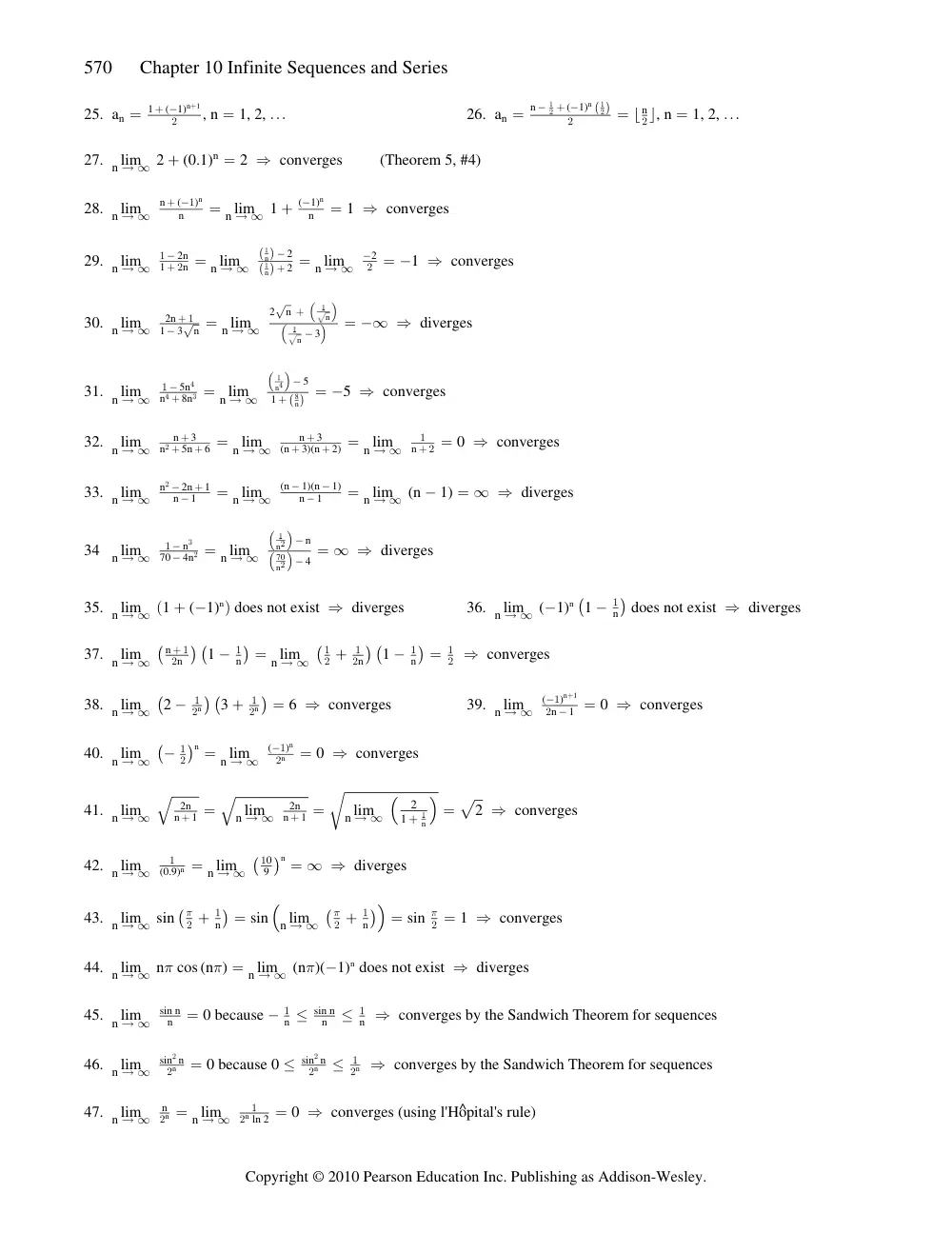
570
Chapter 10 Infinite Sequences and Series
25. a
, n
1, 2,
26. a
, n
1, 2,
n
n
1
( 1)
n
( 1)
n
œ
œ
á
œ
œ Ú Û
œ
á
� �
#
#
#
�
� �
n 1
n
�
"
"
#
#
ˆ ‰
27. lim 2
(0.1)
2
converges
(Theorem 5, #4)
n Ä _
�
œ
Ê
n
28. lim
lim 1
1
converges
n
n
Ä _
Ä _
n
(
)
( 1)
n
n
� �"
�
n
n
œ
�
œ
Ê
29. lim
lim
lim
1
converges
n
n
n
Ä _
Ä _
Ä _
" �
�
� #
#
�
�
2n
2
1
n
2
2
œ
œ
œ �
Ê
ˆ ‰
ˆ ‰
"
"
n
n
30. lim
lim
diverges
n
n
Ä _
Ä _
2n
1
3
n
2
n
3
� "
�
�
�
È
È
Š
‹
Š
‹
œ
œ �_ Ê
"
"
È
È
n
n
31. lim
lim
5
converges
n
n
Ä _
Ä _
" �
�
�
�
5n
n
8n
5
1
%
%
$
"
%
œ
œ �
Ê
Š
‹
ˆ ‰
n
8
n
32. lim
lim
lim
0
converges
n
n
n
Ä _
Ä _
Ä _
n
3
n
3
n
5n
6
(n
3)(n
2)
n
�
�
"
�
�
�
�
� #
#
œ
œ
œ
Ê
33. lim
lim
lim (n
1)
diverges
n
n
n
Ä _
Ä _
Ä _
n
2n
1
n
1
n
1
(n
1)(n
1)
# �
�
�
�
�
�
œ
œ
�
œ _ Ê
34
lim
lim
diverges
n
n
Ä _
Ä _
" �
�
�
�
n
70
4n
n
4
$
# œ
œ _ Ê
Š
‹
Š
‹
"
#
#
n
70
n
35. lim 1
( 1) does not exist
diverges
36. lim ( 1)
1
does not exist
diverges
n
n
Ä _
Ä _
a
b
ˆ
‰
� �
Ê
�
�
Ê
n
n
"
n
37. lim
1
lim
1
converges
n
n
Ä _
Ä _
ˆ
‰ ˆ
‰
ˆ
‰ ˆ
‰
n
n
n
n
n
� "
"
"
"
"
"
#
#
#
#
�
œ
�
�
œ
Ê
38. lim 2
3
6
converges
39. lim
0
converges
n
n
Ä _
Ä _
ˆ
‰ ˆ
‰
�
�
œ
Ê
œ
Ê
"
"
#
#
# �
�"
n
n
n 1
(
)
n
1
�
40. lim
lim
0
converges
n
n
Ä _
Ä _
ˆ
� ‰
œ
œ
Ê
"
#
#
�"
n
(
)n
n
41. lim
lim
lim
2
converges
n
n
n
Ä _
Ä _
Ä _
É
É
Ê
Š
‹
È
2n
2n
n
1
n
1
�
�
œ
œ
œ
Ê
2
1 � "
n
42. lim
lim
diverges
n
n
Ä _
Ä _
"
"
(0.9)
9
0
n œ
œ _ Ê
ˆ
‰
n
43. lim sin
sin
lim
sin
1
converges
n
n
Ä _
Ä _
ˆ
‰
ˆ
‰
Š
‹
1
1
1
#
#
#
"
"
�
œ
�
œ
œ
Ê
n
n
44. lim n cos (n )
lim (n )( 1) does not exist
diverges
n
n
Ä _
Ä _
1
1
1
œ
�
Ê
n
45. lim
0 because
converges by the Sandwich Theorem for sequences
n Ä _
sin n
sin n
n
n
n
n
œ
�
Ÿ
Ÿ
Ê
"
"
46. lim
0 because 0
converges by the Sandwich Theorem for sequences
n Ä _
sin n
sin n
#
#
#
#
#
"
n
n
n
œ
Ÿ
Ÿ
Ê
47. lim
lim
0
converges (using l'Hopital's rule)
^
n
n
Ä _
Ä _
n
ln 2
#
#
"
n
n
œ
œ
Ê
Copyright © 2010 Pearson Education Inc. Publishing as Addison-Wesley.
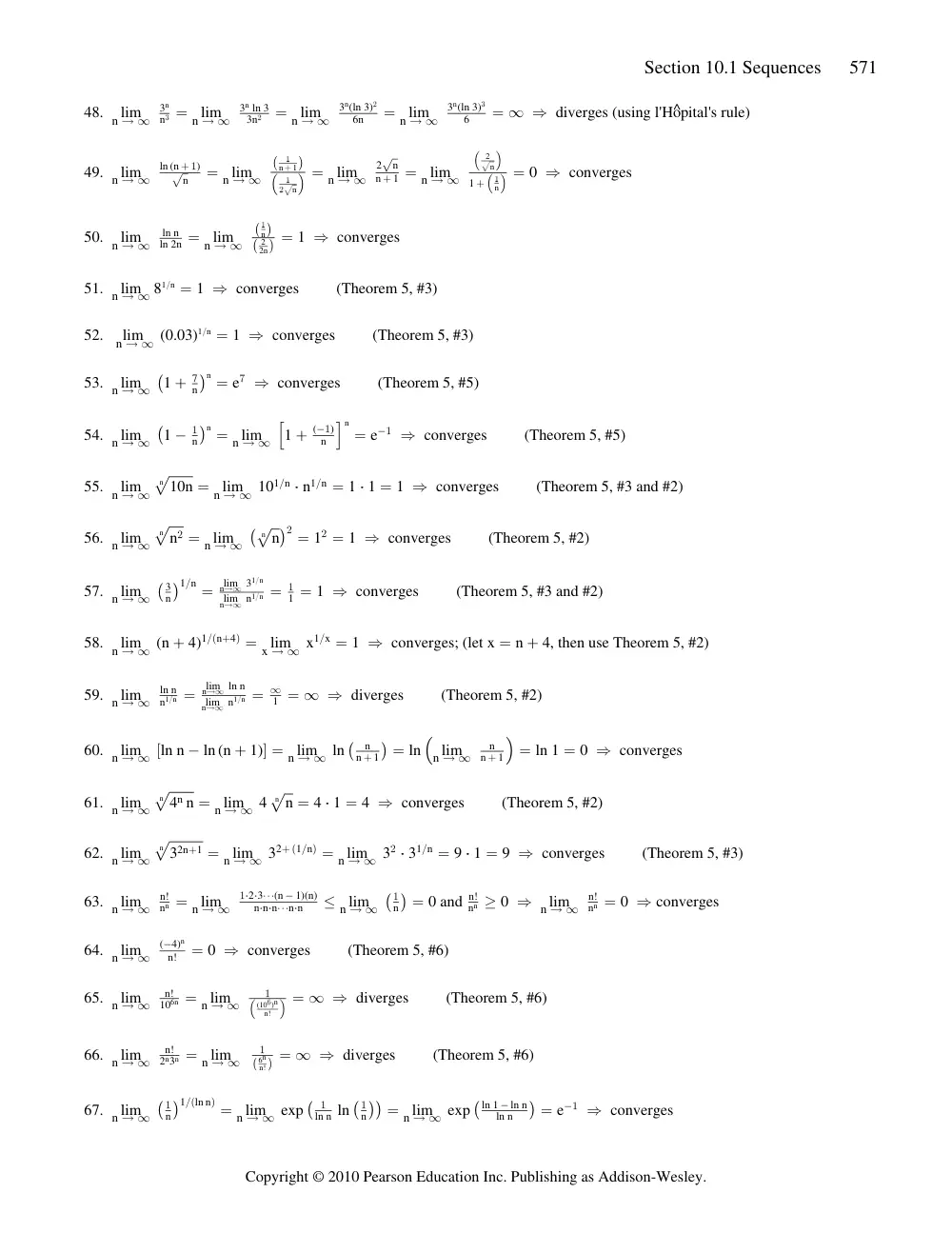
Section 10.1 Sequences
571
48. lim
lim
lim
lim
diverges (using l'Hopital's rule)
^
n
n
n
n
Ä _
Ä _
Ä _
Ä _
3
3 ln 3
n
3n
6n
6
3 (ln 3)
3 (ln 3)
n
n
n
n
$
#
#
$
œ
œ
œ
œ _ Ê
49. lim
lim
lim
lim
0
converges
n
n
n
n
Ä _
Ä _
Ä _
Ä _
ln (n
)
n
2
n
n
1
1
� "
�
�
È
È
Š
‹
Š ‹
œ
œ
œ
œ
Ê
ˆ
‰
Š
‹
"
�
"
#
"
n
1
n
2
n
n
È
È
50. lim
lim
1
converges
n
n
Ä _
Ä _
ln n
ln 2n œ
œ
Ê
ˆ ‰
ˆ
‰
"
n
2
2n
51. lim 8
1
converges
(Theorem 5, #3)
n Ä _
1 n
Î œ
Ê
52. lim (0.03)
1
converges
(Theorem 5, #3)
n Ä _
1 n
Î œ
Ê
53. lim 1
e
converges
(Theorem 5, #5)
n Ä _ ˆ
‰
�
œ
Ê
7
n
n
(
54. lim 1
lim 1
e
converges
(Theorem 5, #5)
n
n
Ä _
Ä _
ˆ
‰
’
“
�
œ
�
œ
Ê
"
�"
�"
n
n
(
)
n
n
55. lim
10n
lim 10
n
1 1
1
converges
(Theorem 5, #3 and #2)
n
n
Ä _
Ä _
È
n
œ
œ
œ
Ê
1 n
1 n
Î
Î
†
†
56. lim
n
lim
n
1
1
converges
(Theorem 5, #2)
n
n
Ä _
Ä _
È
ˆ
‰
È
n
n
#
#
#
œ
œ
œ
Ê
57. lim
1
converges
(Theorem 5, #3 and #2)
n Ä _ ˆ ‰
3
n
1
1 n
lim 3
lim n
Î
"
œ
œ
œ
Ê
n
n
Ä_
Ä_
1 n
1 n
Î
Î
58. lim (n
4)
lim x
1
converges; (let x
n
4, then use Theorem 5, #2)
n
x
Ä _
Ä _
�
œ
œ
Ê
œ
�
1
n 4
1 x
ÎÐ � Ñ
Î
59. lim
diverges
(Theorem 5, #2)
n Ä _
ln n
n
lim n
lim ln n
1
1 n
1 n
Î
Î
œ
œ
œ _ Ê
n
n
Ä_
Ä_
_
60. lim ln n
ln (n
1)
lim ln
ln
lim
ln 1
0
converges
n
n
n
Ä _
Ä _
Ä _
c
d
ˆ
‰
Š
‹
�
�
œ
œ
œ
œ
Ê
n
n
n
1
n
1
�
�
61. lim
4 n
lim 4
n
4 1
4
converges
(Theorem 5, #2)
n
n
Ä _
Ä _
È
È
n
n
n
œ
œ
œ
Ê
†
62. lim
3
lim 3
lim 3
3
9 1
9
converges
(Theorem 5, #3)
n
n
n
Ä _
Ä _
Ä _
È
n
2n 1
2
1 n
1 n
�
�
Î
#
Î
œ
œ
œ
œ
Ê
a
b
†
†
63. lim
lim
lim
0 and
0
lim
0
converges
n
n
n
n
Ä _
Ä _
Ä _
Ä _
n!
n!
n!
n
n n n
n n
n
n
n
2 3
(n
1)(n)
n
n
n
œ
Ÿ
œ
Ê
œ
Ê
"
â
�
â
"
† †
† †
†
ˆ ‰
64. lim
0
converges
(Theorem 5, #6)
n Ä _
( 4)
n!
�
n œ
Ê
65. lim
lim
diverges
(Theorem 5, #6)
n
n
Ä _
Ä _
n!
106n
(10 )n
n!
œ
œ _ Ê
"
Š
‹
'
66. lim
lim
diverges
(Theorem 5, #6)
n
n
Ä _
Ä _
n!
2 3
n n
6n
n!
œ
œ _ Ê
"
ˆ
‰
67. lim
lim exp
ln
lim exp
e
converges
n
n
n
Ä _
Ä _
Ä _
ˆ ‰
ˆ
‰
ˆ
‰
ˆ ‰
"
"
"
�
ÎÐ
Ñ
�"
n
ln n
n
ln n
1
ln n
ln 1
ln n
œ
œ
œ
Ê
Copyright © 2010 Pearson Education Inc. Publishing as Addison-Wesley.
572
Chapter 10 Infinite Sequences and Series
68. lim ln 1
ln
lim 1
ln e
1
converges
(Theorem 5, #5)
n
n
Ä _
Ä _
ˆ
‰
ˆ
‰
Š
‹
�
œ
�
œ
œ
Ê
"
"
n
n
n
n
69. lim
lim exp n ln
lim exp
n
n
n
Ä _
Ä _
Ä _
ˆ
‰
ˆ
‰
ˆ
‰
Š
‹
3n
3n
3n
1
3n
1
n
ln (3n
1)
ln (3n
1)
� "
� "
�
�
�
�
�
œ
œ
"
n
lim exp
lim exp
exp
e
converges
œ
œ
œ
œ
Ê
n
n
Ä _
Ä _
�
�
Š
‹
ˆ ‰
3
3
3n
1
3n
1
n
�
�
"
#
�
Š�
‹
6n
6
(3n
1)(3n
1)
9
#
�
�
#Î$
70. lim
lim exp n ln
lim exp
lim exp
n
n
n
n
Ä _
Ä _
Ä _
Ä _
ˆ
‰
ˆ
‰
ˆ
‰
Š
‹
�
�
n
n
n
1
n
1
n
ln n
ln (n
1)
�
�
�
�
œ
œ
œ
ˆ ‰
Š
‹
"
"
"
�
"
#
n
n
n
1
n
�
�
lim exp
e
converges
œ
�
œ
Ê
n Ä _
Š
‹
n
n(n
1)
#
�
�"
71. lim
lim x
x lim exp
ln
x lim exp
n
n
n
n
Ä _
Ä _
Ä _
Ä _
ˆ
‰
ˆ
‰
ˆ
‰
ˆ
‰
Š
‹
x
2n
1
n
1
n
n
1
n
1 n
1 n
ln (2n
1)
n
�
# �
# �
Î
"
"
"
Î
�
�
œ
œ
œ
x lim exp
xe
x, x
0
converges
œ
œ
œ
�
Ê
n Ä _
ˆ
‰
�
�
!
2
2n 1
72. lim 1
lim exp n ln 1
lim exp
lim exp
n
n
n
n
Ä _
Ä _
Ä _
Ä _
ˆ
‰
ˆ
‰
ˆ
‰
�
�
–
—
�
œ
�
œ
œ
"
"
n
n
n
#
#
ln 1
1
Š
‹
‚
ˆ ‰
Š
‹
Š
‹
Š
‹
�
�
�
"
#
"
$
#
"
"
#
n
n
2
n
n
n
lim exp
e
1
converges
œ
œ
œ
Ê
n Ä _
ˆ
‰
�
�
!
2n
n
1
#
73. lim
lim
0
converges
(Theorem 5, #6)
n
n
Ä _
Ä _
3 6
36
2
n!
n!
n
n
n
n†
� †
œ
œ
Ê
74. lim
lim
lim
0
converg
n
n
n
Ä _
Ä _
Ä _
ˆ
‰
ˆ
‰ ˆ
‰
ˆ
‰
ˆ
‰
ˆ
‰
ˆ
‰ ˆ
‰
ˆ
‰ ˆ
‰
ˆ
‰
10
12
10
120
11
11
11
121
n
n
n
n
9
11
12
9
12
11
108
10
12
11
10
11
12
110
n
n
n
n
n
n
n
�
�
�
œ
œ
œ
Ê
1
es
(Theorem 5, #4)
75. lim tanh n
lim
lim
lim
lim
1
converges
n
n
n
n
n
Ä _
Ä _
Ä _
Ä _
Ä _
œ
œ
œ
œ
" œ
Ê
e
e
e
2e
e
e
e
1
2e
n
n
2n
2n
n
n
2n
2n
�
� "
�
�
�
�
76. lim sinh (ln n)
lim
lim
diverges
n
n
n
Ä _
Ä _
Ä _
œ
œ
œ _ Ê
e
e
2
n
ln n
ln n
n
�
�
#
�
"
ˆ ‰
77. lim
lim
lim
lim
converges
n
n
n
n
Ä _
Ä _
Ä _
Ä _
n sin
2n
1
#
"
ˆ ‰
n
�
#
"
œ
œ
œ
œ
Ê
sin
cos
cos
ˆ ‰
ˆ ‰
Š
‹
Š
‹
ˆ
‰
ˆ ‰ Š
‹
ˆ ‰
"
"
"
#
#
$
"
"
#
n
n
2
2
2
n
n
n
n
n
n
2
n
�
�
�
�
�
�# �
78. lim n 1
cos
lim
lim
lim sin
0
converges
n
n
n
n
Ä _
Ä _
Ä _
Ä _
ˆ
‰
ˆ ‰
�
œ
œ
œ
œ
Ê
"
"
n
n
ˆ
‰
ˆ ‰
�
‘
ˆ ‰ Š
‹
Š
‹
" � cos
sin
"
"
"
"
#
"
#
n
n
n
n
n
79. lim
n sin
lim
lim
lim cos
cos 0
1
converges
n
n
n
n
Ä _
Ä _
Ä _
Ä _
È
Š
‹
Š
‹
1
1
n
n
sin
cos
È
È
Š
‹
Š
‹Š
‹
œ
œ
œ
œ
œ
Ê
1
1
1
n
n
1
1
n
2n3 2
2n3 2
È
È
È
�
�
Î
Î
80. lim 3
5
lim exp ln 3
5
lim exp
lim exp
n
n
n
n
Ä _
Ä _
Ä _
Ä _
a
b
a
b
’
“
’
“
–
—
n
n
n
n
1 n
1 n
ln 3
5
n
1
�
œ
�
œ
œ
Î
Î
�
a
b
n
n
3 ln 3
5 ln 5
n
n
3
5
n
� n
�
lim exp
lim exp
exp ln 5
5
œ
œ
œ
œ
n
n
Ä _
Ä _
’
“
’
“
a
b
Š
‹
ˆ
‰
ˆ ‰
ˆ ‰
3n
5n
3
3
n
n
5
5
n
3
5
n
ln 3
ln 5
1
1
ln 3
ln 5
�
�
�
�
81. lim tan
n
converges
82. lim
tan
n
0
0
converges
n
n
Ä _
Ä _
�"
�"
#
#
"
œ
Ê
œ
œ
Ê
1
1
Èn
†
Copyright © 2010 Pearson Education Inc. Publishing as Addison-Wesley.
Section 10.1 Sequences
573
83. lim
lim
0
converges
(Theorem 5, #4)
n
n
Ä _
Ä _
ˆ ‰
Šˆ ‰
‹
Š
‹
"
"
"
"
3
3
n
n
2
2
n
�
œ
�
œ
Ê
È
È
n
84. lim
n
n
lim exp
lim exp
e
1
converges
n
n
n
Ä _
Ä _
Ä _
È
’
“
ˆ
‰
n
#
�
�
�
!
�
œ
œ
œ
œ
Ê
ln n
n
n
n
n
2n
1
a
b
#
#
85. lim
lim
lim
lim
0
converges
n
n
n
n
Ä _
Ä _
Ä _
Ä _
(ln n)
200 (ln n)
200 199 (ln n)
n
n
n
n
200!
#!!
"**
"*)
œ
œ
œ á œ
œ
Ê
†
86. lim
lim
lim
lim
lim
0
converges
n
n
n
n
n
Ä _
Ä _
Ä _
Ä _
Ä _
(ln n)
10(ln n)
80(ln n)
n
n
n
n
3840
&
%
$
È
È
È
È
œ
œ
œ
œ á œ
œ
Ê
–
—
Š
‹
Š
‹
5(ln n)
n
n
%
"
#È
87. lim n
n
n
lim n
n
n
lim
lim
n
n
n
n
Ä _
Ä _
Ä _
Ä _
Š
‹
Š
‹ Š
‹
È
È
�
�
œ
�
�
œ
œ
#
#
�
�
�
�
�
�
"
�
�
n
n
n
n
n
n
n
n
n
n
1
1
È
È
È
É
#
#
#
"
n
converges
œ
Ê
"
#
88. lim
lim
lim
n
n
n
Ä _
Ä _
Ä _
"
"
�
�
�
�
�
�
�
�
�
�
�
�
�
�
�
� �
È
È
È
È
È
È
È
È
È
È
n
1
n
n
n
1
n
n
n
1
n
n
n
1
n
n
n
1
n
n
1
n
#
#
#
#
#
#
#
#
#
#
œ
œ
Š
‹ Š
‹
lim
2
converges
œ
œ �
Ê
n Ä _
É
É
ˆ
‰
1
1
1
�
�
�
�
�
"
"
#
"
n
n
n
89. lim
dx
lim
lim
0
converges
(Theorem 5, #1)
n
n
n
Ä _
Ä _
Ä _
"
"
"
n
x
n
n
ln n
'
1
n
œ
œ
œ
Ê
90. lim
dx
lim
lim
1
if p
1
converges
n
n
n
Ä _
Ä _
Ä _
'
1
n
n
1
"
"
"
"
"
"
�
�
�
x
1 p x
1 p
n
p 1
p
p 1
p 1
œ
œ
�
œ
�
Ê
’
“
ˆ
‰
�
�
91. Since a converges
lim a
L
lim a
lim
L
L 1
L
72
L
L
72
0
n
n
n
1
72
72
1
a
1
L
2
Ê
œ
Ê
œ
Ê
œ
Ê
�
œ
Ê
�
�
œ
n
n
n
Ä _
Ä _
Ä _
�
�
�
n
a
b
L
9 or L
8; since a
0 for n
1
L
8
Ê
œ �
œ
�
Ê
œ
n
92. Since a converges
lim a
L
lim a
lim
L
L L
2
L
6
L
L
6
0
n
n
n
1
a
6
a
2
L
2
L
6
2
Ê
œ
Ê
œ
Ê
œ
Ê
�
œ
�
Ê
�
�
œ
n
n
n
Ä _
Ä _
Ä _
�
�
�
�
�
n
n
a
b
L
3 or L
2; since a
0 for n
2
L
2
Ê
œ �
œ
�
Ê
œ
n
93. Since a converges
lim a
L
lim a
lim
8
2a
L
8
2L
L
2L
8
0
L
2
n
n
n
1
n
2
Ê
œ
Ê
œ
�
Ê
œ
�
Ê
�
�
œ
Ê
œ �
n
n
n
Ä _
Ä _
Ä _
�
È
È
or L
4; since a
0 for n
3
L
4
œ
�
Ê
œ
n
94. Since a converges
lim a
L
lim a
lim
8
2a
L
8
2L
L
2L
8
0
L
2
n
n
n
1
n
2
Ê
œ
Ê
œ
�
Ê
œ
�
Ê
�
�
œ
Ê
œ �
n
n
n
Ä _
Ä _
Ä _
�
È
È
or L
4; since a
0 for n
2
L
4
œ
�
Ê
œ
n
95. Since a converges
lim a
L
lim a
lim
5a
L
5L
L
5L
0
L
0 or L
5; since
n
n
n
1
n
2
Ê
œ
Ê
œ
Ê
œ
Ê
�
œ
Ê
œ
œ
n
n
n
Ä _
Ä _
Ä _
�
È
È
a
0 for n
1
L
5
n �
Ê
œ
96. Since a converges
lim a
L
lim a
lim
12
a
L
12
L
L
25L
144
0
n
n
n
1
n
2
Ê
œ
Ê
œ
�
Ê
œ
�
Ê
�
�
œ
n
n
n
Ä _
Ä _
Ä _
�
ˆ
‰
È
Š
‹
È
L
9 or L
16; since 12
a
12 for n
1
L
9
Ê
œ
œ
�
�
Ê
œ
È n
97. a
2
, n
1, a
2. Since a converges
lim a
L
lim a
lim
2
L
2
n
1
1
n
n
n
1
1
1
1
a
a
L
�
�
œ
�
œ
Ê
œ
Ê
œ
�
Ê
œ
�
n
n
n
n
n
Ä _
Ä _
Ä _Š
‹
L
2L
1
0
L
1
2; since a
0 for n
1
L
1
2
Ê
�
�
œ
Ê
œ
„
�
Ê
œ
�
2
n
È
È
Copyright © 2010 Pearson Education Inc. Publishing as Addison-Wesley.
574
Chapter 10 Infinite Sequences and Series
98. a
1
a , n
1, a
1. Since a converges
lim a
L
lim a
lim
1
a
L
1
L
n
1
n
1
n
n
n
1
n
�
�
œ
�
œ
Ê
œ
Ê
œ
�
Ê
œ
�
È
È
È
È
n
n
n
Ä _
Ä _
Ä _
L
L
1
0
L
; since a
0 for n
1
L
Ê
�
�
œ
Ê
œ
�
Ê
œ
2
1
5
1
5
2
2
n
„
�
È
È
99. 1, 1, 2, 4, 8, 16, 32,
1, 2 , 2 , 2 , 2 , 2 , 2 ,
x
1 and x
2
for n
2
á œ
á Ê
œ
œ
!
"
#
$
%
&
"
n
n 2
�
100. (a) 1
2(1)
1, 3
2(2)
1; let f(a b)
(a
2b)
2(a
b)
a
4ab
4b
2a
4ab
2b
#
#
#
#
#
#
#
#
#
#
�
œ �
�
œ
ß
œ
�
�
�
œ
�
�
�
�
�
2b
a ; a
2b
1
f(a b)
2b
a
1; a
2b
1
f(a b)
2b
a
1
œ
�
�
œ �
Ê
ß
œ
�
œ
�
œ
Ê
ß
œ
�
œ �
#
#
#
#
#
#
#
#
#
#
(b) r
2
2
r
2
#
�
�
�
�
�
�
„"
"
�
�
�
#
�
�
#
n
n
�
œ
�
œ
œ
œ
Ê
œ
„
ˆ
‰
Ê
Š
‹
a
2b
a
4ab
4b
2a
4ab
2b
a
b
(a
b)
(a
b)
y
y
a
2b
#
#
#
#
#
#
#
#
#
a
b
n
n
In the first and second fractions, y
n. Let represent the (n
1)th fraction where
1 and b
n
1
n
�
�
a
a
b
b
for n a positive integer
3. Now the nth fraction is
and a
b
2b
2n
2
n
y
n. Thus,
�
�
Ê
a
2b
a
b
�
�
n
lim r
2.
n Ä _
n œ È
101. (a) f(x)
x
2; the sequence converges to 1.414213562
2
œ
�
¸
#
È
(b) f(x)
tan (x)
1; the sequence converges to 0.7853981635
œ
�
¸ 1
4
(c) f(x)
e ; the sequence 1, 0, 1, 2, 3, 4, 5,
diverges
œ
�
�
�
�
�
á
x
102. (a) lim nf
lim
lim
f (0), where
x
n
x
x
Ä _
Ä !
Ä !
ˆ ‰
"
"
�
�
w
n
x
x
n
f(
x)
f(0
x)
f(0)
œ
œ
œ
œ
?
?
�
�
?
?
?
?
?
(b) lim n tan
f (0)
1, f(x)
tan
x
n Ä _
�"
w
�"
"
"
�
ˆ ‰
n
1
0
œ
œ
œ
œ
#
(c) lim n e
1
f (0)
e
1, f(x)
e
1
n Ä _
a
b
1 n
x
Î �
œ
œ
œ
œ
�
w
!
(d) lim n ln 1
f (0)
2, f(x)
ln (1
2x)
n Ä _
ˆ
‰
�
œ
œ
œ
œ
�
2
2
n
1
2(0)
w
�
103. (a) If a
2n
1, then b
2n
2n
2n
2n, c
2n
2n
œ
�
œ Ú
Û œ Ú
Û œ Ú
�
�
Û œ
�
œ Ü
Ý œ Ü
�
�
Ý
a
4n
4n
1
a
#
#
#
#
#
#
#
#
�
�
"
"
#
#
#
2n
2n
1 and a
b
(2n
1)
2n
2n
4n
4n
1
4n
8n
4n
œ
�
�
�
œ
�
�
�
œ
�
�
�
�
�
#
#
#
#
#
#
%
$
#
#
a
b
4n
8n
8n
4n
1
2n
2n
1
c .
œ
�
�
�
�
œ
�
�
œ
%
$
#
#
#
#
a
b
(b) lim
lim
1 or lim
lim sin
lim sin
1
a
a
a
a
2
Ä _
Ä _
Ä _
Ä _
Ä
Î
Ú
Û
Ú
Û
Ü
Ý
Ü
Ý
a
a
a
a
#
#
#
#
#
#
#
#
œ
œ
œ
œ
œ
2n
2n
2n
2n
1
#
#
�
�
�
)
)
)
1
104. (a) lim (2n )
lim exp
lim exp
lim exp
e
1;
n
n
n
n
Ä _
Ä _
Ä _
Ä _
1 1
2n
ln 2n
2n
n
Î
!
#
#
"
a
b
Š
‹
œ
œ
œ
œ
œ
ˆ
‰
ˆ
‰
�
�
1
2
2n
1
1
n!
2n , Stirlings approximation
n!
(2n )
for large values of n
¸
Ê
¸
¸
ˆ ‰
ˆ ‰
È
È
n
n
n
e
e
e
1
2n
n
n
1
1
Î a
b
(b)
n
n!
40
15.76852702
14.71517765
50
19.48325423
18.393
È
n
n
e
97206
60
23.19189561
22.07276647
105. (a) lim
lim
lim
0
n
n
n
Ä _
Ä _
Ä _
ln n
n
cn
cn
c
c 1
c
œ
œ
œ
ˆ ‰
"
n
�
"
(b) For all
0, there exists an N
e
such that n
e
ln n
ln n
ln
% �
œ
�
Ê
� �
Ê
�
�Ð
ÑÎ
�Ð
ÑÎ
"
ln
c
ln
c
c
ln
c
%
%
%
%
ˆ ‰
n
0
lim
0
n
Ê
�
Ê
�
Ê
�
�
Ê
œ
Ä _
c
n
n
n
"
"
"
"
%
c
c
c
%
%
¸
¸
106. Let {a } and {b } be sequences both converging to L. Define {c } by c
b and c
a , where
n
n
n
2n
n
2n 1
n
œ
� œ
n
1, 2, 3,
. For all
0 there exists N such that when n
N then a
L
and there exists N
œ
á
�
�
�
�
%
%
"
"
#
k
k
n
such that when n
N then b
L
. If n
1
2max{N
N }, then c
L
, so {c } converges to L.
�
�
�
�
�
ß
�
�
#
"
#
k
k
k
k
n
n
n
%
%
Copyright © 2010 Pearson Education Inc. Publishing as Addison-Wesley.
Section 10.1 Sequences
575
107. lim n
lim exp
ln n
lim exp
e
1
n
n
n
Ä _
Ä _
Ä _
1 n
n
n
Î
!
"
"
œ
œ
œ
œ
ˆ
‰
ˆ ‰
108. lim x
lim exp
ln x
e
1, because x remains fixed while n gets large
n
n
Ä _
Ä _
1 n
n
Î
!
"
œ
œ
œ
ˆ
‰
109. Assume the hypotheses of the theorem and let be a positive number. For all there exists a N such that
%
%
"
when n
N then a
L
a
L
L
a , and there exists a N such that when
�
�
�
Ê � �
�
�
Ê
�
�
"
#
k
k
n
n
n
%
%
%
%
n
N then c
L
c
L
c
L
. If n
max{N
N }, then
�
�
�
Ê � �
�
�
Ê
�
�
�
ß
#
"
#
k
k
n
n
n
%
%
%
%
L
a
b
c
L
b
L
lim b
L.
�
�
Ÿ
Ÿ
�
�
Ê
�
�
Ê
œ
%
%
%
n
n
n
n
n
k
k
n Ä _
110. Let
. We have f continuous at L
there exists so that x
L
f(x)
f(L)
. Also, a
L
there
%
$
$
%
� !
Ê
�
�
Ê
�
�
Ä
Ê
k
k
k
k
n
exists N so that for n
N a
L
. Thus for n
N, f(a )
f(L)
f(a )
f(L).
�
�
�
�
�
�
Ê
Ä
k
k
k
k
n
n
n
$
%
111. a
a
3n
3n
4n
4
3n
6n
n
2
n 1
n
3(n
1)
1
(n
1)
1
n
1
n
n
1
3n
1
3n
4
3n
1
�
�
�
�
�
�
� #
�
�
�
�
#
#
Ê
�
Ê
�
Ê
�
�
�
�
�
�
�
4
2; the steps are reversible so the sequence is nondecreasing;
3
3n
1
3n
3
Ê
�
�
Ê
�
�
�
3n
n
1
� "
�
1
3; the steps are reversible so the sequence is bounded above by 3
Ê
�
112. a
a
n 1
n
(2(n
1)
3)!
(2n
3)!
(2n
5)!
(2n
3)!
(2n
5)!
(n
2)!
((n
1)
1)!
(n
1)!
(n
2)!
(n
1)!
(2n
3)!
(n
1)!
�
�
�
�
�
�
�
�
�
�
�
�
�
�
�
Ê
�
Ê
�
Ê
�
(2n
5)(2n
4)
n
2; the steps are reversible so the sequence is nondecreasing; the sequence is not
Ê
�
�
�
�
bounded since
(2n
3)(2n
2)
(n
2) can become as large as we please
(2n
3)!
(n
1)!
�
�
œ
�
�
â
�
113. a
a
2 3
n
1 which is true for n
5; the steps are
n 1
n
2
3
2 3
2
3
(n
1)!
n!
2 3
n!
(n
1)!
�
�
�
Ÿ
Ê
Ÿ
Ê
Ÿ
Ê
Ÿ
�
n 1 n 1
n n
n 1 n 1
n n
�
�
�
�
†
reversible so the sequence is decreasing after a , but it is not nondecreasing for all its terms; a
6, a
18,
&
"
#
œ
œ
a
36, a
54, a
64.8
the sequence is bounded from above by 64.8
$
%
&
œ
œ
œ
œ
Ê
324
5
114. a
a
2
2
; the steps are
n 1
n
2
2
2
2
2
n 1
n
n
n 1
n(n
1)
�
�
#
#
�
#
#
�
#
"
"
"
"
"
Ê
�
�
�
�
Ê
�
�
Ê
�
n 1
n
n 1
n
n 1
�
�
�
reversible so the sequence is nondecreasing; 2
2
the sequence is bounded from above
�
�
Ÿ
Ê
2
n
"
#n
115. a
1
converges because
0 by Example 1; also it is a nondecreasing sequence bounded above by 1
n œ
�
Ä
"
"
n
n
116. a
n
diverges because n
and
0 by Example 1, so the sequence is unbounded
n œ
�
Ä _
Ä
"
"
n
n
117. a
1
and 0
; since
0 (by Example 1)
0, the sequence converges; also it is
n
2
1
2
n
n
œ
œ
�
�
�
Ä
Ê
Ä
n
n
n
n
n
�
"
"
"
"
"
#
#
#
a nondecreasing sequence bounded above by 1
118. a
; the sequence converges to by Theorem 5, #4
n
2
1
2
3
3
3
n
œ
œ
�
!
n
n
n
�
"
ˆ ‰
119. a
( 1)
1
diverges because a
0 for n odd, while for n even a
2 1
converges to 2; it
n
n
n
n
n 1
n
n
œ
�
�
œ
œ
�
a
b ˆ
‰
ˆ
‰
�
"
diverges by definition of divergence
120. x
max {cos 1 cos 2 cos 3
cos n} and x
max {cos 1 cos 2 cos 3
cos (n
1)}
x with x
1
n
n 1
n
n
œ
ß
ß
ß á ß
œ
ß
ß
ß á ß
�
Ÿ
�
so the sequence is nondecreasing and bounded above by 1
the sequence converges.
Ê
121. a
a
n
1
2n
2n
n
2n
2n
n
1
n
n
n 1
1
2n
n
2(n
1)
n
1
Í
Í
�
�
�
�
�
Í
�
�
�
" �
�
�
#
#
È
È
È
È
È
È
È
È
È
È
and
2 ; thus the sequence is nonincreasing and bounded below by
2
it converges
1
2n
n
� È
È
Ê
È
È
Copyright © 2010 Pearson Education Inc. Publishing as Addison-Wesley.
576
Chapter 10 Infinite Sequences and Series
122. a
a
n
2n
1
n
2n
1
0 and
1; thus the sequence is
n
n 1
n
1
n
1
n
n
1
n
(n
1)
Í
Í
�
�
�
Í
�
�
�
�
� "
�
#
#
nonincreasing and bounded below by 1
it converges
Ê
123.
4
so a
a
4
4
1
and
4
3
3
3
3
3
3
3
4
4
4
4
4
4
4
n
n
n
n
n 1
n
n 1
n 1
n
n
� �
�
�"
�
œ
�
Í
�
�
Í
Í
ˆ ‰
ˆ ‰
ˆ ‰
ˆ ‰
ˆ ‰
4
4; thus the sequence is nonincreasing and bounded below by 4
it converges
�
Ê
ˆ ‰
3
4
n
124. a
1, a
2
3, a
2(2
3)
3
2
2
3, a
2 2
2
3
3
2
2
1 3,
"
#
$
%
#
#
$
$
œ
œ
�
œ
�
�
œ
�
� "
œ
�
� "
�
œ
�
�
a
b
a
b
a
b
a
b
2
2
†
†
a
2 2
2
1 3
3
2
2
1 3,
, a
2
2
1 3
2
3 2
3
&
$
$
%
%
�"
�"
�"
�
œ
�
�
�
œ
�
�
á
œ
�
�
œ
�
�
c
d
a
b
a
b
a
b
n
n
n
n
† n 1
2
(1
3)
3
2
3; a
a
2
3
2
3
2
2
1
2
œ
�
�
œ �
�
Í �
�
�
�
Í �
�
Í
Ÿ
n 1
n
n
n 1
n
n 1
n
n 1
�
�
�
�
so the sequence is nonincreasing but not bounded below and therefore diverges
125. Let 0
M
1 and let N be an integer greater than
. Then n
N
n
n
nM
M
�
�
�
Ê
�
Ê
�
�
M
M
1
M
1
M
�
�
n
M
nM
n
M(n
1)
M.
Ê
�
�
Ê
�
�
Ê
�
n
n
1
�
126. Since M is a least upper bound and M is an upper bound, M
M . Since M is a least upper bound and M
"
#
"
#
#
"
Ÿ
is an upper bound, M
M . We conclude that M
M so the least upper bound is unique.
#
"
"
#
Ÿ
œ
127. The sequence a
1
is the sequence , , , ,
. This sequence is bounded above by ,
n
(
)
3
3
3
œ
�
á
�"
#
#
#
#
#
#
"
"
n
but it clearly does not converge, by definition of convergence.
128. Let L be the limit of the convergent sequence {a }. Then by definition of convergence, for there
n
%
#
corresponds an N such that for all m and n, m
N
a
L
and n
N
a
L
. Now
�
Ê
�
�
�
Ê
�
�
k
k
k
k
m
n
%
%
#
#
a
a
a
L
L
a
a
L
L
a
whenever m
N and n
N.
k
k
k
k
k
k
k
k
m
n
m
n
m
n
�
œ
�
�
�
Ÿ
�
�
�
�
�
œ
�
�
%
%
#
#
%
129. Given an
0, by definition of convergence there corresponds an N such that for all n
N,
% �
�
L
a
and L
a
. Now L
L
L
a
a
L
L
a
a
L
2 .
k
k
k
k
k
k
k
k
k
k
k
k
"
#
#
"
#
"
#
"
�
�
�
�
�
œ
�
�
�
Ÿ
�
�
�
�
�
œ
n
n
n
n
n
n
%
%
%
%
%
L
L
2 says that the difference between two fixed values is smaller than any positive number 2 .
k
k
#
"
�
� %
%
The only nonnegative number smaller than every positive number is 0, so L
L
0 or L
L .
k
k
"
#
"
#
�
œ
œ
130. Let k(n) and i(n) be two order-preserving functions whose domains are the set of positive integers and whose
ranges are a subset of the positive integers. Consider the two subsequences a
and a
, where a
L ,
k n
i n
k n
Ð Ñ
Ð Ñ
Ð Ñ
"
Ä
a
L and L
L . Thus a
a
L
L
0. So there does not exist N such that for all m, n
N
i n
k n
i n
Ð Ñ
Ð Ñ
Ð Ñ
#
"
#
"
#
Ä
Á
�
Ä
�
�
�
¸
¸
k
k
a
a
. So by Exercise 128, the sequence a
is not convergent and hence diverges.
Ê
�
�
Ö
×
k
k
m
n
n
%
131. a
L
given an
0 there corresponds an N such that 2k
N
a
L
. Similarly,
2k
2k
Ä
Í
�
�
Ê
�
�
%
%
"
"
c
d
k
k
a
L
2k
1
N
a
L
. Let N
max{N
N }. Then n
N
a
L
whether
2k 1
2k 1
n
�
#
�
"
#
Ä
Í
�
�
Ê
�
�
œ
ß
�
Ê
�
�
c
d
k
k
k
k
%
%
n is even or odd, and hence a
L.
n Ä
132. Assume a
0. This implies that given an
0 there corresponds an N such that n
N
a
0
n
n
Ä
�
�
Ê
�
�
%
%
k
k
a
a
a
0
a
0. On the other hand, assume a
0. This implies that
Ê
�
Ê
�
Ê
�
�
Ê
Ä
Ä
k
k
k
k
k
k
k
k
k
k
k
k
k
k
n
n
n
n
n
%
%
%
given an
0 there corresponds an N such that for n
N, a
0
a
a
%
%
%
%
�
�
�
�
Ê
�
Ê
�
k
k
k
k
k
k
k
k
k
k
n
n
n
a
0
a
0.
Ê
�
�
Ê
Ä
k
k
n
n
%
133. (a) f(x)
x
a
f (x)
2x
x
x
x
œ
�
Ê
œ
Ê
œ
�
Ê
œ
œ
œ
#
w
�
�
�
�
�
�
#
#
�
n 1
n
n 1
x
a
2x
x
a
x
a
x
2x
2x
x
#
#
#
#
n
n
n
n
n
n
n
n
n
xa
a
b
ˆ
‰
(b) x
2, x
1.75, x
1.732142857, x
1.73205081, x
1.732050808; we are finding the positive
"
#
$
%
&
œ
œ
œ
œ
œ
number where x
3
0; that is, where x
3, x
0, or where x
3 .
#
#
�
œ
œ
�
œ È
Copyright © 2010 Pearson Education Inc. Publishing as Addison-Wesley.
Section 10.2 Infinite Series
577
134. x
1, x
1
cos (1)
1.540302306, x
1.540302306
cos (1
cos (1))
1.570791601,
"
#
$
œ
œ
�
œ
œ
�
�
œ
x
1.570791601
cos (1.570791601)
1.570796327
to 9 decimal places. After a few steps, the
%
#
œ
�
œ
œ 1
arc x
and line segment cos x
are nearly the same as the quarter circle.
a
b
a
b
n 1
n 1
�
�
135-146. Example CAS Commands:
: (sequence functions may vary):
Mathematica
Clear[a, n]
a[n_]; = n1 / n
first25= Table[N[a[n]],{n, 1, 25}]
Limit[a[n], n
Ä 8]
Mathematica: (sequence functions may vary):
Clear[a, n]
a[n_]; = n1 / n
first25= Table[N[a[n]],{n, 1, 25}]
Limit[a[n], n
Ä 8]
The last command (Limit) will not always work in Mathematica. You could also explore the limit by enlarging your table
to more than the first 25 values.
If you know the limit (1 in the above example), to determine how far to go to have all further terms within 0.01 of the
limit, do the following.
Clear[minN, lim]
lim= 1
Do[{diff=Abs[a[n]
� lim], If[diff < .01, {minN= n, Abort[]}]}, {n, 2, 1000}]
minN
For sequences that are given recursively, the following code is suggested. The portion of the command a[n_]:=a[n] stores
the elements of the sequence and helps to streamline computation.
Clear[a, n]
a[1]= 1;
a[n_]; = a[n]= a[n
1]
(1/5)
�
�
(n 1)
�
first25= Table[N[a[n]], {n, 1, 25}]
The limit command does not work in this case, but the limit can be observed as 1.25.
Clear[minN, lim]
lim= 1.25
Do[{diff=Abs[a[n]
� lim], If[diff < .01, {minN= n, Abort[]}]}, {n, 2, 1000}]
minN
10.2 INFINITE SERIES
1. s
lim s
3
n
n
a 1 r
(1 r)
2 1
1
1
2
œ
œ
Ê
œ
œ
a
b
ˆ
ˆ ‰ ‰
ˆ ‰
ˆ ‰
�
�
�
�
�
n
3
n
3
3
"
"
"
n Ä _
2. s
lim s
n
n
a 1 r
(1 r)
11
1
1
1
œ
œ
Ê
œ
œ
a
b
ˆ
‰ ˆ
‰
ˆ
‰
ˆ
‰
ˆ
‰
ˆ
‰
�
�
�
�
�
"
n
9
9
100
100
100
n
100
100
"
"
"
n Ä _
3. s
lim s
n
n
a 1 r
(1 r)
3
1
1
2
œ
œ
Ê
œ
œ
a
b
ˆ
‰
ˆ
‰
ˆ ‰
�
�
� �
� �
"
n
n
3
"
#
"
#
#
n Ä _
4. s
, a geometric series where r
1
divergence
n
1 ( 2)
œ 1 ( 2)
�
Ê
� �
� �
n
k k
5.
s
lim s
"
"
"
"
"
"
"
"
"
"
"
"
�
� #
�
� #
#
�
� #
#
� #
#
(n 1)(n )
n 1
n
3
3
4
n 1
n
n
n
n
œ
�
Ê
œ
�
�
�
� á �
�
œ
�
Ê
œ
ˆ
‰
ˆ
‰
ˆ
‰
n Ä _
Copyright © 2010 Pearson Education Inc. Publishing as Addison-Wesley.
578
Chapter 10 Infinite Sequences and Series
6.
s
5
5
5
5
5
5
5
5
5
5
5
5
5
5
5
n(n 1)
n
n 1
2
2
3
3
4
n 1
n
n
n 1
n 1
n
�
�
�
�
�
œ
�
Ê
œ
�
�
�
�
�
� á �