
MATH 201 Problems For Quiz 2, Fall 2012
American University of Beirut · Calculus and Analytical Geometry III · 3 pages
More MATH 201 files
- Problems Difficult Problem 2 · Spring 2019ProblemsView
- Problems Combining Taylor Series with Triple Integrals · Spring 2019ProblemsView
- Problems Difficult Problem 8 Yamani · Spring 2019ProblemsView
- Problems Difficult Problem 6 Tlas 2017 Exam 1 · Spring 2019ProblemsView
- Problems Difficult Problem 3 · Spring 2019ProblemsView
- Problems Difficult Problem 7 Yamani · Spring 2019ProblemsView
- Problems Difficult Problem 4 · Spring 2019ProblemsView
- Problems Difficult Problem 10 · Spring 2019ProblemsView
Show the text of this problems
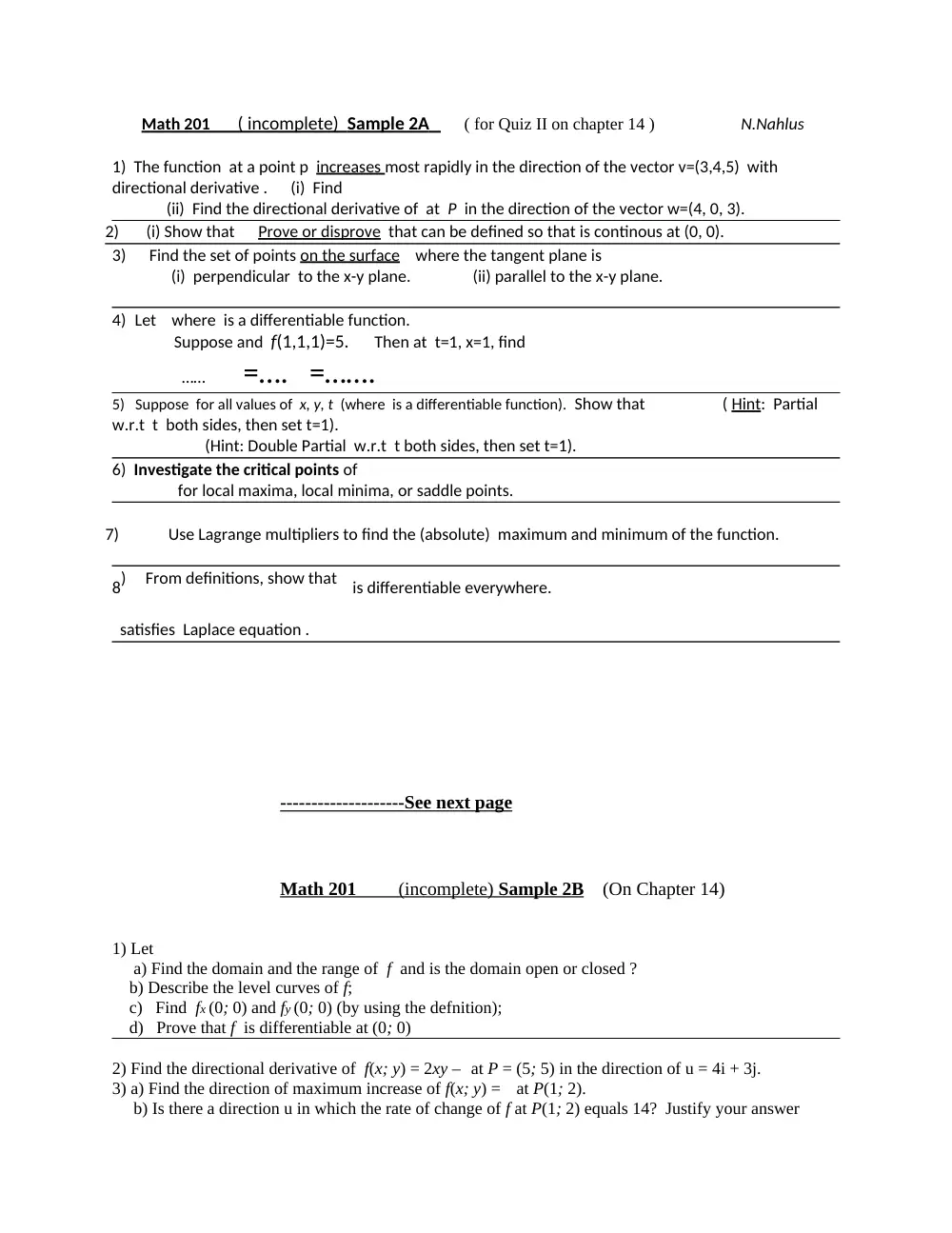
Math 201
( incomplete)
Sample 2A
( for Quiz II on chapter 14 )
N.Nahlus
1) The function at a point p increases most rapidly in the direction of the vector v=(3,4,5) with
directional derivative . (i) Find
(ii) Find the directional derivative of at P in the direction of the vector w=(4, 0, 3).
2) (i) Show that
Prove or disprove that can be defined so that is continous at (0, 0).
3) Find the set of points on the surface where the tangent plane is
(i) perpendicular to the x-y plane. (ii) parallel to the x-y plane.
4) Let where is a differentiable function.
Suppose and f(1,1,1)=5. Then at t=1, x=1, find
…… =…. =…….
5) Suppose for all values of x, y, t (where is a differentiable function). Show that ( Hint: Partial
w.r.t t both sides, then set t=1).
(Hint: Double Partial w.r.t t both sides, then set t=1).
6) Investigate the critical points of
for local maxima, local minima, or saddle points.
7)
Use Lagrange multipliers to find the (absolute) maximum and minimum of the function.
8) From definitions, show that is differentiable everywhere.
satisfies Laplace equation .
--------------------See next page
Math 201
(incomplete)
Sample 2B
(On Chapter 14)
1) Let
a) Find the domain and the range of f and is the domain open or closed ?
b) Describe the level curves of f;
c) Find fx (0; 0) and fy (0; 0) (by using the defnition);
d) Prove that f is differentiable at (0; 0)
2) Find the directional derivative of f(x; y) = 2xy – at P = (5; 5) in the direction of u = 4i + 3j.
3) a) Find the direction of maximum increase of f(x; y) = at P(1; 2).
b) Is there a direction u in which the rate of change of f at P(1; 2) equals 14? Justify your answer
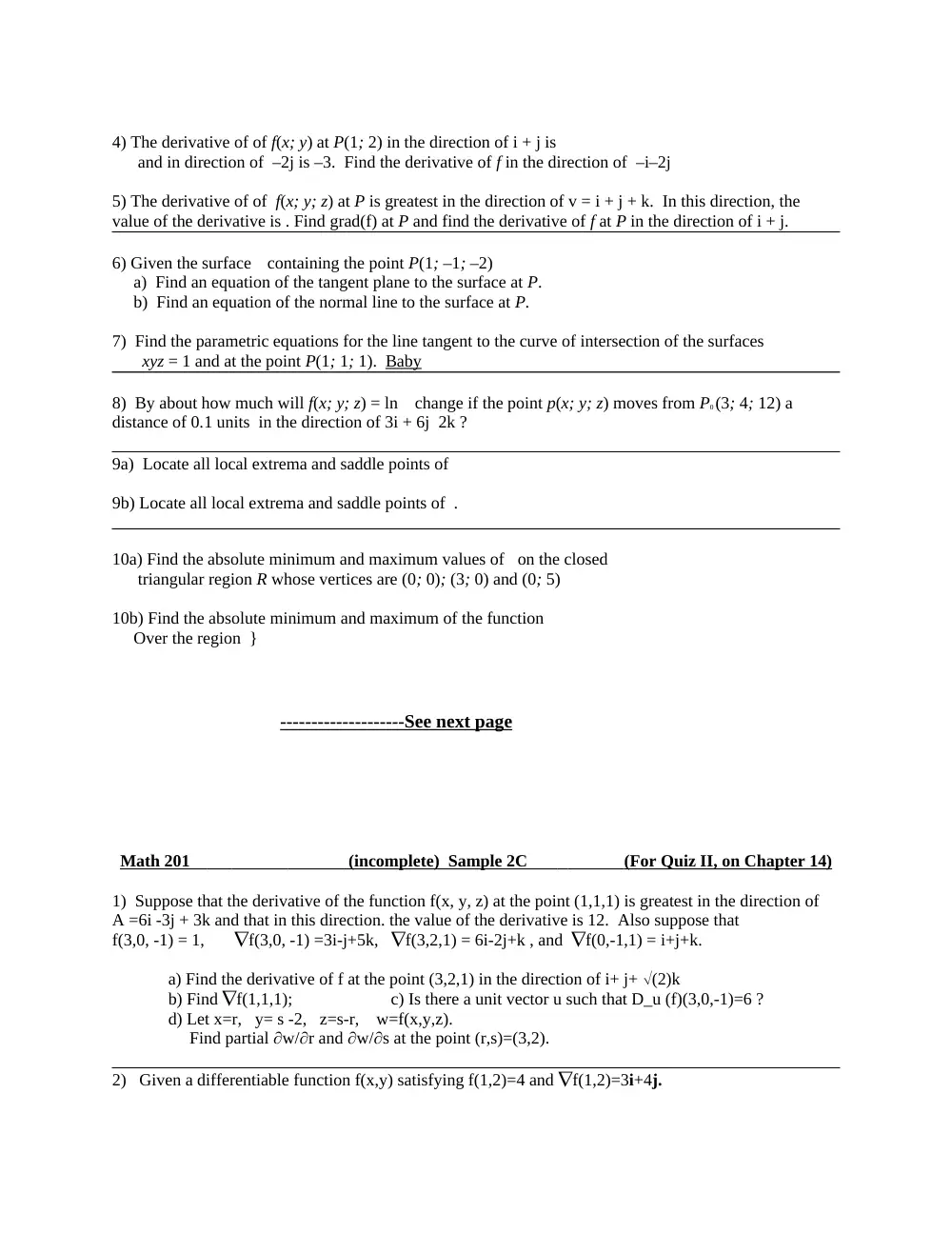
4) The derivative of of f(x; y) at P(1; 2) in the direction of i + j is
and in direction of –2j is –3. Find the derivative of f in the direction of –i–2j
5) The derivative of of f(x; y; z) at P is greatest in the direction of v = i + j + k. In this direction, the
value of the derivative is . Find grad(f) at P and find the derivative of f at P in the direction of i + j.
6) Given the surface containing the point P(1; –1; –2)
a) Find an equation of the tangent plane to the surface at P.
b) Find an equation of the normal line to the surface at P.
7) Find the parametric equations for the line tangent to the curve of intersection of the surfaces
xyz = 1 and at the point P(1; 1; 1). Baby
8) By about how much will f(x; y; z) = ln change if the point p(x; y; z) moves from P0 (3; 4; 12) a
distance of 0.1 units in the direction of 3i + 6j 2k ?
9a) Locate all local extrema and saddle points of
9b) Locate all local extrema and saddle points of .
10a) Find the absolute minimum and maximum values of on the closed
triangular region R whose vertices are (0; 0); (3; 0) and (0; 5)
10b) Find the absolute minimum and maximum of the function
Over the region }
--------------------See next page
Math 201
(incomplete) Sample 2C
(For Quiz II, on Chapter 14)
1) Suppose that the derivative of the function f(x, y, z) at the point (1,1,1) is greatest in the direction of
A =6i -3j + 3k and that in this direction. the value of the derivative is 12. Also suppose that
f(3,0, -1) = 1, f(3,0, -1) =3i-j+5k, f(3,2,1) = 6i-2j+k , and f(0,-1,1) = i+j+k.
a) Find the derivative of f at the point (3,2,1) in the direction of i+ j+ (2)k
b) Find f(1,1,1); c) Is there a unit vector u such that D_u (f)(3,0,-1)=6 ?
d) Let x=r, y= s -2, z=s-r, w=f(x,y,z).
Find partial w/r and w/s at the point (r,s)=(3,2).
2) Given a differentiable function f(x,y) satisfying f(1,2)=4 and f(1,2)=3i+4j.
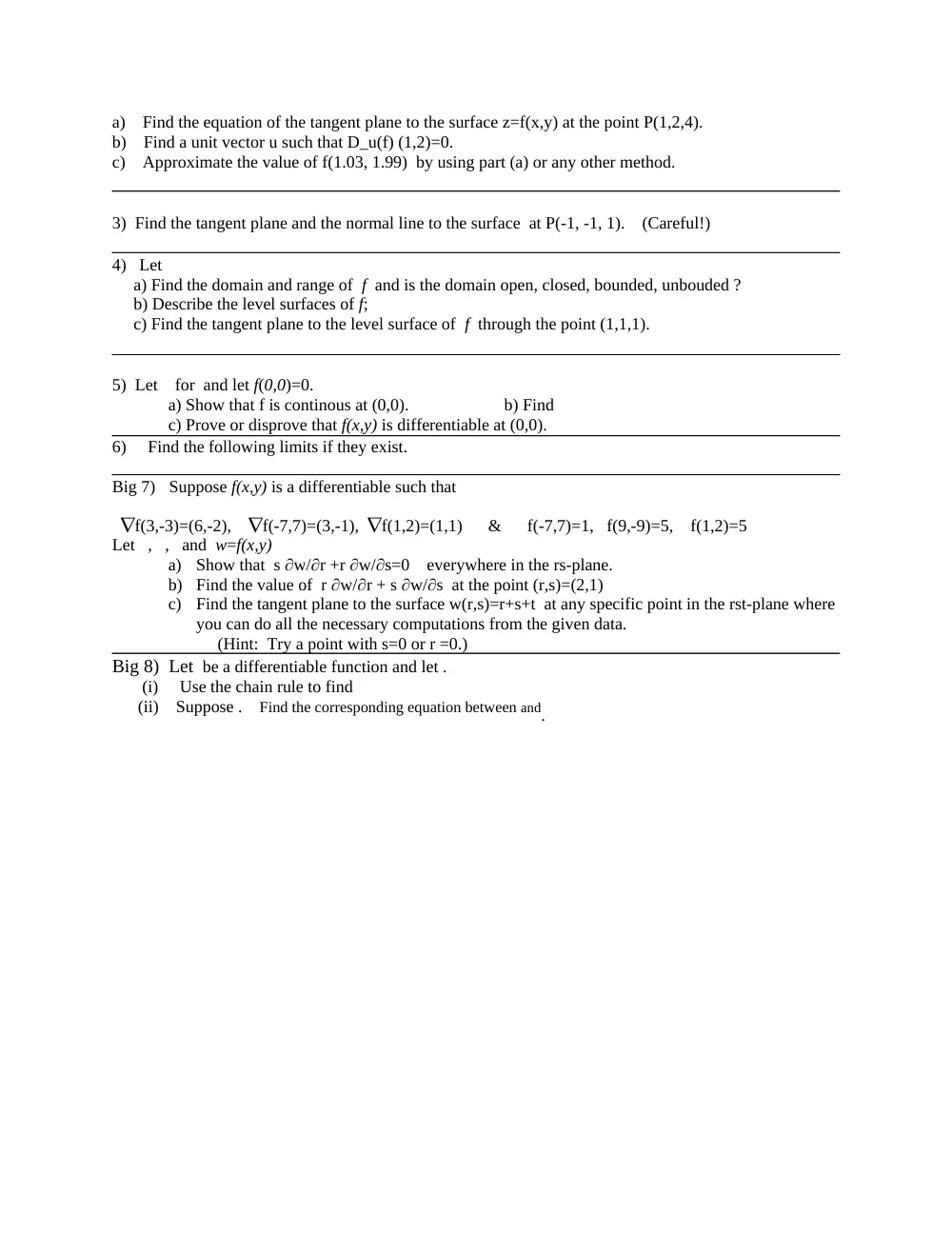
a) Find the equation of the tangent plane to the surface z=f(x,y) at the point P(1,2,4).
b) Find a unit vector u such that D_u(f) (1,2)=0.
c) Approximate the value of f(1.03, 1.99) by using part (a) or any other method.
3) Find the tangent plane and the normal line to the surface at P(-1, -1, 1). (Careful!)
4) Let
a) Find the domain and range of f and is the domain open, closed, bounded, unbouded ?
b) Describe the level surfaces of f;
c) Find the tangent plane to the level surface of f through the point (1,1,1).
5) Let for and let f(0,0)=0.
a) Show that f is continous at (0,0).
b) Find
c) Prove or disprove that f(x,y) is differentiable at (0,0).
6) Find the following limits if they exist.
Big 7) Suppose f(x,y) is a differentiable such that
f(3,-3)=(6,-2), f(-7,7)=(3,-1), f(1,2)=(1,1) & f(-7,7)=1, f(9,-9)=5, f(1,2)=5
Let , , and w=f(x,y)
a)
Show that s w/r +r w/s=0 everywhere in the rs-plane.
b)
Find the value of r w/r + s w/s at the point (r,s)=(2,1)
c)
Find the tangent plane to the surface w(r,s)=r+s+t at any specific point in the rst-plane where
you can do all the necessary computations from the given data.
(Hint: Try a point with s=0 or r =0.)
Big 8) Let be a differentiable function and let .
(i) Use the chain rule to find
(ii) Suppose . Find the corresponding equation between and.