
MATH 201 Problems Quiz 2, Fall 2012
American University of Beirut · Calculus and Analytical Geometry III · 1 page · Dr. Mohammad Kobeissi
Stuck on a question? A tutor can walk you through it.
More MATH 201 files
- Problems Difficult Problem 2 · Spring 2019ProblemsView
- Problems Combining Taylor Series with Triple Integrals · Spring 2019ProblemsView
- Problems Difficult Problem 8 Yamani · Spring 2019ProblemsView
- Problems Difficult Problem 6 Tlas 2017 Exam 1 · Spring 2019ProblemsView
- Problems Difficult Problem 3 · Spring 2019ProblemsView
- Problems Difficult Problem 7 Yamani · Spring 2019ProblemsView
- Problems Difficult Problem 4 · Spring 2019ProblemsView
- Problems Difficult Problem 10 · Spring 2019ProblemsView
Show the text of this problems
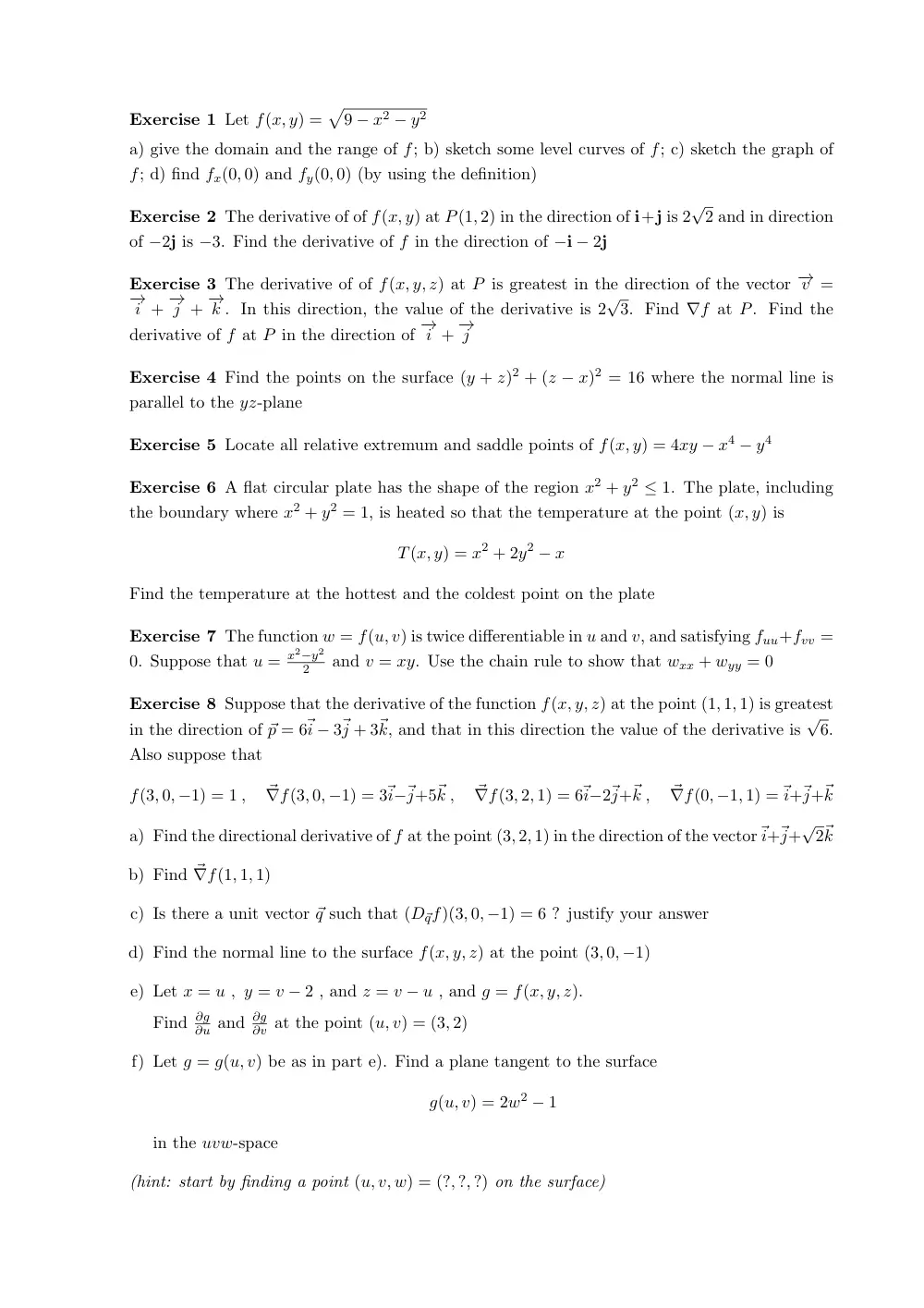
Exercise 1 Let f(x, y) =
√
9 − x2 − y2
a) give the domain and the range of f; b) sketch some level curves of f; c) sketch the graph of
f; d) find fx(0, 0) and fy(0, 0) (by using the definition)
Exercise 2 The derivative of of f(x, y) at P(1, 2) in the direction of i+j is 2
√
2 and in direction
of −2j is −3. Find the derivative of f in the direction of −i − 2j
Exercise 3 The derivative of of f(x, y, z) at P is greatest in the direction of the vector −→v =
−→i + −→j + −→k . In this direction, the value of the derivative is 2
√
3. Find ∇f at P. Find the
derivative of f at P in the direction of −→i + −→j
Exercise 4 Find the points on the surface (y + z)2 + (z − x)2 = 16 where the normal line is
parallel to the yz-plane
Exercise 5 Locate all relative extremum and saddle points of f(x, y) = 4xy − x4 − y4
Exercise 6 A flat circular plate has the shape of the region x2 + y2 ≤ 1. The plate, including
the boundary where x2 + y2 = 1, is heated so that the temperature at the point (x, y) is
T(x, y) = x2 + 2y2 − x
Find the temperature at the hottest and the coldest point on the plate
Exercise 7 The function w = f(u, v) is twice differentiable in u and v, and satisfying fuu+fvv =
0. Suppose that u = x2−y2
2
and v = xy. Use the chain rule to show that wxx + wyy = 0
Exercise 8 Suppose that the derivative of the function f(x, y, z) at the point (1, 1, 1) is greatest
in the direction of ⃗p = 6⃗i − 3⃗j + 3⃗k, and that in this direction the value of the derivative is
√
6.
Also suppose that
f(3, 0, −1) = 1 ,
⃗∇f(3, 0, −1) = 3⃗i−⃗j+5⃗k ,
⃗∇f(3, 2, 1) = 6⃗i−2⃗j+⃗k ,
⃗∇f(0, −1, 1) =⃗i+⃗j+⃗k
a) Find the directional derivative of f at the point (3, 2, 1) in the direction of the vector⃗i+⃗j+
√
2⃗k
b) Find ⃗∇f(1, 1, 1)
c) Is there a unit vector ⃗q such that (D⃗qf)(3, 0, −1) = 6 ? justify your answer
d) Find the normal line to the surface f(x, y, z) at the point (3, 0, −1)
e) Let x = u , y = v − 2 , and z = v − u , and g = f(x, y, z).
Find ∂g
∂u and ∂g
∂v at the point (u, v) = (3, 2)
f) Let g = g(u, v) be as in part e). Find a plane tangent to the surface
g(u, v) = 2w2 − 1
in the uvw-space
(hint: start by finding a point (u, v, w) = (?, ?, ?) on the surface)