
MATH 201 Problems Sample for Exam 2, Spring 2012
American University of Beirut · Calculus and Analytical Geometry III · 4 pages

More MATH 201 files
- Problems Difficult Problem 2 · Spring 2019ProblemsView
- Problems Combining Taylor Series with Triple Integrals · Spring 2019ProblemsView
- Problems Difficult Problem 8 Yamani · Spring 2019ProblemsView
- Problems Difficult Problem 6 Tlas 2017 Exam 1 · Spring 2019ProblemsView
- Problems Difficult Problem 3 · Spring 2019ProblemsView
- Problems Difficult Problem 7 Yamani · Spring 2019ProblemsView
- Problems Difficult Problem 4 · Spring 2019ProblemsView
- Problems Difficult Problem 10 · Spring 2019ProblemsView
Show the text of this problems
1) Let f(x, y) =
�
9 − x2 − y2
a) Give the domain and the range of f: Df = {(x, y) ∈ R2; x2+y2 ≤ 9}, and Range(f) = [0, 3]
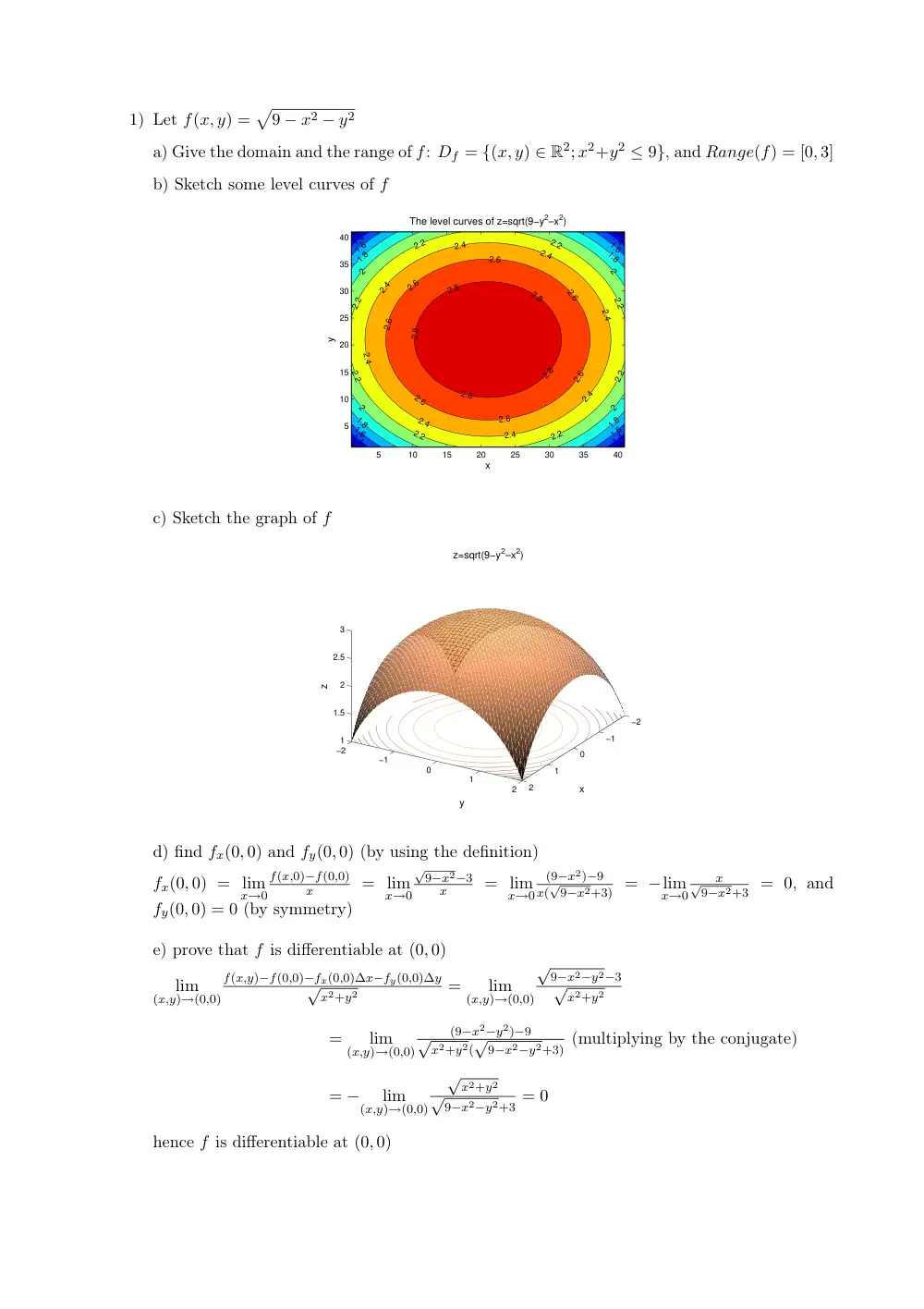
b) Sketch some level curves of f
1.4
1.4
1.4
1.4
1.6
1.6
1.6
1.6
1.8
1.8
1.8
1.8
2
2
2
2
2.2
2.2
2.2
2.2
2.2
2.2
2.2
2.2
2.4
2.4
2.4
2.4
2.4
2.4
2.4
2.4
2.6
2.6
2.6
2.6
2.6
2.6
2.6
2.8
2.8
2.8
2.8
2.8
The level curves of z=sqrt(9−y2–x2)
x
y
5
10
15
20
25
30
35
40
5
10
15
20
25
30
35
40
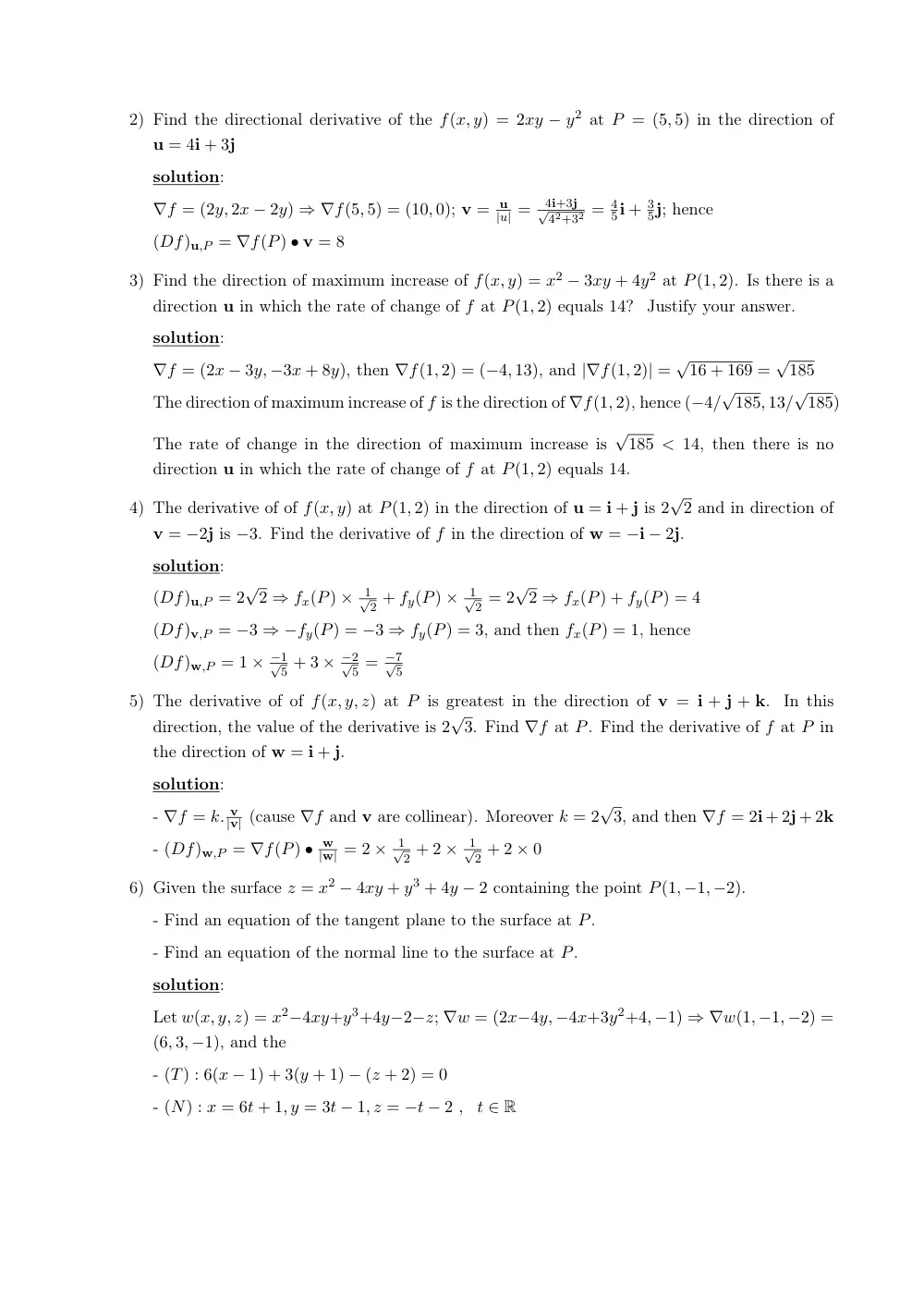
c) Sketch the graph of f
−2
−1
0
1
2
−2
−1
0
1
2
1
1.5
2
2.5
3
x
z=sqrt(9−y2–x2)
y
z
d) find fx(0, 0) and fy(0, 0) (by using the definition)
fx(0, 0) = lim
x→0
f(x,0)−f(0,0)
x
= lim
x→0
√
9−x2−3
x
= lim
x→0
(9−x2)−9
x(
√
9−x2+3) = −lim
x→0
x
√
9−x2+3 = 0, and
fy(0, 0) = 0 (by symmetry)
e) prove that f is differentiable at (0, 0)
lim
(x,y)→(0,0)
f(x,y)−f(0,0)−fx(0,0)∆x−fy(0,0)∆y
√
x2+y2
=
lim
(x,y)→(0,0)
√
9−x2−y2−3
√
x2+y2
=
lim
(x,y)→(0,0)
(9−x2−y2)−9
√
x2+y2(√
9−x2−y2+3) (multiplying by the conjugate)
= −
lim
(x,y)→(0,0)
√
x2+y2
√
9−x2−y2+3 = 0
hence f is differentiable at (0, 0)
2) Find the directional derivative of the f(x, y) = 2xy − y2 at P = (5, 5) in the direction of
u = 4i + 3j
solution:
∇f = (2y, 2x − 2y) ⇒ ∇f(5, 5) = (10, 0); v = u
|u| =
4i+3j
√
42+32 = 4
5i + 3
5j; hence
(Df)u,P = ∇f(P) • v = 8
3) Find the direction of maximum increase of f(x, y) = x2 − 3xy + 4y2 at P(1, 2). Is there is a
direction u in which the rate of change of f at P(1, 2) equals 14? Justify your answer.
solution:
∇f = (2x − 3y, −3x + 8y), then ∇f(1, 2) = (−4, 13), and |∇f(1, 2)| = √16 + 169 =
√
185
The direction of maximum increase of f is the direction of ∇f(1, 2), hence (−4/
√
185, 13/
√
185)
The rate of change in the direction of maximum increase is
√
185 < 14, then there is no
direction u in which the rate of change of f at P(1, 2) equals 14.
4) The derivative of of f(x, y) at P(1, 2) in the direction of u = i + j is 2
√
2 and in direction of
v = −2j is −3. Find the derivative of f in the direction of w = −i − 2j.
solution:
(Df)u,P = 2
√
2 ⇒ fx(P) ×
1
√
2 + fy(P) ×
1
√
2 = 2
√
2 ⇒ fx(P) + fy(P) = 4
(Df)v,P = −3 ⇒ −fy(P) = −3 ⇒ fy(P) = 3, and then fx(P) = 1, hence
(Df)w,P = 1 × −1
√
5 + 3 × −2
√
5 = −7
√
5
5) The derivative of of f(x, y, z) at P is greatest in the direction of v = i + j + k. In this
direction, the value of the derivative is 2
√
3. Find ∇f at P. Find the derivative of f at P in
the direction of w = i + j.
solution:
- ∇f = k. v
|v| (cause ∇f and v are collinear). Moreover k = 2
√
3, and then ∇f = 2i + 2j + 2k
- (Df)w,P = ∇f(P) • w
|w| = 2 ×
1
√
2 + 2 ×
1
√
2 + 2 × 0
6) Given the surface z = x2 − 4xy + y3 + 4y − 2 containing the point P(1, −1, −2).
- Find an equation of the tangent plane to the surface at P.
- Find an equation of the normal line to the surface at P.
solution:
Let w(x, y, z) = x2−4xy+y3+4y−2−z; ∇w = (2x−4y, −4x+3y2+4, −1) ⇒ ∇w(1, −1, −2) =
(6, 3, −1), and the
- (T) : 6(x − 1) + 3(y + 1) − (z + 2) = 0
- (N) : x = 6t + 1, y = 3t − 1, z = −t − 2 ,
t ∈ R
7) Find parametric equation for the line tangent to the curve of intersection of the surfaces
xyz = 1 and x2 + 2y2 + 3z2 = 6 at the point P(1, 1, 1).
solution:
∇f = (yz, xz, xy) ⇒ ∇f(1, 1, 1) = (1, 1, 1) , and ∇g = (2x, 4y, 6z) ⇒ ∇g(1, 1, 1) = (2, 4, 6)
�������
i
j
k
1
1
1
2
4
6
�������
= 2i − 4j + 2k ⇒ tangent line T : x = 1 + 2t, y1 − 4t, z = 1 + 2t
8) By about how much will f(x, y, z) = ln
�
x2 + y2 + z2 change if the point p(x, y, z) moves
from P(3, 4, 12) a distance of 0.1 unit in the direction of u = 3i + 6j − 2k ?
solution:
the change df is given by df = (Df)u,P × ds; ∇f = (
x
x2+y2+z2 ,
y
x2+y2+z2 ,
z
x2+y2+z2 ), and
∇f(P) = ( 3
169,
4
169, 12
169)
(Df)u,P = ∇f(P) • u
|u| =
3
169 × 3
7 +
4
169 × 6
7 − 12
169 × 2
7 =
9
1183; then df = 0.9/1183 ≃ 0.0008
9) Locate all relative extrema and saddle points of f(x, y) = x3 − y3 − 2xy + 6.
solution:
critical points: (0, 0) (saddle point); (−2/3, 2/3) (local maximum) and the maximum is
f(−2/3, 2/3) = 120/27.
10) Locate all relative extrema and saddle points of f(x, y) = 4xy − x4 − y4.
solution:
The critical points are (0, 0) (saddle point); (1, 1) (local maximum) and f(1, 1) = 2; (−1, −1)
(local maximum) and f(−1, −1) = 2.
11) Find the absolute minimum and maximum values of f(x, y) = 3xy −6x−3y +7 on the closed
triangular region R whose vertices are (0, 0), (3, 0) and (0, 5).
solution:
critical point: ∂f/∂x = 3y − 3 and ∂f/∂y = −3x − 6, then the only critical point is (−2, 1)
on the path x = 0: g(y) = f(0, y) = −3y + 7, g′(y) = −3 ̸= 0,
on the path y = 0: h(x) = f(x, 0) = −6x + 7, h′(x) = −6 ̸= 0,
on the path y = 5 − 5
3x: k(x) = f(x, x) = −5x2 + 14x − 8, k′(x) = −10x + 14, k′(x) = 0 →
x = 7/5, and then y = 8/3
point
value
(-2,1)
9
(0,0)
7
(3,0)
-11
(0,5)
-8
(7/5,8/3)
81/5
The minimum is then equals to −11 at (3, 0); the maximum is equals to 81/5 at (7/5, 8/3)
12) Find the absolute minimum and maximum of the function f(x, y) = x2 + 2y2 − y − 1 over the
region R = {(x, y); x2 + y2 ≤ 1 , y ≥ 0}.
solution:
critical point: ∂f/∂x = 2x and ∂f/∂y = 4y − 1, then the only critical point is (0, 1/4)
on the path y = 0: g(x) = f(x, 0) = x2 − 1, g′(x) = 2x; g′(x) = 0 ⇒ x = 0, and then y = 0;
(0, 0) is also a critical point
on the semi circle x2 + y2 = 1 ⇒ x2 = 1 − y2:
h(y) = f(1 − y2, y) = y2 − y, h′(y) = 2y − 1, h′(y) = 0 → y = 1/2, and then x = ±
√
3/2
point
value
(0,1/4)
-9/8
(-1,0)
0
(1,0)
0
(0,0)
-1
(
√
3/2, 1/2)
1/2
(−
√
3/2, 1/2)
1/2
The minimum is then equals to −9/8 at (0, 1/4); the maximum is equals to 1/2 at (
√
3/2, 1/2)
and (−
√
3/2, 1/2).