
MATH 201 Questions, Fall 2005
American University of Beirut · Calculus and Analytical Geometry III · 8 pages · Prof. Nazih Nahlus




More MATH 201 files
- Problems Difficult Problem 2 · Spring 2019ProblemsView
- Problems Combining Taylor Series with Triple Integrals · Spring 2019ProblemsView
- Problems Difficult Problem 8 Yamani · Spring 2019ProblemsView
- Problems Difficult Problem 6 Tlas 2017 Exam 1 · Spring 2019ProblemsView
- Problems Difficult Problem 3 · Spring 2019ProblemsView
- Problems Difficult Problem 7 Yamani · Spring 2019ProblemsView
- Problems Difficult Problem 4 · Spring 2019ProblemsView
- Problems Difficult Problem 10 · Spring 2019ProblemsView
Show the text of this problems
Math 201
Math 201 Final Examination (Time: 2.5 hours)
Feb 1, 2006
N. Nahlus & H. Yamani
Name
I.D
Section Number
Part 1: (60/100 points:) 15 problems with 4 points each
Be Careful: Many problems have 2 parts (with 2 points each)
Circle your multiple choice answers & fill in the blanks (as in problem 1)
Penalty:
− /1 2
1) Let
∑
∞
=
+
+
1
0
sin
cos
2
n
n
n
nx
b
nx
a
a
be the Fourier series of
π
π
<
<
−
=
x
x on
f x
( )
.
(i) Fill in the blank:
∫
=
...
....
3
..... ...............
dx
b
.
(ii) A)
3b =
0 B)
3b =
2/ 5
C)
3b =
−2/5
D)
3b =
1/ 5
E)
3b =
−1/5
(F) None of the above
2) The series ∑
∞
=
+
−
1
5
ln
1
)1
(
n
n
n
n
is
(i) X) Convergent Y) Divergent
(ii) A) Absolutely convergent B) Conditionally convergent C) Divergent
Reminder: Answer both parts
3) The series ∑
∞
=
+
−
1
)
2
(
)1
(
n
n
n
n
n
is
A) Absolutely convergent B) Conditionally convergent C) Divergent
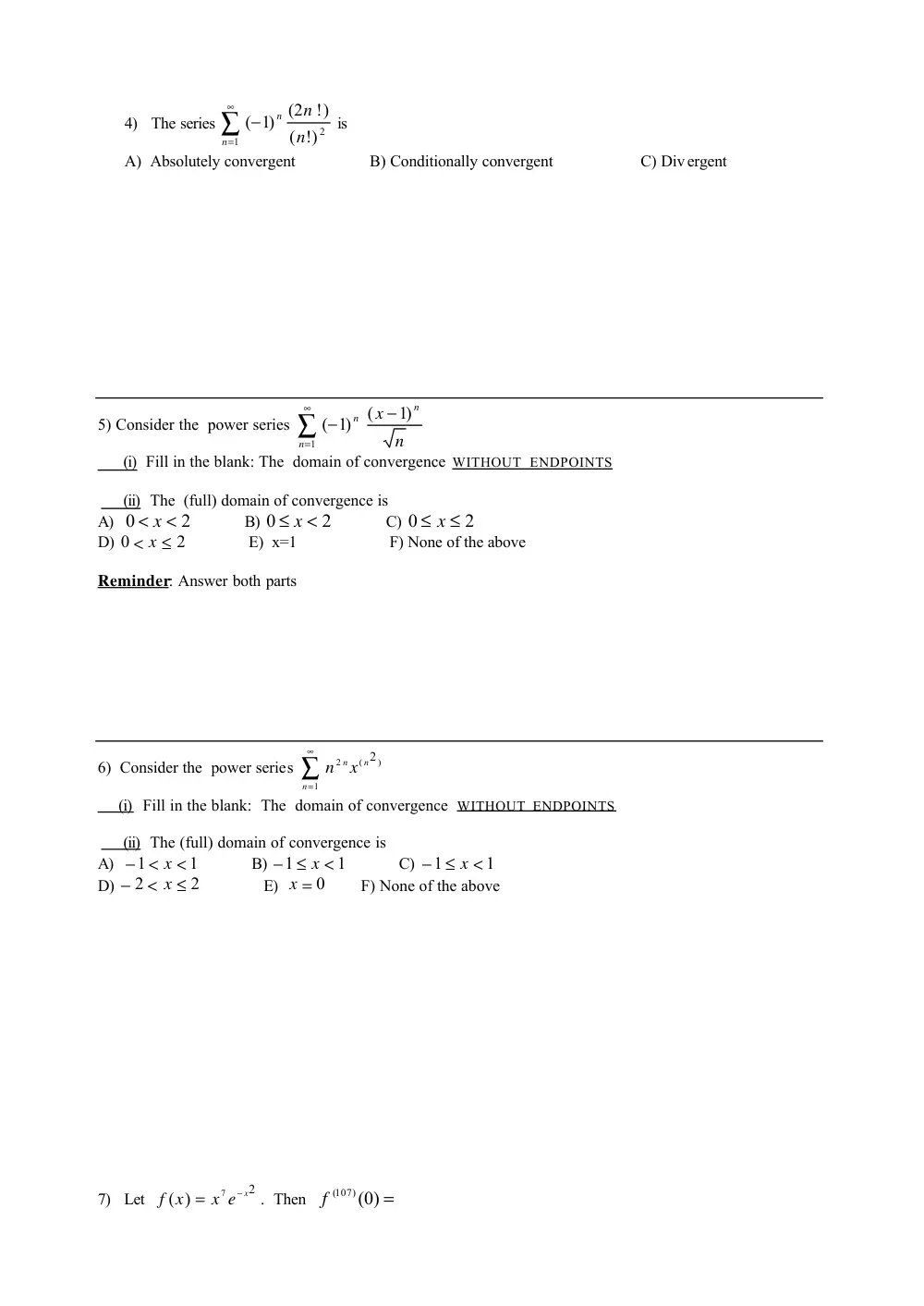
4) The series ∑
∞
=
−
1
2)!
(
)!
(2
)1
(
n
n
n
n
is
A) Absolutely convergent B) Conditionally convergent C) Divergent
5) Consider the power series ∑
∞
=
−
−
1
)1
(
)1
(
n
n
n
n
x
(i) Fill in the blank: The domain of convergence WITHOUT ENDPOINTS
(ii) The (full) domain of convergence is
A)
2
0
< x <
B)
2
0
≤ x <
C)
2
0
≤ x ≤
D)
2
0
< x ≤
E) x=1 F) None of the above
Reminder: Answer both parts
6) Consider the power series
)
(
1
2
2
n
n
n nx
∑
∞
=
(i) Fill in the blank: The domain of convergence WITHOUT ENDPOINTS
(ii) The (full) domain of convergence is
A)
1
1
<
− <
x
B)
1
1
<
− ≤
x
C)
1
1
<
− ≤
x
D)
2
2
≤
<
−
x
E)
x = 0
F) None of the above
7) Let
2
7
)
(
x e x
x
f
−
=
. Then
(f 107) (0) =
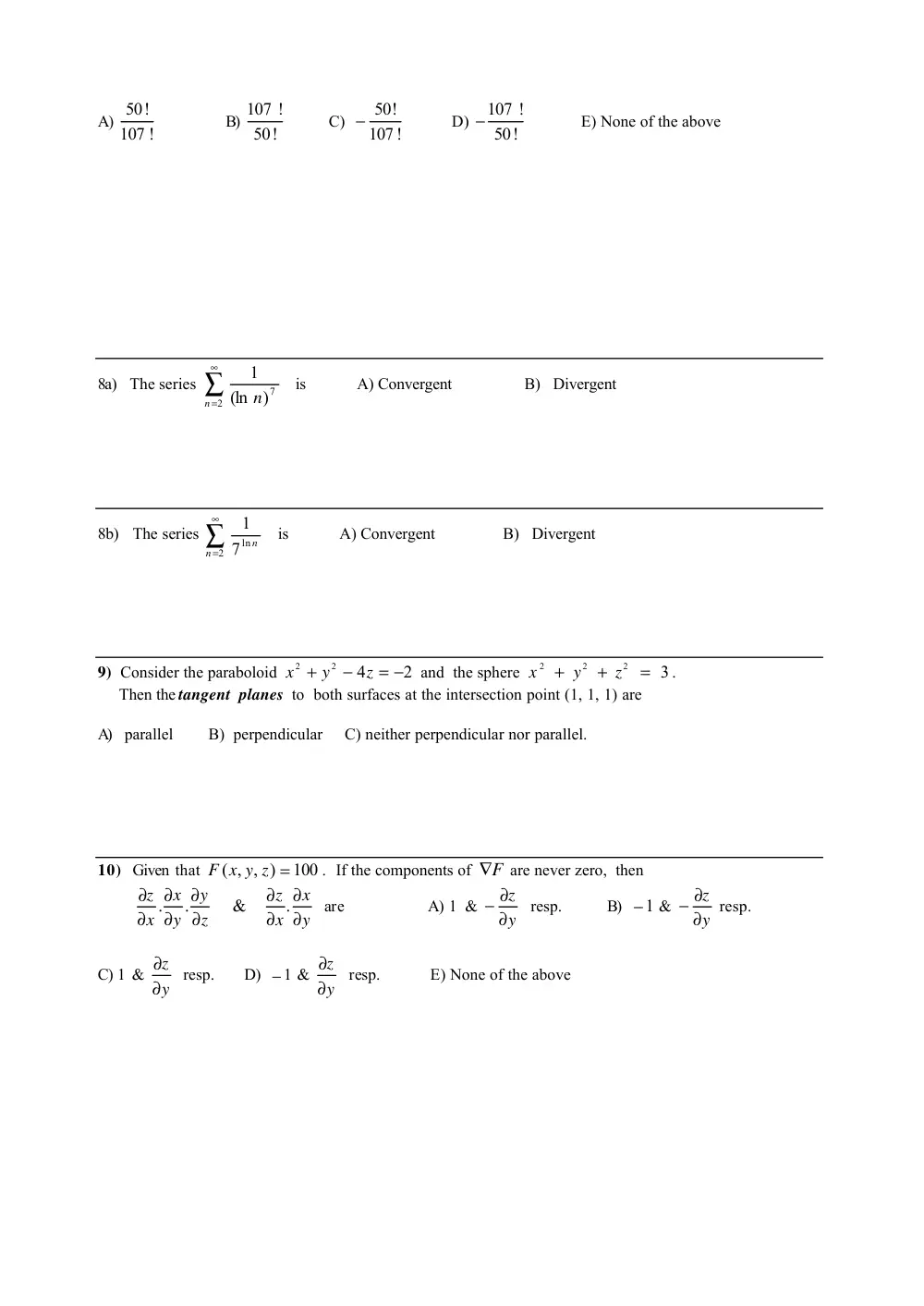
A)
107 !
50!
B)
50!
107 !
C)
107 !
− 50!
D)
50!
−107 !
E) None of the above
8a) The series ∑
∞
=2
7)
(ln
1
n
n
is A) Convergent B) Divergent
8b) The series ∑
∞
=2
7ln
1
n
n is A) Convergent B) Divergent
9) Consider the paraboloid
2
4
2
2
= −
−
+
z
y
x
and the sphere x
y
z
2
2
2
3
+
+
=
.
Then the tangent planes to both surfaces at the intersection point (1, 1, 1) are
A) parallel B) perpendicular C) neither perpendicular nor parallel.
10) Given that
100
( , , )
F x y z =
. If the components of ∇F are never zero, then
y
x
x
z
z
y
y
x
x
z
∂
∂
∂
∂
∂
∂
∂
∂
∂
∂
.
&
.
.
are A) 1 &
y
z
∂
− ∂
resp. B)
1
− &
y
z
∂
− ∂
resp.
C) 1 &
y
z
∂
∂ resp. D)
1
− &
y
z
∂
∂
resp. E) None of the above
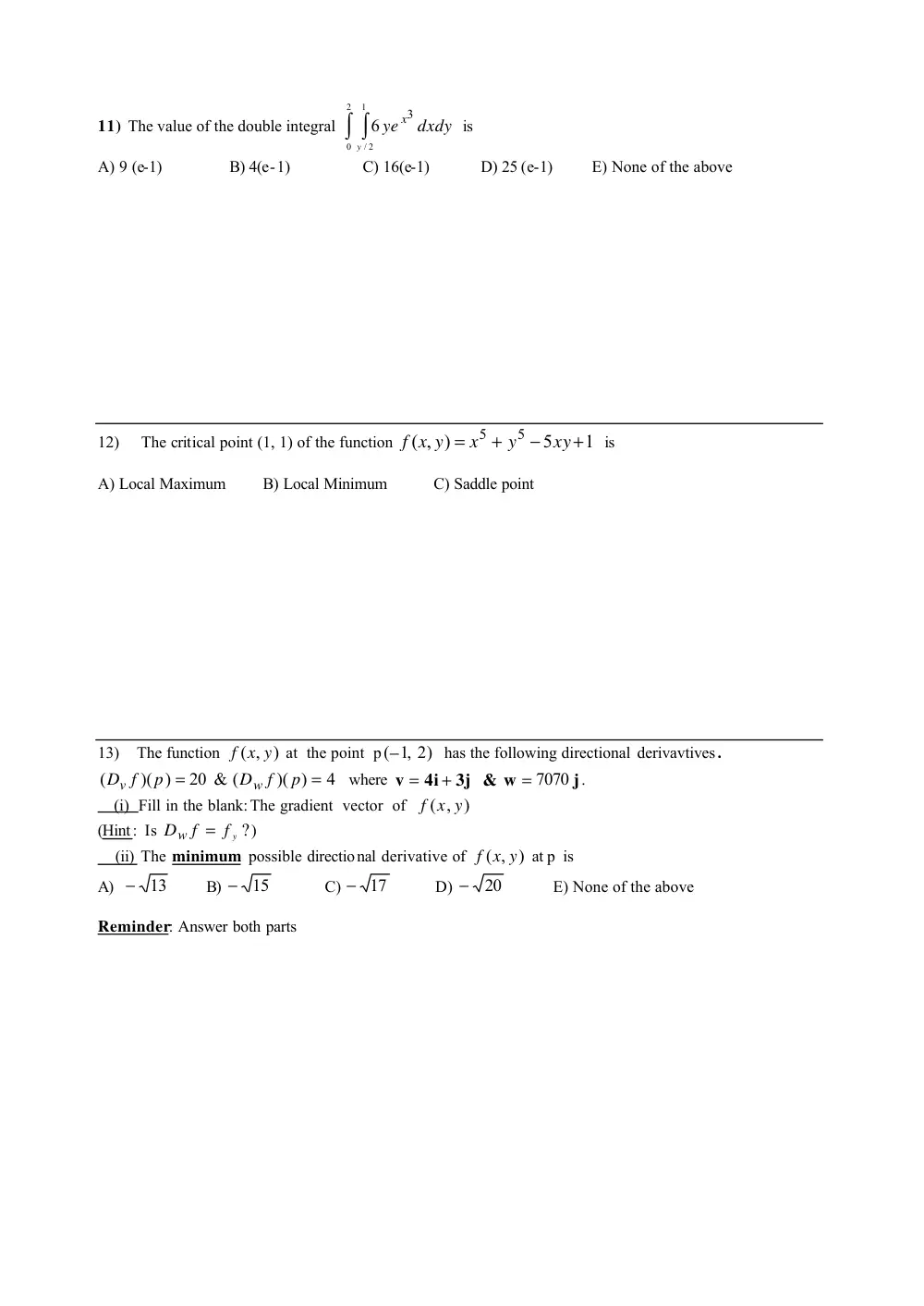
11) The value of the double integral ∫ ∫
2
0
1
2
/
3
6
y
dxdy
ye
x
is
A) 9 (e-1) B) 4(e-1) C) 16(e-1) D) 25 (e-1) E) None of the above
12) The critical point (1, 1) of the function
1
5
( , )
5
5
+
−
+
=
xy
y
x
f x y
is
A) Local Maximum B) Local Minimum C) Saddle point
13) The function
( , )
f x y
at the point p
(− ,1 2)
has the following directional derivavtives.
4
)( )
20 & (
)( )
(
=
=
p
f
D
p
f
D
w
v
where
j
3j & w
4i
v
= 7070
+
=
.
(i) Fill in the blank: The gradient vector of
( , )
f x y
(Hint: Is
yf ?
Dw f
=
)
(ii) The minimum possible directional derivative of
( , )
f x y
at p is
A)
13
−
B)
15
−
C)
17
−
D)
20
−
E) None of the above
Reminder: Answer both parts
14) Let
)
,
,
(
2
3
5
t
t
P = f t
where
)
( , ,
f u v w
is a differentiable function.
Suppose
2
)1,1,1(
=
f
& {
1 .0
)1,1,1(
5 and
)1,1,1(
,3 and
)1,1
,1(
=
= −
=
w
v
u
f
f
f
}.
Then
1
at
t =
,
dP / dt =
A) 20 B) 30 C) 40 D) 50 E) None of the above
15a)
1 )( cos 1 )
(sin
2
2
(0,0)
,
( lim
y
x
xy
x y
→
A) 0 B) does not exist
15b)
4
6
(0,0)
,
(
6
lim
y
x
xy
x y
+
→
A) 0 B) does not exist
Part 2 : (40 points) Subjective
16) (6 pts). Set up but do not evaluate the triple integral(s) in cylinderical coordinates
that represent the volume of the region bounded by the paraboloids
2
2
y
x
z
+
=
and
)
(
18
2
2
y
x
z
+
−
=
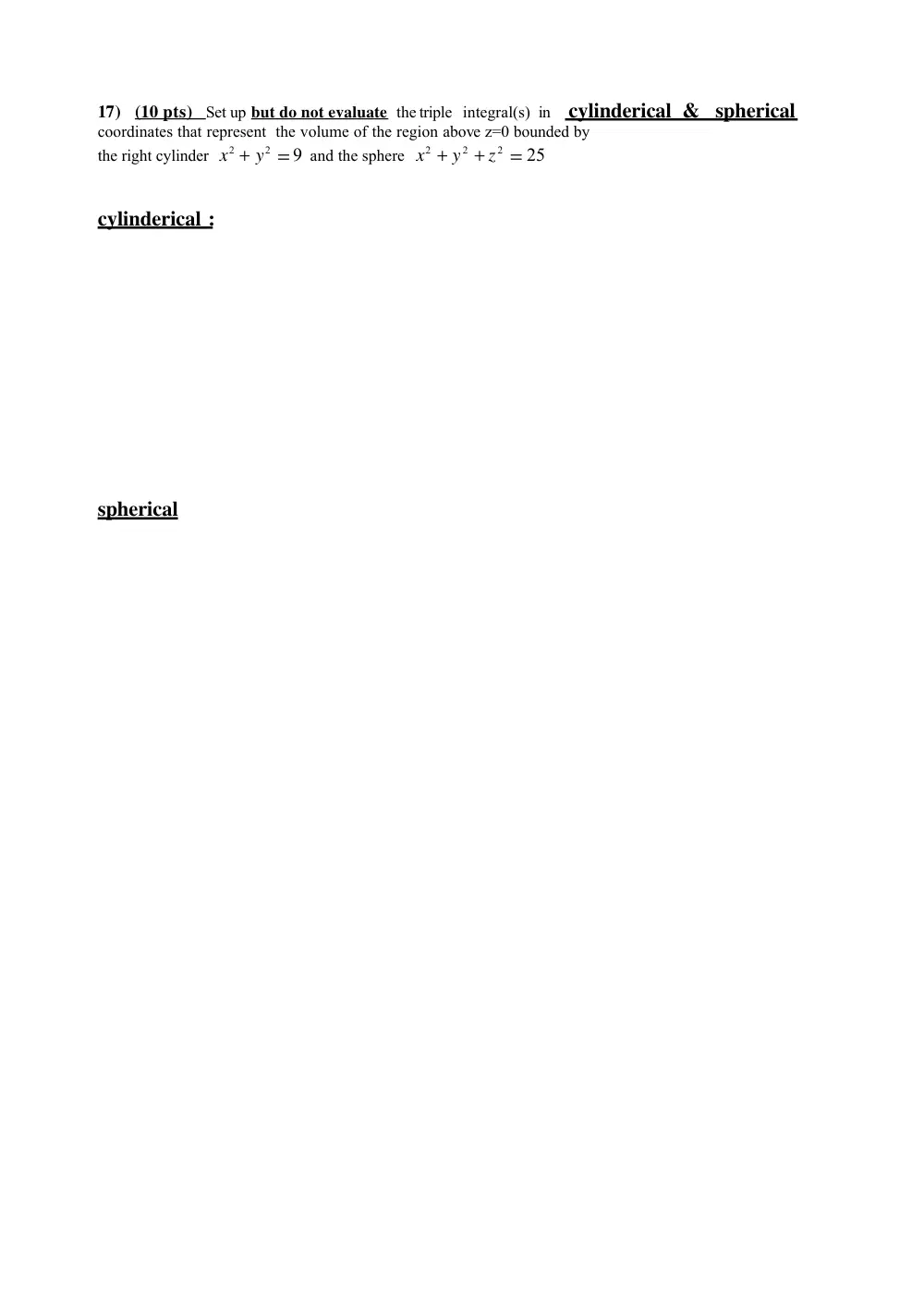
17) (10 pts) Set up but do not evaluate the triple integral(s) in cylinderical & spherical
coordinates that represent the volume of the region above z=0 bounded by
the right cylinder
9
2
2
x + y =
and the sphere
25
2
2
2
=
+
+
z
y
x
cylinderical :
spherical
3/ 2
2
= −
−
∫
C
xydy
y dx
where C is the square with vertices (0,0), (0,1), (1, 0), (1,1) (traced once and counter clockwise)
19) (3 pts)(i) Show that
4
2
5
5
)
(2
x y
x dx
xy
+
+
dy is an exact differential
(5 pts) (ii) Use part (i) to find (if possible) ∫
+
+
C
dy
x y
x dx
xy
4
2
5
5
)
(2
where C is
a very complicated curve from A(1,1) to B(2,5)
20) ( 3 pts) Find the Jacobian
, )
/)
( ,
r θ
x y
∂
∂
for the transformation
θ
θ
r
y
r
x
=
=
2
21) (5 pts) Find the absolute maximum & absolute minimum of the function
20
5
4
3
4
, , )
(
2
2
2
+
+
−
+
=
z
y
y
x
T x y z
on the ellipsoid
9
5
2
2
2
=
+
+
z
y
x
.
(Eliminate
2
5z OR use Lagrange method)