
MATH 202 Exam 1 SAMPLE006, Spring 2015
American University of Beirut · Differential Equations · 2 pages · Prof. Nazih Nahlus
More MATH 202 files
- Exam Solution to Sample Exam I · Spring 2019Exam · with solutionView
- Exam 2 Clean Copy · Spring 2019ExamView
- Exam 1 Quiz 1 Spring 18 · Spring 2019ExamView
- Exam 1 SAMPLE EXAM I · Spring 2019ExamView
- Midterm · Summer 2018ExamView
- Exam 1 Quiz 1 2007 · Spring 2017ExamView
- Exam 1 · Fall 2017ExamView
- Exam 1 Quiz 1 2008 with Solution · Spring 2017Exam · with solutionView
Show the text of this exam
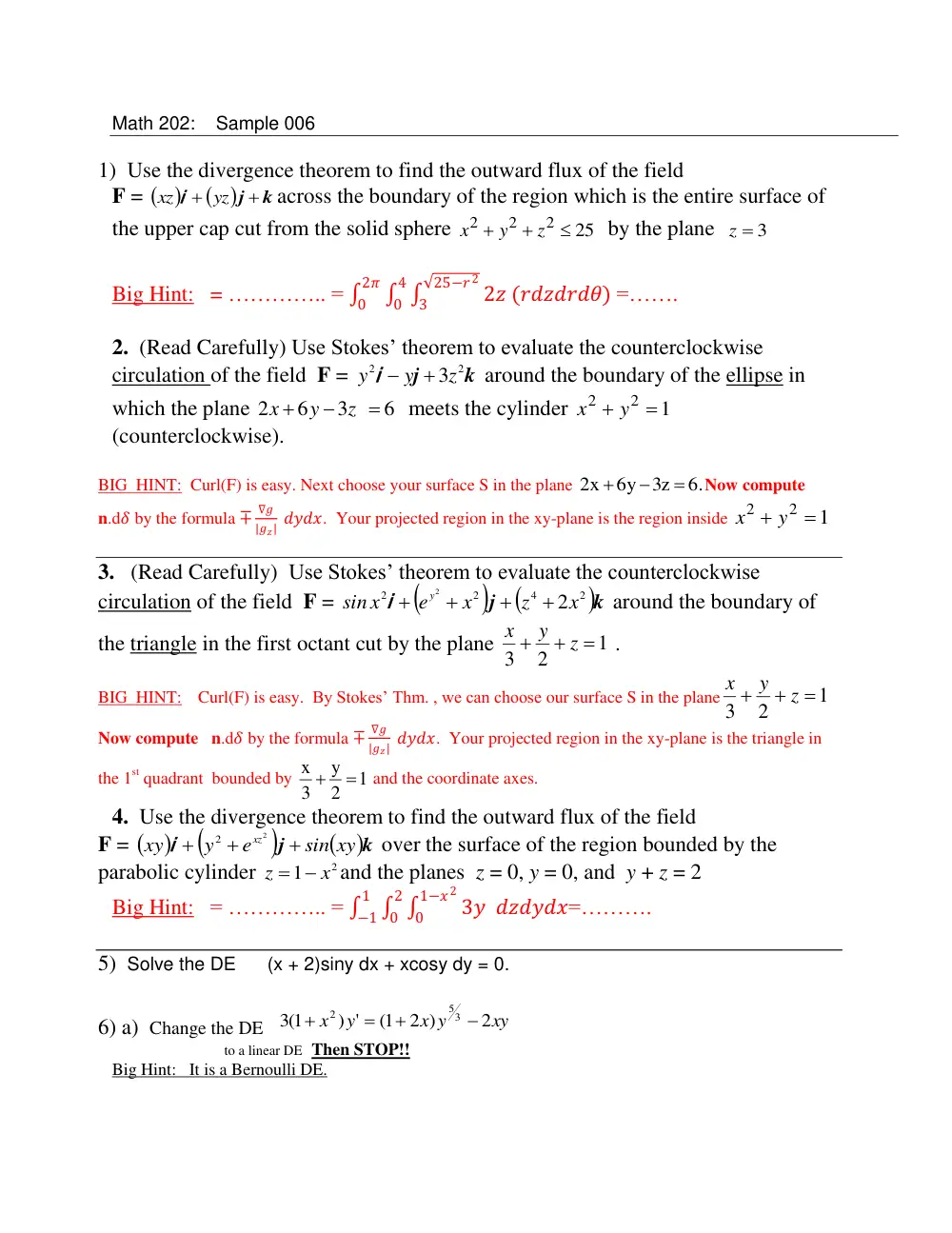
Math 202: Sample 006
1) Use the divergence theorem to find the outward flux of the field
F =
xz i yz j k
across the boundary of the region which is the entire surface of
the upper cap cut from the solid sphere
25
2
2
2
z
y
x
by the plane
z 3
Big Hint: = ………….. =
2𝑧 (𝑟𝑑𝑧𝑑𝑟𝑑𝜃)
25−𝑟2
3
4
0
2𝜋
0
=…….
2. (Read Carefully) Use Stokes’ theorem to evaluate the counterclockwise
circulation of the field F =
k
j
2
2
3z
y
y
i
around the boundary of the ellipse in
which the plane
6
3
6
2
z
y
x
meets the cylinder
1
2
2
x y
(counterclockwise).
BIG HINT: Curl(F) is easy. Next choose your surface S in the plane
.6
3z
6y
2x
Now compute
n.d𝛿 by the formula ∓
∇𝑔
|𝑔𝑧| 𝑑𝑦𝑑𝑥. Your projected region in the xy-plane is the region inside
1
2
2
y
x
3. (Read Carefully) Use Stokes’ theorem to evaluate the counterclockwise
circulation of the field F =
k
j
2
4
2
2
2
2
x
z
x
e
x
sin
y
i
around the boundary of
the triangle in the first octant cut by the plane
1
2
3
z
y
x
.
BIG HINT: Curl(F) is easy. By Stokes’ Thm. , we can choose our surface S in the plane
1
2
3
z
y
x
Now compute n.d𝛿 by the formula ∓
∇𝑔
|𝑔𝑧| 𝑑𝑦𝑑𝑥. Your projected region in the xy-plane is the triangle in
the 1st quadrant bounded by
1
2
y
3
x
and the coordinate axes.
4. Use the divergence theorem to find the outward flux of the field
F =
k
j
sin xy
e
y
xy
xz
2
2
i
over the surface of the region bounded by the
parabolic cylinder
2
1
x
z
and the planes z = 0, y = 0, and y + z = 2
Big Hint: = ………….. =
3𝑦 𝑑𝑧𝑑𝑦𝑑𝑥
1−𝑥2
0
2
0
1
−1
=……….
5) Solve the DE (x + 2)siny dx + xcosy dy = 0.
6) a) Change the DE
xy
x y
y
x
2
2 )
1(
) '
3 1(
53
2
to a linear DE Then STOP!!
Big Hint: It is a Bernoulli DE.
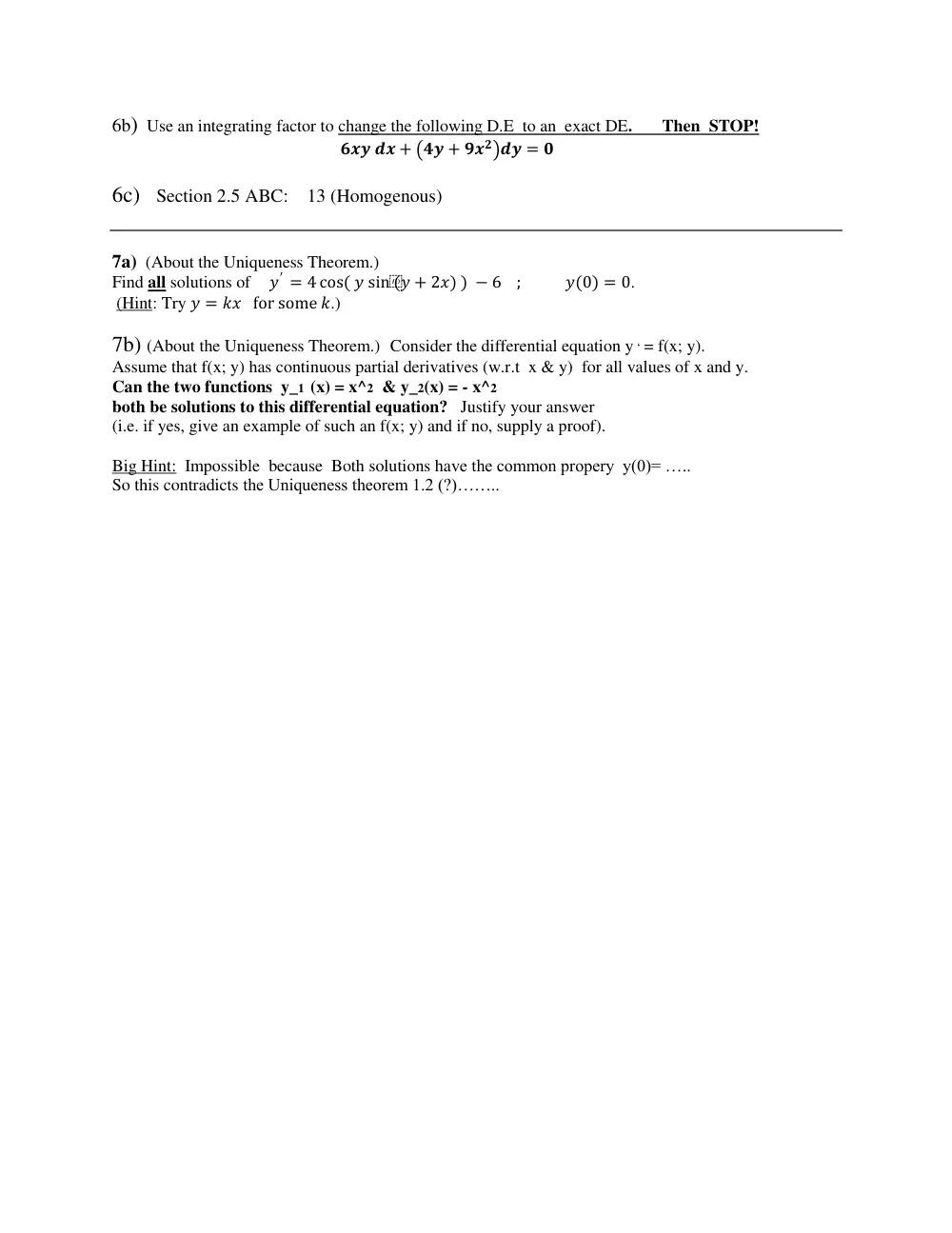
6b) Use an integrating factor to change the following D.E to an exact DE. Then STOP!
𝟔𝒙𝒚 𝒅𝒙 + 𝟒𝒚 + 𝟗𝒙𝟐 𝒅𝒚 = 𝟎
6c) Section 2.5 ABC: 13 (Homogenous)
7a) (About the Uniqueness Theorem.)
Find all solutions of 𝑦′ = 4 cos 𝑦 sin(𝑦 + 2𝑥) − 6 ; 𝑦 0 = 0.
(Hint: Try 𝑦 = 𝑘𝑥 for some 𝑘.)
7b) (About the Uniqueness Theorem.) Consider the differential equation y ‘ = f(x; y).
Assume that f(x; y) has continuous partial derivatives (w.r.t x & y) for all values of x and y.
Can the two functions y_1 (x) = x^2 & y_2(x) = - x^2
both be solutions to this differential equation? Justify your answer
(i.e. if yes, give an example of such an f(x; y) and if no, supply a proof).
Big Hint: Impossible because Both solutions have the common propery y(0)= …..
So this contradicts the Uniqueness theorem 1.2 (?)……..