
MATH 202 Exam 1, Spring 2002
American University of Beirut · Differential Equations · 8 pages


More MATH 202 files
- Exam Solution to Sample Exam I · Spring 2019Exam · with solutionView
- Exam 2 Clean Copy · Spring 2019ExamView
- Exam 1 Quiz 1 Spring 18 · Spring 2019ExamView
- Exam 1 SAMPLE EXAM I · Spring 2019ExamView
- Midterm · Summer 2018ExamView
- Exam 1 Quiz 1 2007 · Spring 2017ExamView
- Exam 1 · Fall 2017ExamView
- Exam 1 Quiz 1 2008 with Solution · Spring 2017Exam · with solutionView
Show the text of this exam
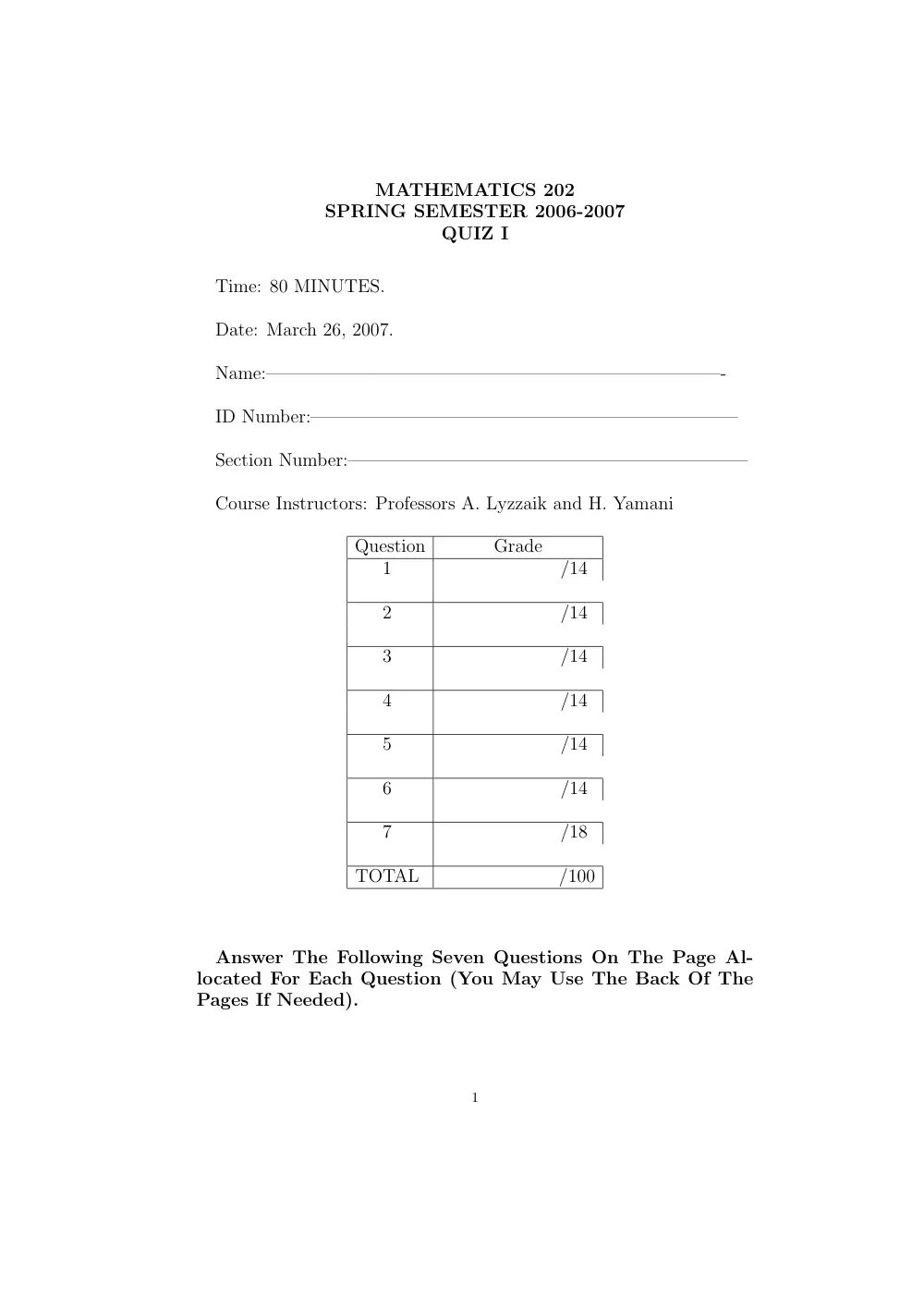
MATHEMATICS 202
SPRING SEMESTER 2006-2007
QUIZ I
Time: 80 MINUTES.
Date: March 26, 2007.
Name:—————————————————————————-
ID Number:———————————————————————–
Section Number:——————————————————————
Course Instructors: Professors A. Lyzzaik and H. Yamani
Question
Grade
1
/14
2
/14
3
/14
4
/14
5
/14
6
/14
7
/18
TOTAL
/100
Answer The Following Seven Questions On The Page Al-
located For Each Question (You May Use The Back Of The
Pages If Needed).
1
2
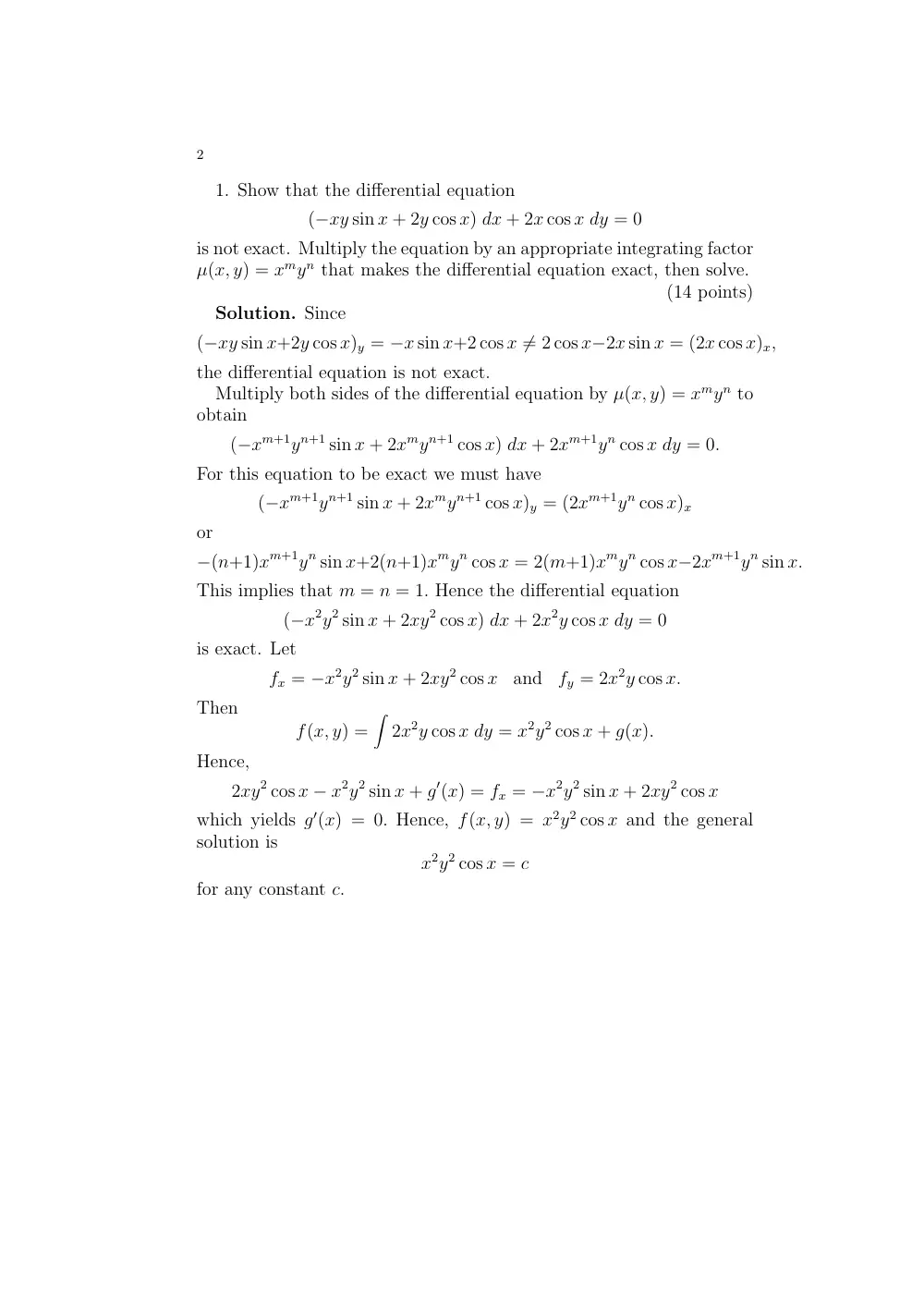
1. Show that the differential equation
(−xy sin x + 2y cos x) dx + 2x cos x dy = 0
is not exact. Multiply the equation by an appropriate integrating factor
µ(x, y) = xmyn that makes the differential equation exact, then solve.
(14 points)
Solution. Since
(−xy sin x+2y cos x)y = −x sin x+2 cos x ̸= 2 cos x−2x sin x = (2x cos x)x,
the differential equation is not exact.
Multiply both sides of the differential equation by µ(x, y) = xmyn to
obtain
(−xm+1yn+1 sin x + 2xmyn+1 cos x) dx + 2xm+1yn cos x dy = 0.
For this equation to be exact we must have
(−xm+1yn+1 sin x + 2xmyn+1 cos x)y = (2xm+1yn cos x)x
or
−(n+1)xm+1yn sin x+2(n+1)xmyn cos x = 2(m+1)xmyn cos x−2xm+1yn sin x.
This implies that m = n = 1. Hence the differential equation
(−x2y2 sin x + 2xy2 cos x) dx + 2x2y cos x dy = 0
is exact. Let
fx = −x2y2 sin x + 2xy2 cos x
and
fy = 2x2y cos x.
Then
f(x, y) =
�
2x2y cos x dy = x2y2 cos x + g(x).
Hence,
2xy2 cos x − x2y2 sin x + g′(x) = fx = −x2y2 sin x + 2xy2 cos x
which yields g′(x) = 0. Hence, f(x, y) = x2y2 cos x and the general
solution is
x2y2 cos x = c
for any constant c.
3
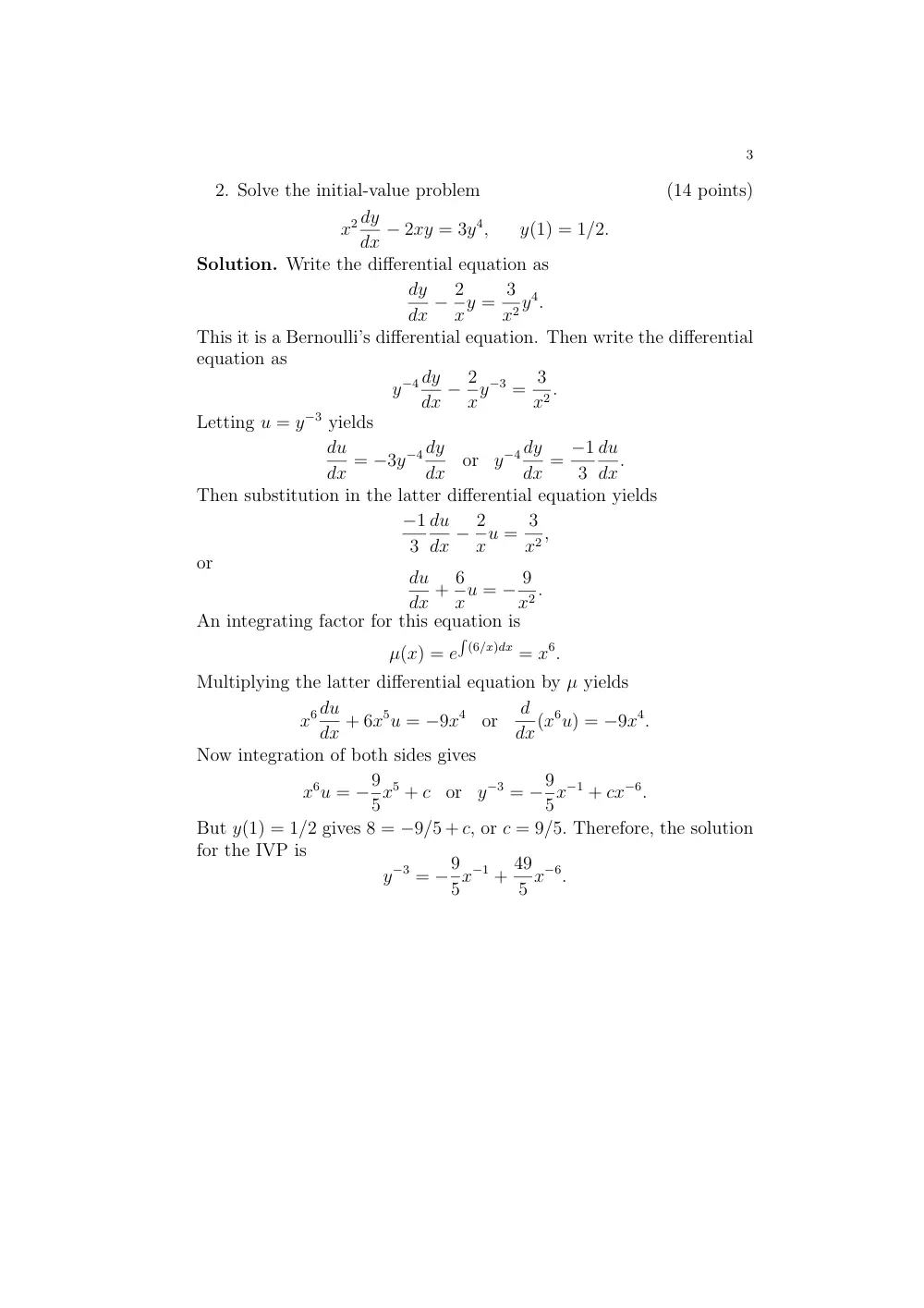
2. Solve the initial-value problem
(14 points)
x2 dy
dx − 2xy = 3y4,
y(1) = 1/2.
Solution. Write the differential equation as
dy
dx − 2
xy = 3
x2y4.
This it is a Bernoulli’s differential equation. Then write the differential
equation as
y−4 dy
dx − 2
xy−3 = 3
x2.
Letting u = y−3 yields
du
dx = −3y−4 dy
dx
or
y−4 dy
dx = −1
3
du
dx.
Then substitution in the latter differential equation yields
−1
3
du
dx − 2
xu = 3
x2,
or
du
dx + 6
xu = − 9
x2.
An integrating factor for this equation is
µ(x) = e
�
(6/x)dx = x6.
Multiplying the latter differential equation by µ yields
x6du
dx + 6x5u = −9x4
or
d
dx(x6u) = −9x4.
Now integration of both sides gives
x6u = −9
5x5 + c
or
y−3 = −9
5x−1 + cx−6.
But y(1) = 1/2 gives 8 = −9/5 + c, or c = 9/5. Therefore, the solution
for the IVP is
y−3 = −9
5x−1 + 49
5 x−6.
4
3. Solve the initial-value problem
(14 points)
�y
x − x2
y2
�
dx − dy = 0,
y(1) = 2.
Solution. Write the differential equation as
(y3 − x3)dx − xy2 dy = 0.
Thus this is a homogeneous differential equation. If
y = ux,
then
dy = u dx + x du.
Then substitution in the latter differential equation yields
x3(u3 − 1)dx − x3u2(u dx + x du) = 0,
or
(u3 − 1)dx − u2(u dx + x du) = 0,
or
dx + xu2 du = 0.
Write this differential equation as
u2 du + dx
x = 0,
then integrate both sides to obtain
1
3u3 + ln |x| = c,
or
y3
3x3 + ln |x| = c.
But y(1) = 2 yields c = 8/3. Therefore, the solution for the IVP is
y3 + 3x3 ln |x| = 8x3.
5
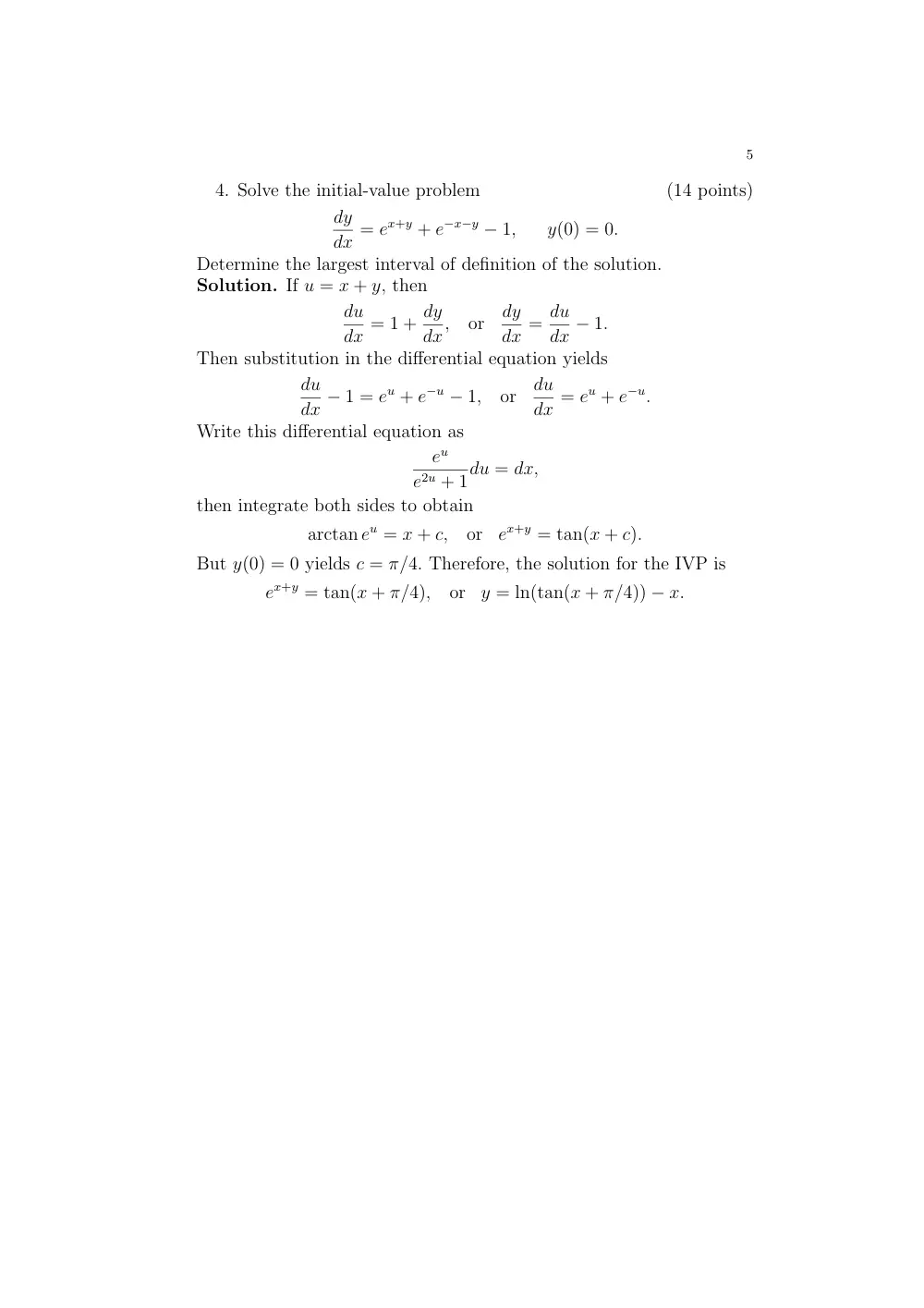
4. Solve the initial-value problem
(14 points)
dy
dx = ex+y + e−x−y − 1,
y(0) = 0.
Determine the largest interval of definition of the solution.
Solution. If u = x + y, then
du
dx = 1 + dy
dx,
or
dy
dx = du
dx − 1.
Then substitution in the differential equation yields
du
dx − 1 = eu + e−u − 1,
or
du
dx = eu + e−u.
Write this differential equation as
eu
e2u + 1du = dx,
then integrate both sides to obtain
arctan eu = x + c,
or
ex+y = tan(x + c).
But y(0) = 0 yields c = π/4. Therefore, the solution for the IVP is
ex+y = tan(x + π/4),
or
y = ln(tan(x + π/4)) − x.
6
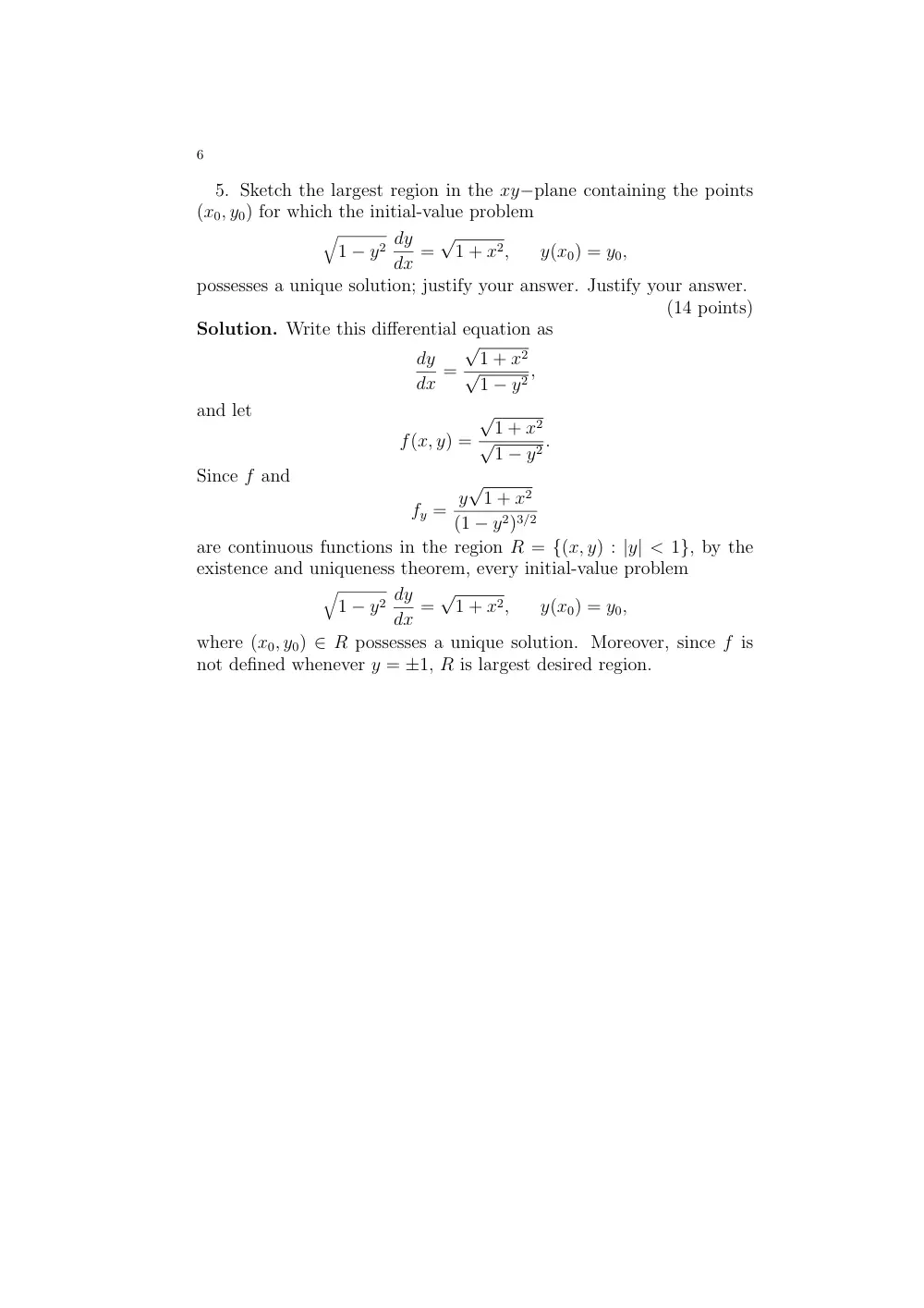
5. Sketch the largest region in the xy−plane containing the points
(x0, y0) for which the initial-value problem
�
1 − y2 dy
dx =
√
1 + x2,
y(x0) = y0,
possesses a unique solution; justify your answer. Justify your answer.
(14 points)
Solution. Write this differential equation as
dy
dx =
√
1 + x2
√1 − y2 ,
and let
f(x, y) =
√
1 + x2
√1 − y2 .
Since f and
fy = y
√
1 + x2
(1 − y2)3/2
are continuous functions in the region R = {(x, y) : |y| < 1}, by the
existence and uniqueness theorem, every initial-value problem
�
1 − y2 dy
dx =
√
1 + x2,
y(x0) = y0,
where (x0, y0) ∈ R possesses a unique solution. Moreover, since f is
not defined whenever y = ±1, R is largest desired region.
7
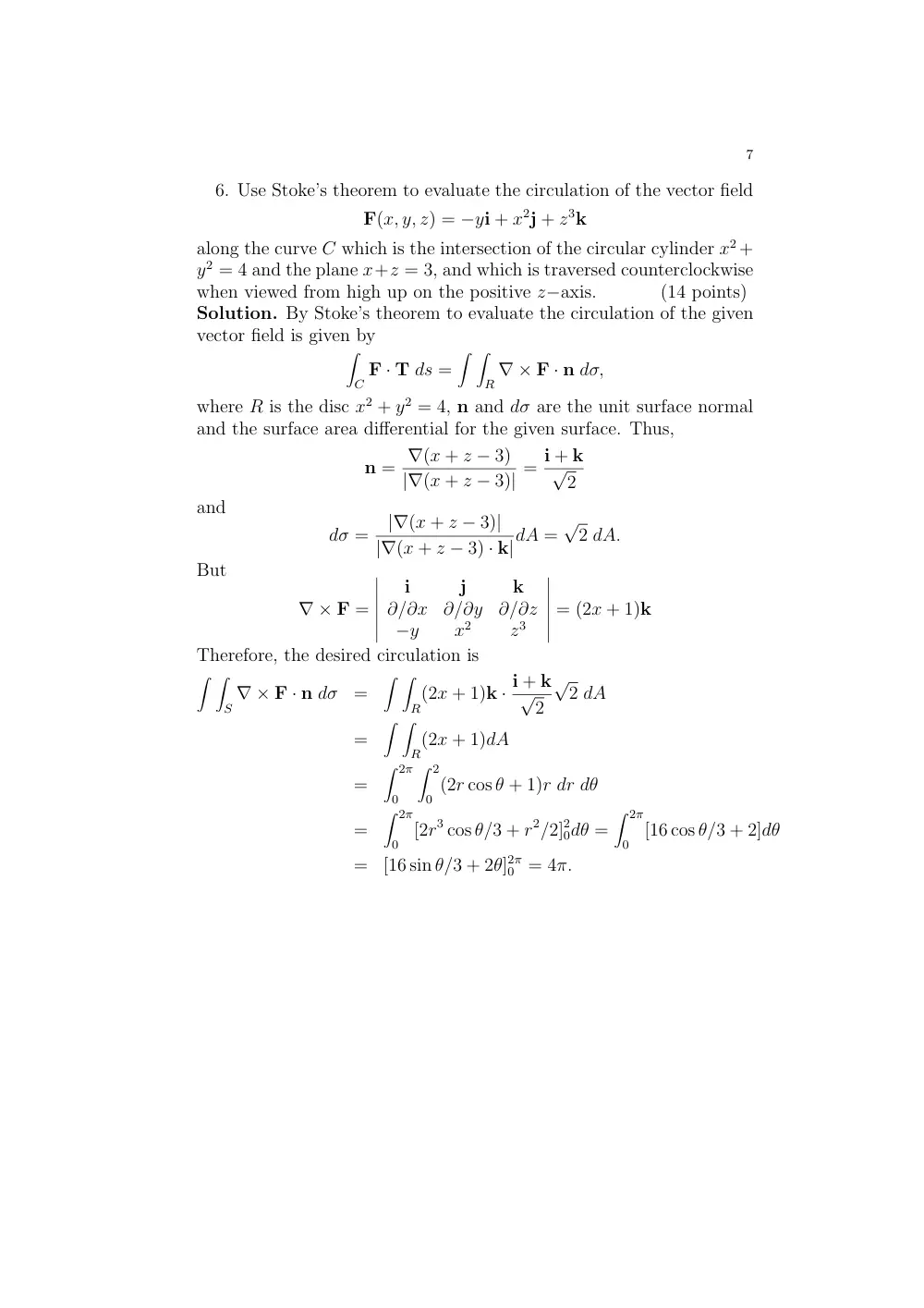
6. Use Stoke’s theorem to evaluate the circulation of the vector field
F(x, y, z) = −yi + x2j + z3k
along the curve C which is the intersection of the circular cylinder x2 +
y2 = 4 and the plane x+z = 3, and which is traversed counterclockwise
when viewed from high up on the positive z−axis.
(14 points)
Solution. By Stoke’s theorem to evaluate the circulation of the given
vector field is given by
�
C F · T ds =
� �
R ∇ × F · n dσ,
where R is the disc x2 + y2 = 4, n and dσ are the unit surface normal
and the surface area differential for the given surface. Thus,
n = ∇(x + z − 3)
|∇(x + z − 3)| = i + k
√
2
and
dσ =
|∇(x + z − 3)|
|∇(x + z − 3) · k|dA =
√
2 dA.
But
∇ × F =
�������
i
j
k
∂/∂x
∂/∂y
∂/∂z
−y
x2
z3
�������
= (2x + 1)k
Therefore, the desired circulation is
� �
S ∇ × F · n dσ
=
� �
R(2x + 1)k · i + k
√
2
√
2 dA
=
� �
R(2x + 1)dA
=
� 2π
0
� 2
0 (2r cos θ + 1)r dr dθ
=
� 2π
0
[2r3 cos θ/3 + r2/2]2
0dθ =
� 2π
0
[16 cos θ/3 + 2]dθ
=
[16 sin θ/3 + 2θ]2π
0 = 4π.
8
7. Evaluate in two different ways the flux of the vector field
F(x, y, z) = xi + yj + zk
across the surface S which is the portion of the paraboloid z = 4−x2−y2
above the xy−plane (n is upward-oriented so that its z−component is
positive).
(16 points)
Solution.
By taking z = 0 in the equation of the paraboloid, we
conclude that the paraboloid meets the xy−plane in the circle x2+y2 =
4. The desired flux is given by
� �
S F · n dσ, where dσ is the surface
area differential for the paraboloid and
n = ∇(x2 + y2 + z − 4)
|∇(x2 + y2 + z − 4)| =
2xi + 2yj + k
√4x2 + 4y2 + 1.
Thus the flux is
� �
S F · n dσ =
� �
S
x2 + y2 + 4
√4x2 + 4y2 + 1 dσ.
Now we find dσ in two ways:
(a)
dσ =
|∇(x2 + y2 + z − 4)|
|∇(x2 + y2 + z − 4) · k| dA = (4x2 + 4y2 + 1) dA.
In this case, the flux is
� �
S F · n dσ
=
� �
R(x2 + y2 + 4) dA
=
� 2π
0
� 2
0 (r2 + 4)r dr dθ
=
16π.
(b) dσ = |rr × rθ|drdθ, where
r(r, θ) = (r cos θ)i + (r sin θ)j + (4 − r2)k.
Then
rr × rθ =
�������
i
j
k
cos θ
sin θ
−2r
−r sin θ
r cos θ
0
�������
,
and
rr × rθ = (2r2 cos θ)i + (2r2 sin θ)j + rk.
Thus, dσ =
√
4r4 + r2 dr dθ =
√
4r2 + 1 rdr dθ. The rest of the work
goes as in (a).