
MATH 202 Exam 1 with Solution
American University of Beirut · Differential Equations · 4 pages · with solution
More MATH 202 files
- Exam Solution to Sample Exam I · Spring 2019Exam · with solutionView
- Exam 2 Clean Copy · Spring 2019ExamView
- Exam 1 Quiz 1 Spring 18 · Spring 2019ExamView
- Exam 1 SAMPLE EXAM I · Spring 2019ExamView
- Midterm · Summer 2018ExamView
- Exam 1 Quiz 1 2007 · Spring 2017ExamView
- Exam 1 · Fall 2017ExamView
- Exam 1 Quiz 1 2008 with Solution · Spring 2017Exam · with solutionView
Show the text of this exam
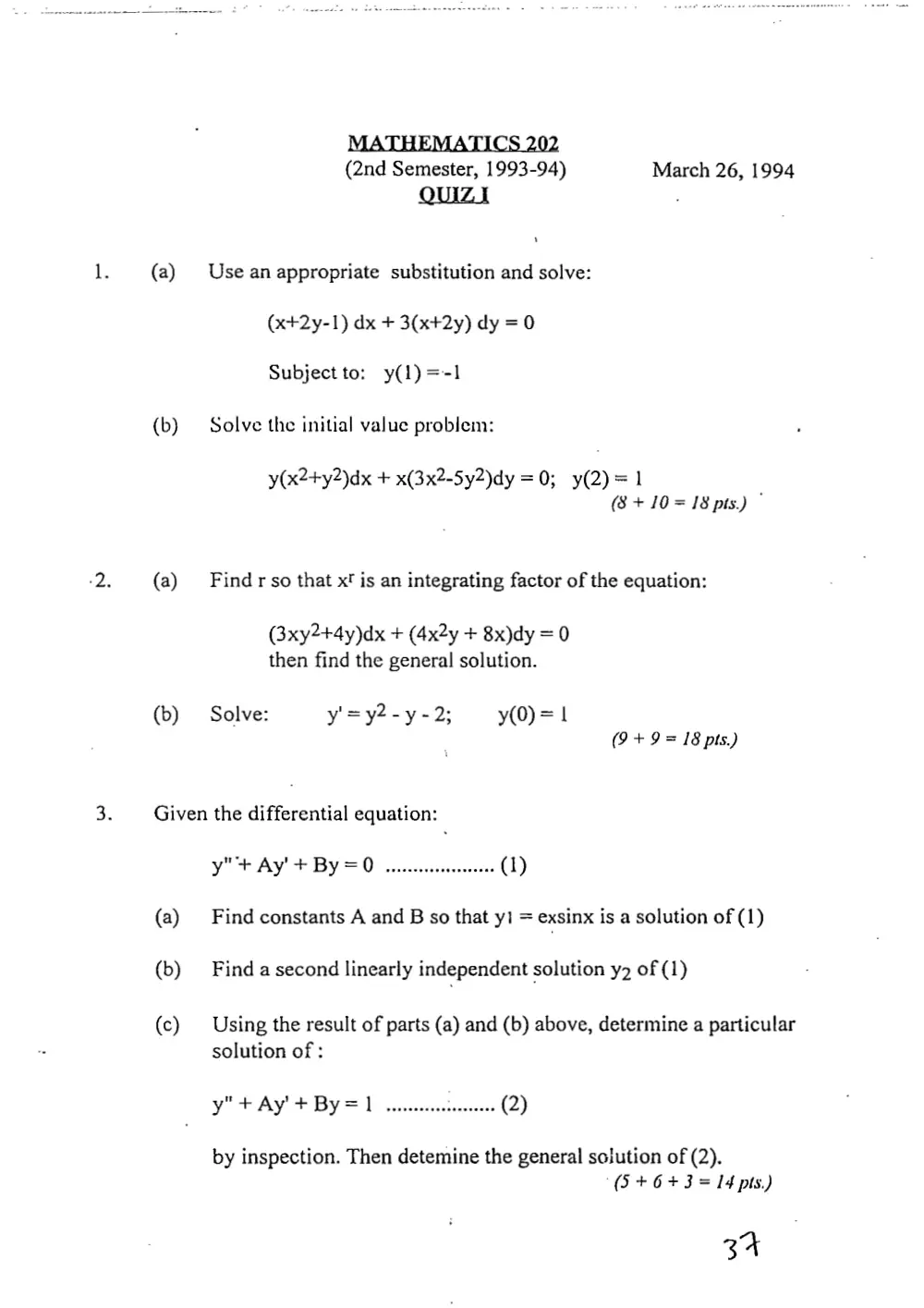
lL. (a)
(b)
2. (a)
(b)
3.
(a)
(b)
(c)
MATHEMATICS 202
(2nd Semester, 1993-94) March 26, 1994
QUIZ 1
1
Use an appropriate substitution and solve:
(x+2y-1) dx + 3(x+2y) dy =0
Subject to: y(1)=-1
Solve the initial value problem:
y(x2+y2)dx + x(3x2-S5y2)dy =0; y(2)=1
(8+ 10 = 18 pts) ©
Find r so that x! is an integrating factor of the equation:
(3xy2+4y)dx + (4x2y + 8x)dy =0
then find the general solution.
Solve: y=y2-y-2; y(0)=1
(9+9= 18 pts.)
Given the differential equation:
y" + Ay! + By =0 wee (1)
Find constants A and B so that y1 = exsinx is a solution of (1)
Find a second linearly independent solution y2 of (1)
Using the result of parts (a) and (b) above, determine a particular
solution of :
by inspection. Then detemine the general solution of (2).
‘(3+6+3=14 pis.)
3H
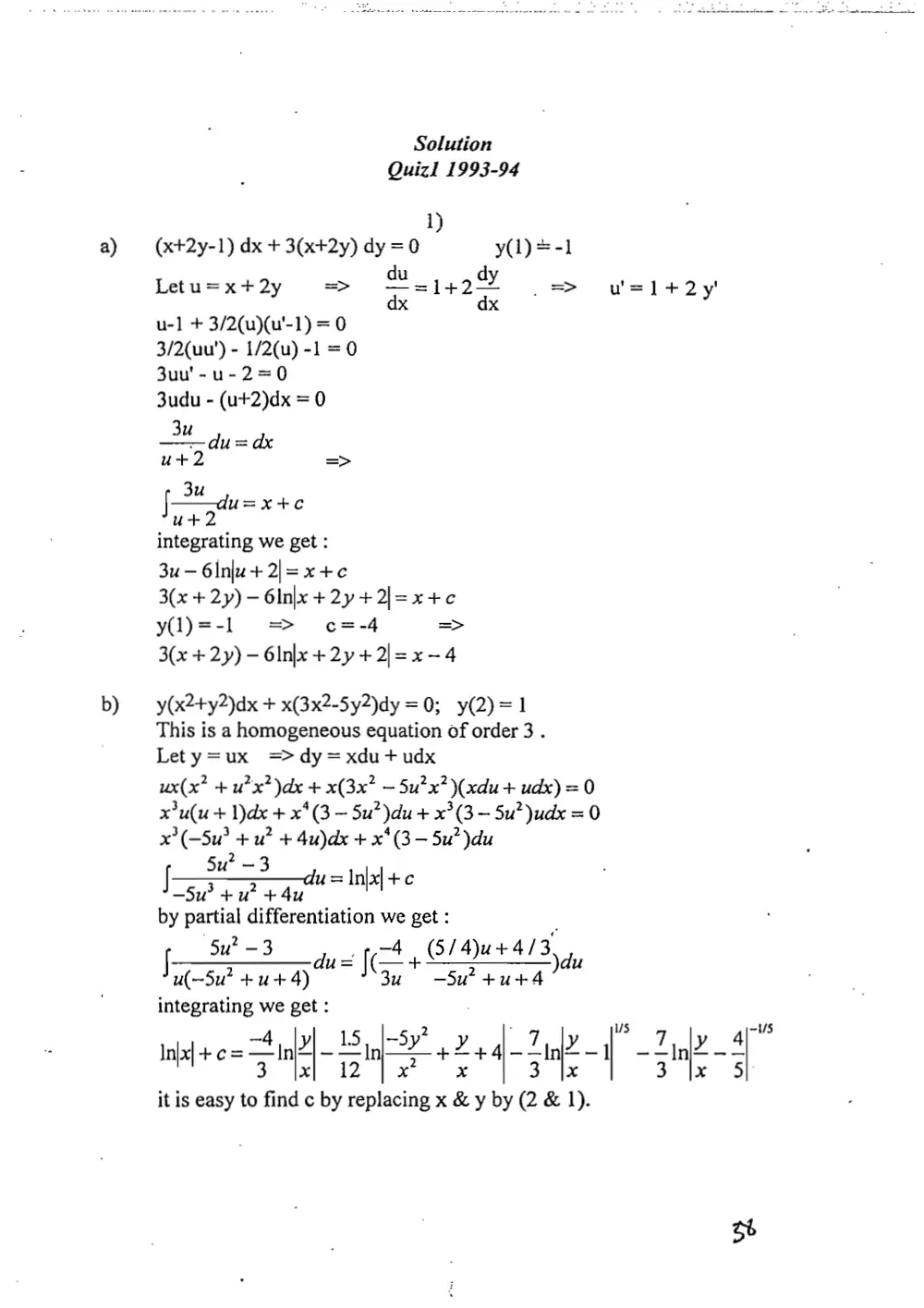
b)
Solution
Quizl 1993-94
1)
(xt2y-1) dx + 3(xt2y) dy = 0 y(1) =-
Letu=x+2y => du 42 =>
dx dx
u-1 + 3/2(u)(u'-1) = 0
3/2(uu’) - 1/2(u) -1 =
3uu'-u-2=0
3udu - (ut2)dx = 0
3M y= de
u+2 =>
JS au= xte
integrating we get :
3u —6lnlu+2|\=x+e
3(x + 2y) — 6ln|x+2y+2)=x+e
yd)=-l => =-4 =>
3(x +2y) —6lnlx+2y+2)=x-4
y(x2+y2)dx + x(3x2-5y2)dy =0; y(2)=1
This is a homogeneous equation of order 3 .
Lety=ux => dy=xdu+udx
ux(x? + u?x?)dx + x(3x? —5u?x?)(xdu + udx) =0
xeu(ut Ide +x*(3—5u")du + x°(3—5u?)udx =0
x (-5u° + u> + 4u)dx + x‘ (3 —5u)du
5u’ -3
Su = = In|x|+c
5 +0? +4u
by partial differentiation we get :
2 -
f ou 3 ux {( 4 _ lAue 4/3, 4,
u(—S5u tus 3u Su? +u+4
integrating we get :
Injx| += In — in °Y 4244) linl
3 |x} 12 | x x 3 |x
it is easy to find c by replacing x & y by (2 & 1).
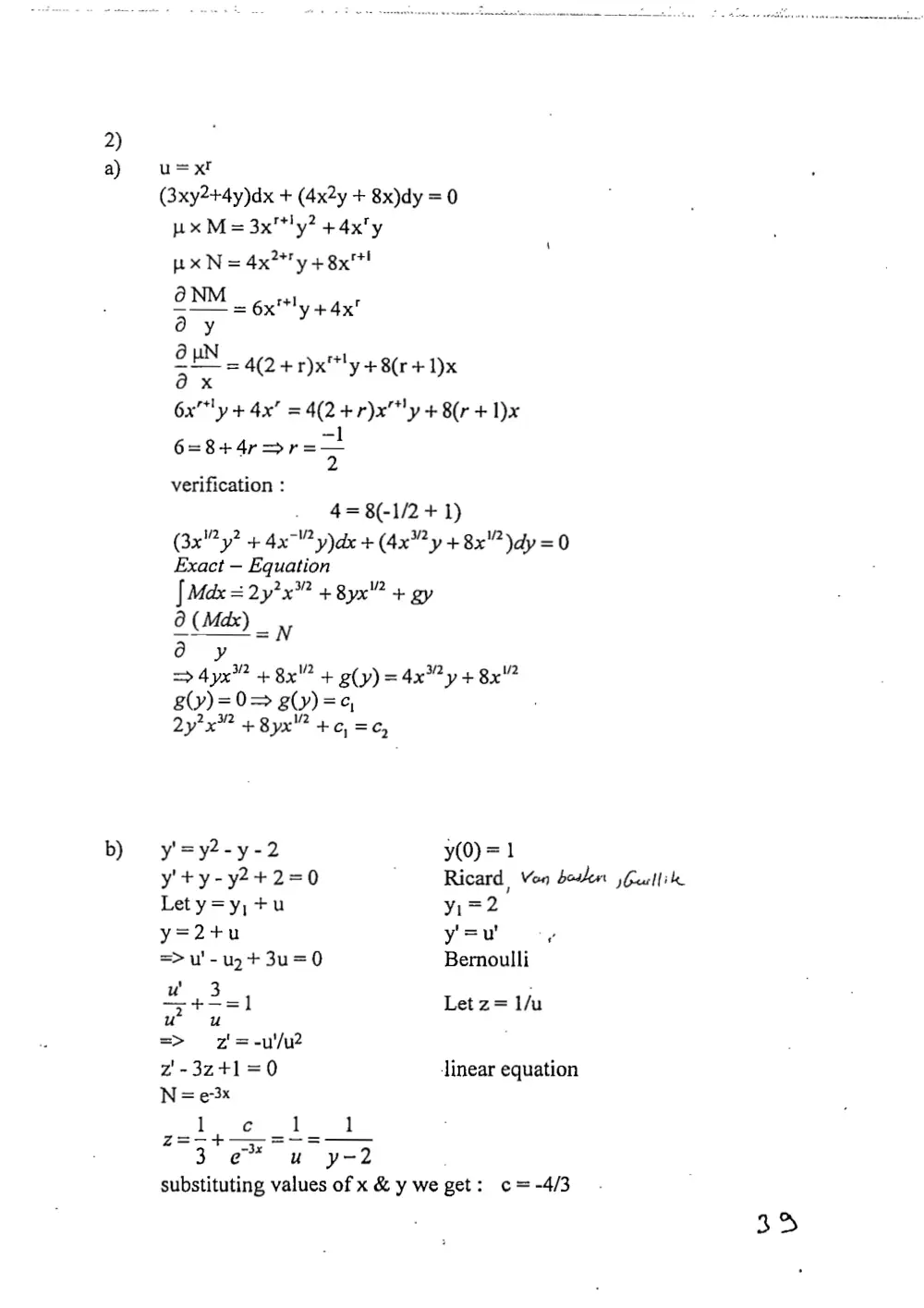
2)
a)
b)
u=x!l
(3xy2+4y)dx + (4x2y + 8x)dy =0
ux M=3x"!y? +4x'y
r+i
Bx N= 4x?*y 48x
@NM = 6x"! y 44x"
dy
aux = 4(2+1r)x"!y +8(r+1)x
x
6x" y+ 4x" =4(2 +r) x" y + B(r + I)x
6=8+4r>r=—
2
verification :
4=8(-1/2+ 1)
(3x1? y? + 4x7 y)dx + (42°? p + 8x"? )dy =0
Exact — Equation
[ Max =2y?x*? + 8yx'? + gy
0 (Max) _N
oy
=> 4yx®? + 8x!" + o(y) = 4x7? y + Bx!”
gy) =0=> gy) =4
Qy?x*? + 8 yxl? + c, =¢,
y=ye-y-2 y(0)=1
y'ty-y2+2=0 Ricard, Von bose Guctlik.
Lety=y,+u y, =2
y=2+u you oy
=>u'-u + 3u=0 Bernoulli
¥3.y Let z= I/u
u u
=> "= -u'/u2
z-3z+1=0 linear equation
N= e-3x
l1 ec 1 1
Z=-—+ ax = - =
3 e uoy-2 ;
substituting values of x & y we get: c=-4/3
3%
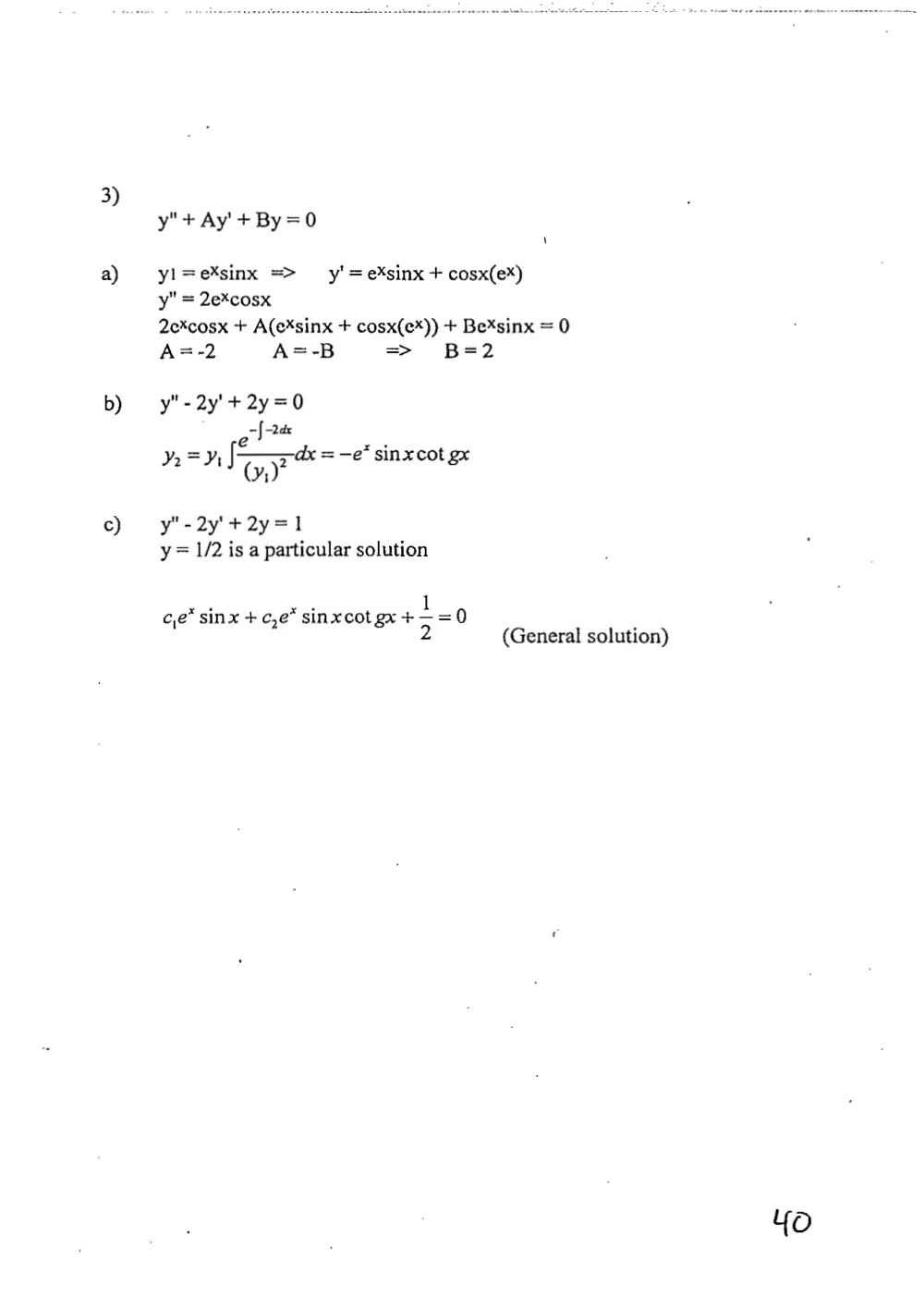
3)
b)
y" + Ay' + By=0
yl =eXsinx => — y'=eXsinx + cosx(ex)
y" = 2eXcosx
2e%cosx + A(eXsinx + cosx(ex)) + Bexsinx = 0
A=-2 A=-B => B=2
y"-2y'+2y=0
: ~|-2de
V2 =); ‘- 7 dx = —e* sinxcot gx
(wy)
y"-2y'+2y=1
y = 1/2 is a particular solution
*sinx + ¢,e* Si t -¢teo
ce SiInx + Cc,e SINX COL gx =
(General solution)