
MATH 202 Exam 2, Spring 2002
American University of Beirut · Differential Equations · 7 pages
More MATH 202 files
- Exam Solution to Sample Exam I · Spring 2019Exam · with solutionView
- Exam 2 Clean Copy · Spring 2019ExamView
- Exam 1 Quiz 1 Spring 18 · Spring 2019ExamView
- Exam 1 SAMPLE EXAM I · Spring 2019ExamView
- Midterm · Summer 2018ExamView
- Exam 1 Quiz 1 2007 · Spring 2017ExamView
- Exam 1 · Fall 2017ExamView
- Exam 1 Quiz 1 2008 with Solution · Spring 2017Exam · with solutionView
Show the text of this exam
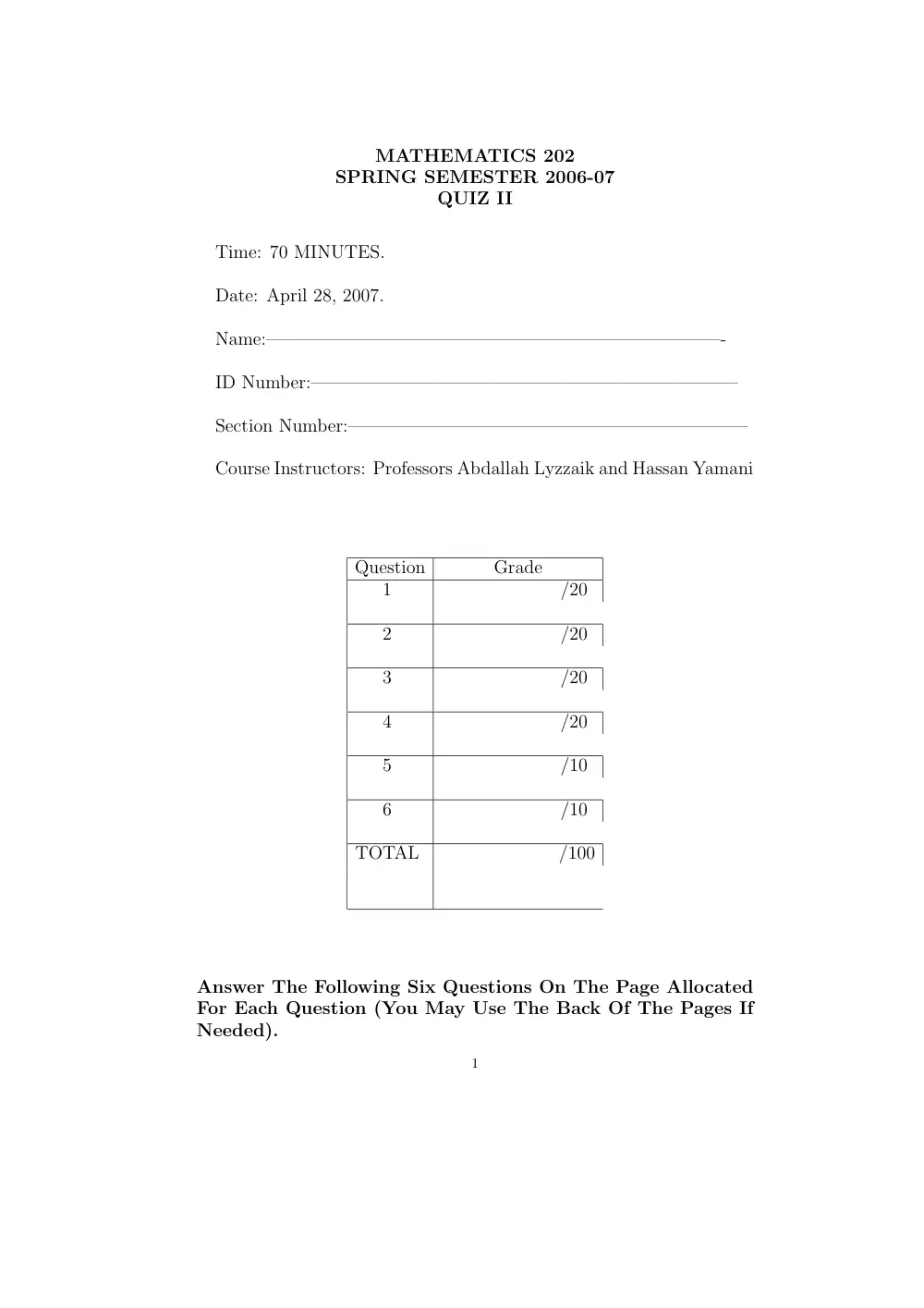
MATHEMATICS 202
SPRING SEMESTER 2006-07
QUIZ II
Time: 70 MINUTES.
Date: April 28, 2007.
Name:—————————————————————————-
ID Number:———————————————————————–
Section Number:——————————————————————
Course Instructors: Professors Abdallah Lyzzaik and Hassan Yamani
Question
Grade
1
/20
2
/20
3
/20
4
/20
5
/10
6
/10
TOTAL
/100
Answer The Following Six Questions On The Page Allocated
For Each Question (You May Use The Back Of The Pages If
Needed).
1
2
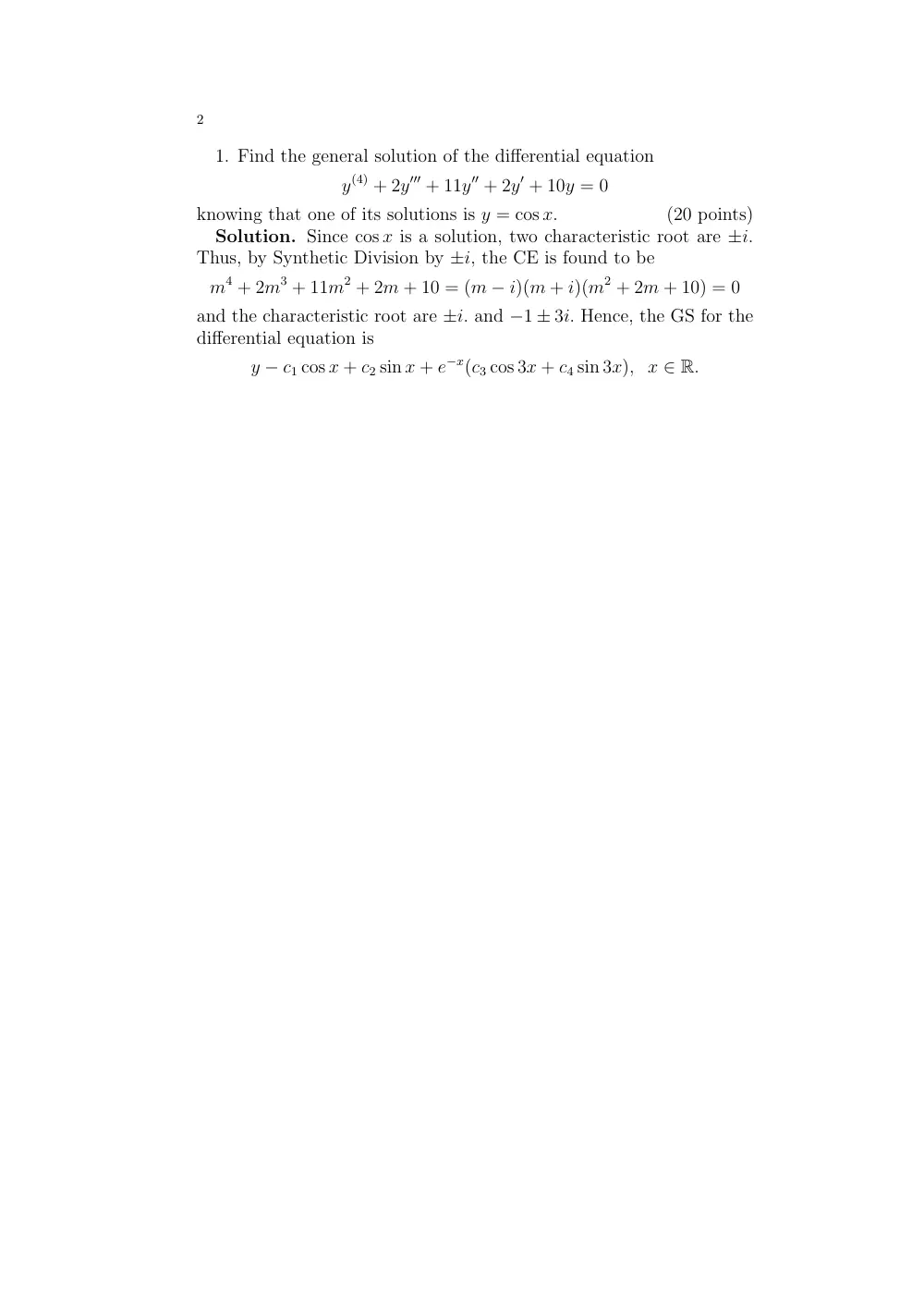
1. Find the general solution of the differential equation
y(4) + 2y′′′ + 11y′′ + 2y′ + 10y = 0
knowing that one of its solutions is y = cos x.
(20 points)
Solution. Since cos x is a solution, two characteristic root are ±i.
Thus, by Synthetic Division by ±i, the CE is found to be
m4 + 2m3 + 11m2 + 2m + 10 = (m − i)(m + i)(m2 + 2m + 10) = 0
and the characteristic root are ±i. and −1 ± 3i. Hence, the GS for the
differential equation is
y − c1 cos x + c2 sin x + e−x(c3 cos 3x + c4 sin 3x), x ∈ R.
3
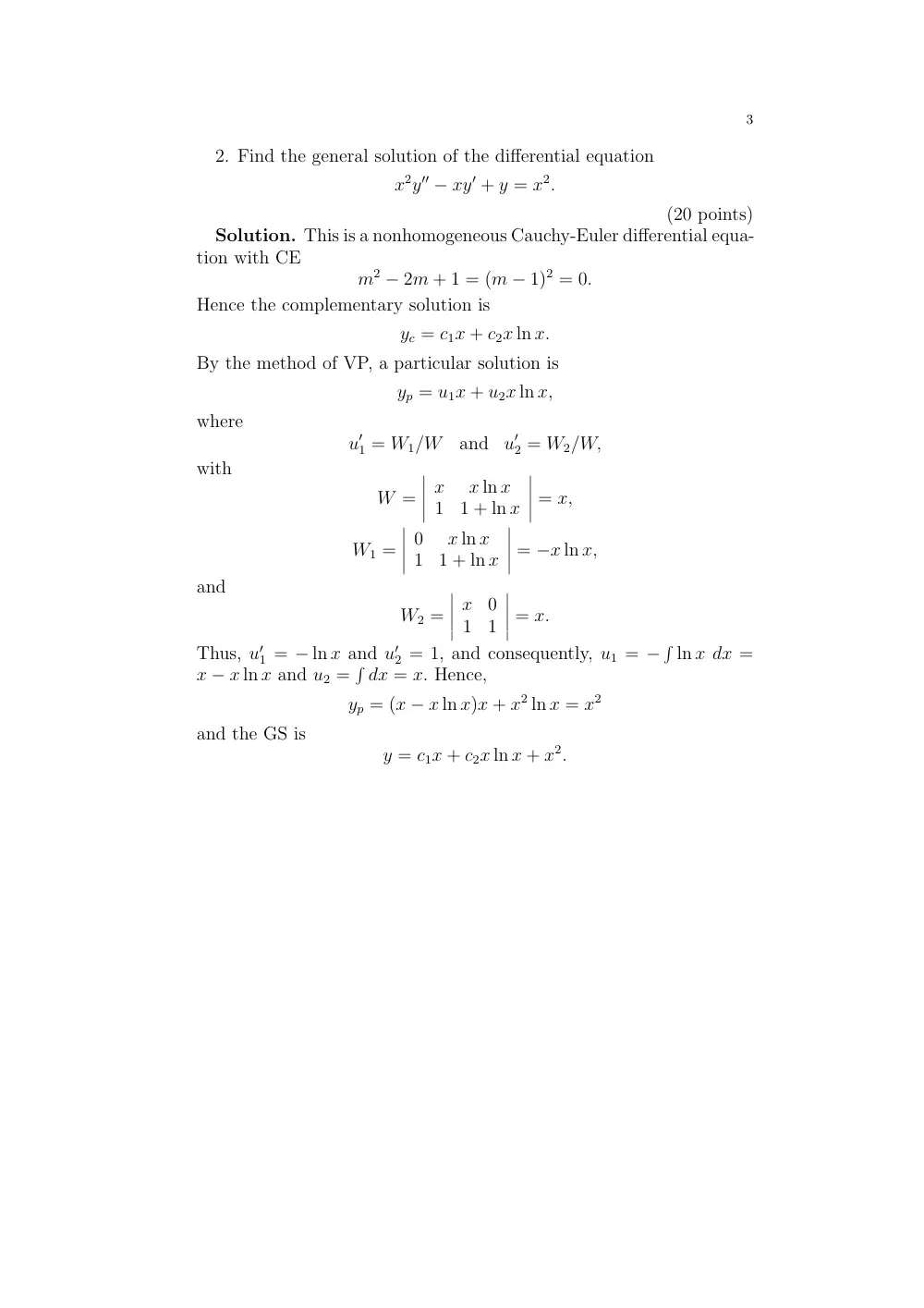
2. Find the general solution of the differential equation
x2y′′ − xy′ + y = x2.
(20 points)
Solution. This is a nonhomogeneous Cauchy-Euler differential equa-
tion with CE
m2 − 2m + 1 = (m − 1)2 = 0.
Hence the complementary solution is
yc = c1x + c2x ln x.
By the method of VP, a particular solution is
yp = u1x + u2x ln x,
where
u′
1 = W1/W
and
u′
2 = W2/W,
with
W =
�����
x
x ln x
1
1 + ln x
����� = x,
W1 =
�����
0
x ln x
1
1 + ln x
����� = −x ln x,
and
W2 =
�����
x
0
1
1
����� = x.
Thus, u′
1 = − ln x and u′
2 = 1, and consequently, u1 = −
� ln x dx =
x − x ln x and u2 =
� dx = x. Hence,
yp = (x − x ln x)x + x2 ln x = x2
and the GS is
y = c1x + c2x ln x + x2.
4
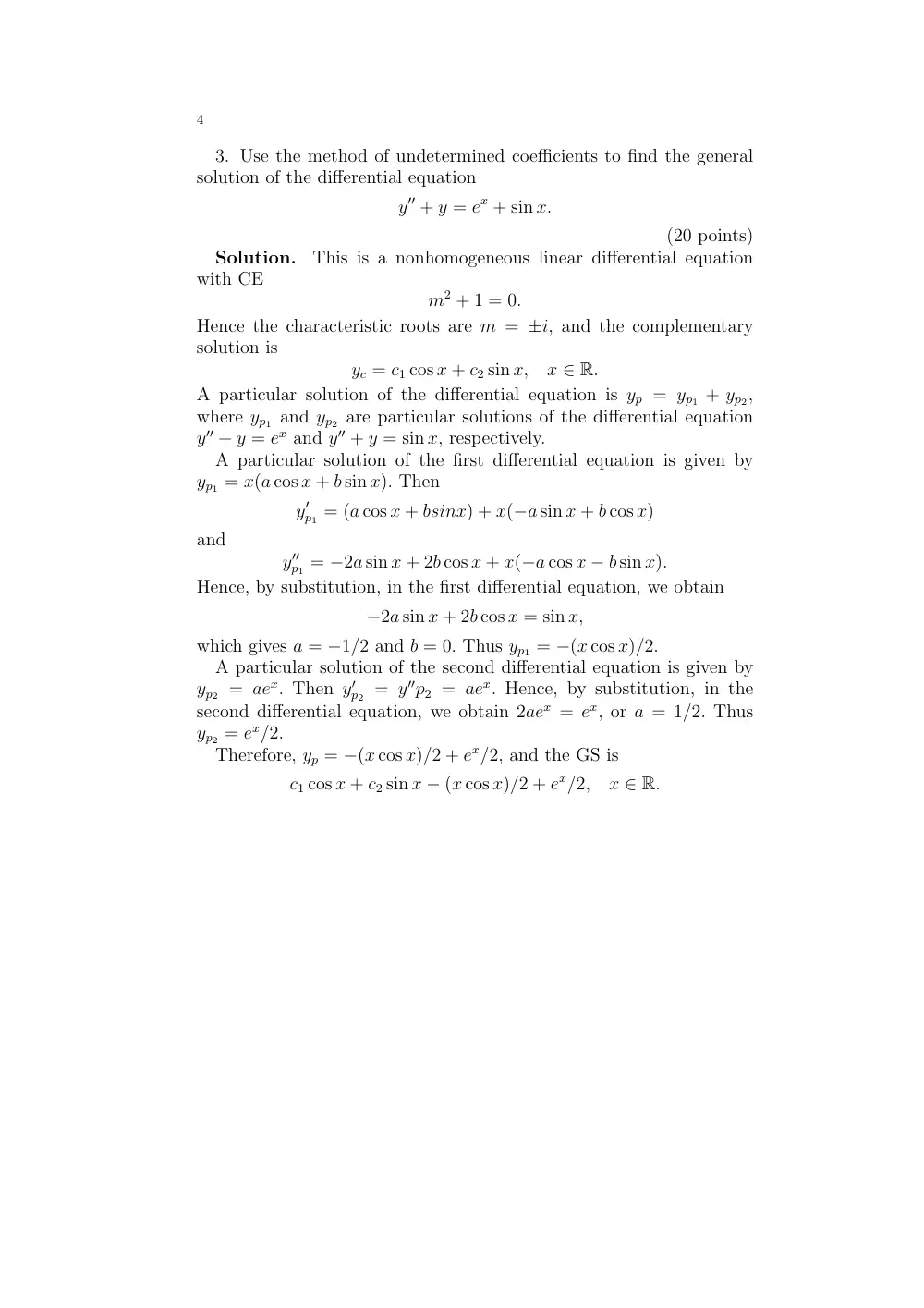
3. Use the method of undetermined coefficients to find the general
solution of the differential equation
y′′ + y = ex + sin x.
(20 points)
Solution.
This is a nonhomogeneous linear differential equation
with CE
m2 + 1 = 0.
Hence the characteristic roots are m = ±i, and the complementary
solution is
yc = c1 cos x + c2 sin x,
x ∈ R.
A particular solution of the differential equation is yp = yp1 + yp2,
where yp1 and yp2 are particular solutions of the differential equation
y′′ + y = ex and y′′ + y = sin x, respectively.
A particular solution of the first differential equation is given by
yp1 = x(a cos x + b sin x). Then
y′
p1 = (a cos x + bsinx) + x(−a sin x + b cos x)
and
y′′
p1 = −2a sin x + 2b cos x + x(−a cos x − b sin x).
Hence, by substitution, in the first differential equation, we obtain
−2a sin x + 2b cos x = sin x,
which gives a = −1/2 and b = 0. Thus yp1 = −(x cos x)/2.
A particular solution of the second differential equation is given by
yp2 = aex. Then y′
p2 = y′′p2 = aex. Hence, by substitution, in the
second differential equation, we obtain 2aex = ex, or a = 1/2. Thus
yp2 = ex/2.
Therefore, yp = −(x cos x)/2 + ex/2, and the GS is
c1 cos x + c2 sin x − (x cos x)/2 + ex/2,
x ∈ R.
5
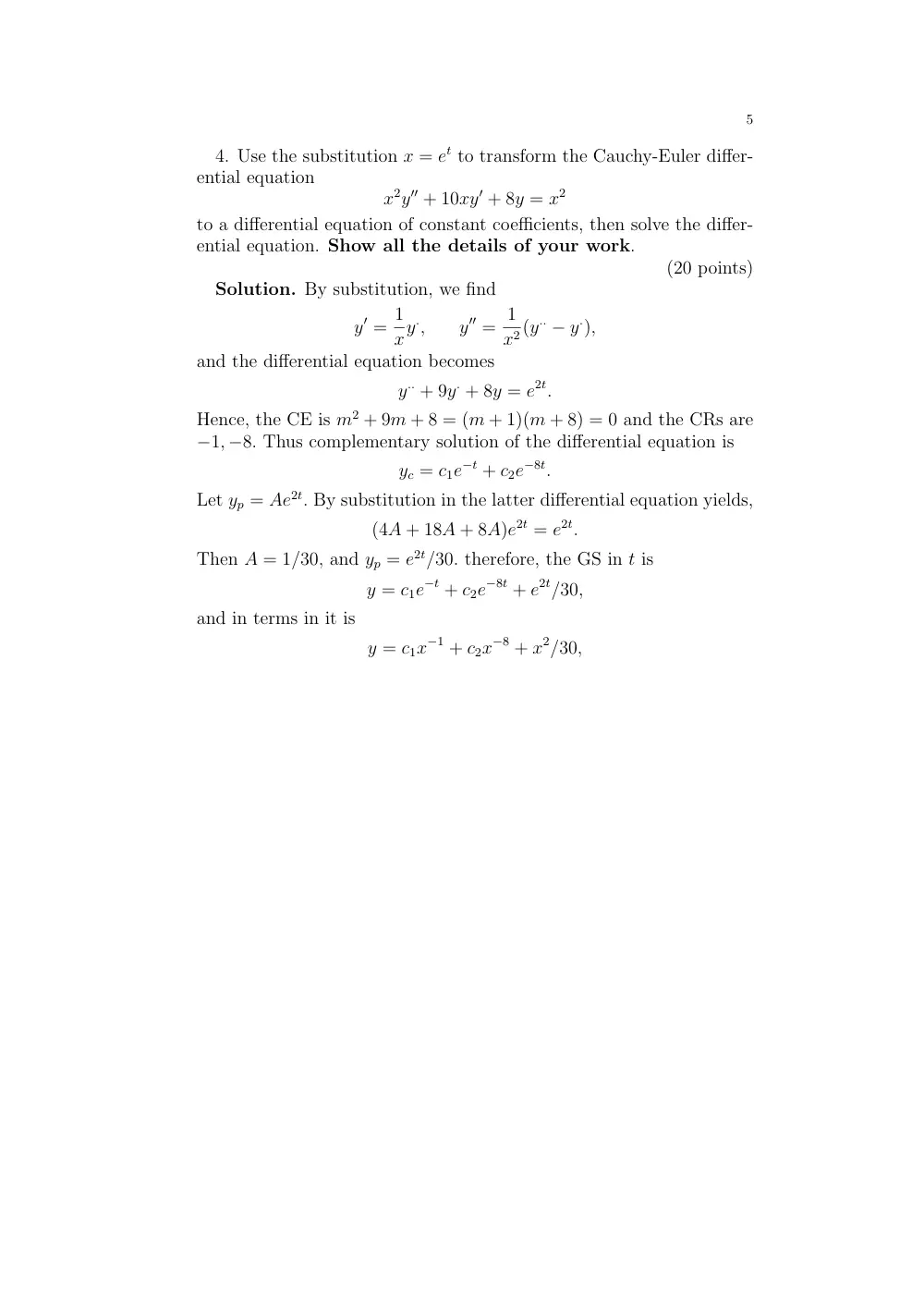
4. Use the substitution x = et to transform the Cauchy-Euler differ-
ential equation
x2y′′ + 10xy′ + 8y = x2
to a differential equation of constant coefficients, then solve the differ-
ential equation. Show all the details of your work.
(20 points)
Solution. By substitution, we find
y′ = 1
xy.,
y′′ = 1
x2(y.. − y.),
and the differential equation becomes
y.. + 9y. + 8y = e2t.
Hence, the CE is m2 + 9m + 8 = (m + 1)(m + 8) = 0 and the CRs are
−1, −8. Thus complementary solution of the differential equation is
yc = c1e−t + c2e−8t.
Let yp = Ae2t. By substitution in the latter differential equation yields,
(4A + 18A + 8A)e2t = e2t.
Then A = 1/30, and yp = e2t/30. therefore, the GS in t is
y = c1e−t + c2e−8t + e2t/30,
and in terms in it is
y = c1x−1 + c2x−8 + x2/30,
6
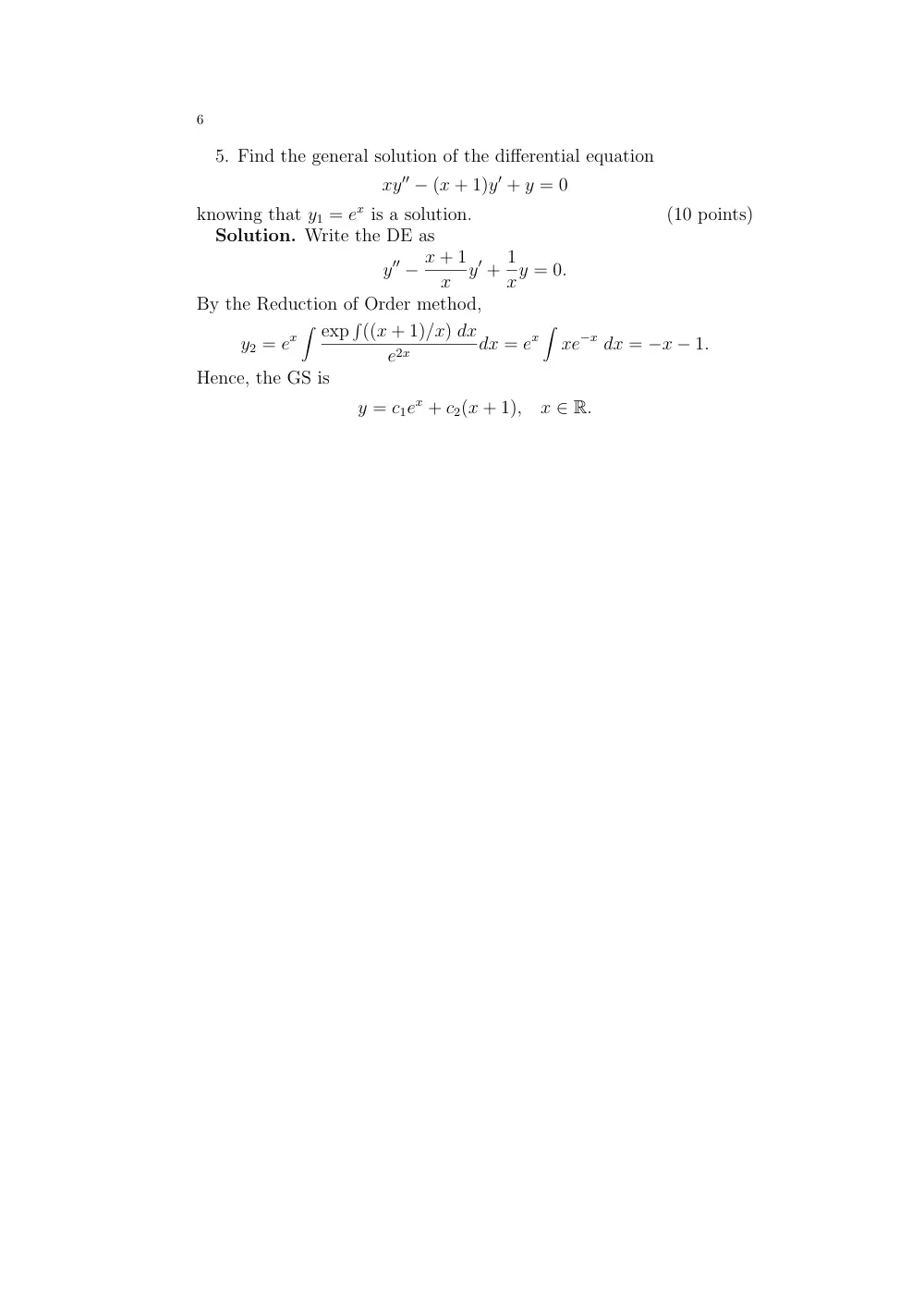
5. Find the general solution of the differential equation
xy′′ − (x + 1)y′ + y = 0
knowing that y1 = ex is a solution.
(10 points)
Solution. Write the DE as
y′′ − x + 1
x
y′ + 1
xy = 0.
By the Reduction of Order method,
y2 = ex
� exp
� ((x + 1)/x) dx
e2x
dx = ex
�
xe−x dx = −x − 1.
Hence, the GS is
y = c1ex + c2(x + 1),
x ∈ R.
7
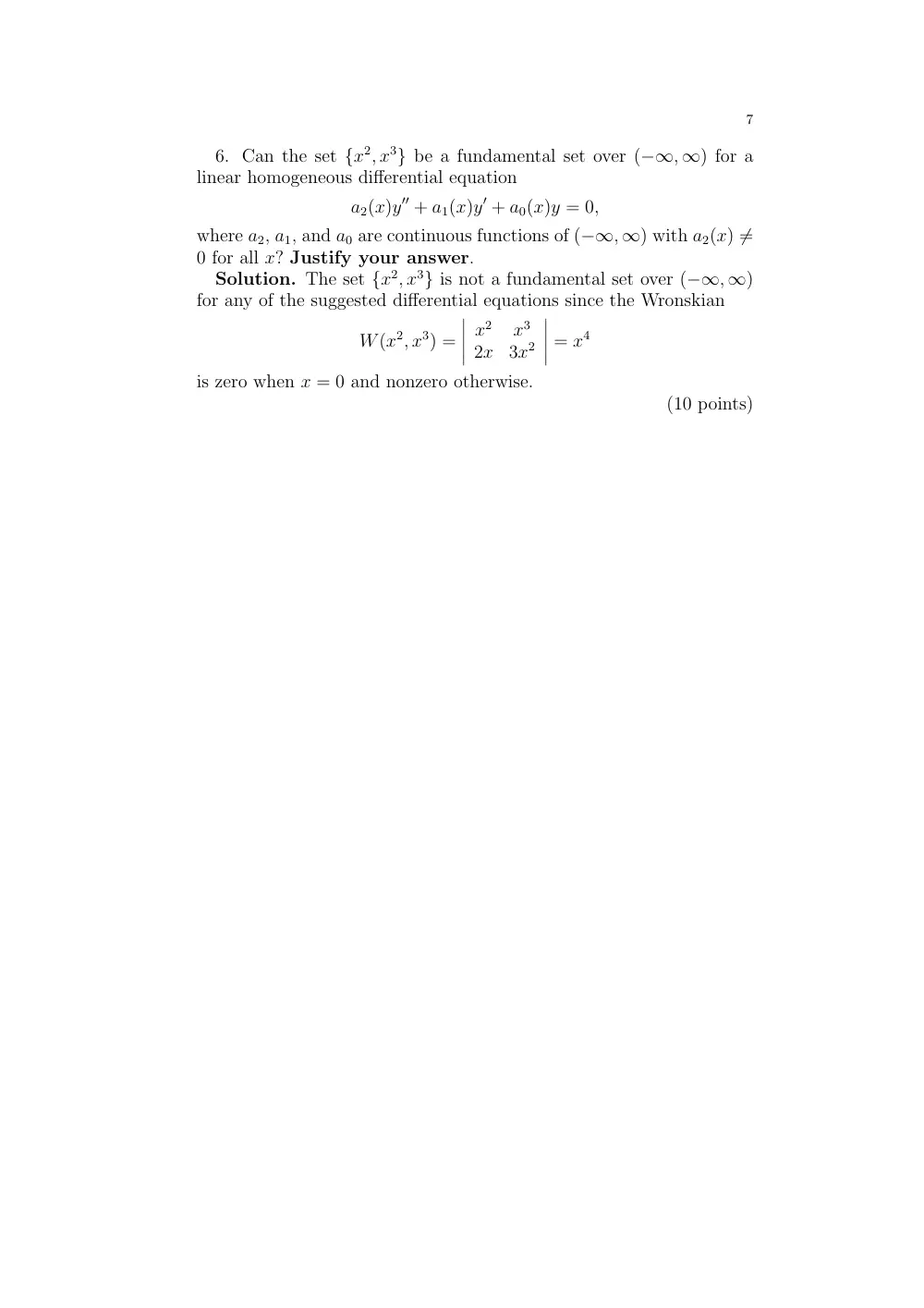
6. Can the set {x2, x3} be a fundamental set over (−∞, ∞) for a
linear homogeneous differential equation
a2(x)y′′ + a1(x)y′ + a0(x)y = 0,
where a2, a1, and a0 are continuous functions of (−∞, ∞) with a2(x) ̸=
0 for all x? Justify your answer.
Solution. The set {x2, x3} is not a fundamental set over (−∞, ∞)
for any of the suggested differential equations since the Wronskian
W(x2, x3) =
�����
x2
x3
2x
3x2
����� = x4
is zero when x = 0 and nonzero otherwise.
(10 points)