
MATH 202 Exam 2, Spring 2002
American University of Beirut · Differential Equations · 8 pages
More MATH 202 files
- Exam Solution to Sample Exam I · Spring 2019Exam · with solutionView
- Exam 2 Clean Copy · Spring 2019ExamView
- Exam 1 Quiz 1 Spring 18 · Spring 2019ExamView
- Exam 1 SAMPLE EXAM I · Spring 2019ExamView
- Midterm · Summer 2018ExamView
- Exam 1 Quiz 1 2007 · Spring 2017ExamView
- Exam 1 · Fall 2017ExamView
- Exam 1 Quiz 1 2008 with Solution · Spring 2017Exam · with solutionView
Show the text of this exam
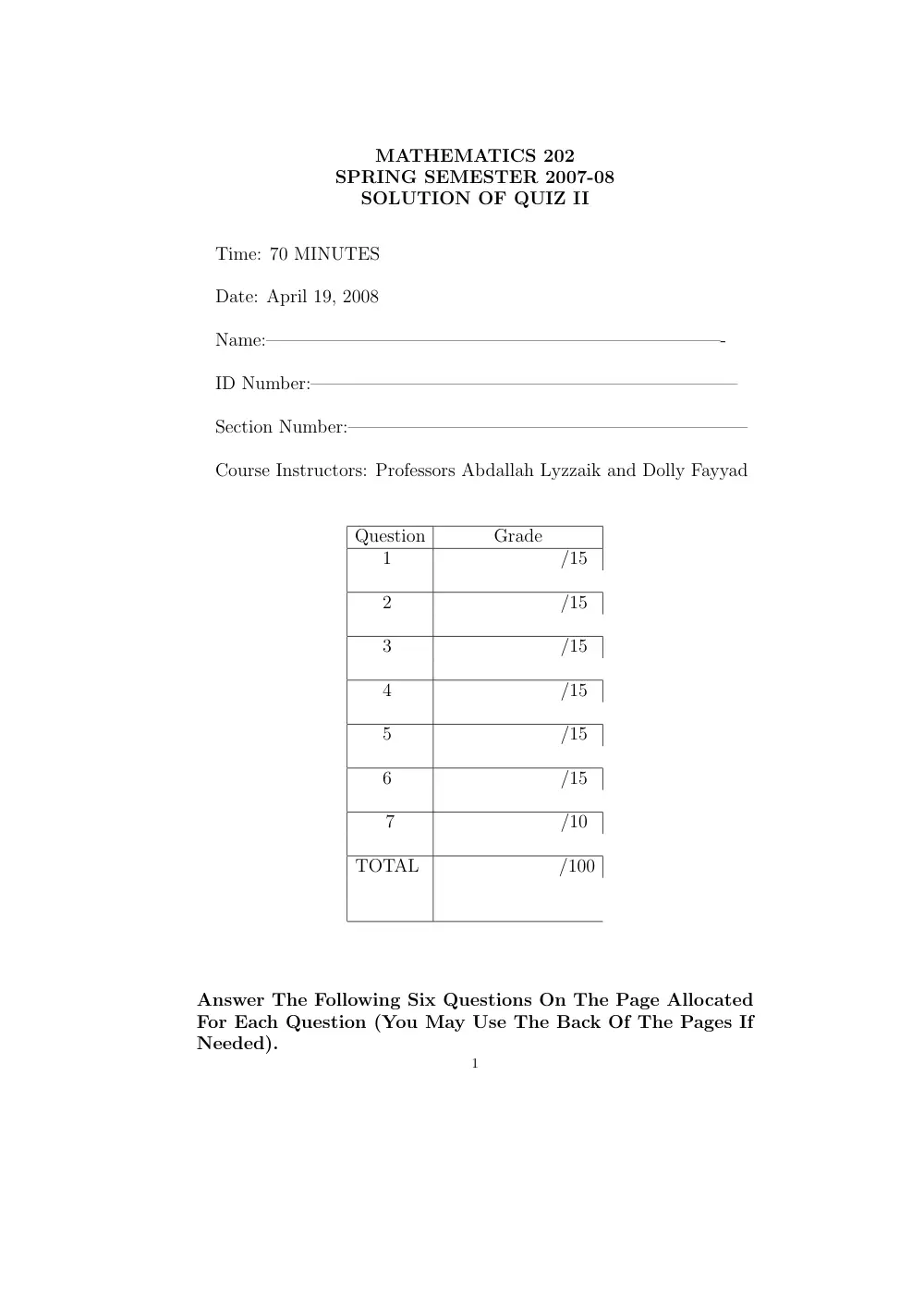
MATHEMATICS 202
SPRING SEMESTER 2007-08
SOLUTION OF QUIZ II
Time: 70 MINUTES
Date: April 19, 2008
Name:—————————————————————————-
ID Number:———————————————————————–
Section Number:——————————————————————
Course Instructors: Professors Abdallah Lyzzaik and Dolly Fayyad
Question
Grade
1
/15
2
/15
3
/15
4
/15
5
/15
6
/15
7
/10
TOTAL
/100
Answer The Following Six Questions On The Page Allocated
For Each Question (You May Use The Back Of The Pages If
Needed).
1
2
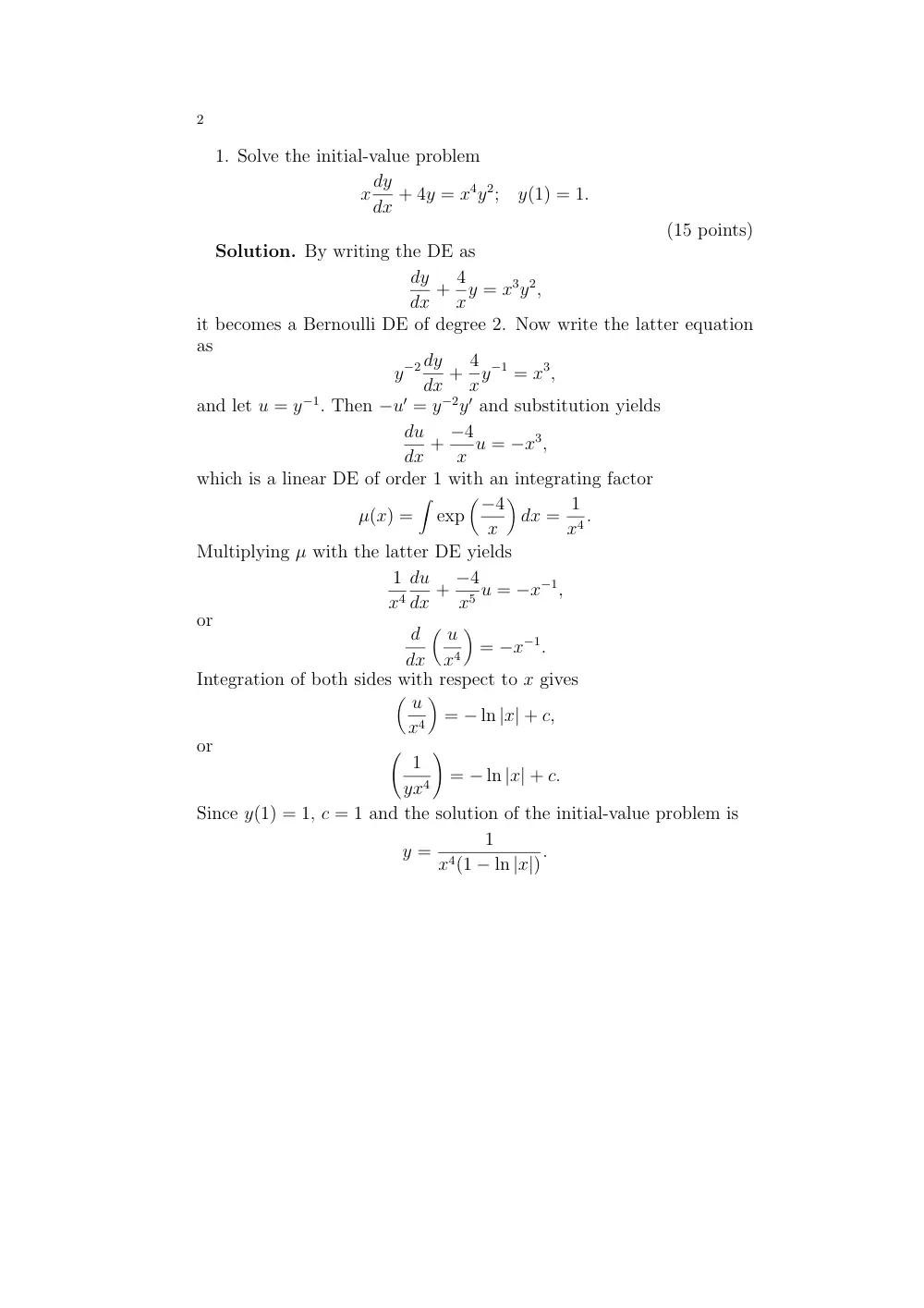
1. Solve the initial-value problem
xdy
dx + 4y = x4y2;
y(1) = 1.
(15 points)
Solution. By writing the DE as
dy
dx + 4
xy = x3y2,
it becomes a Bernoulli DE of degree 2. Now write the latter equation
as
y−2 dy
dx + 4
xy−1 = x3,
and let u = y−1. Then −u′ = y−2y′ and substitution yields
du
dx + −4
x u = −x3,
which is a linear DE of order 1 with an integrating factor
µ(x) =
�
exp
�−4
x
�
dx = 1
x4.
Multiplying µ with the latter DE yields
1
x4
du
dx + −4
x5 u = −x−1,
or
d
dx
� u
x4
�
= −x−1.
Integration of both sides with respect to x gives
� u
x4
�
= − ln |x| + c,
or
� 1
yx4
�
= − ln |x| + c.
Since y(1) = 1, c = 1 and the solution of the initial-value problem is
y =
1
x4(1 − ln |x|).
3
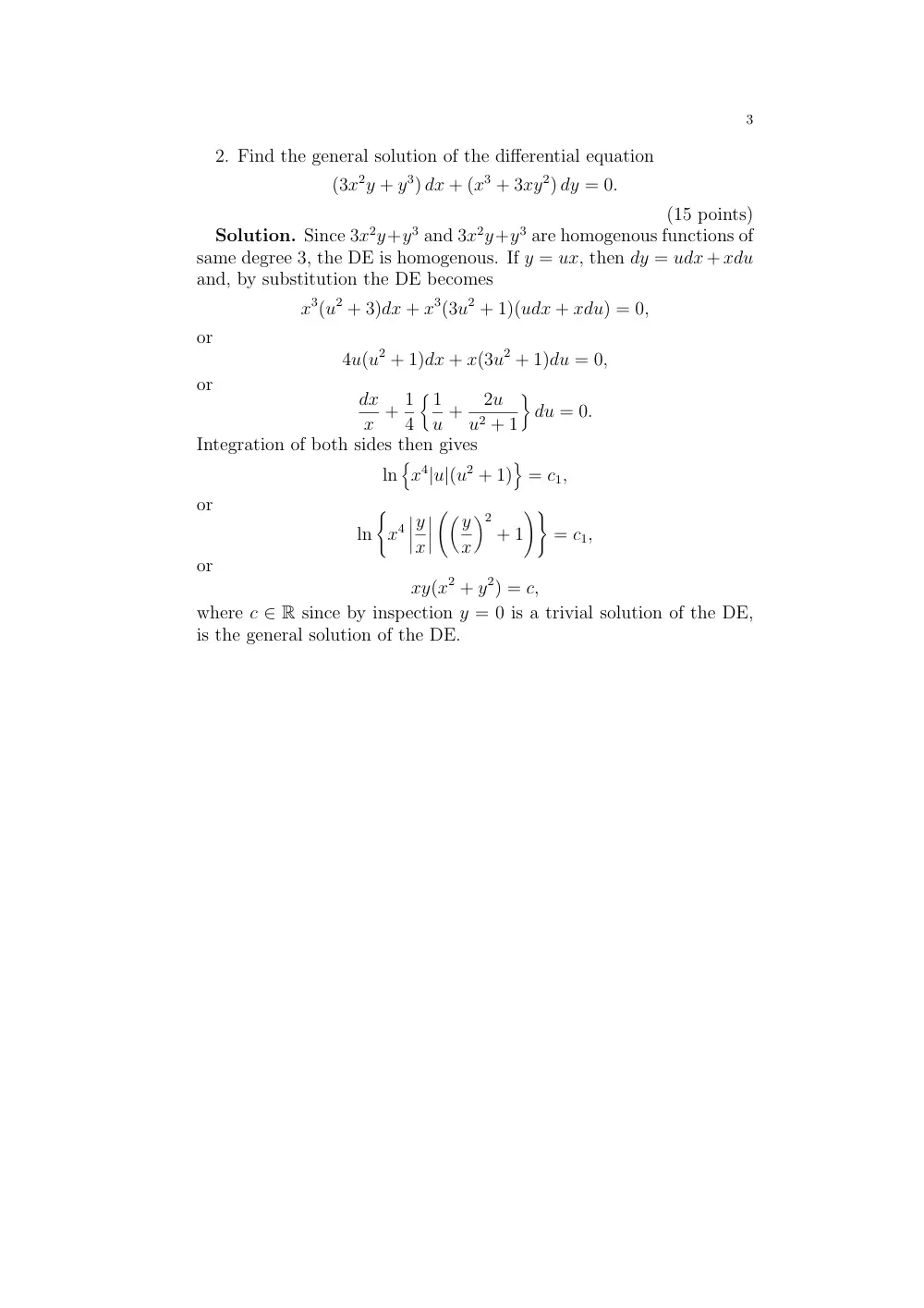
2. Find the general solution of the differential equation
(3x2y + y3) dx + (x3 + 3xy2) dy = 0.
(15 points)
Solution. Since 3x2y+y3 and 3x2y+y3 are homogenous functions of
same degree 3, the DE is homogenous. If y = ux, then dy = udx+xdu
and, by substitution the DE becomes
x3(u2 + 3)dx + x3(3u2 + 1)(udx + xdu) = 0,
or
4u(u2 + 1)dx + x(3u2 + 1)du = 0,
or
dx
x + 1
4
�1
u +
2u
u2 + 1
�
du = 0.
Integration of both sides then gives
ln
�
x4|u|(u2 + 1)
�
= c1,
or
ln
�
x4
����
y
x
����
��y
x
�2
+ 1
��
= c1,
or
xy(x2 + y2) = c,
where c ∈ R since by inspection y = 0 is a trivial solution of the DE,
is the general solution of the DE.
4
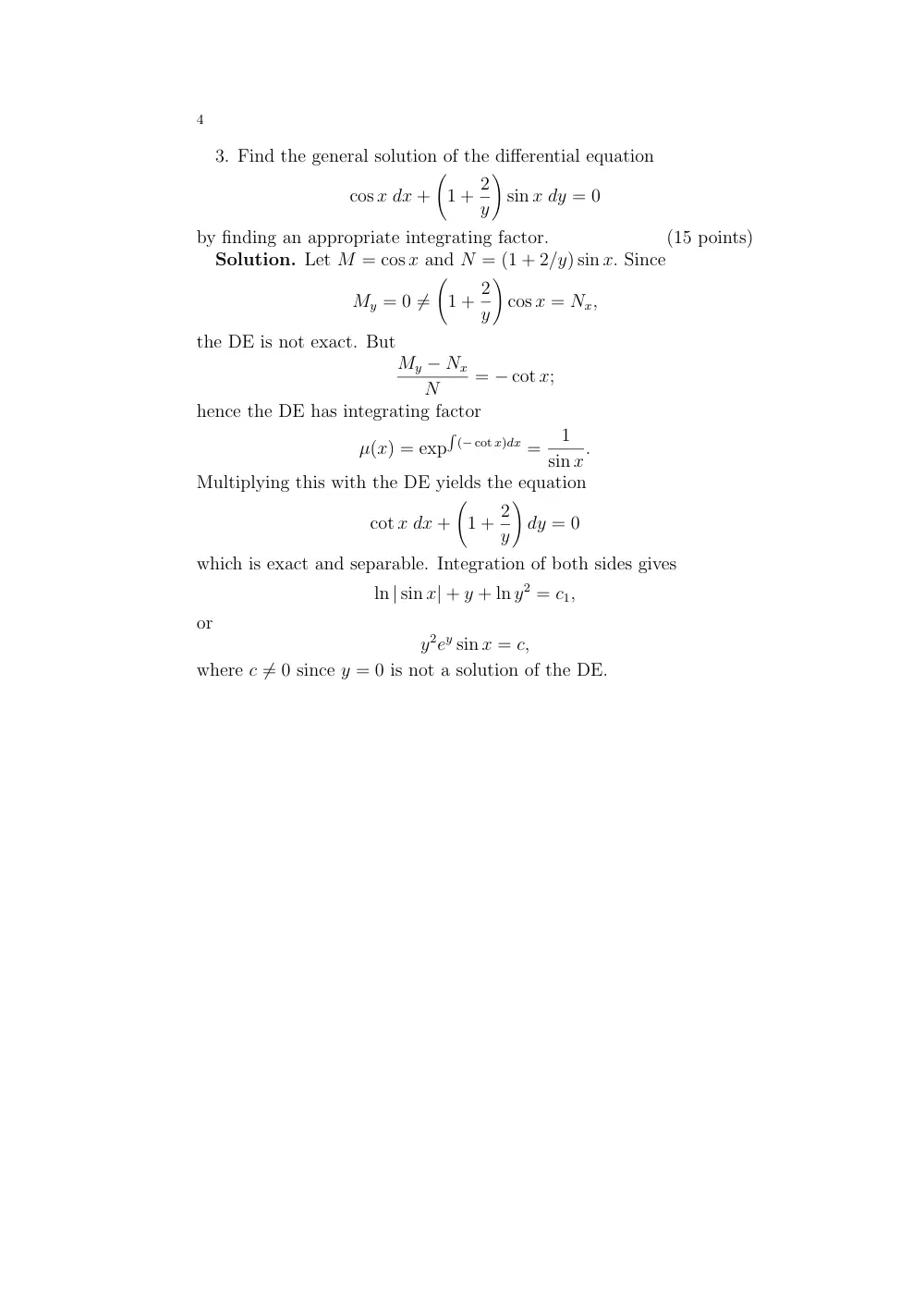
3. Find the general solution of the differential equation
cos x dx +
�
1 + 2
y
�
sin x dy = 0
by finding an appropriate integrating factor.
(15 points)
Solution. Let M = cos x and N = (1 + 2/y) sin x. Since
My = 0 ̸=
�
1 + 2
y
�
cos x = Nx,
the DE is not exact. But
My − Nx
N
= − cot x;
hence the DE has integrating factor
µ(x) = exp
�
(− cot x)dx =
1
sin x.
Multiplying this with the DE yields the equation
cot x dx +
�
1 + 2
y
�
dy = 0
which is exact and separable. Integration of both sides gives
ln | sin x| + y + ln y2 = c1,
or
y2ey sin x = c,
where c ̸= 0 since y = 0 is not a solution of the DE.
5
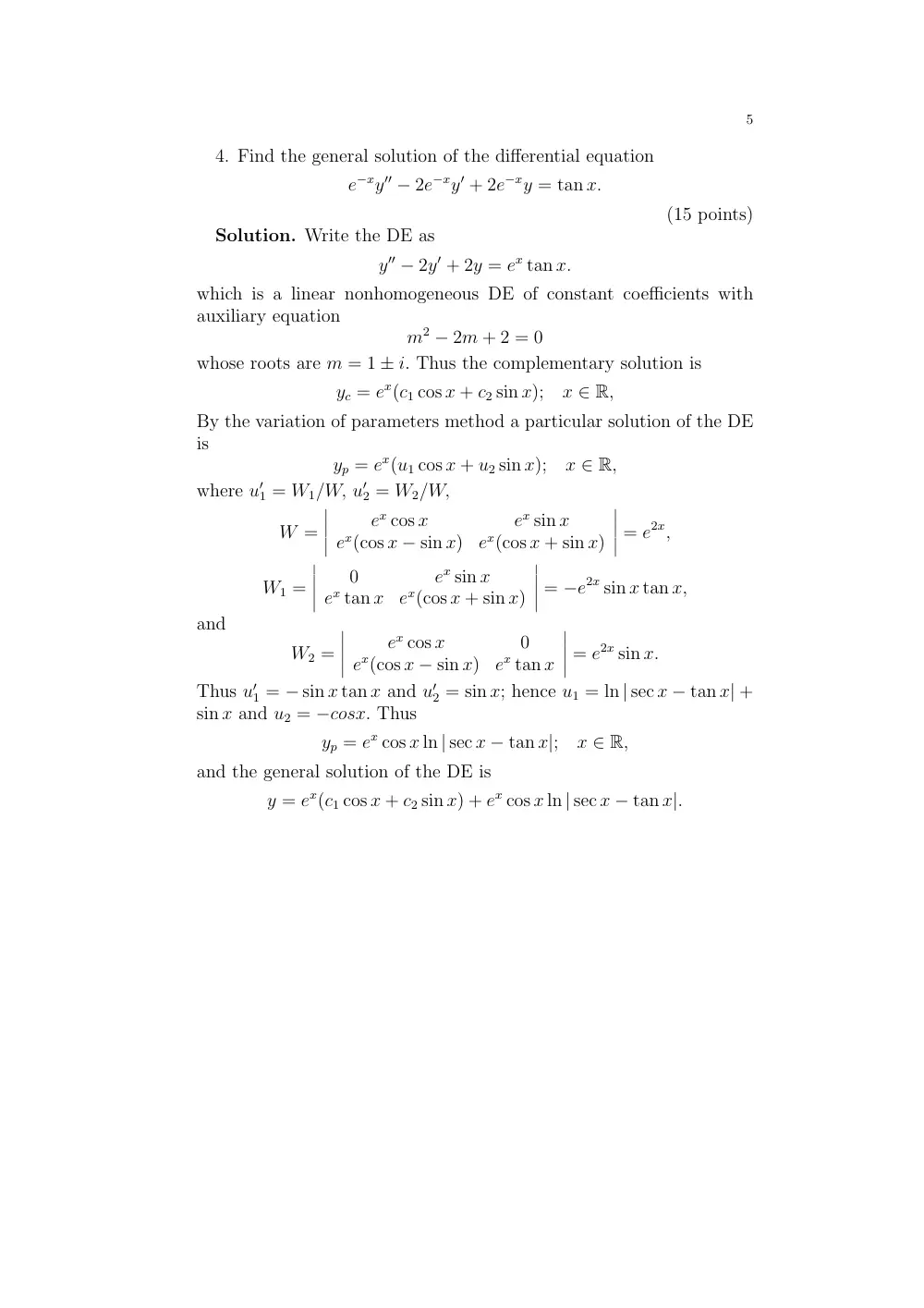
4. Find the general solution of the differential equation
e−xy′′ − 2e−xy′ + 2e−xy = tan x.
(15 points)
Solution. Write the DE as
y′′ − 2y′ + 2y = ex tan x.
which is a linear nonhomogeneous DE of constant coefficients with
auxiliary equation
m2 − 2m + 2 = 0
whose roots are m = 1 ± i. Thus the complementary solution is
yc = ex(c1 cos x + c2 sin x);
x ∈ R,
By the variation of parameters method a particular solution of the DE
is
yp = ex(u1 cos x + u2 sin x);
x ∈ R,
where u′
1 = W1/W, u′
2 = W2/W,
W =
�����
ex cos x
ex sin x
ex(cos x − sin x)
ex(cos x + sin x)
����� = e2x,
W1 =
�����
0
ex sin x
ex tan x
ex(cos x + sin x)
����� = −e2x sin x tan x,
and
W2 =
�����
ex cos x
0
ex(cos x − sin x)
ex tan x
����� = e2x sin x.
Thus u′
1 = − sin x tan x and u′
2 = sin x; hence u1 = ln | sec x − tan x| +
sin x and u2 = −cosx. Thus
yp = ex cos x ln | sec x − tan x|;
x ∈ R,
and the general solution of the DE is
y = ex(c1 cos x + c2 sin x) + ex cos x ln | sec x − tan x|.
6
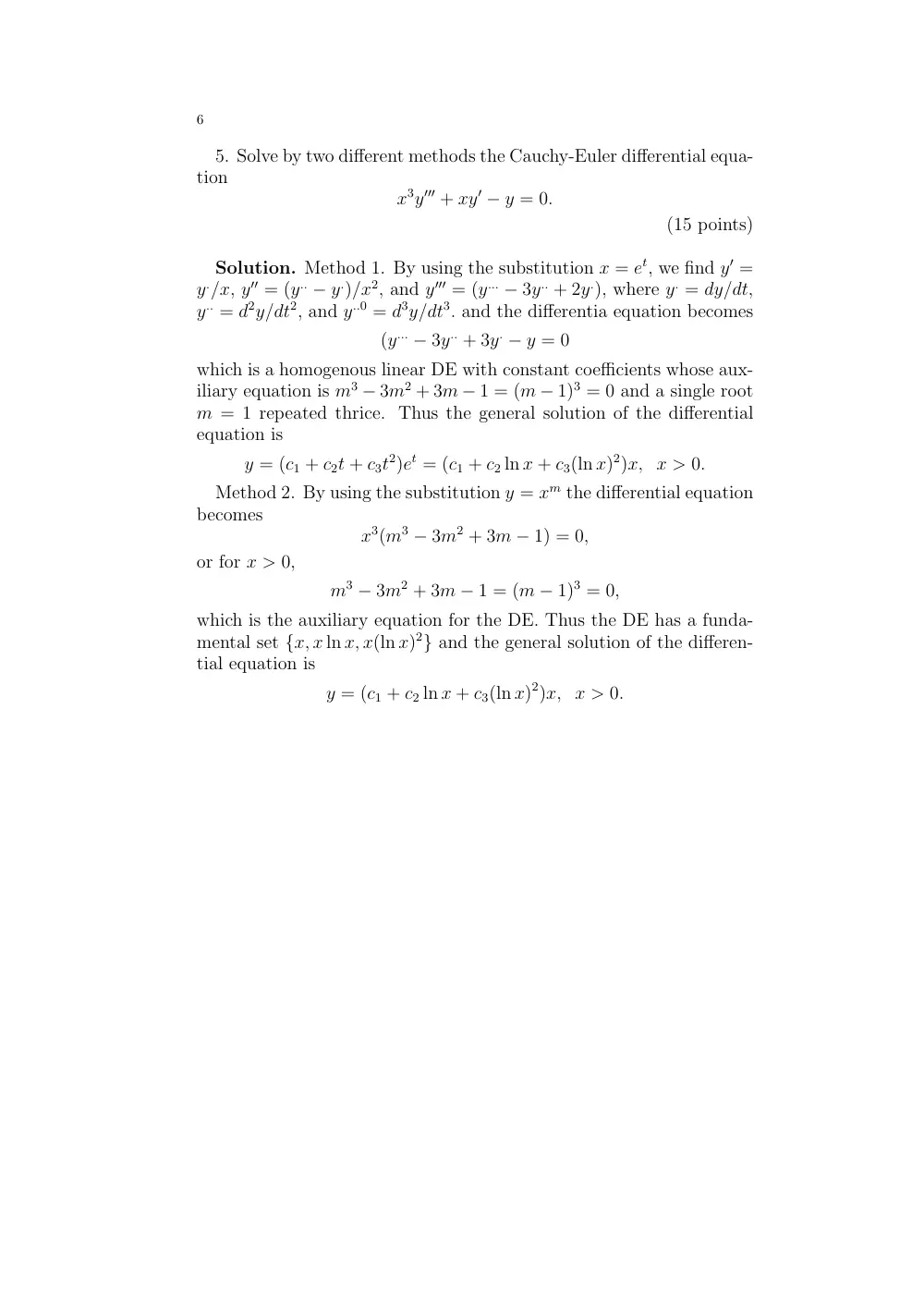
5. Solve by two different methods the Cauchy-Euler differential equa-
tion
x3y′′′ + xy′ − y = 0.
(15 points)
Solution. Method 1. By using the substitution x = et, we find y′ =
y./x, y′′ = (y.. − y.)/x2, and y′′′ = (y... − 3y.. + 2y.), where y. = dy/dt,
y.. = d2y/dt2, and y..0 = d3y/dt3. and the differentia equation becomes
(y... − 3y.. + 3y. − y = 0
which is a homogenous linear DE with constant coefficients whose aux-
iliary equation is m3 − 3m2 + 3m − 1 = (m − 1)3 = 0 and a single root
m = 1 repeated thrice. Thus the general solution of the differential
equation is
y = (c1 + c2t + c3t2)et = (c1 + c2 ln x + c3(ln x)2)x, x > 0.
Method 2. By using the substitution y = xm the differential equation
becomes
x3(m3 − 3m2 + 3m − 1) = 0,
or for x > 0,
m3 − 3m2 + 3m − 1 = (m − 1)3 = 0,
which is the auxiliary equation for the DE. Thus the DE has a funda-
mental set {x, x ln x, x(ln x)2} and the general solution of the differen-
tial equation is
y = (c1 + c2 ln x + c3(ln x)2)x, x > 0.
7
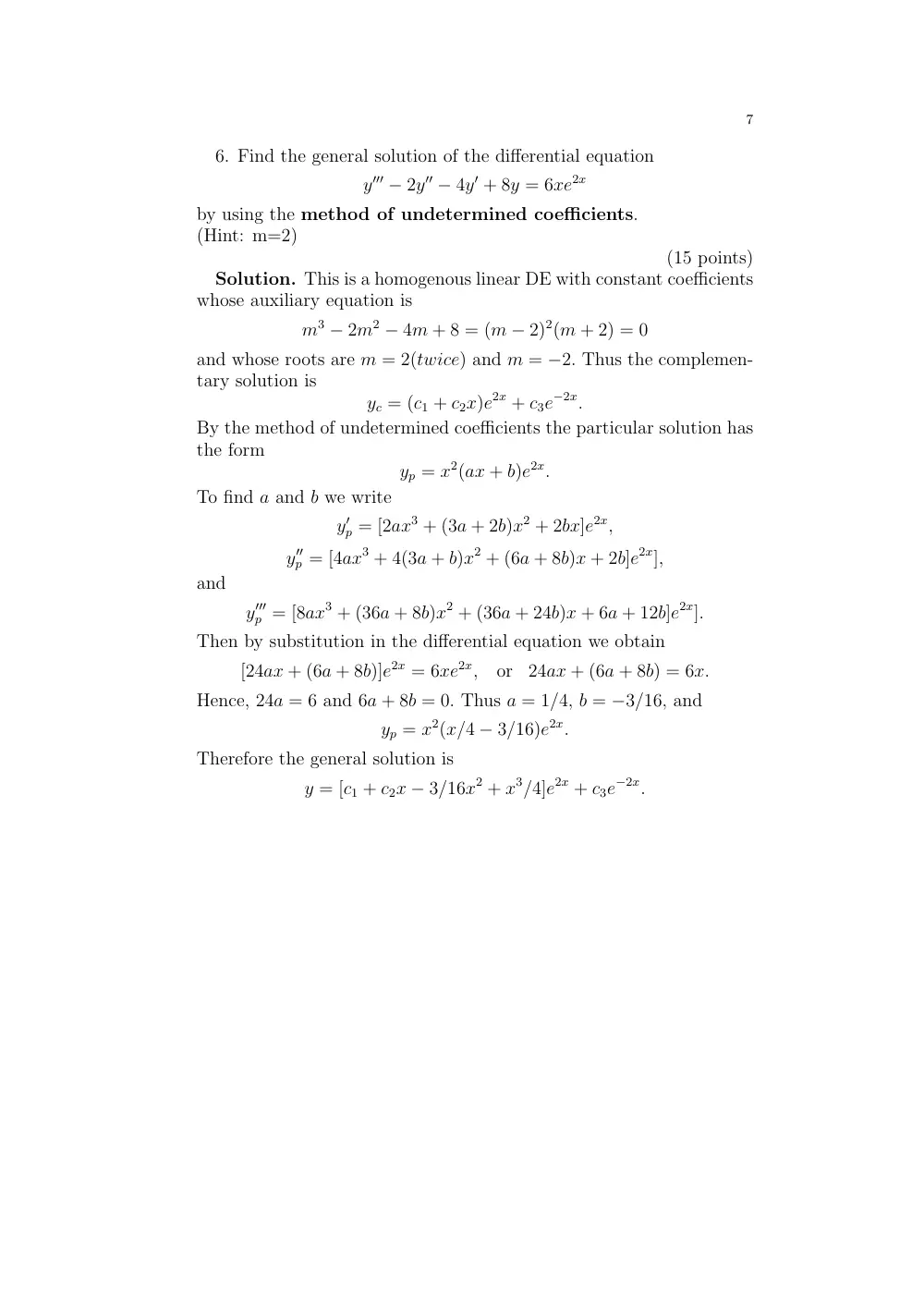
6. Find the general solution of the differential equation
y′′′ − 2y′′ − 4y′ + 8y = 6xe2x
by using the method of undetermined coefficients.
(Hint: m=2)
(15 points)
Solution. This is a homogenous linear DE with constant coefficients
whose auxiliary equation is
m3 − 2m2 − 4m + 8 = (m − 2)2(m + 2) = 0
and whose roots are m = 2(twice) and m = −2. Thus the complemen-
tary solution is
yc = (c1 + c2x)e2x + c3e−2x.
By the method of undetermined coefficients the particular solution has
the form
yp = x2(ax + b)e2x.
To find a and b we write
y′
p = [2ax3 + (3a + 2b)x2 + 2bx]e2x,
y′′
p = [4ax3 + 4(3a + b)x2 + (6a + 8b)x + 2b]e2x],
and
y′′′
p = [8ax3 + (36a + 8b)x2 + (36a + 24b)x + 6a + 12b]e2x].
Then by substitution in the differential equation we obtain
[24ax + (6a + 8b)]e2x = 6xe2x,
or
24ax + (6a + 8b) = 6x.
Hence, 24a = 6 and 6a + 8b = 0. Thus a = 1/4, b = −3/16, and
yp = x2(x/4 − 3/16)e2x.
Therefore the general solution is
y = [c1 + c2x − 3/16x2 + x3/4]e2x + c3e−2x.
8
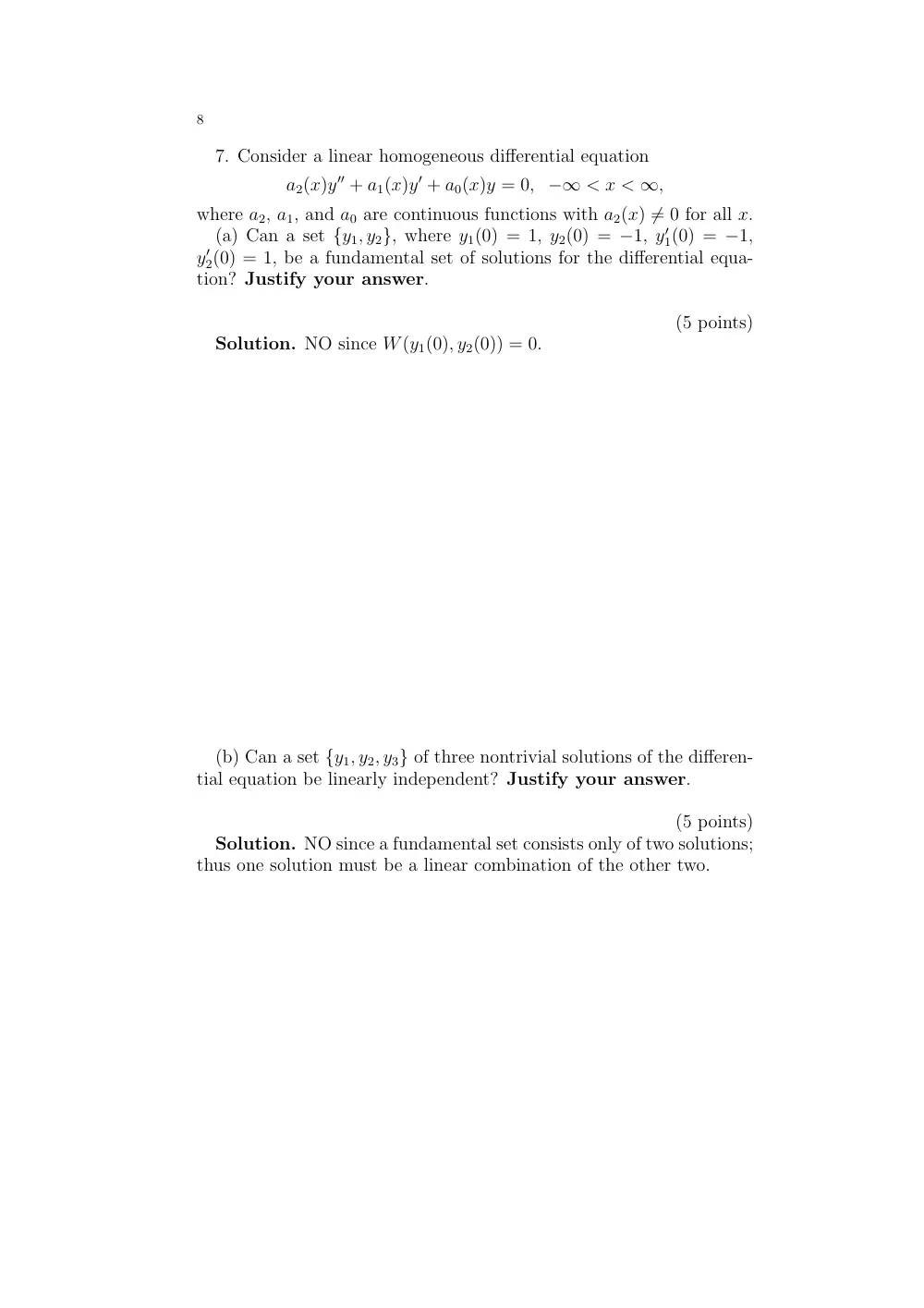
7. Consider a linear homogeneous differential equation
a2(x)y′′ + a1(x)y′ + a0(x)y = 0, −∞ < x < ∞,
where a2, a1, and a0 are continuous functions with a2(x) ̸= 0 for all x.
(a) Can a set {y1, y2}, where y1(0) = 1, y2(0) = −1, y′
1(0) = −1,
y′
2(0) = 1, be a fundamental set of solutions for the differential equa-
tion? Justify your answer.
(5 points)
Solution. NO since W(y1(0), y2(0)) = 0.
(b) Can a set {y1, y2, y3} of three nontrivial solutions of the differen-
tial equation be linearly independent? Justify your answer.
(5 points)
Solution. NO since a fundamental set consists only of two solutions;
thus one solution must be a linear combination of the other two.