
MATH 202 Exam 2, Spring 2008
American University of Beirut · Differential Equations · 7 pages

More MATH 202 files
- Exam Solution to Sample Exam I · Spring 2019Exam · with solutionView
- Exam 2 Clean Copy · Spring 2019ExamView
- Exam 1 Quiz 1 Spring 18 · Spring 2019ExamView
- Exam 1 SAMPLE EXAM I · Spring 2019ExamView
- Midterm · Summer 2018ExamView
- Exam 1 Quiz 1 2007 · Spring 2017ExamView
- Exam 1 · Fall 2017ExamView
- Exam 1 Quiz 1 2008 with Solution · Spring 2017Exam · with solutionView
Show the text of this exam
MATHEMATICS 202
SPRING SEMESTER 2005-06
QUIZ II
Time: 70 MINUTES.
Date: April 8, 2006.
Name:—————————————————————————-
ID Number:———————————————————————–
Section Number:——————————————————————
Course Instructors: Prof. Abdallah Lyzzaik and Dr. Hassan Yamani
Question
Grade
1
/16
2
/16
3
/16
4
/16
5
/16
6
/20
TOTAL
/100
Answer The Following Six Questions On The Page Allocated
For Each Question (You May Use The Back Of The Pages If
Needed).
1
2
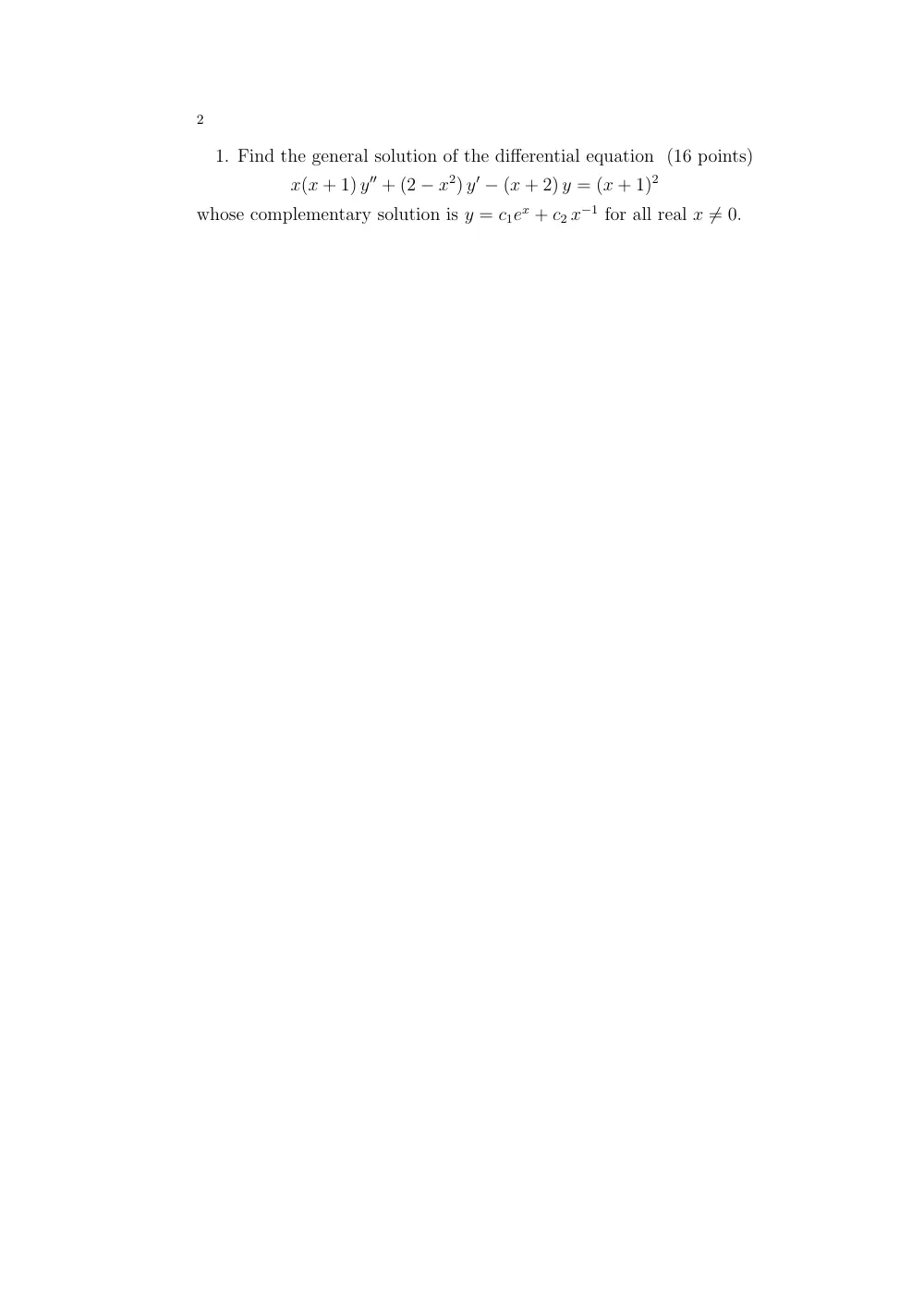
1. Find the general solution of the differential equation (16 points)
x(x + 1) y′′ + (2 − x2) y′ − (x + 2) y = (x + 1)2
whose complementary solution is y = c1ex + c2 x−1 for all real x ̸= 0.
3
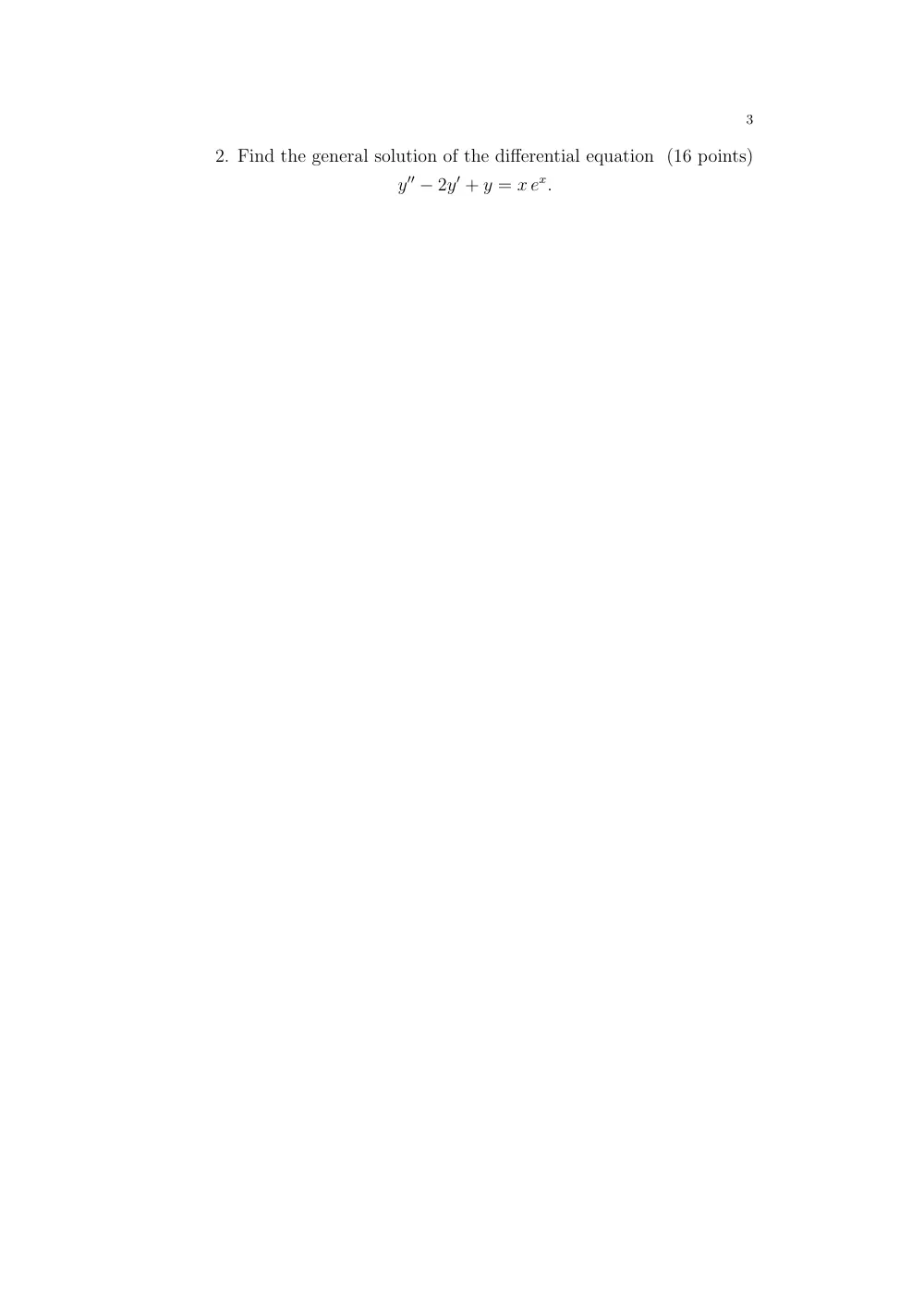
2. Find the general solution of the differential equation (16 points)
y′′ − 2y′ + y = x ex.
4
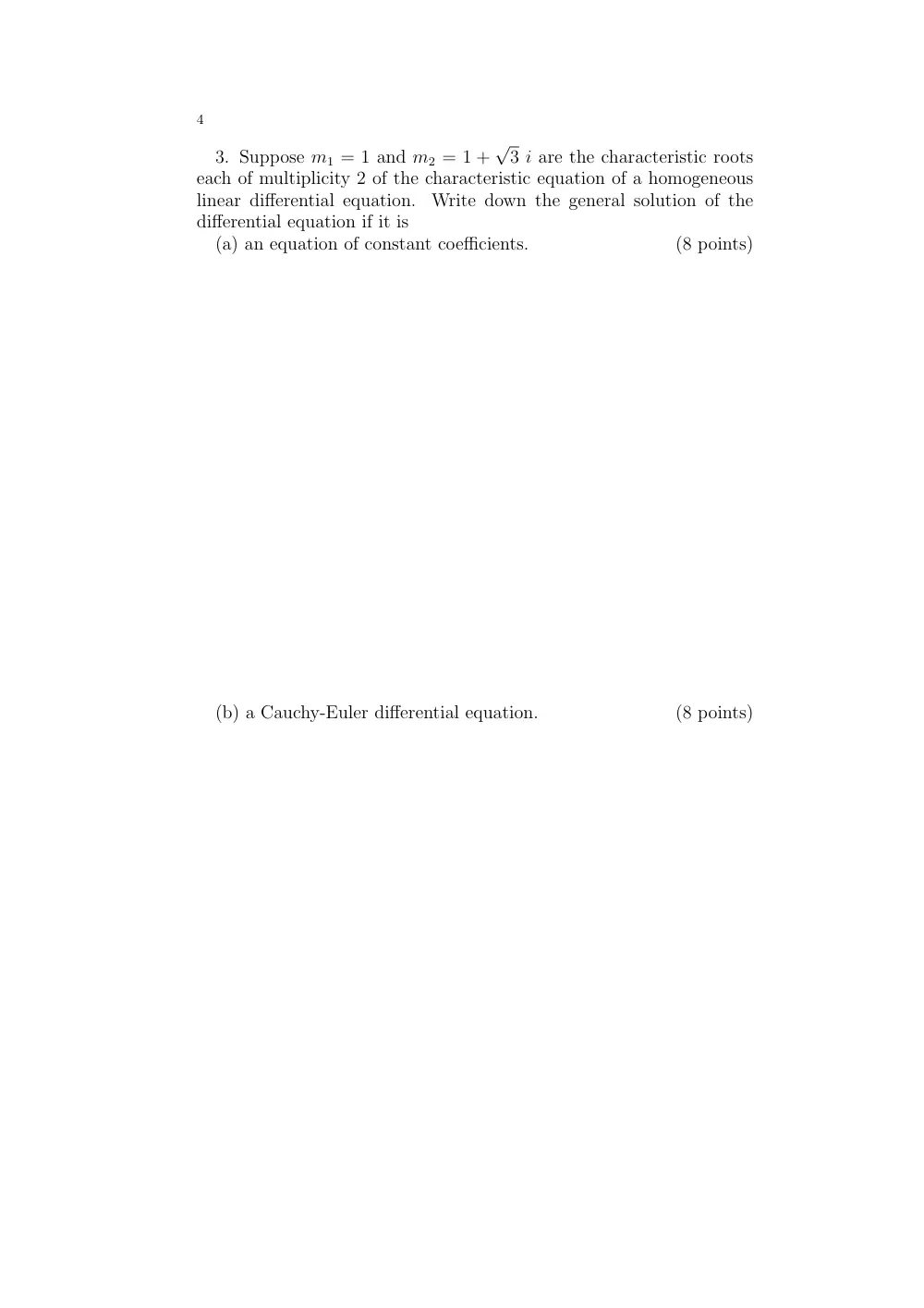
3. Suppose m1 = 1 and m2 = 1 +
√
3 i are the characteristic roots
each of multiplicity 2 of the characteristic equation of a homogeneous
linear differential equation.
Write down the general solution of the
differential equation if it is
(a) an equation of constant coefficients.
(8 points)
(b) a Cauchy-Euler differential equation.
(8 points)
5
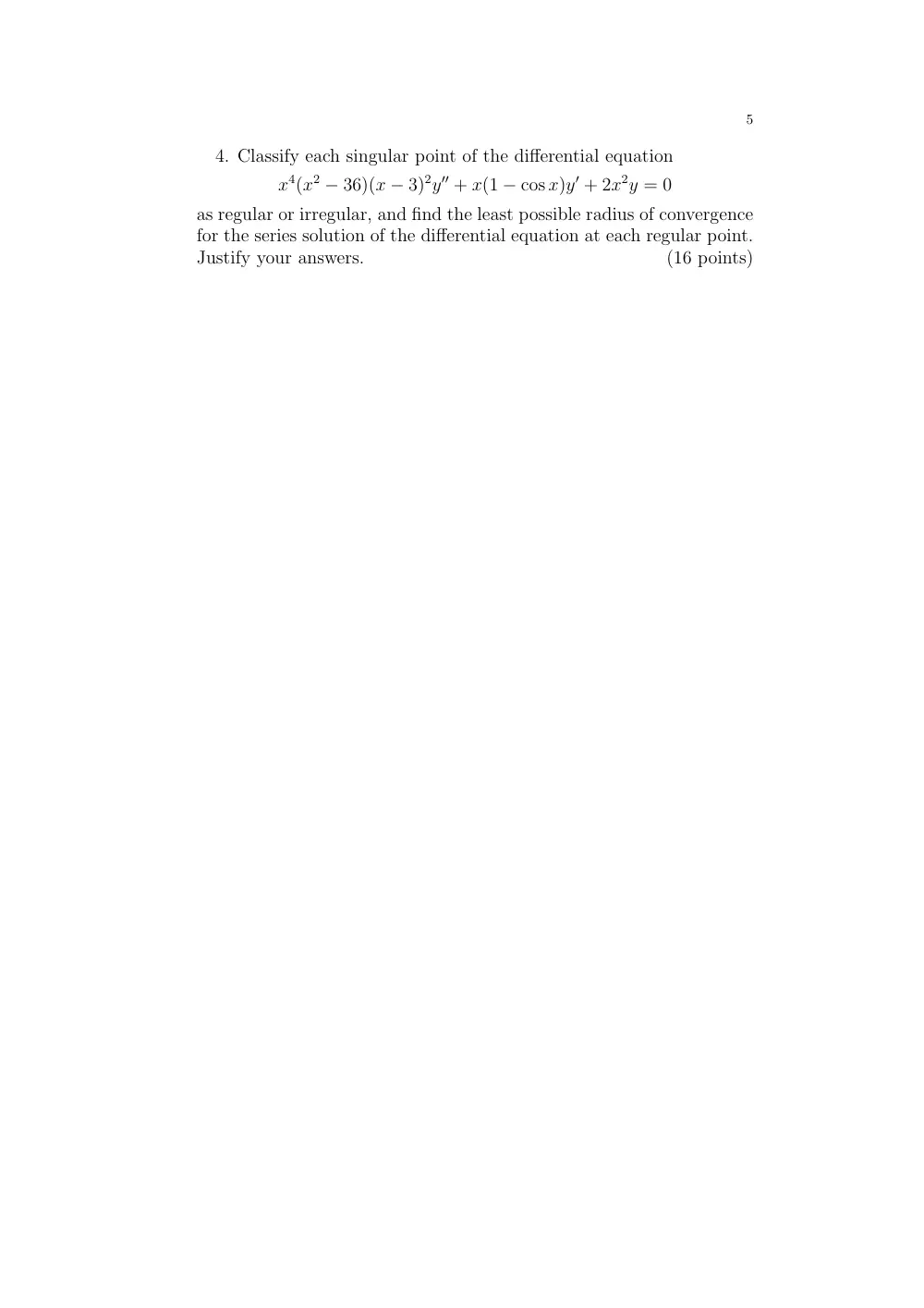
4. Classify each singular point of the differential equation
x4(x2 − 36)(x − 3)2y′′ + x(1 − cos x)y′ + 2x2y = 0
as regular or irregular, and find the least possible radius of convergence
for the series solution of the differential equation at each regular point.
Justify your answers.
(16 points)
6
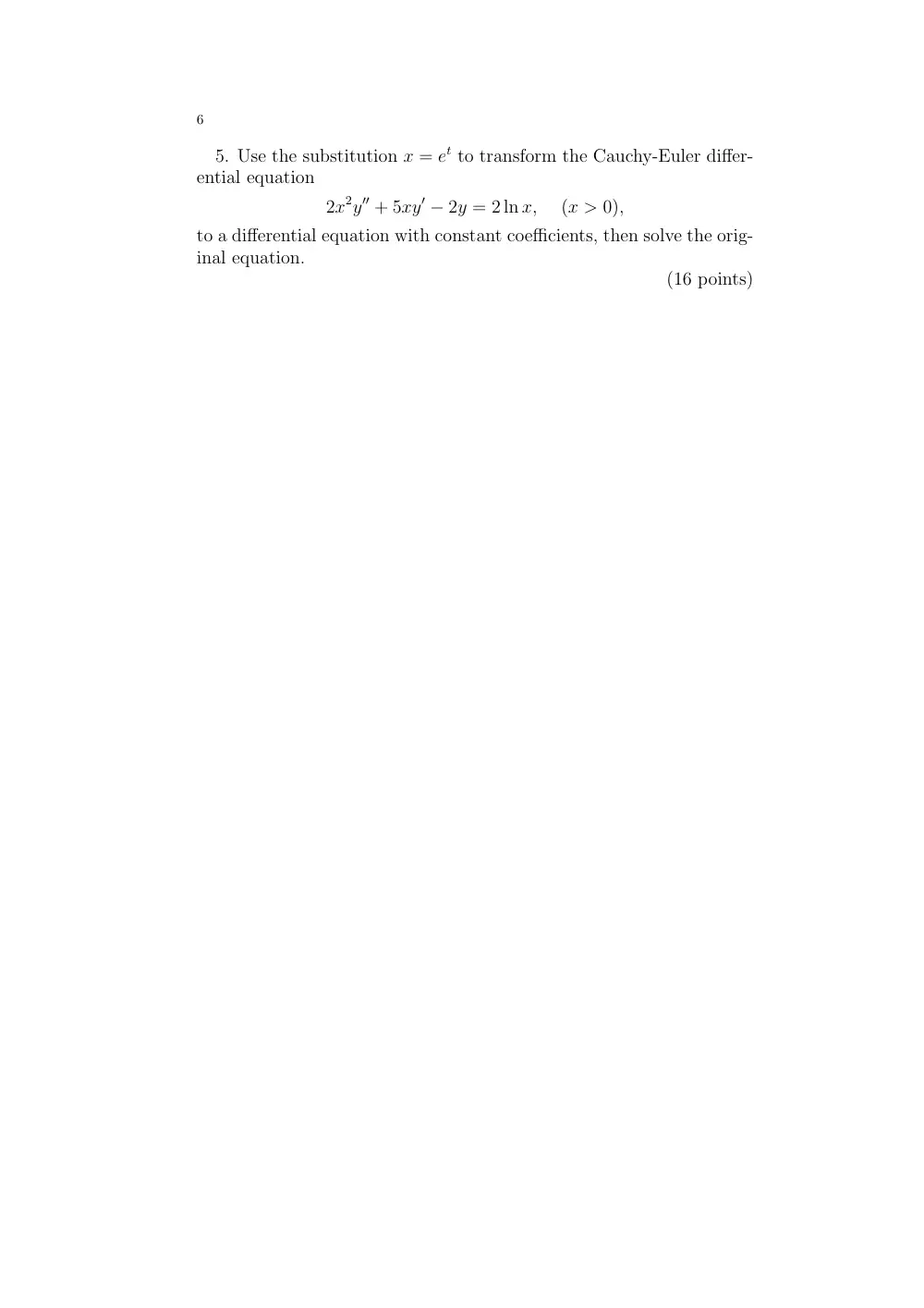
5. Use the substitution x = et to transform the Cauchy-Euler differ-
ential equation
2x2y′′ + 5xy′ − 2y = 2 ln x,
(x > 0),
to a differential equation with constant coefficients, then solve the orig-
inal equation.
(16 points)
7
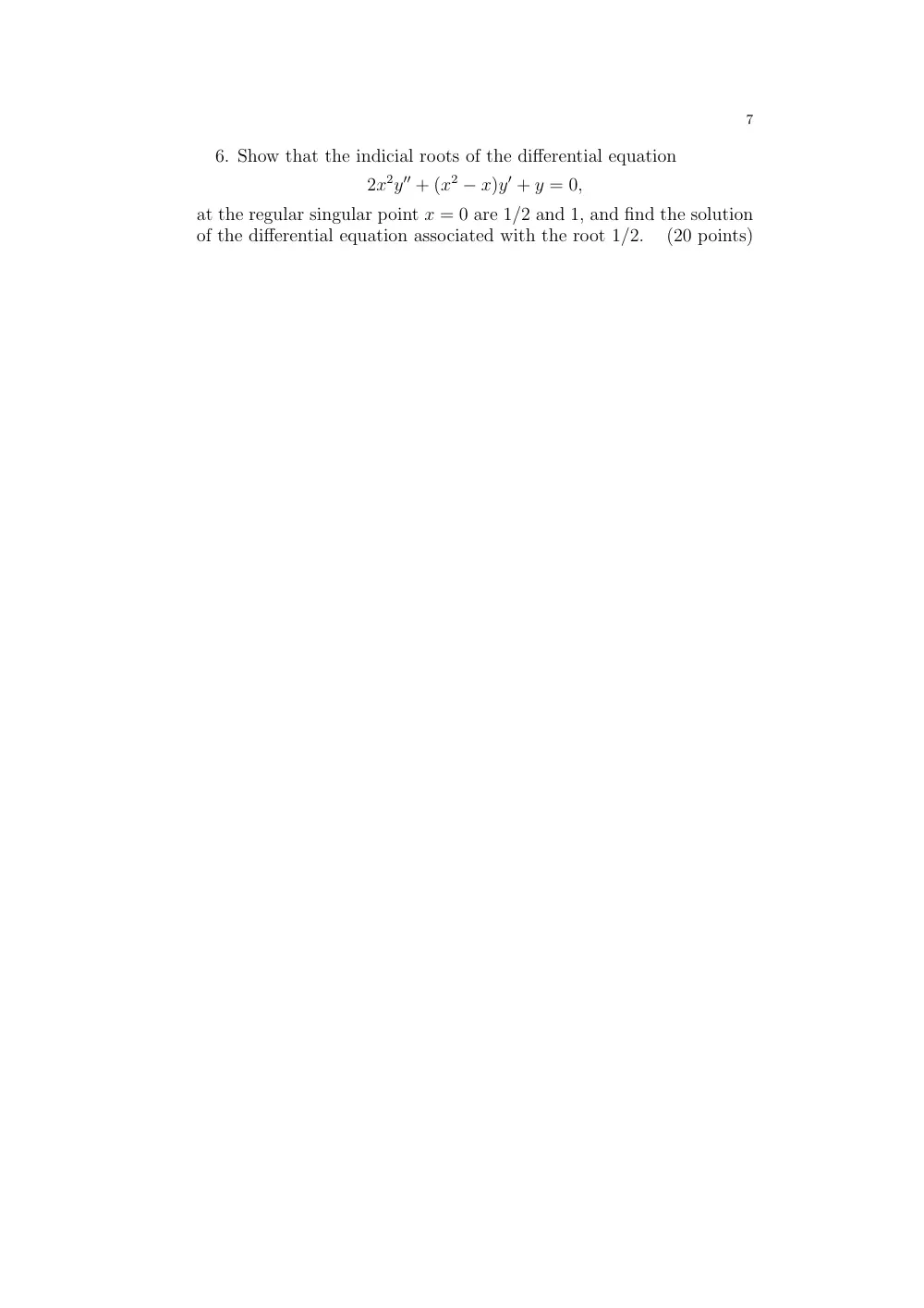
6. Show that the indicial roots of the differential equation
2x2y′′ + (x2 − x)y′ + y = 0,
at the regular singular point x = 0 are 1/2 and 1, and find the solution
of the differential equation associated with the root 1/2.
(20 points)