
MATH 202 Exam 2, Spring 2008
American University of Beirut · Differential Equations · 8 pages




More MATH 202 files
- Exam Solution to Sample Exam I · Spring 2019Exam · with solutionView
- Exam 2 Clean Copy · Spring 2019ExamView
- Exam 1 Quiz 1 Spring 18 · Spring 2019ExamView
- Exam 1 SAMPLE EXAM I · Spring 2019ExamView
- Midterm · Summer 2018ExamView
- Exam 1 Quiz 1 2007 · Spring 2017ExamView
- Exam 1 · Fall 2017ExamView
- Exam 1 Quiz 1 2008 with Solution · Spring 2017Exam · with solutionView
Show the text of this exam
1
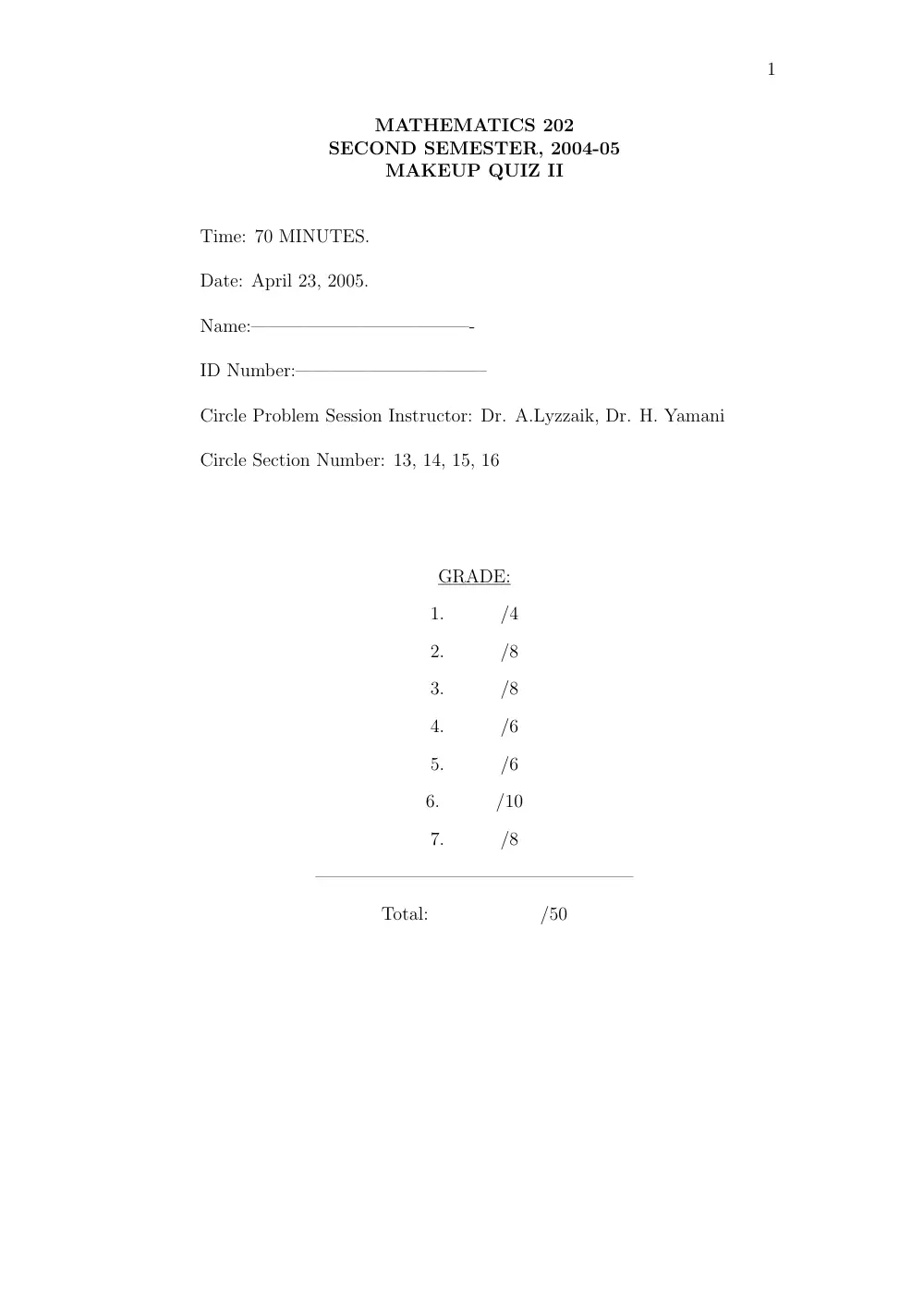
MATHEMATICS 202
SECOND SEMESTER, 2004-05
MAKEUP QUIZ II
Time: 70 MINUTES.
Date: April 23, 2005.
Name:————————————-
ID Number:——————————–
Circle Problem Session Instructor: Dr. A.Lyzzaik, Dr. H. Yamani
Circle Section Number: 13, 14, 15, 16
GRADE:
1.
/4
2.
/8
3.
/8
4.
/6
5.
/6
6.
/10
7.
/8
—————————————————–
Total:
/50
2
1. Use the method of undetermined coefficients to find the expected
form of a particular solution yp for the differential equation
y′′ − 2y′ + 5y = ex sin 2x.
Caution: Need not find yp explicitly.
(4 points)
3
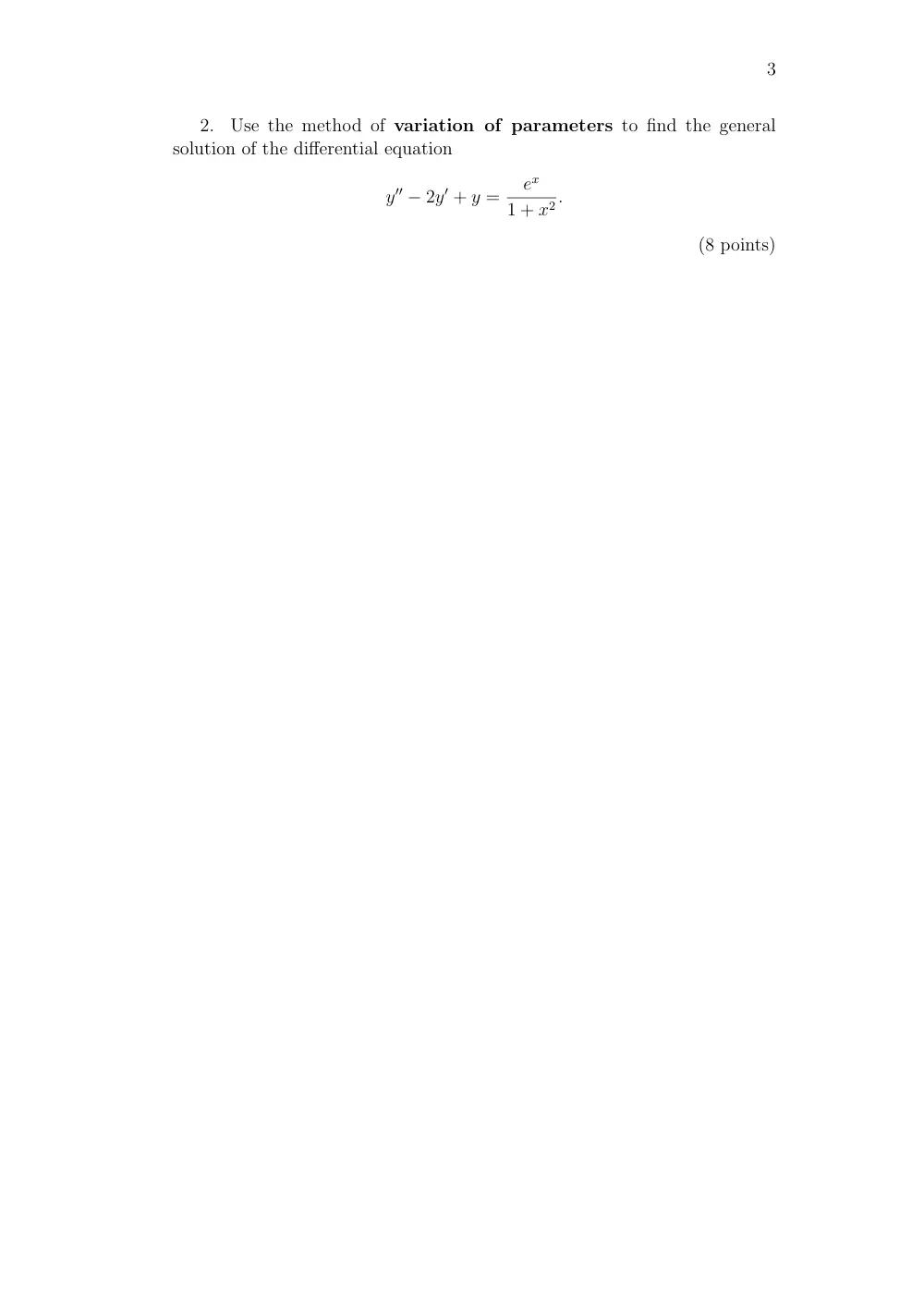
2.
Use the method of variation of parameters to find the general
solution of the differential equation
y′′ − 2y′ + y =
ex
1 + x2.
(8 points)
4
3. Solve by the power series method the initial value problem
(x − 1)y′′ − xy′ + y = 0, y(0) = −2, y′(0) = 6.
(8 points)
5
4. Find the general solution of the Bessel-type differential equation
d
dx(xy′) +
�
x − 4
x
�
y = 0; x > 0.
(6 points)
6
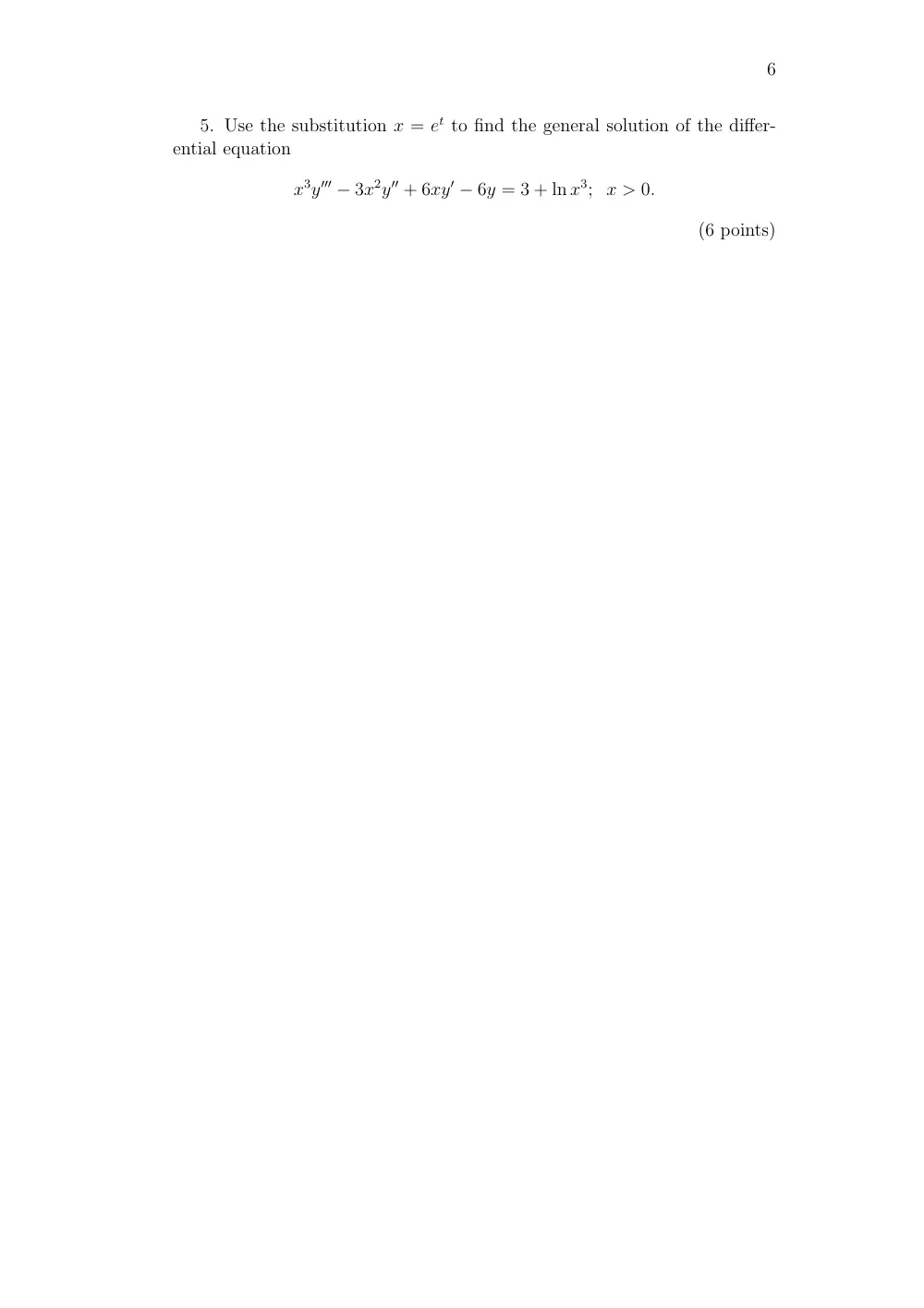
5. Use the substitution x = et to find the general solution of the differ-
ential equation
x3y′′′ − 3x2y′′ + 6xy′ − 6y = 3 + ln x3; x > 0.
(6 points)
7
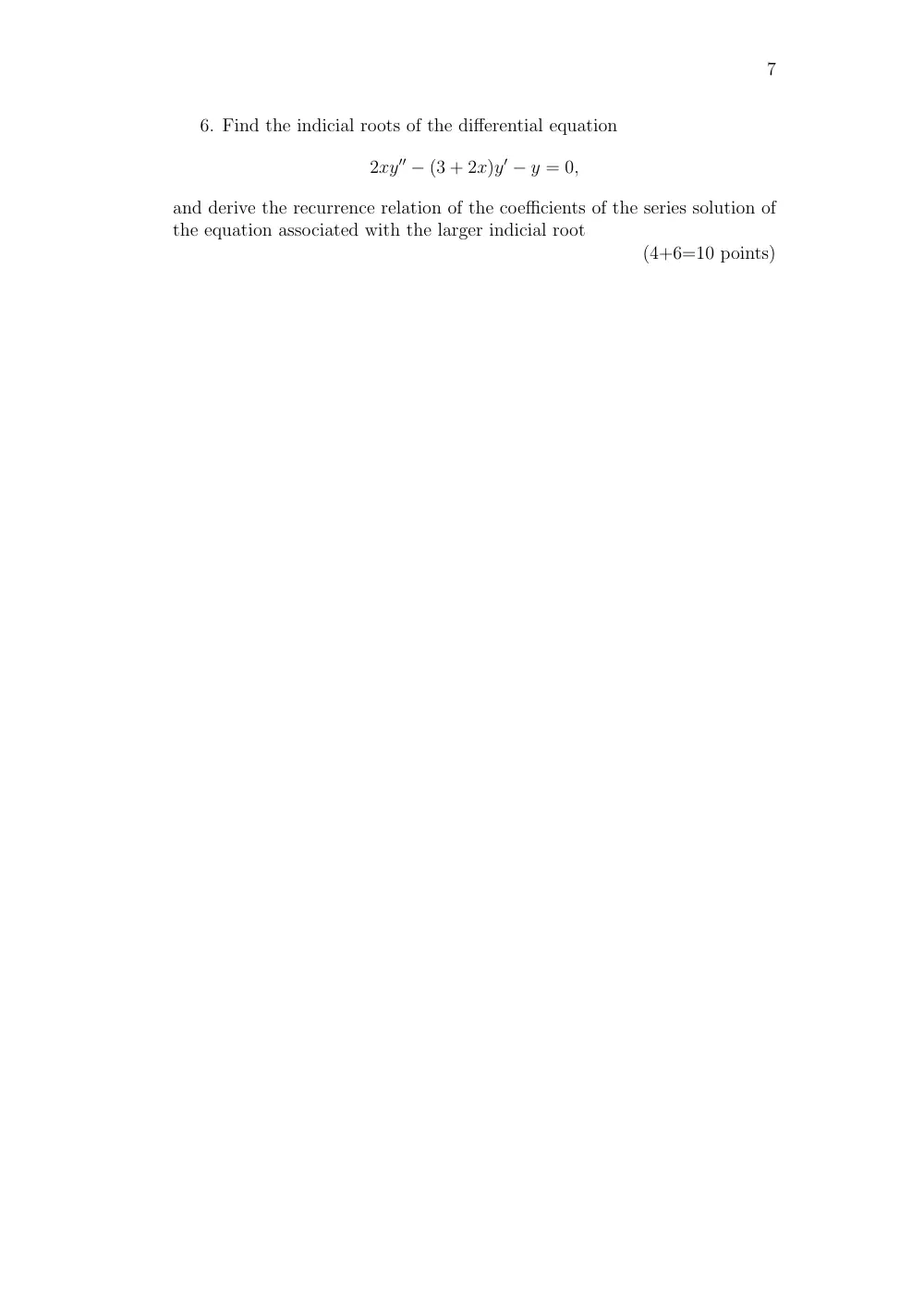
6. Find the indicial roots of the differential equation
2xy′′ − (3 + 2x)y′ − y = 0,
and derive the recurrence relation of the coefficients of the series solution of
the equation associated with the larger indicial root
(4+6=10 points)
8
7. Answer TRUE (T) or FALSE (F) only:
(a) ——- The differential equation
y′′ + P(x)y′ + Q(x)y = 0,
has exactly two power series solution near a regular singular point x0.
(2 points)
(b) ——- The differential equation
y′′ + P(x)y′ + Q(x)y = 0
has no fundamental set of power series solutions near an ordinary point x0.
(2 points)
(c) ——- The differential equation
(x3 − 2x2 − 3x)2y′′ + (x + 1)(x − 3)2(sin x)y′ − (x + 1)y = 0
has irregular singular points.
(2 points)
(d) ——- The interval of convergence of series solutions of the differential
equation
(x3 + x)y′′ + xy′ + y = 0
about the regular singular point x = 0 is ]0, 1[.
(2 points)