
MATH 203 Exam 1, Fall 2007
American University of Beirut · Mathematics for Social Sciences I · 7 pages


More MATH 203 files
Show the text of this exam
American University of Beirut
Math 203
Quiz I Fall 2006-2007
Time: 70min.
Name……………………………… Student # :………………………….
o Circle your section number:
Section 1: Th. @ 9:30
Section 3: Fr. @ 3:00
Section 2: Th. @ 11:00
Section 4: Fr. @ 4:00
________________________________________________________________________
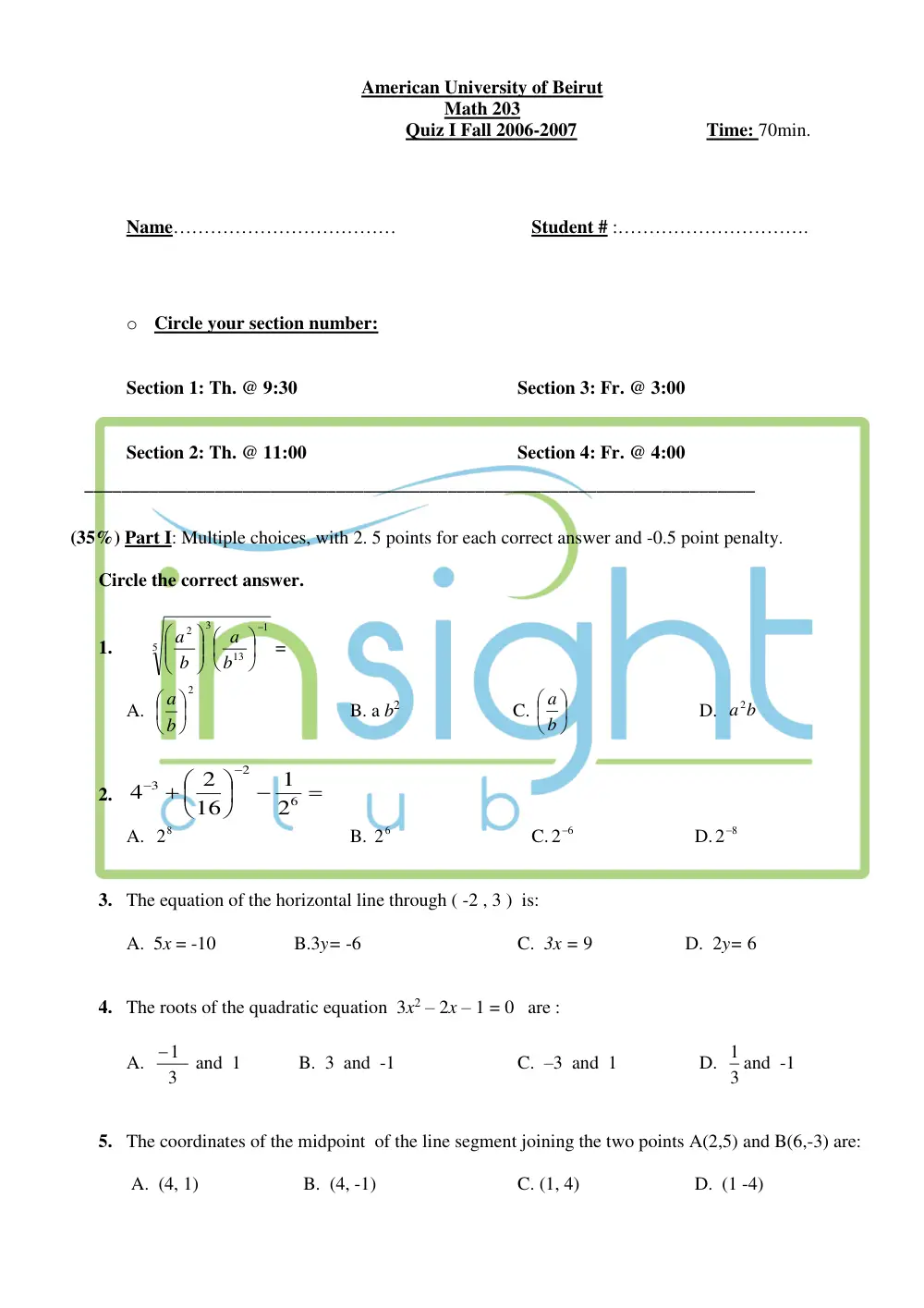
(35%) Part I: Multiple choices, with 2. 5 points for each correct answer and -0.5 point penalty.
Circle the correct answer.
1. 5
1
13
3
2
b
a
b
a
=
A.
2
b
a
B. a b2
C.
b
a
D.
b
a 2
2.
6
2
3
2
1
16
2
4
A.
8
2
B.
6
2
C.
6
2
D.
8
2
3. The equation of the horizontal line through ( -2 , 3 ) is:
A. 5x = -10
B.3y= -6
C. 3x = 9
D. 2y= 6
4. The roots of the quadratic equation 3x2 – 2x – 1 = 0 are :
A. 3
1
and 1
B. 3 and -1
C. –3 and 1
D. 3
1 and -1
5. The coordinates of the midpoint of the line segment joining the two points A(2,5) and B(6,-3) are:
A. (4, 1)
B. (4, -1)
C. (1, 4)
D. (1 -4)
2
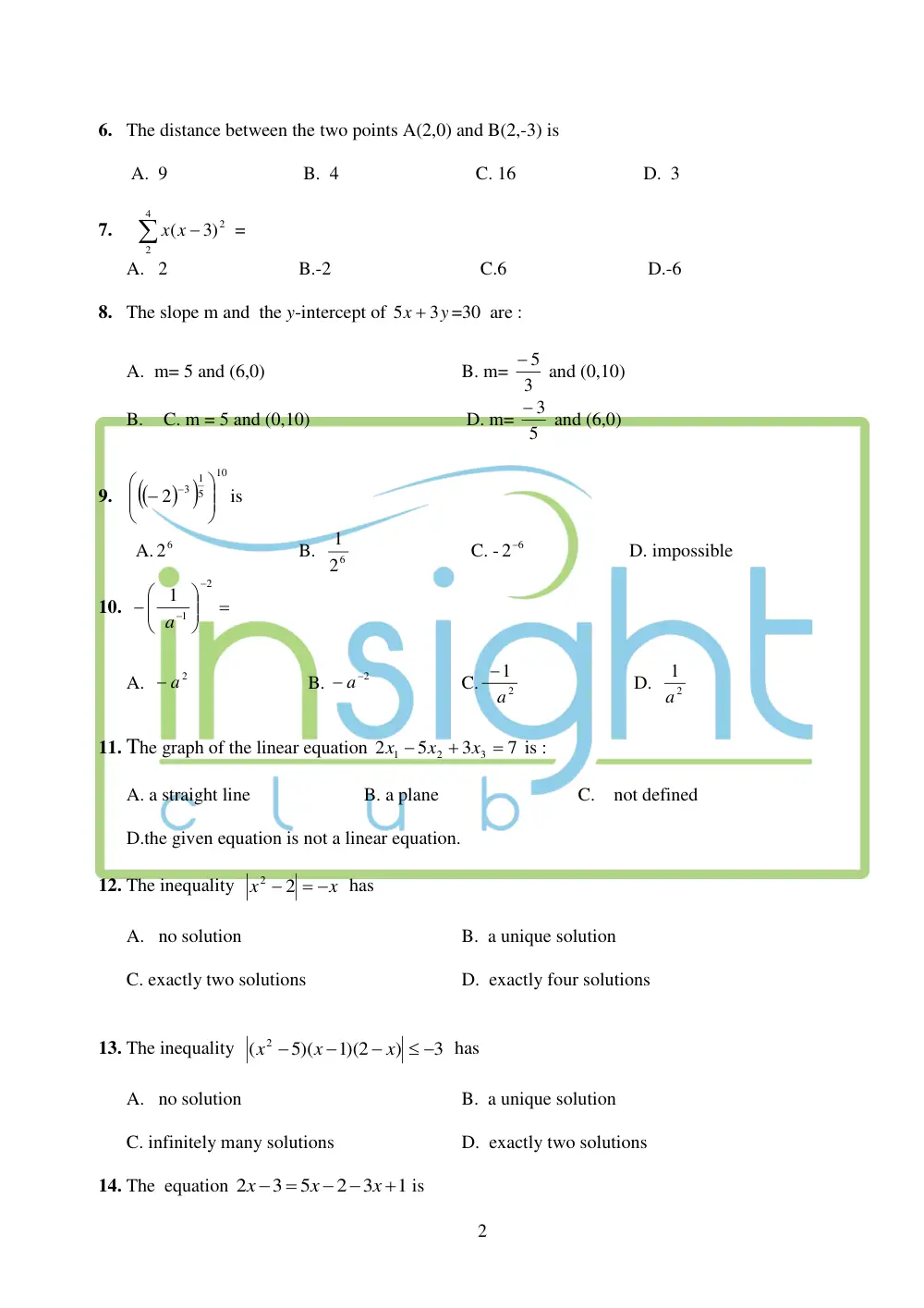
6. The distance between the two points A(2,0) and B(2,-3) is
A. 9
B. 4
C. 16
D. 3
7.
4
2
3 2)
x(x
=
A. 2
B.-2
C.6
D.-6
8. The slope m and the y-intercept of
y
x
5 3
=30 are :
A. m= 5 and (6,0)
B. m= 3
5
and (0,10)
B. C. m = 5 and (0,10)
D. m= 5
3
and (6,0)
9.
10
5
1
2 3
is
A.
6
2
B.
26
1
C. -
6
2
D. impossible
10.
2
1
1
a
A.
a2
B.
a2
C.
2
1
a
D.
2
1
a
11. The graph of the linear equation
7
3
5
2
3
2
1
x
x
x
is :
A. a straight line
B. a plane
C. not defined
D.the given equation is not a linear equation.
12. The inequality
x
x
2 2
has
A. no solution
B. a unique solution
C. exactly two solutions
D. exactly four solutions
13. The inequality
3
)
1)(2
5)(
(
2
x
x
x
has
A. no solution
B. a unique solution
C. infinitely many solutions
D. exactly two solutions
14. The equation
1
3
2
5
3
2
x
x
x
is
3
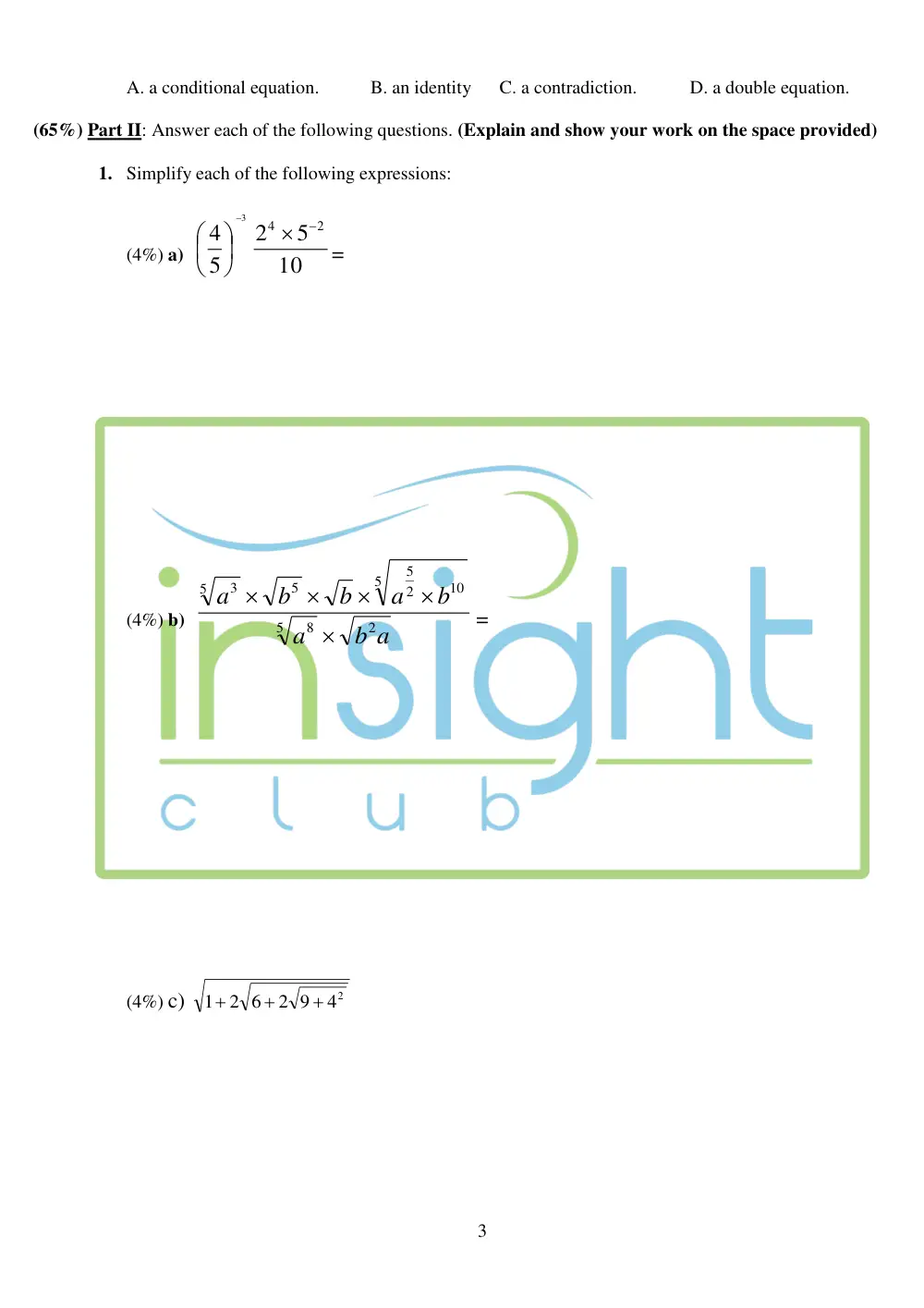
A. a conditional equation. B. an identity C. a contradiction.
D. a double equation.
(65%) Part II: Answer each of the following questions. (Explain and show your work on the space provided)
1. Simplify each of the following expressions:
(4%) a)
10
5
2
5
4
2
4
3
=
(4%) b)
b a
a
b
a
b
b
a
2
5
8
5
10
2
5
5
5
3
=
(4%) c)
42
2 9
2 6
1
4
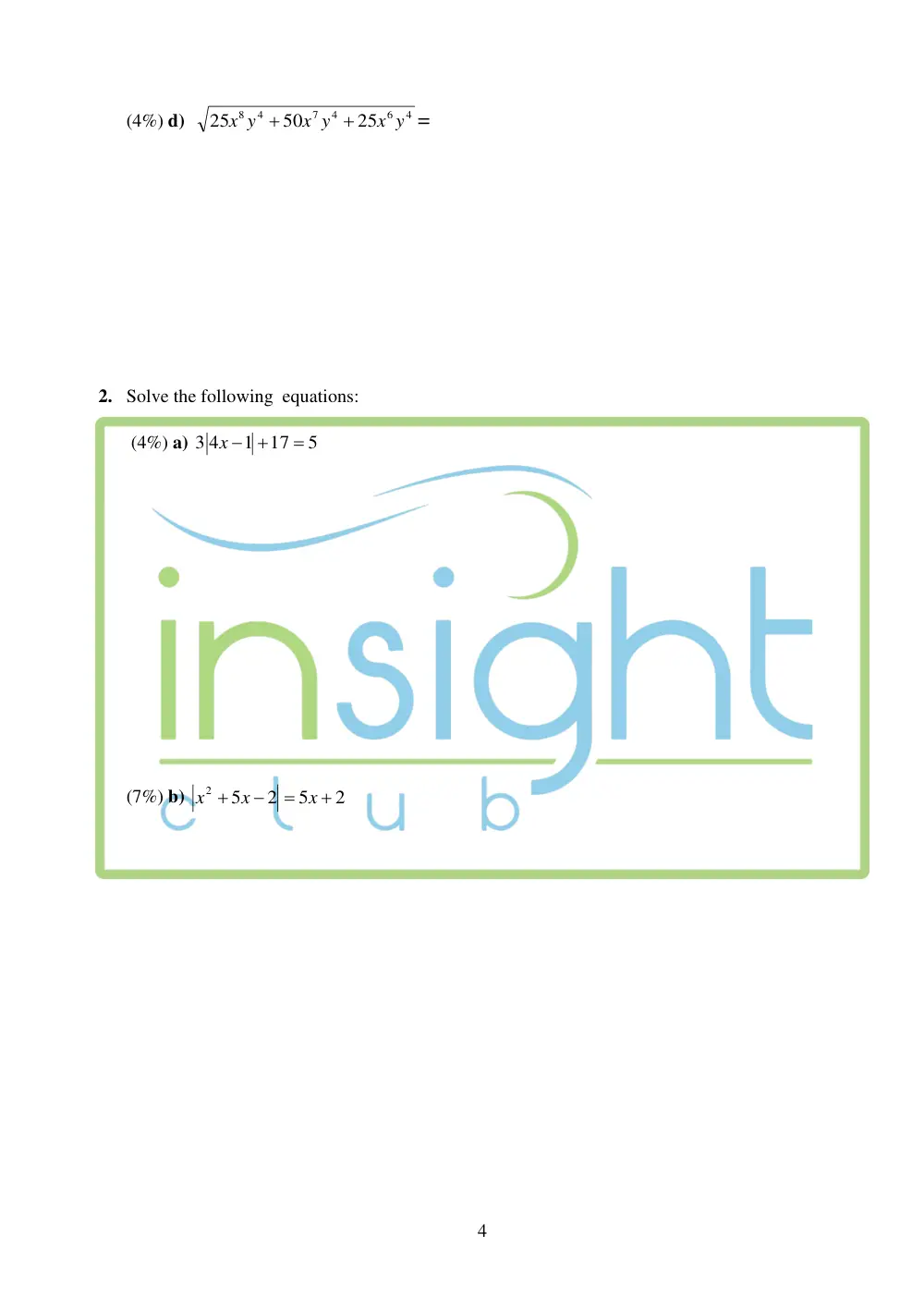
(4%) d)
4
6
4
7
8 4
25
50
25
x y
x y
x y
=
2. Solve the following equations:
(4%) a)
5
17
1
3 4
x
(7%) b)
2
5
2
5
2
x
x
x
5
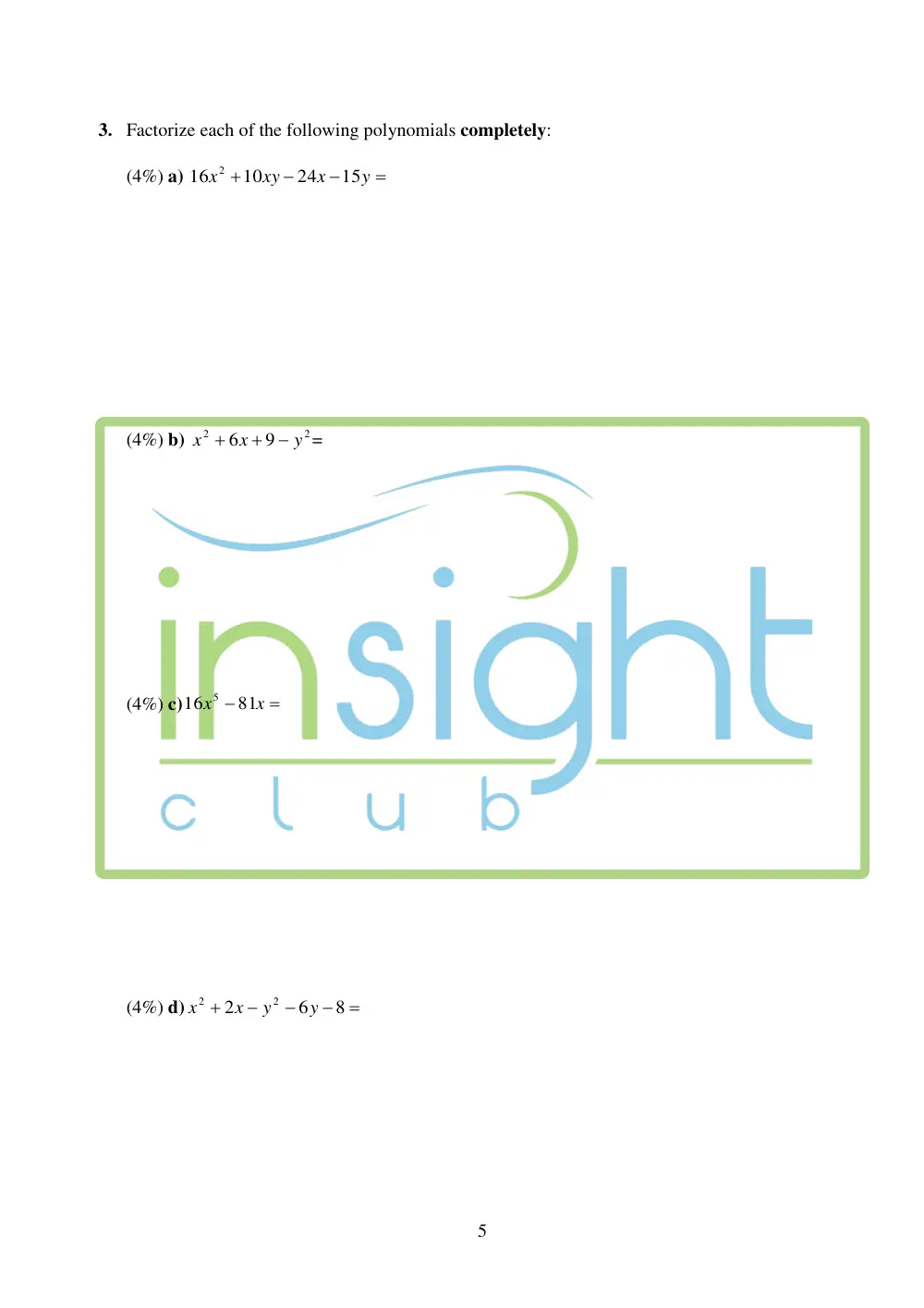
3. Factorize each of the following polynomials completely:
(4%) a)
y
x
xy
x
15
24
10
16
2
(4%) b)
2
2
9
6
y
x
x
=
(4%) c)
x
x
81
16
5
(4%) d)
8
6
2
2
2
y
y
x
x
6
4. Solve the following inequalities:
(4%) a)
0
18
12
2
2
x
x
(7%) b)
6
5
2
x x
7
(4%) c)
0
)1
4(
2
x
(7%) d)
0
7)
(
5)
4)(
(
2
x
x
x