
MATH 204 Exam 2, Fall 2005
American University of Beirut · Mathematics for Social Sciences II · 6 pages

More MATH 204 files
Show the text of this exam
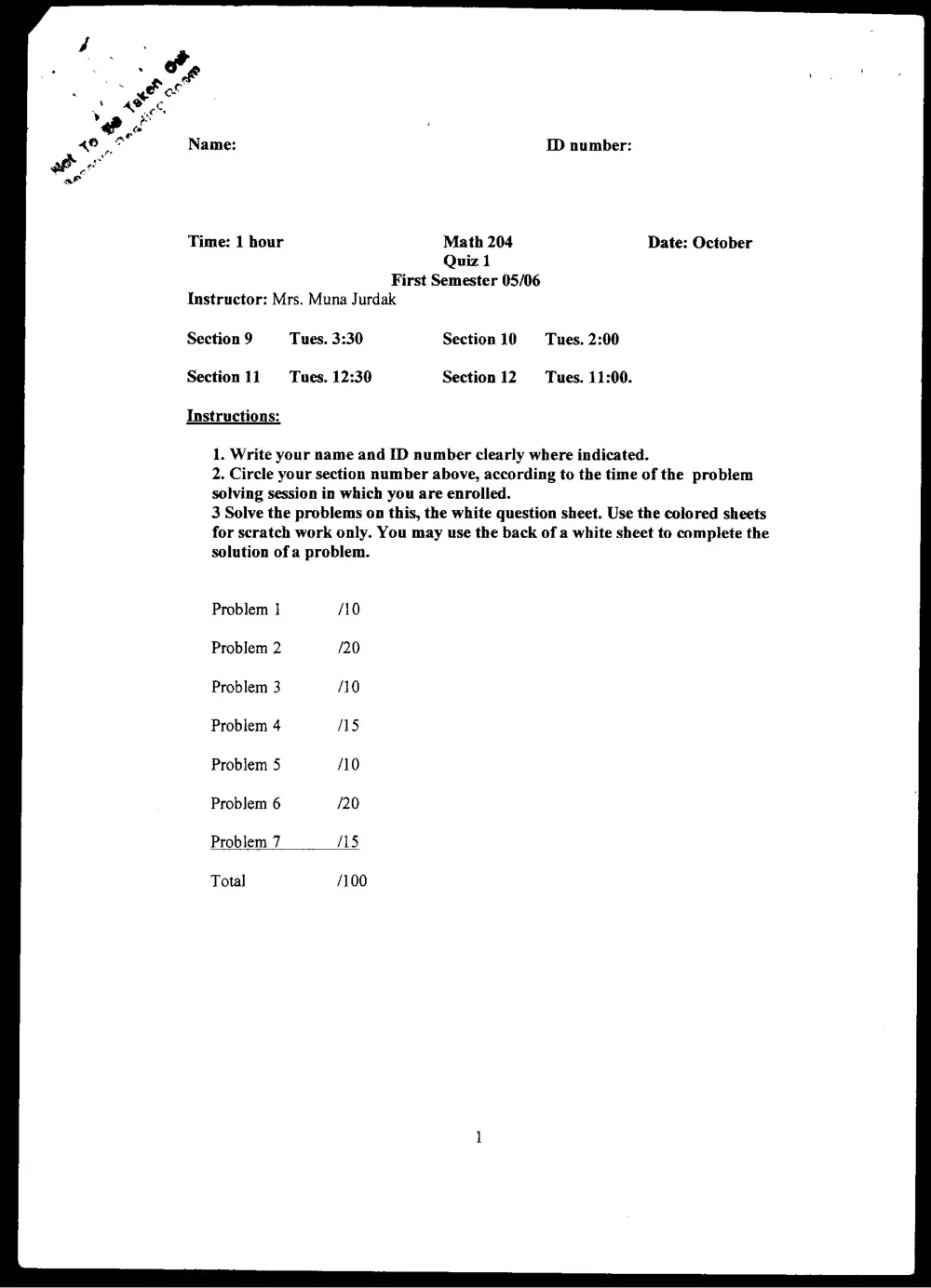
Time: 1 hour Math 204 Date: October
Quiz 1
First Semester 05/06
Instructor: Mrs. Muna Jurdak
Section 9 Tues. 3:30 Section 10 = Tues. 2:00
Section 11 Tues. 12:30 Section 12 Tues. 11:00.
Instructions:
1. Write your name and ID number clearly where indicated.
2. Circle your section number above, according to the time of the problem
solving session in which you are enrolled.
3 Solve the problems on this, the white question sheet. Use the colored sheets
for scratch work only. You may use the back of a white sheet to complete the
solution of a problem.
Problem 1 /10
Problem 2 /20
Problem 3 ‘10
Probiem 4 AWS
Problem 5 ‘10
Problem 6 /20
Problem 7 AS
Total /100
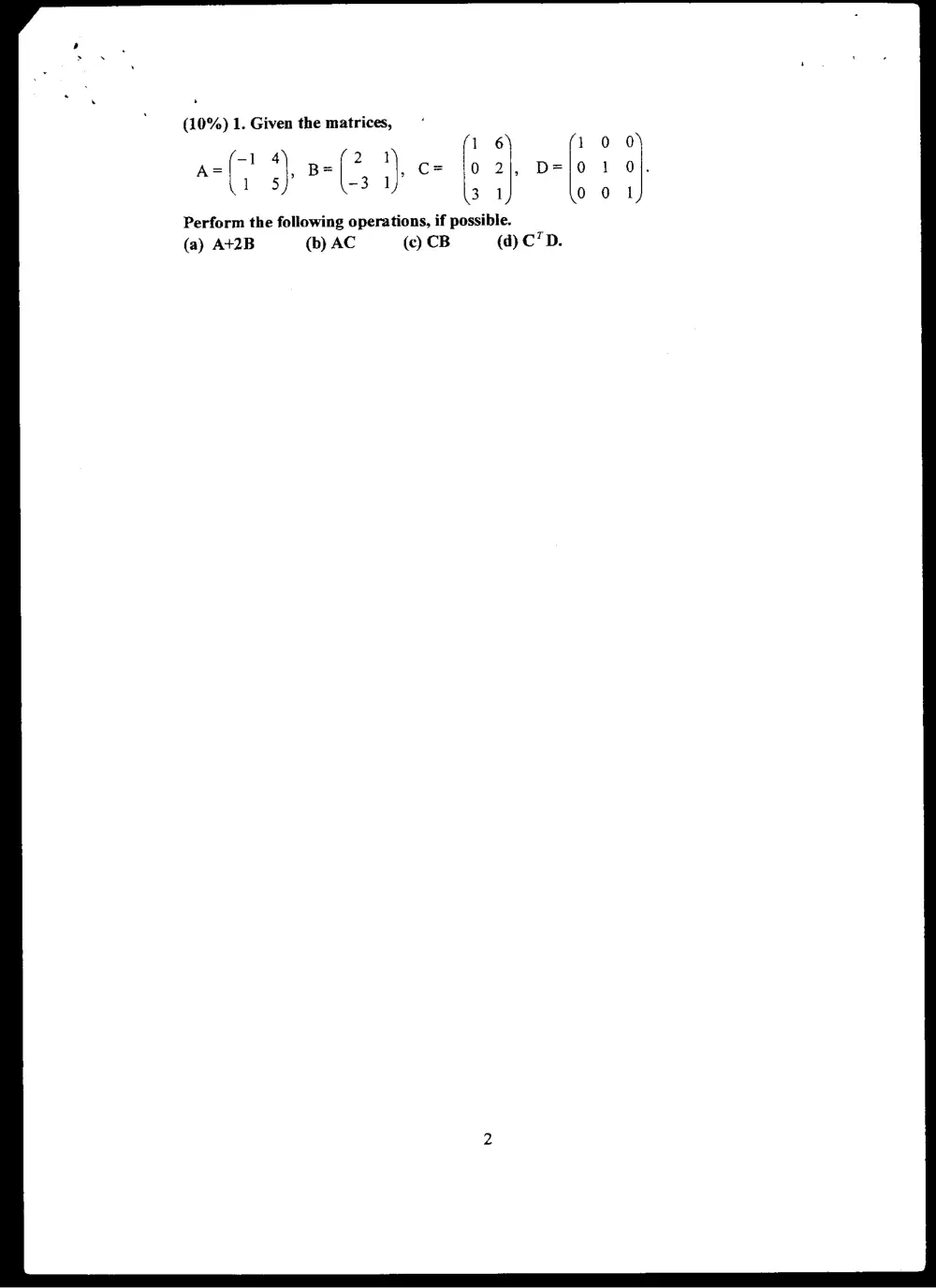
(10%) 1. Given the matrices,
1 4 2 1 1 6
A=|_ , C= 10 2), De
1 5 -3 1
301
Perform the following operations, if possible.
(a) A+2B (b) AC (c) CB (d) C"D.
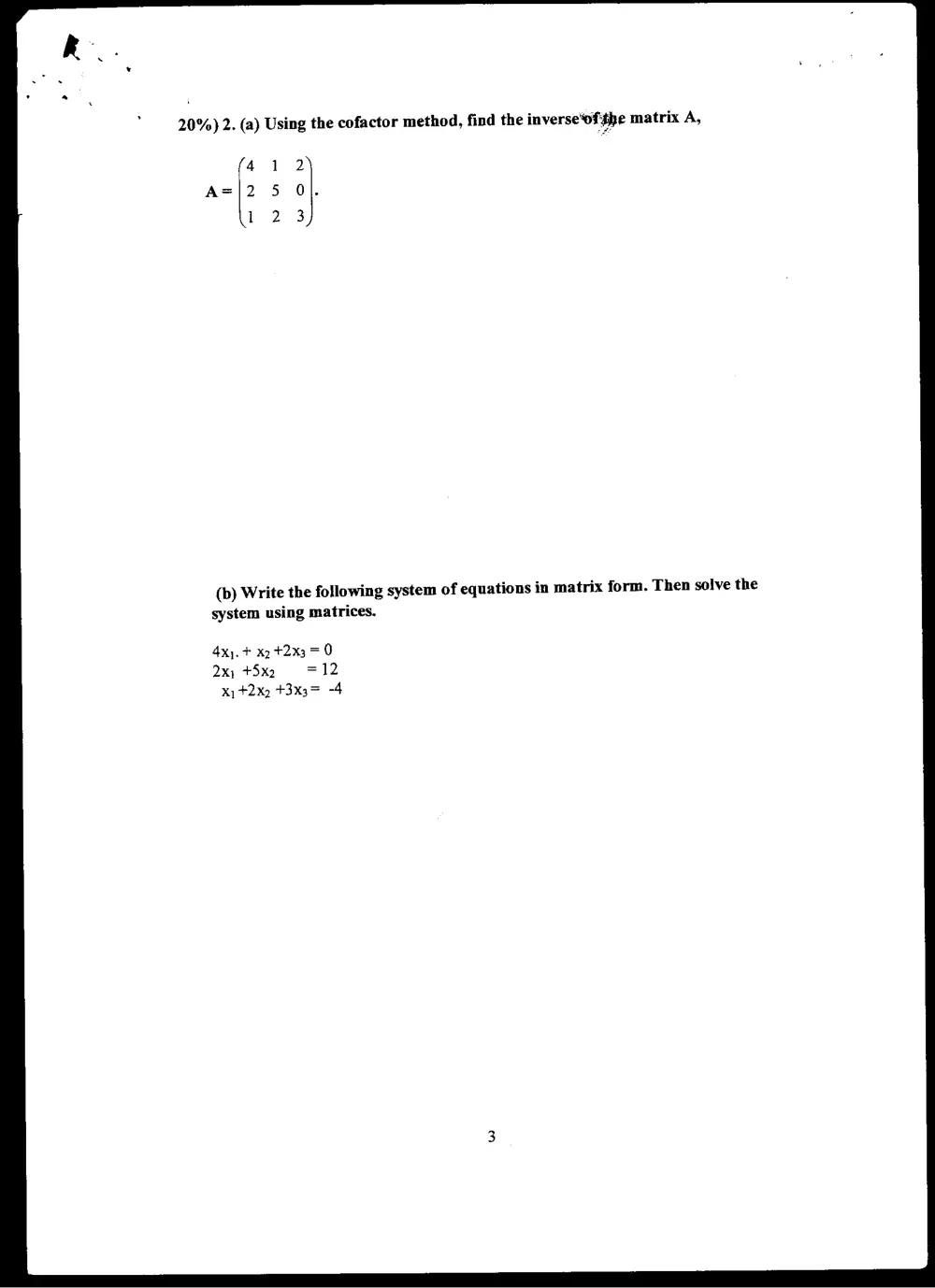
20%) 2. (a) Using the cofactor method, find the inverseofthe matrix A,
4 2
A=|2 0}.
1 3
(b) Write the following system of equations in matrix form. Then solve the
system using matrices.
4x). + X27 +2x3=0
2x, +5x2 =]2
X1 +2x) +3x3= 4
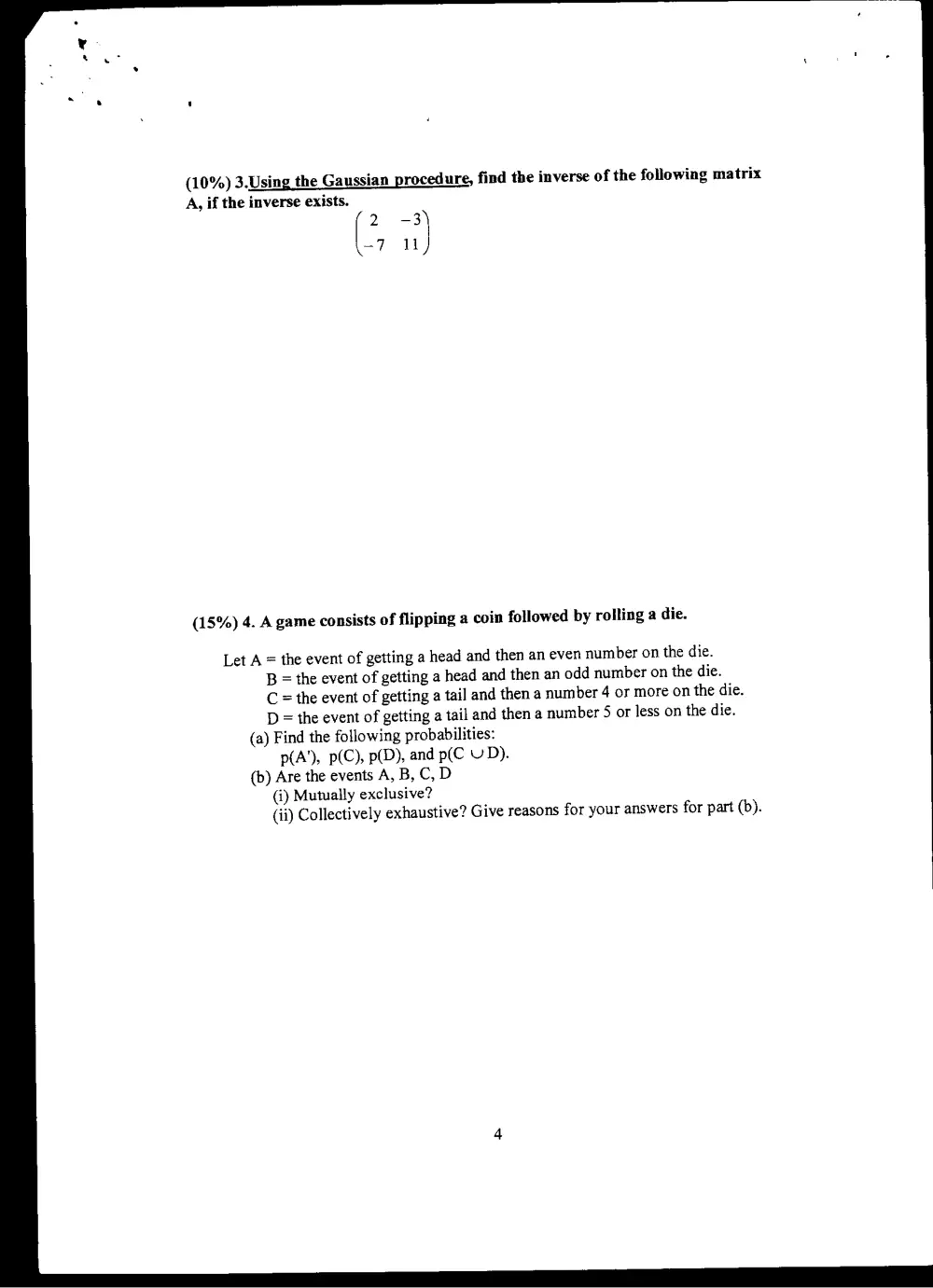
(10%) 3.Using the Gaussian procedure, find the inverse of the following matrix
A, if the inverse exists.
2 -3
-7 Wi
(15%) 4. A game consists of flipping a coin followed by rolling a die.
Let A = the event of getting a head and then an even number on the die.
B = the event of getting a head and then an odd number on the die.
C = the event of getting a tai] and then a number 4 or more on the die.
D = the event of getting a tail and then a number 5 or less on the die.
(a) Find the following probabilities:
p(A’), p(C), p(D), and p(C UD).
(b) Are the events A, B,C,D
(i) Mutually exclusive?
(ii) Collectively exhaustive? Give reasons for your answers for part (b).
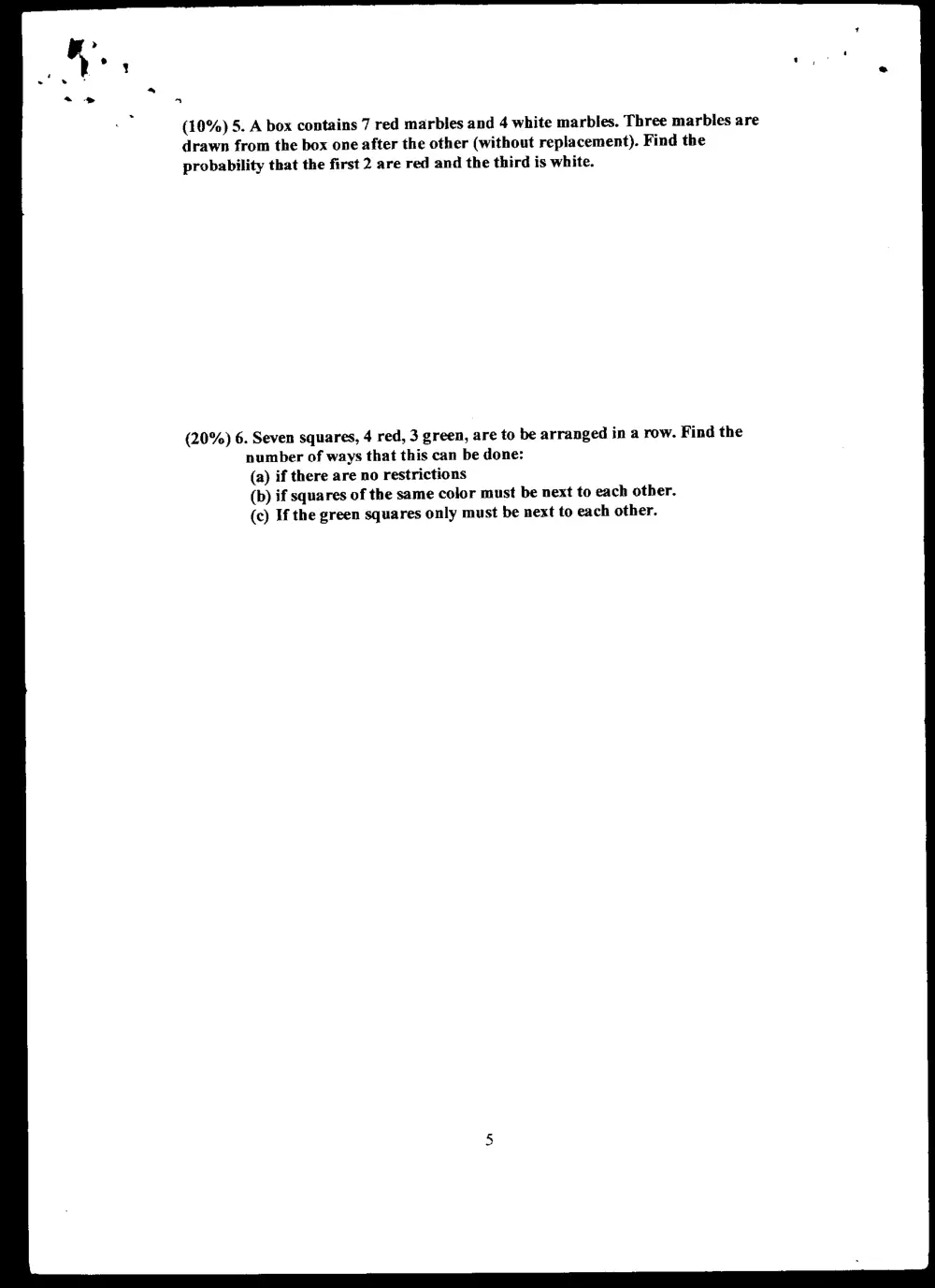
(10%) 5. A box contains 7 red marbles and 4 white marbles. Three marbles are
drawn from the box one after the other (without replacement). Find the
probability that the first 2 are red and the third is white.
(20%) 6. Seven squares, 4 red, 3 green, are to be arranged in a row. Find the
number of ways that this can be done:
(a) if there are no restrictions
(b) if squares of the same color must be next to each other.
(c) If the green squares only must be next to each other.
1
(15%)7. (a) A woman has 12 close friends. Find the number of ways that she can
invite 5 of them to dinner.
(b) If two of the woman's friends are married and will not attend
separately, find the number of ways that the woman can invite 5 of her
12 friends.