
MATH 204 Exam 2, Spring 2006
American University of Beirut · Mathematics for Social Sciences II · 7 pages




More MATH 204 files
Show the text of this exam
Name: ID number:
Time: | hour Math 204 8/04/06
Quiz I
Second Semester 05/06
Instructor: Mrs. Muna Jurdak
Section 1 Thurs. 11:00 a.m. Section 2: Fri. 1:00 p.m.
Section 3: Thurs. 3:30 p.m. Section 4: Thurs. 2:00 p.m.
Instructions:
1. Write your name and ID number clearly where indicated.
2. Circle your section number above, according to the time of the problem solving
session in which you are enrolled.
3. Solve the problems on this, the white question sheet. Use the colored sheets
for scratch work only. You may use the back of a white sheet to complete the
solution of a problem.
4. Give numerical answers correct to 2 decimal places.
5. Show your work in all the problems.
1 2 3 4 5 6 7 8 Total
/12 /10 ‘10 AS B ‘AT /10 ‘8 /100
(12%) 1. (@)Fing & » for y=(e Din ls Bev dy a uly ey!
os ats
ix Axe” (Qav% +1) + 2* “ak he VR 41 Sinca tl’ 2 LK *)
rovers
(b) Find (1) for f(x) =
€'Ce) = (k>% +>, |
(c)Use the chain rule to find ,ify =4ol and u =(x? — 3x + 1)”.
dx’ u+l?
#ui4t) Las-Orl
a oo aye da = O° —Bxt) “4 Bx 3).
Shae Ox-3) 2 ©. ~s)
AGF * Bro Bea IT are Bat ya 3B ees x4) 2
tH) x +1)
3
(10%) 2. (a) Find J(ol5x + Fo 21a* - Idx «es - |G Yy er va Yo, 2 Ix ae.
~M4C 2 BAS » yr RSK -3 K+ C |
Where Cie @ camctant,
-2
wo (b) Ife"(x) = = +2, g'(1)=5 and g(1) = 9, find g(x).
“yy Must Ne a ade Qs (x) Koi ce ho Lind A &2
SMe ax Feds Qe) = BK “ etS, Ft tax tc, Bad.
Ail!) =S so A) y FALE, >
= AB) = xe “sata (x) =
bal Asset v7RAx4C,. But >
+ 2x 49
(10%) 3. The frequency distribution for a random variable X is given below.
X 1 2 3 6
Frequency 40 20 60 80
<. Construct the probability distribution of X.
yet divide Erequoncy ef rack Vor.
xe. 4 tot AR sue e€ Lreqguancies, wie
> Ss
6.3 5.
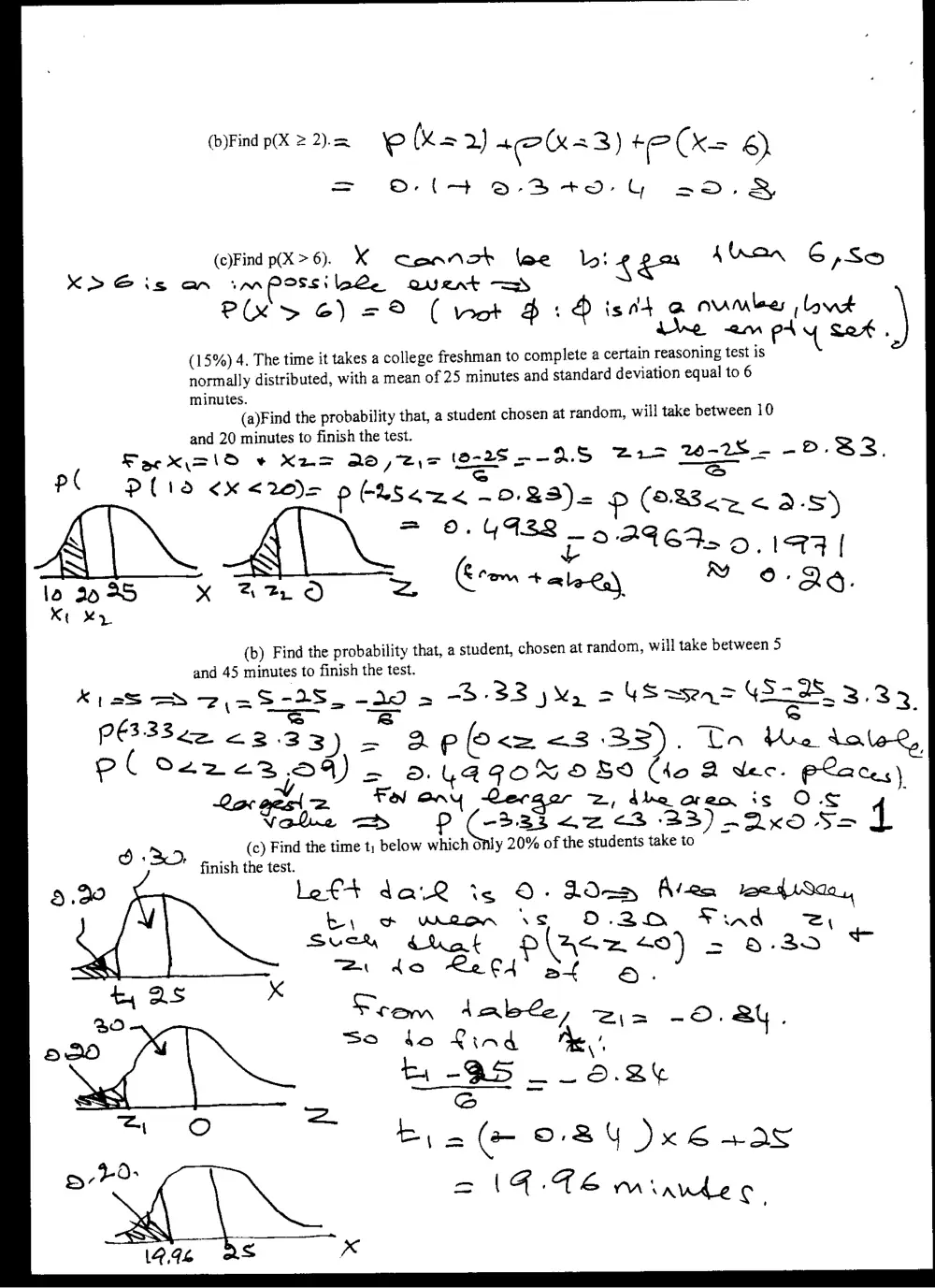
(Find p(X > 2) IO (Ks 2) +33) te (x= 6)
= OO fH OB Bt#dO | 35D.
()Find p(X>6). X ceaansh lee wb: sian 6,86
K> Gis a simPossilple avent md KE* /
PIS 6) =2 (vot :4 istt @ numba ows
ne am en y Lok,
(15%) 4. The time it takes a college freshman to complete a certain reasoning test is
normally distributed, with a mean of 25 minutes and standard deviation equal to 6
minutes.
(a)Find the probability that, a student chosen at random, will take between 10
and 20 minutes to finish the test.
Sack SlO e Xs Ad, Vo (22S 5-A.S Sr1= w-28 - -2. 83.
fo) &
PC liad <x <20)5 pPrRSez< ~0.83). P (OB3ez< aS)
= ©4438 5 .2969..5, 149 |
{| \ iN] 9° Qd.
A tb
lo 29 25 xX AwO =z [rom + alee)
Ki xz,
(b) Find the probability that, a student, chosen at random, will take between 5
and 45 minutes to finish the test.
Kies =S 75S —35_ “22 = 3.33), = YS ssen.> VAs, 3.23
3.33 —~ °
a <= <3:33) = 4 pe<= <3 :33). Un He datee,
Pp 42-3 09%) = dD 4AGONOS9 Clo a ceo. PLaces)
Oar =z FA ony Rerger z, dba aren is OS ;
fobe bs P(-B8tencs 23)-9x05o4
(c) Find the time t; below which only 20% of the students take to
finish the test.
left dar® ig O- Ldan Alen wedWar,
athe? VAL OW al D.2D Fiad
¥ dthat asz sO) =
2 da BY 5. )
Trem dabée, Za -O. 24
Sa do Rind ey: .
1 -95 __5.2¢
S
CHAPTER 14 PROBABILITY DISTRIBUTIONS
i
Area Under the Standard Normal Curve :
-00 01 .02 .03 04 .05 -06 .08 -09
0.0 .0000 .0040 .0080 .0120 .0160
0.1 .0398 0488 .0478 .0517 .0557
0.2 .0793 .0832 .0871 .0910 .0948
0.3 .1179 1217) 612551293 .1331
0.4 1554 1591 =-.1628. + .1664 =.1700
0.6 .1915 1950 =.1985 = «.2019 Ss .2054
0.6 .2257 2291 .2324 = 2357 ~— 62389
0.7 .2580 2612 .2642 .2673 .2704
0.8 .2881 2910 .29389 2967 ~=—.2995
0.9 .38159 8186 .8212 3238 .3264
1.0 .3413 3438 .3461 .38485 .3508
11.3643 3665 3686 .3708 .3729
1.2°° .3849 8869 .38888 .3907 .3925
1.3 .4032 4049 .4066 .4082 .4099
14 4192 .4207 4222 4236 .4251 ©
1.5 .43382 4345 .4857° 4370. 4382
1.6 .4452 4463 4474 4484 4495
1.7 .4554 4564 .4573 .4582 .4591
18 .4641 4649 4656 4664 4671
1.9 .4713 A719 .4726 4732 .4738
2.0 .4772 4778 4783 4788 .4793
i, 21.4821 4826 4830 4834 .4838
2.2 (4861 - .4864 .4868 4871 .4875
2.3 .4893 4896 .4898 4901 .4904
2.4 .4918 4920 4922 4925 .4927
2.5 .4938 4940 .4941 49438 .4945
2.6 4953 4955 .4956 4957 .4959
2.7 4965 .4966 .4967 .4968 .4969
2.8 4974 A975 4976 4977 4977
29 4981: .4982 4982. 4983 .4984
“3.0 .49865 .4987 .4987 4988 .4988 . .
eC Und EEE EUEEERAnenemenmneneanmeeeneemmmemnel
Area = 0.3413 Area = 0.3413
(8%) 5. A box contains 4 red balls and 6 white balls. An experiment consists of
drawing 5 balls at random from the box, with replacement. Find the probability that at
fast 3 of the balls are oo is a Be reaulli Ace tAwant +
wokere NS. wt 42@ cats > Adi €
Yaatl lan 1. w sucesser jae Y in wy
rane Lb (ed loolls. p= He q= & ~Se
P(K23)= o(Ka) 4 pliezy) 'F
-Blente ch Glee ahs seen
(17%) 6. Of 120 students, 60 are studying French, 50 are studying Spanish,
studying both French and Spanish. fs2e
(a)A student is chosen at random. Find the probability that: - weet st ud ary
eon lenely,
i)The student is studying neither French nor Spanish.
Ones “Ss Ue com peamart of SS Geet els suds
aai m). Poe iy Yt
~p(FAS)+ G04 SO~198- AS
2 el)
TD
(ii) The student is studying exactly one of the two languages.
Silber Srenct, ar Seaist omty (s Gaded «
- ¢ SAF )2 GO-
(Spee jeer Pee See
(iii)The student is studying French, given that he is studying Spanish.
PCF IS) 2» eCFaAS) = 244 2 F/g.
“—P(s) S/tr
(b) Let F be the event that the student is studying French, and S be the event
that the student is studying Spanish. Are F and S statistically independent events?
Give a clear reason for your answer.
- Pt S ere sdodigti (
ce SF 7S) = pe) oO
depenbend -
P( & vs) =% (Reomliy)- ple)=s&
a 4! '*
Zs PCR Cs) EH)
Fe SS oe sdedisd co (ly La ponds cof
4
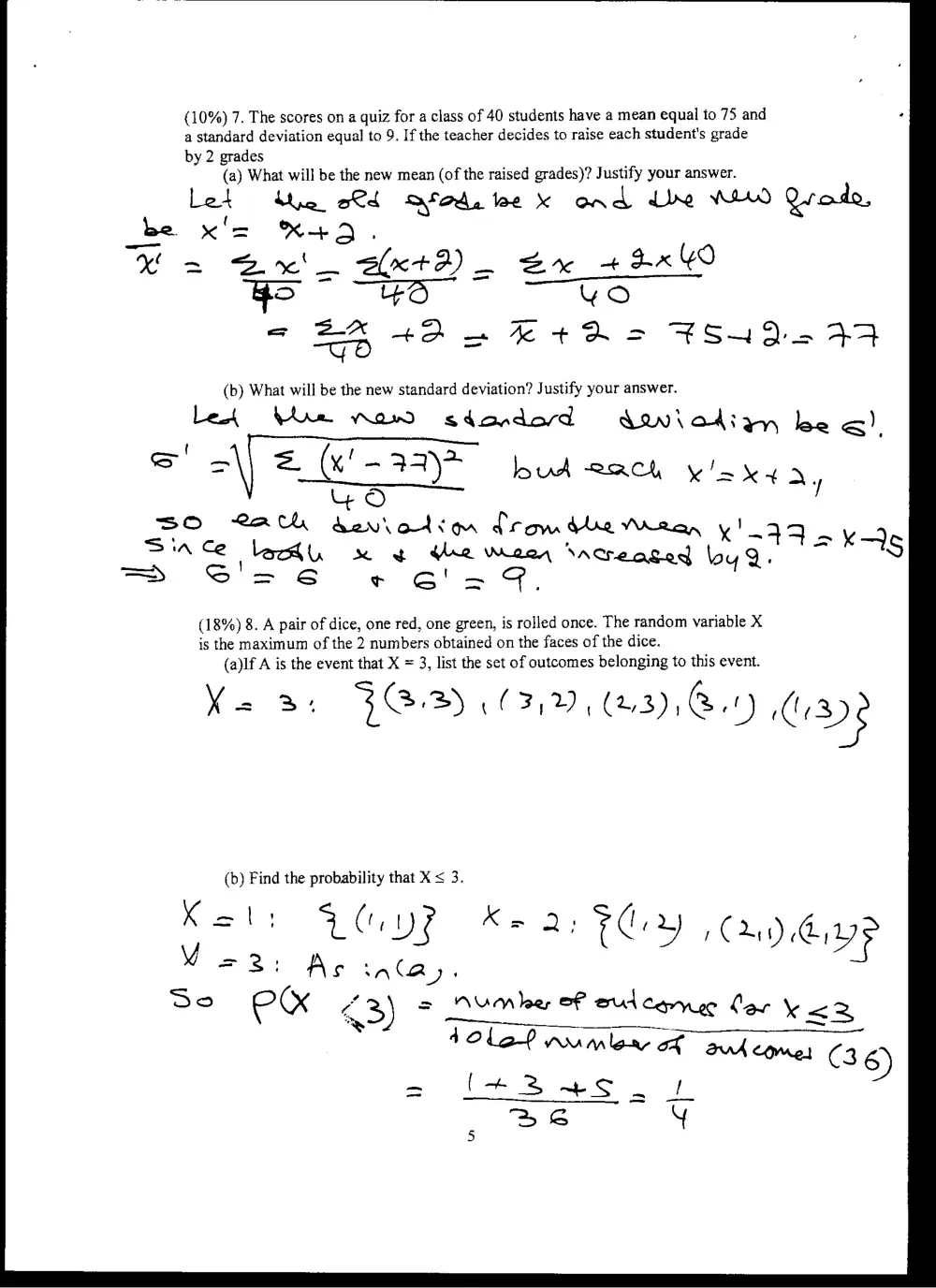
(10%) 7. The scores on a quiz for a class of 40 students have a mean equal to 75 and
a standard deviation equal to 9. If the teacher decides to raise each student's grade
by 2 grades
(a) What will be the new mean (of the raised grades)? Justify your answer.
due ofd Sfods toe & ond Un WWW Qrode,
(b) What will be the new standard deviation? Justify your answer.
le We naw sdondard Awicdian ke a)
{
St a\) EW! = 33% bud each ylaxe a,
GS }
BO PACK deviatiom drown Ue Maa x'-39 2 ke
Since lecdt& de vreen
=) SG'=c6 ory =F, Acreaked bby Q.
(18%) 8. A pair of dice, one red, one green, is rolled once. The random variable X
is the maximum of the 2 numbers obtained on the faces of the dice.
(a)lf A is the event that X = 3, list the set of outcomes belonging to this event.
Mss. 3G.3) 603,27, (23), 8.9 Wd?
(b) Find the probability that X < 3.
Kal; LOyF
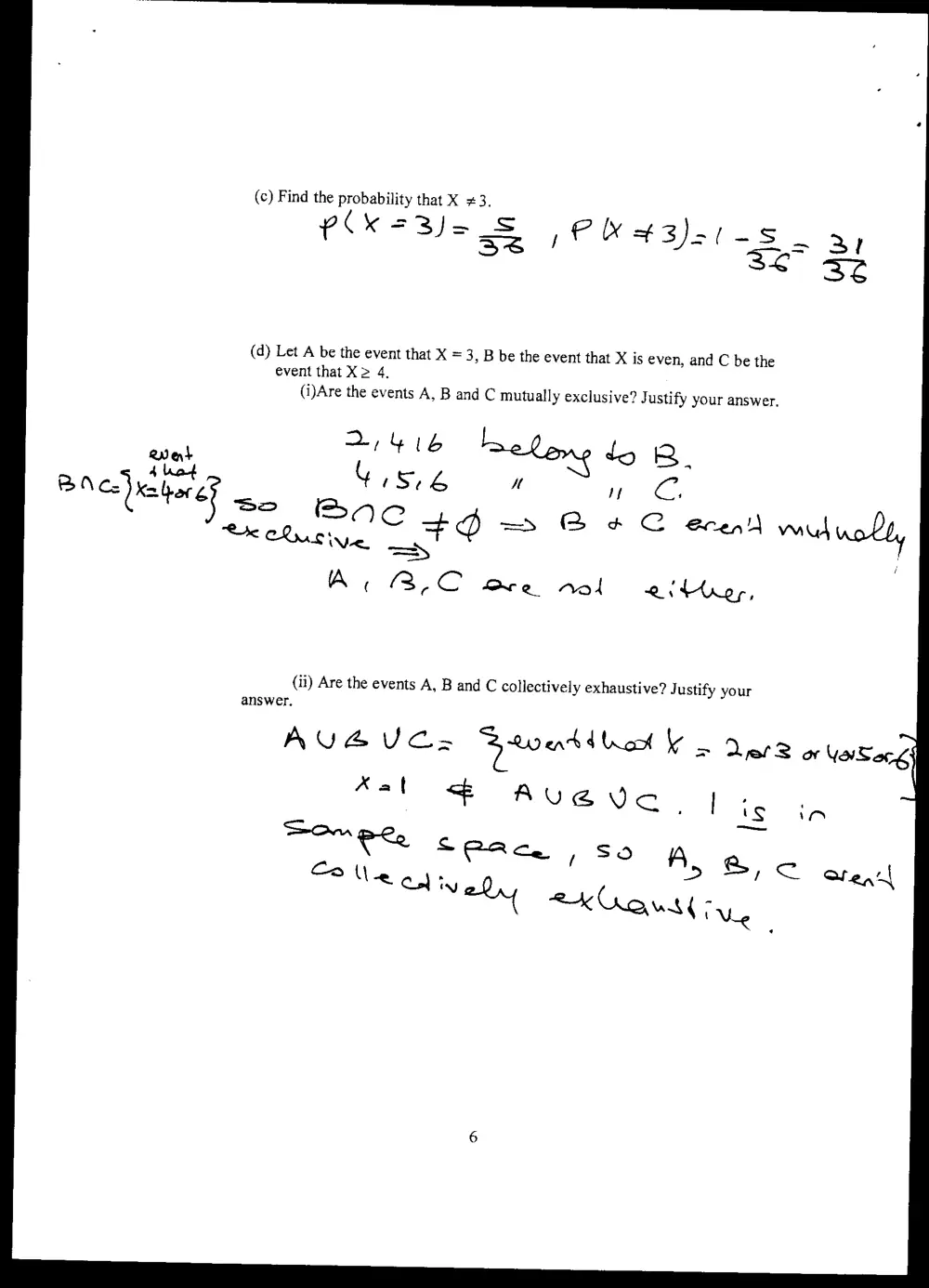
(c) Find the probability that X #3.
p(k 23s pP&X#3)-(/-S _ a,
(d) Let A be the event that X = 3, B be the event that X is even, and C be the
event that X> 4,
(Are the events A, B and C mutually exclusive? Justify your answer,
oe o, Wee Seton to >
Pneshiclace? so eos 4Q@—-@24 S ecen’] wd no
Che eRe ee, =
A , a C Bee Aol aidtre,,
(ii) Are the events A, B and C collectively exhaustive? Justify your
answer.
AUAUC= Bwertd ror ¥ Derk or VoSargf