
MATH 204 Final, Fall 2008
American University of Beirut · Mathematics for Social Sciences II · 9 pages · Dr. Maha Itani



More MATH 204 files
Show the text of this final exam
American University of Beirut
Mathematics Department
Time: 2 hrs
Fall Semester 2008-2009
Math 204 Final Exam
Name : _______________________
ID#: _________________________
• Instructors: Mrs. M. Itani Hatab ,Miss Lina Rahal & Miss Manal Salam
• Circle your problem solving section:
Section 5 : M @10:00 Section 6 : M @11:00 Section 7 : W @10:00
Section 8 : W @11:00 Section9 : Th @3:30
Section 10 : Th @2:00
Section 11 : Tu @12:00 Section 12 : Tu @11:00
• Answer table for Part I
1
9
17
2
10
18
3
11
19
4
12
20
5
13
21
6
14
22
7
15
23
8
16
24
# of correct answers : -----------------------
# of wrong answers : -------------------------
Grade of Part I
Total
/ 60
1.
2.
3.
4.
5.
Grade of Part II
/ 40
Final Grade
2
Part I (60%) : 24 multiple choice questions with 2.5 points for each correct answer.
Circle the correct answer then, copy your answers as a, b, c or d on the table provided on page 1:
1. For a standard normal distribution P (-1.3 < z < 0.45 ) =
a) 0.5768
b) 0.1451
c)0.2296
d) 0.7251
---------------------------------------------------------------------------------------------------------------------
2. If P(B) = 0.4 ,
( P A / B)
′
= 0.75 and P(AU B) = 0.7 , then P (A) =
a) 0.4
b) 0.3
c) 0.5
d) 0.2
---------------------------------------------------------------------------------------------------------------------
3. Given the matrices, B =
−
−
2
3
1
3
4
0
1
5
, and D =
−
−
−
6
4
3
1
3
5
n
m
n
If 3B = D T then the constant m =
a) 5
b) 3
c) -3
d) -5
---------------------------------------------------------------------------------------------------------------------
4.
=
=
−
−
−
=
−
then x
and A
x
If A
,
1
2
2
1
2
3
,
3
4
1
2
1
a) 2
b) -1
c) 1
d) 2
1
---------------------------------------------------------------------------------------------------------------------
5. If
,
( )
3)
3
(
5)
3
(2
2
2
∫
∫
∫
=
+
+
+
+
+
b
a
b
a
a
b
f x dx
dx
x
x
dx
x
x
then
f (x)
can be
a)
x
x
2 − 2
b)
8
6
3
2
x + x −
c)
x2 − 2
d)
x2 + 2
---------------------------------------------------------------------------------------------------------------------
6. If the matrix A=(
)
aij 5×4
is defined as a
−
−
=
if j i s odd
i
j
if j is even
j
ij
2
1
2
then
24
33
a
a
+
=….
a)
− 2
b) 8 c) 6 d) 24
---------------------------------------------------------------------------------------------------------------------
7. If (
)(
)(
)
3
2
1
3
2
1
1
2
−
+
−
− +
=
−
−
−
+
x
C
x
B
x
A
x
x
x
x
then ……
a)
C = 2
b)
C = −5
c)
C = 1
d)
C = 5
---------------------------------------------------------------------------------------------------------------------
3
8. If the area to the left of
0z on the standard normal curve is 0.0516 then the value of
0z is….
a) 1.63
b)
− .1 63
c)
− .1 96
d) 1.96
---------------------------------------------------------------------------------------------------------------------
9. If f(x,y) =
(ln )
4
2
3
2
x
e
y
yx
y
+
−
then
0,2 ) =
xf (
a) 1
b) 0
c) 2
d) 5
---------------------------------------------------------------------------------------------------------------------
10. There are 20 contestants in a beauty contest. In how many ways can the judges choose the three
best contestants?
a) 20!
b)
= 3
20
20C3
c)
3
20 P
d)
3
20
---------------------------------------------------------------------------------------------------------------------
11. There are 20 contestants in a beauty contest. In how many ways can the judges choose the Beauty
Queen, the first runner-up and the second runner-up?
a) 20!
b)
= 3
20
20C3
c)
3
20 P
d)
3
20
---------------------------------------------------------------------------------------------------------------------
12. A password consists of 2 distinct letters of the English alphabet followed by 2 digits such that the
first digit is different from zero, then the number of passwords that can formed is…..
a) (
) ( )
26 2 10 2
b)
25 26 9 10
× ×
×
c)(
) ( )
25 2 9 2
d)
( )
10 2
26
25
×
×
---------------------------------------------------------------------------------------------------------------------
13. X is a normally distributed variable with a mean equal to 40 and a standard deviation
equal to 5. The probability that X is between 46.6 and 48 is
a) 0.0542
b) 0.3462
c) 0.0386
d) 0.0575
---------------------------------------------------------------------------------------------------------------------
Consider the definite integral: I=∫
−
5
1
2)
(25
dx
x
.
14. The approximation of the definite integral I using the trapezoidal rule with n=4 is:
a) 42 b) 58 c) 38 d) 48
15. The approximation of the definite integral I using the Simpson’s rule with n=4 is:
a) 3
136 b) 3
156 c) 3
126 d) 3
176
---------------------------------------------------------------------------------------------------------------------
16. If
e x
x
f
5
)
(
= −
then
(
)
) =
(
f 53 x
a)
553 e 5x
−
b)
53e 5x
−
−
c)
553 e 5x
−
−
d)
5e 53x
−
−
---------------------------------------------------------------------------------------------------------------------------
4
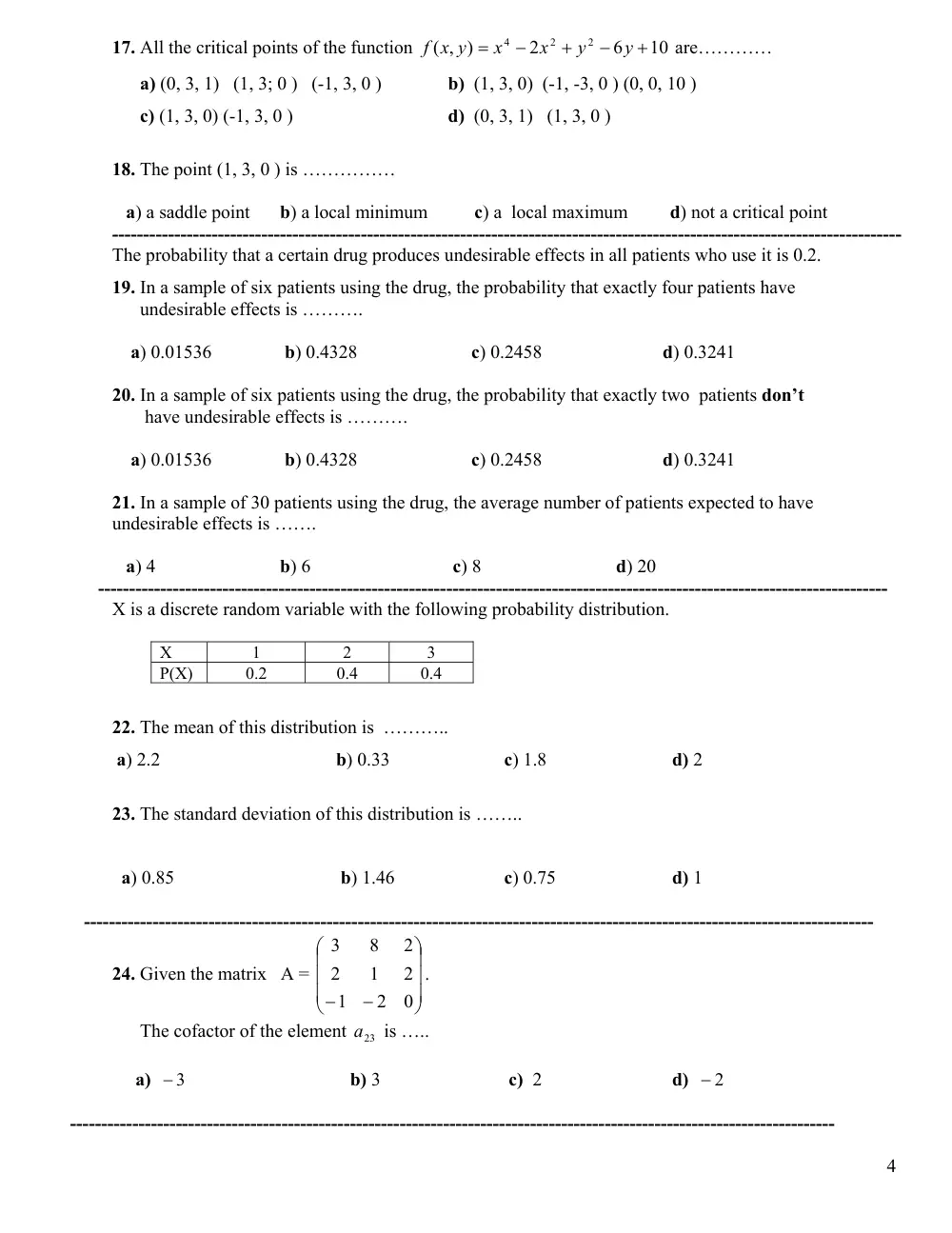
17. All the critical points of the function
10
6
2
, )
(
2
2
4
+
−
+
−
=
y
y
x
x
f x y
are…………
a) (0, 3, 1) (1, 3; 0 ) (-1, 3, 0 )
b) (1, 3, 0) (-1, -3, 0 ) (0, 0, 10 )
c) (1, 3, 0) (-1, 3, 0 )
d) (0, 3, 1) (1, 3, 0 )
18. The point (1, 3, 0 ) is ……………
a) a saddle point
b) a local minimum c) a local maximum d) not a critical point
-------------------------------------------------------------------------------------------------------------------------------
The probability that a certain drug produces undesirable effects in all patients who use it is 0.2.
19. In a sample of six patients using the drug, the probability that exactly four patients have
undesirable effects is ……….
a) 0.01536
b) 0.4328
c) 0.2458
d) 0.3241
20. In a sample of six patients using the drug, the probability that exactly two patients don’t
have undesirable effects is ……….
a) 0.01536
b) 0.4328
c) 0.2458
d) 0.3241
21. In a sample of 30 patients using the drug, the average number of patients expected to have
undesirable effects is …….
a) 4
b) 6
c) 8
d) 20
-------------------------------------------------------------------------------------------------------------------------------
X is a discrete random variable with the following probability distribution.
22. The mean of this distribution is ………..
a) 2.2
b) 0.33
c) 1.8
d) 2
23. The standard deviation of this distribution is ……..
a) 0.85
b) 1.46
c) 0.75
d) 1
-------------------------------------------------------------------------------------------------------------------------------
24. Given the matrix A =
−
−
0
2
1
2
1
2
2
8
3
.
The cofactor of the element
a23
is …..
a)
3
−
b) 3
c) 2
d)
− 2
---------------------------------------------------------------------------------------------------------------------------
X
1
2
3
P(X)
0.2
0.4
0.4
5
Part II ( 40%) Answer each of the following questions, explain and show your work
1. Given the system of equations AX=B ,
=
+
+
= −
+
+
=
+
+
0
10
10
5
2
3
7
3
1
2
3
2
1
3
2
1
3
2
1
x
x
x
x
x
x
x
x
x
a. Use the Gaussian method to find
A−1
, where A is the matrix of coefficients.
b. Use
A−1
to solve the given system.
( 8 %)
6
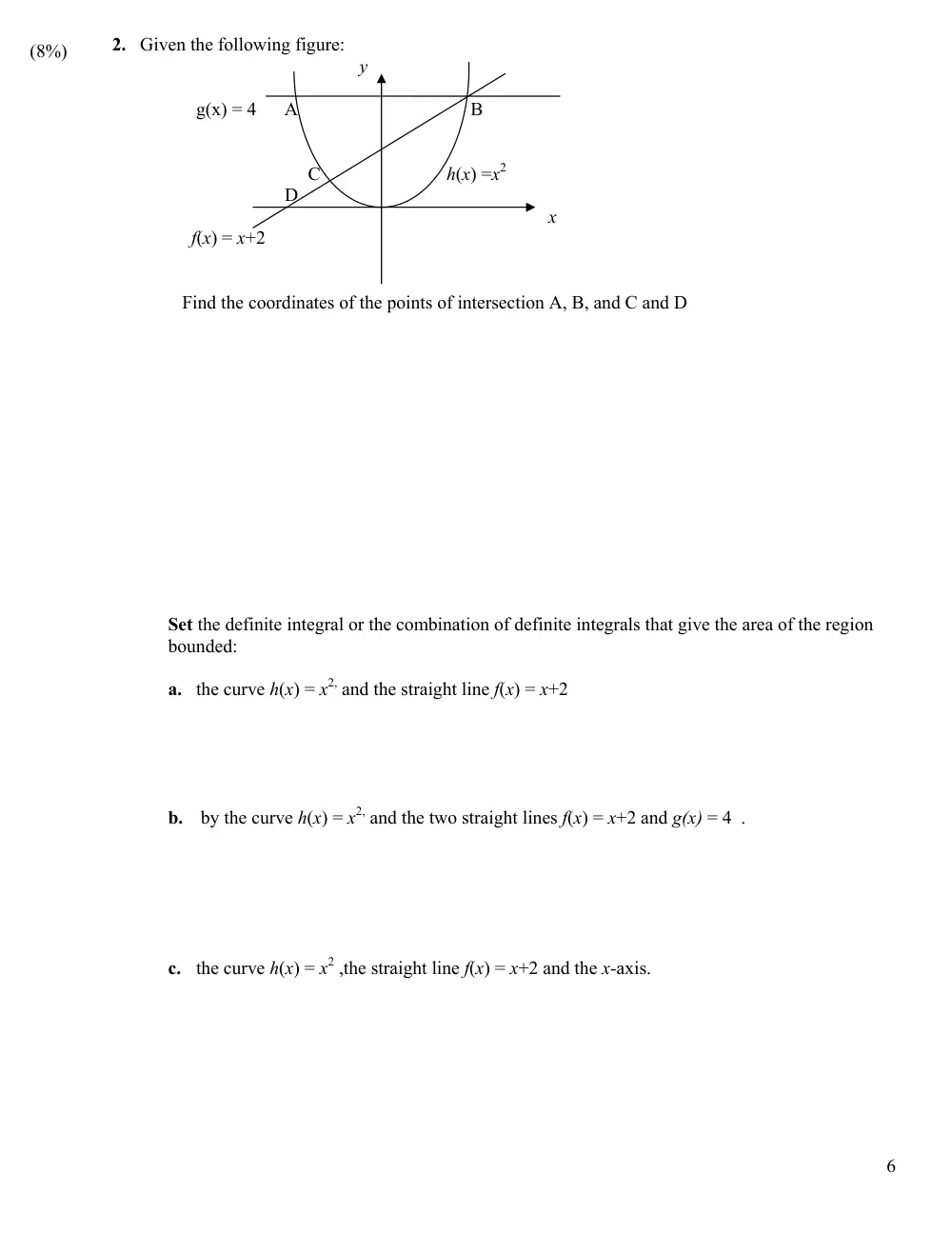
2. Given the following figure:
y
g(x) = 4 A B
C h(x) =x2
D
x
f(x) = x+2
Find the coordinates of the points of intersection A, B, and C and D
Set the definite integral or the combination of definite integrals that give the area of the region
bounded:
a. the curve h(x) = x2, and the straight line f(x) = x+2
b. by the curve h(x) = x2, and the two straight lines f(x) = x+2 and g(x) = 4 .
c. the curve h(x) = x2 ,the straight line f(x) = x+2 and the x-axis.
(8%)
7
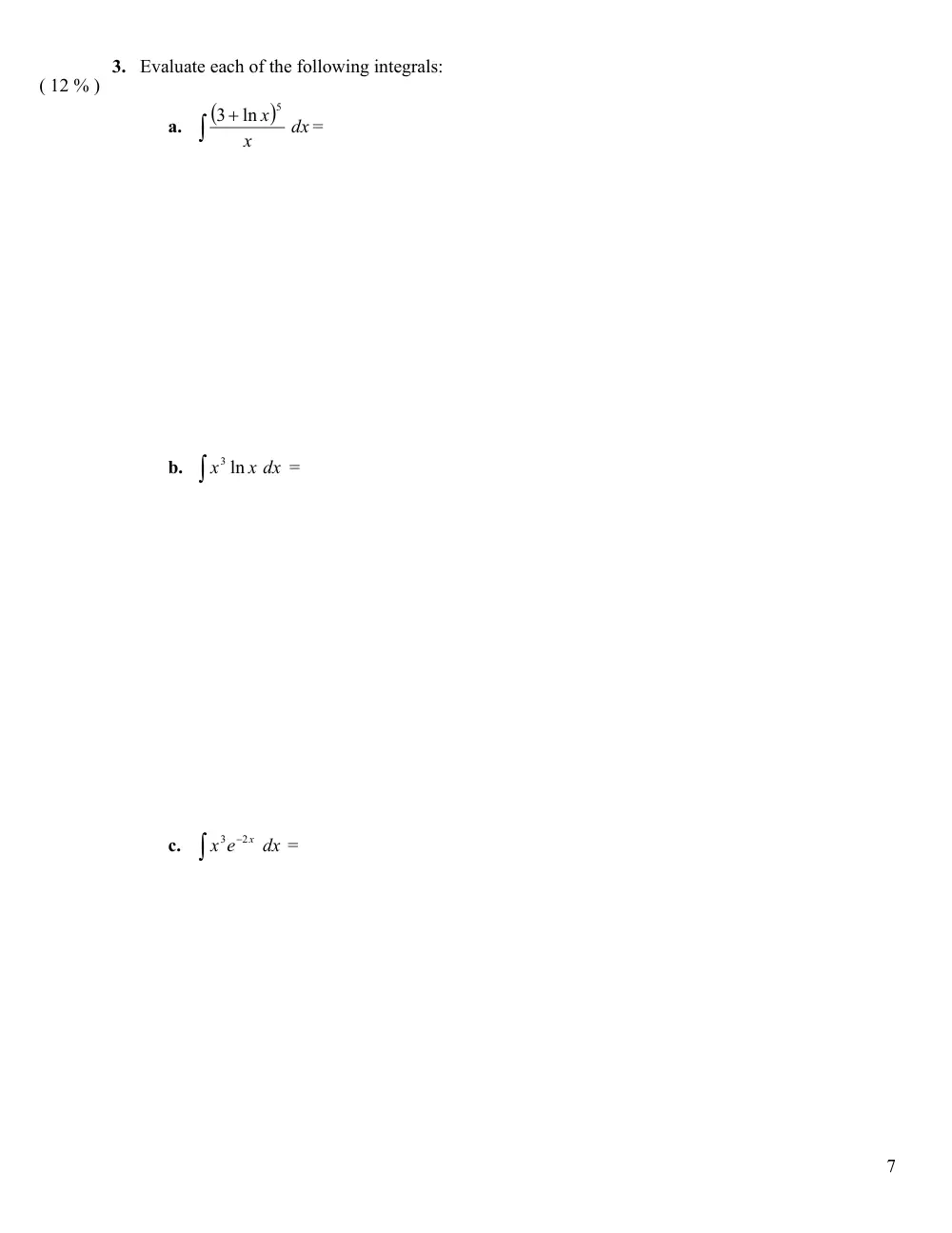
3. Evaluate each of the following integrals:
a.
(
)
dx
x
x
∫
+
5
ln
3
=
b.
x dx
x∫
3 ln
=
c.
dx
x e
x
∫
3 −2
=
( 12 % )
8
d.
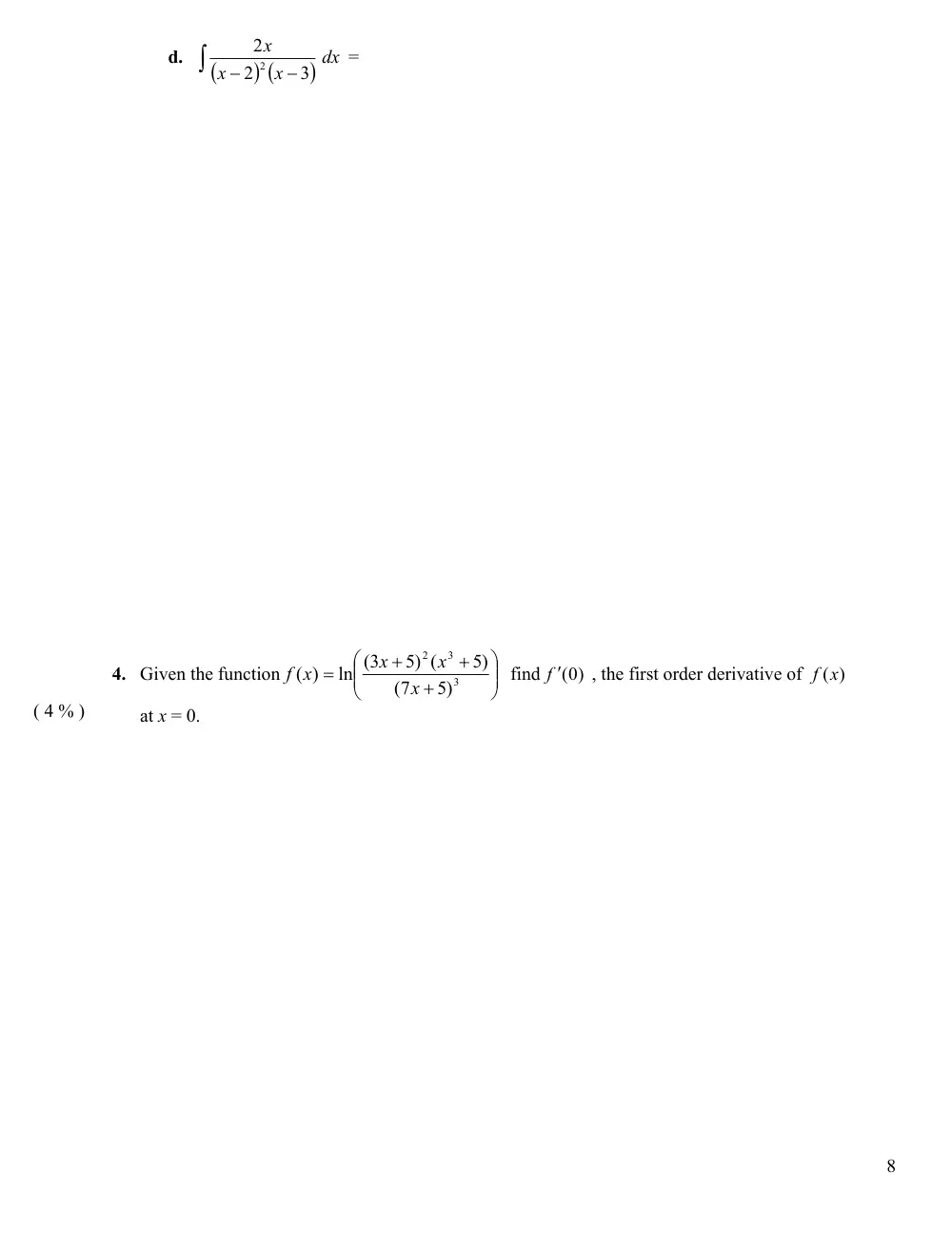
(
) (
)
dx
x
x
x
∫
−
−
3
2
2
2
=
4. Given the function
+
+
+
=
3
3
2
5)
(7
5)
5) (
ln (3
( )
x
x
x
f x
find
f ′(0)
, the first order derivative of
f (x)
at x = 0.
( 4 % )
9
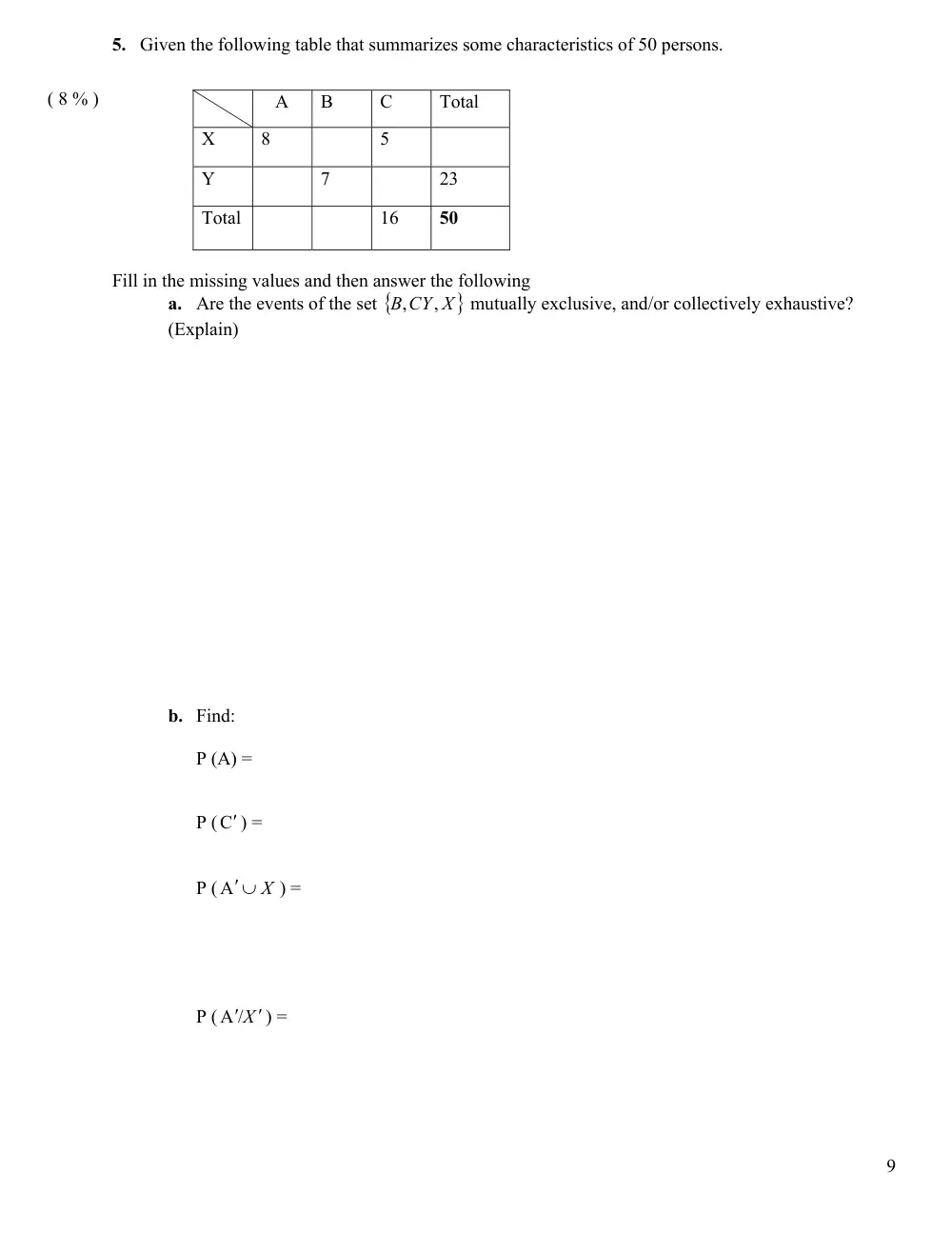
5. Given the following table that summarizes some characteristics of 50 persons.
Fill in the missing values and then answer the following
a. Are the events of the set {
B CY X}
,
,
mutually exclusive, and/or collectively exhaustive?
(Explain)
b. Find:
P (A) =
P (C′ ) =
P (
A′ ∪ X
) =
P (
A′/X ′
) =
A
B
C
Total
X
8
5
Y
7
23
Total
16
50
( 8 % )