
MATH 210 Exam 1 Solution, Fall 2016
American University of Beirut · Introduction to Analysis · 2 pages · with solution

More MATH 210 files
- Exam 2 Wl Sol · Spring 2019Exam · with solutionView
- Exam 1 With Sol · Spring 2018Exam · with solutionView
- Exam 1 Exam 1 Without Solution · Fall 2017Exam · with solutionView
- Exam 1 Exam with Solution · Fall 2017Exam · with solutionView
- Exam 2 · Fall 2017ExamView
- Exam 2 · Fall 2017ExamView
- Exam 2 · Spring 2017ExamView
- Exam 1 · Spring 2017ExamView
Show the text of this exam
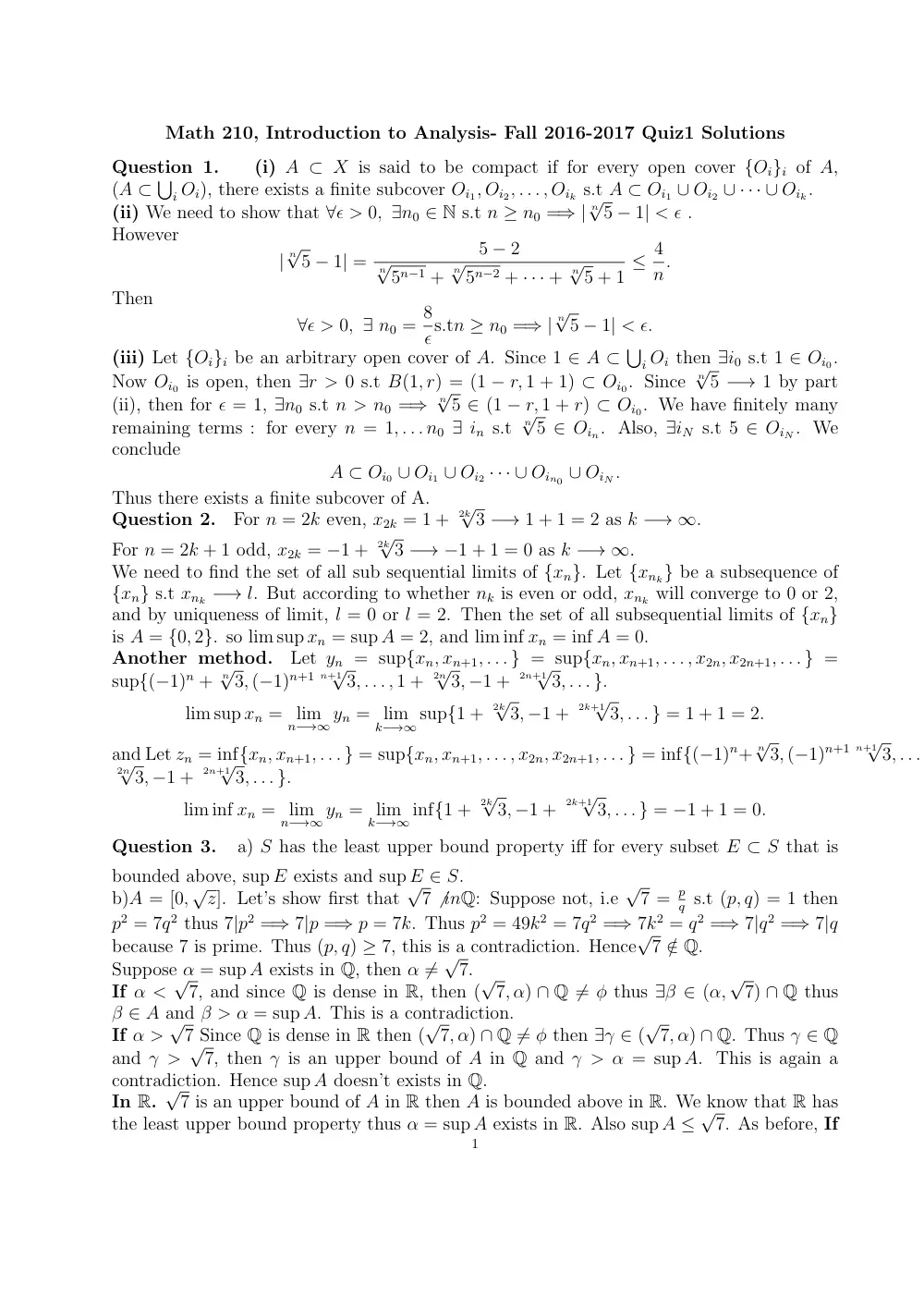
Math 210, Introduction to Analysis- Fall 2016-2017 Quiz1 Solutions
Question 1.
(i) A ⊂ X is said to be compact if for every open cover {Oi}i of A,
(A ⊂ �
i Oi), there exists a finite subcover Oi1, Oi2, . . . , Oik s.t A ⊂ Oi1 ∪ Oi2 ∪ · · · ∪ Oik.
(ii) We need to show that ∀ϵ > 0, ∃n0 ∈ N s.t n ≥ n0 =⇒ |
n√
5 − 1| < ϵ .
However
|
n√
5 − 1| =
5 − 2
n√
5n−1 +
n√
5n−2 + · · · +
n√
5 + 1
≤ 4
n.
Then
∀ϵ > 0, ∃ n0 = 8
ϵs.tn ≥ n0 =⇒ |
n√
5 − 1| < ϵ.
(iii) Let {Oi}i be an arbitrary open cover of A. Since 1 ∈ A ⊂ �
i Oi then ∃i0 s.t 1 ∈ Oi0.
Now Oi0 is open, then ∃r > 0 s.t B(1, r) = (1 − r, 1 + 1) ⊂ Oi0. Since
n√
5 −→ 1 by part
(ii), then for ϵ = 1, ∃n0 s.t n > n0 =⇒
n√
5 ∈ (1 − r, 1 + r) ⊂ Oi0. We have finitely many
remaining terms : for every n = 1, . . . n0 ∃ in s.t
n√
5 ∈ Oin. Also, ∃iN s.t 5 ∈ OiN. We
conclude
A ⊂ Oi0 ∪ Oi1 ∪ Oi2 · · · ∪ Oin0 ∪ OiN.
Thus there exists a finite subcover of A.
Question 2.
For n = 2k even, x2k = 1 +
2k√
3 −→ 1 + 1 = 2 as k −→ ∞.
For n = 2k + 1 odd, x2k = −1 +
2k√
3 −→ −1 + 1 = 0 as k −→ ∞.
We need to find the set of all sub sequential limits of {xn}. Let {xnk} be a subsequence of
{xn} s.t xnk −→ l. But according to whether nk is even or odd, xnk will converge to 0 or 2,
and by uniqueness of limit, l = 0 or l = 2. Then the set of all subsequential limits of {xn}
is A = {0, 2}. so lim sup xn = sup A = 2, and lim inf xn = inf A = 0.
Another method.
Let yn = sup{xn, xn+1, . . . } = sup{xn, xn+1, . . . , x2n, x2n+1, . . . } =
sup{(−1)n +
n√
3, (−1)n+1 n+1√
3, . . . , 1 +
2n√
3, −1 +
2n+1√
3, . . . }.
lim sup xn = lim
n−→∞ yn = lim
k−→∞ sup{1 +
2k√
3, −1 +
2k+1√
3, . . . } = 1 + 1 = 2.
and Let zn = inf{xn, xn+1, . . . } = sup{xn, xn+1, . . . , x2n, x2n+1, . . . } = inf{(−1)n+
n√
3, (−1)n+1 n+1√
3, . . .
2n√
3, −1 +
2n+1√
3, . . . }.
lim inf xn = lim
n−→∞ yn = lim
k−→∞ inf{1 +
2k√
3, −1 +
2k+1√
3, . . . } = −1 + 1 = 0.
Question 3.
a) S has the least upper bound property iff for every subset E ⊂ S that is
bounded above, sup E exists and sup E ∈ S.
b)A = [0, √z]. Let’s show first that
√
7 ̸ inQ: Suppose not, i.e
√
7 = p
q s.t (p, q) = 1 then
p2 = 7q2 thus 7|p2 =⇒ 7|p =⇒ p = 7k. Thus p2 = 49k2 = 7q2 =⇒ 7k2 = q2 =⇒ 7|q2 =⇒ 7|q
because 7 is prime. Thus (p, q) ≥ 7, this is a contradiction. Hence
√
7 /∈ Q.
Suppose α = sup A exists in Q, then α ̸=
√
7.
If α <
√
7, and since Q is dense in R, then (
√
7, α) ∩ Q ̸= φ thus ∃β ∈ (α,
√
7) ∩ Q thus
β ∈ A and β > α = sup A. This is a contradiction.
If α >
√
7 Since Q is dense in R then (
√
7, α) ∩ Q ̸= φ then ∃γ ∈ (
√
7, α) ∩ Q. Thus γ ∈ Q
and γ >
√
7, then γ is an upper bound of A in Q and γ > α = sup A. This is again a
contradiction. Hence sup A doesn’t exists in Q.
In R.
√
7 is an upper bound of A in R then A is bounded above in R. We know that R has
the least upper bound property thus α = sup A exists in R. Also sup A ≤
√
7. As before, If
1
2
α <
√
7, and since Q is dense in R, then (
√
7, α) ∩ Q ̸= φ thus ∃β ∈ (α,
√
7) ∩ Q thus β ∈ A
and β > α = sup A. This is a contradiction. Then α = sup A =
√
7 in R.
c) Q doesn’t have the least upper bound property since by b), the set A ⊂ Q is bounded
above in Q (for example 3 is an upper bound for A in Q) and sup A doesn’t exist in Q.
Question 4. We have
lim
n−→∞
sin n2 + (−1)nn
n3 + 1
= 0and lim
n−→∞
2√n − 3
√n + 4 −→ 2
Proof. ∀ϵ > 0, find n0 s.t
n ≥ n0 =⇒ d∞
�
(sin n2 + (−1)nn
n3 + 1
, 2√n − 3
√n + 4 ), (0, 2)
�
< ϵ
i.e
max
�����
sin n2 + (−1)nn
n3 + 1
− 0
����,
����
2√n − 3
√n + 4 − 2
����
�
< ϵ.
But
| sin n2+(−1)nn
n3+1
− 0
���� ≤
1+n
n3+1 ≤ 2n
n3 =
2
n2. Pick n1 s.t
2
n2
1 < ϵ i.e n1 =
��
2
ϵ
�
+ 1. Also
����
2√n − 3
√n + 4 − 2
���� =
����
2√n − 3 − 2√n − 8
√n + 4
���� ≤ 2|√n − 3 − √n|
√n + 4
+
8
√n + 4
= 2.
6
(√n + 4)(√n − 3 + √n) +
8
√n + 4 ≤ 6
n + 8
√n = 14
√n.
We want this to < ϵ, so take take n2 =
�
(14)2
ϵ2
�
+ 1, then ∀n ≥ n2,
����
2√n−3
√n+4 − 2
���� < ϵ. Put
n0 = max(n1, n2) then
∀n ≥ n0, we have d∞
�
(sin n2 + (−1)nn
n3 + 1
, 2√n − 3
√n + 4 ), (0, 2)
�
< ϵ
□
Question 5.
a) i. x is a limit point of E ⊂ X iff ∀r > 0, B(x, r) � E\{x} ̸= φ.
ii. E = E ∪ E′ where E′ is the set of all limit points of E.
b) Claim: E = {(x, y) ∈ R2; x ≤ 1}: Let M(1, b) ∈ R2; Let’s show M ∈ E :
∀r > 0 consider the point N(x, b), we need N to be in Bd1 ∩ E : so take x < 1 and
d1(M, N) < r i.e |x − 1| + |b − b| = |x − 1| < r so take 1 − r < x < 1 + r and x < 1
i.e 1 − r < x < 1, pick for example x = 1 − r
2 then N(1 − r
2, b) ∈ Bd1(M, r) ∩ E, hence
the line (x = 1) ⊂ E. We’ll now show that any point M(a, b′) with a > 1 will not be in
E: for r = a−1
2 , Bd1(M, r) ∩ E = φ since any point in B(M, r) will have its x-coordinate
≥ 1 + a−1
2
= 1
2 + a
2 > 1 s such M(a, b′); a > 1 is not in E. Thus E = {(x, y) ∈ R2; x ≤ 1}