
MATH 210 Exam 2 Solution, Fall 2016
American University of Beirut · Introduction to Analysis · 2 pages · with solution
More MATH 210 files
- Exam 2 Wl Sol · Spring 2019Exam · with solutionView
- Exam 1 With Sol · Spring 2018Exam · with solutionView
- Exam 1 Exam 1 Without Solution · Fall 2017Exam · with solutionView
- Exam 1 Exam with Solution · Fall 2017Exam · with solutionView
- Exam 2 · Fall 2017ExamView
- Exam 2 · Fall 2017ExamView
- Exam 1 · Spring 2017ExamView
- Exam 2 · Spring 2017ExamView
Show the text of this exam
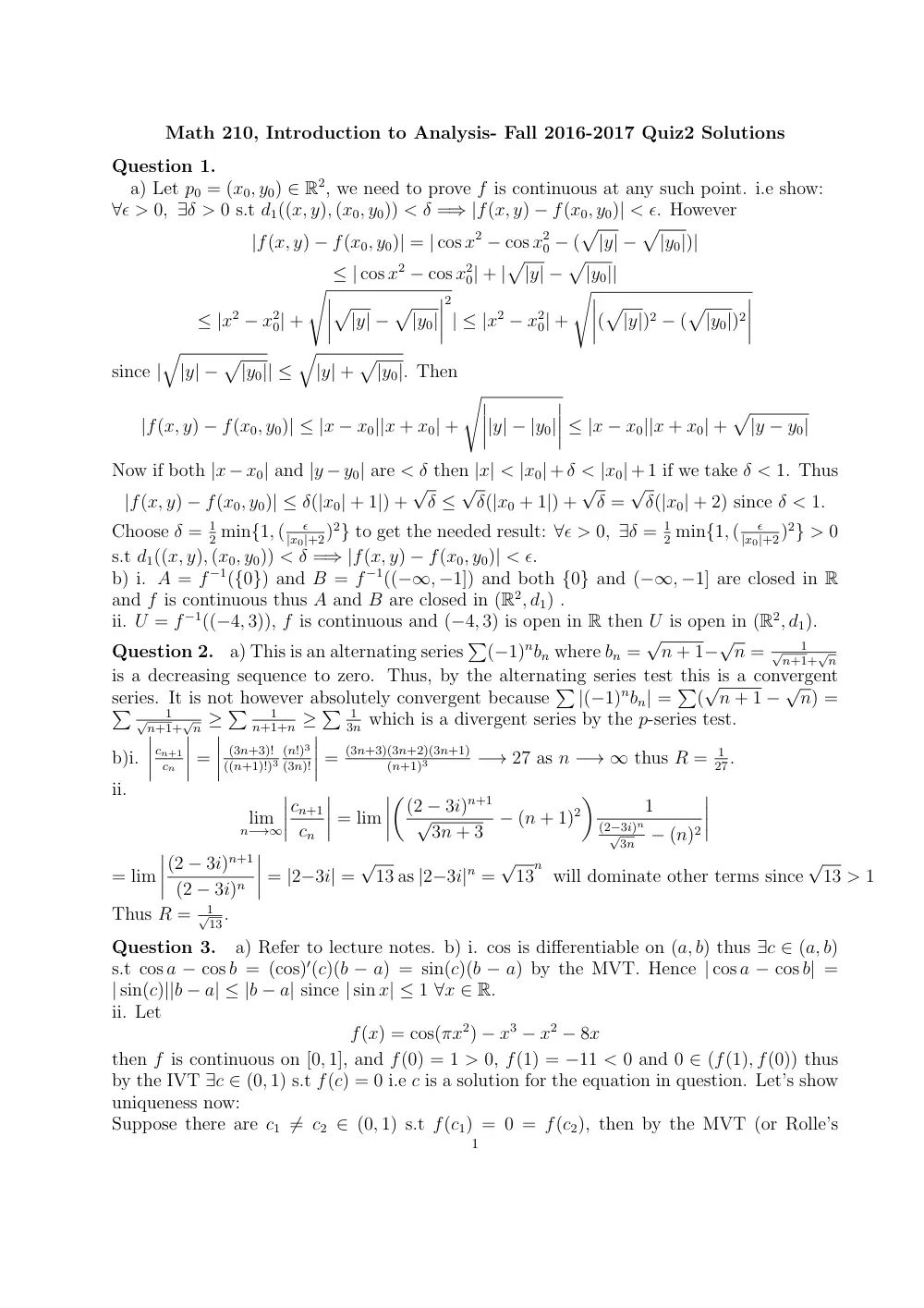
Math 210, Introduction to Analysis- Fall 2016-2017 Quiz2 Solutions
Question 1.
a) Let p0 = (x0, y0) ∈ R2, we need to prove f is continuous at any such point. i.e show:
∀ϵ > 0, ∃δ > 0 s.t d1((x, y), (x0, y0)) < δ =⇒ |f(x, y) − f(x0, y0)| < ϵ. However
|f(x, y) − f(x0, y0)| = | cos x2 − cos x2
0 − (
�
|y| −
�
|y0|)|
≤ | cos x2 − cos x2
0| + |
�
|y| −
�
|y0||
≤ |x2 − x2
0| +
�����
�
|y| −
�
|y0|
����
2
| ≤ |x2 − x2
0| +
�����(
�
|y|)2 − (
�
|y0|)2
����
since |
�
|y| −
�
|y0|| ≤
�
|y| +
�
|y0|. Then
|f(x, y) − f(x0, y0)| ≤ |x − x0||x + x0| +
�����|y| − |y0|
���� ≤ |x − x0||x + x0| +
�
|y − y0|
Now if both |x− x0| and |y − y0| are < δ then |x| < |x0| +δ < |x0| +1 if we take δ < 1. Thus
|f(x, y) − f(x0, y0)| ≤ δ(|x0| + 1|) +
√
δ ≤
√
δ(|x0 + 1|) +
√
δ =
√
δ(|x0| + 2) since δ < 1.
Choose δ = 1
2 min{1, (
ϵ
|x0|+2)2} to get the needed result: ∀ϵ > 0, ∃δ = 1
2 min{1, (
ϵ
|x0|+2)2} > 0
s.t d1((x, y), (x0, y0)) < δ =⇒ |f(x, y) − f(x0, y0)| < ϵ.
b) i. A = f −1({0}) and B = f −1((−∞, −1]) and both {0} and (−∞, −1] are closed in R
and f is continuous thus A and B are closed in (R2, d1) .
ii. U = f −1((−4, 3)), f is continuous and (−4, 3) is open in R then U is open in (R2, d1).
Question 2.
a) This is an alternating series �(−1)nbn where bn = √n + 1−√n =
1
√n+1+√n
is a decreasing sequence to zero. Thus, by the alternating series test this is a convergent
series. It is not however absolutely convergent because � |(−1)nbn| = �(√n + 1 − √n) =
�
1
√n+1+√n ≥ �
1
n+1+n ≥ � 1
3n which is a divergent series by the p-series test.
b)i.
����
cn+1
cn
���� =
����
(3n+3)!
((n+1)!)3
(n!)3
(3n)!
���� = (3n+3)(3n+2)(3n+1)
(n+1)3
−→ 27 as n −→ ∞ thus R =
1
27.
ii.
lim
n−→∞
����
cn+1
cn
���� = lim
����
�(2 − 3i)n+1
√3n + 3
− (n + 1)2
�
1
(2−3i)n
√
3n
− (n)2
����
= lim
����
(2 − 3i)n+1
(2 − 3i)n
���� = |2−3i| =
√
13 as |2−3i|n =
√
13
n will dominate other terms since
√
13 > 1
Thus R =
1
√
13.
Question 3.
a) Refer to lecture notes. b) i. cos is differentiable on (a, b) thus ∃c ∈ (a, b)
s.t cos a − cos b = (cos)′(c)(b − a) = sin(c)(b − a) by the MVT. Hence | cos a − cos b| =
| sin(c)||b − a| ≤ |b − a| since | sin x| ≤ 1 ∀x ∈ R.
ii. Let
f(x) = cos(πx2) − x3 − x2 − 8x
then f is continuous on [0, 1], and f(0) = 1 > 0, f(1) = −11 < 0 and 0 ∈ (f(1), f(0)) thus
by the IVT ∃c ∈ (0, 1) s.t f(c) = 0 i.e c is a solution for the equation in question. Let’s show
uniqueness now:
Suppose there are c1 ̸= c2 ∈ (0, 1) s.t f(c1) = 0 = f(c2), then by the MVT (or Rolle’s
1
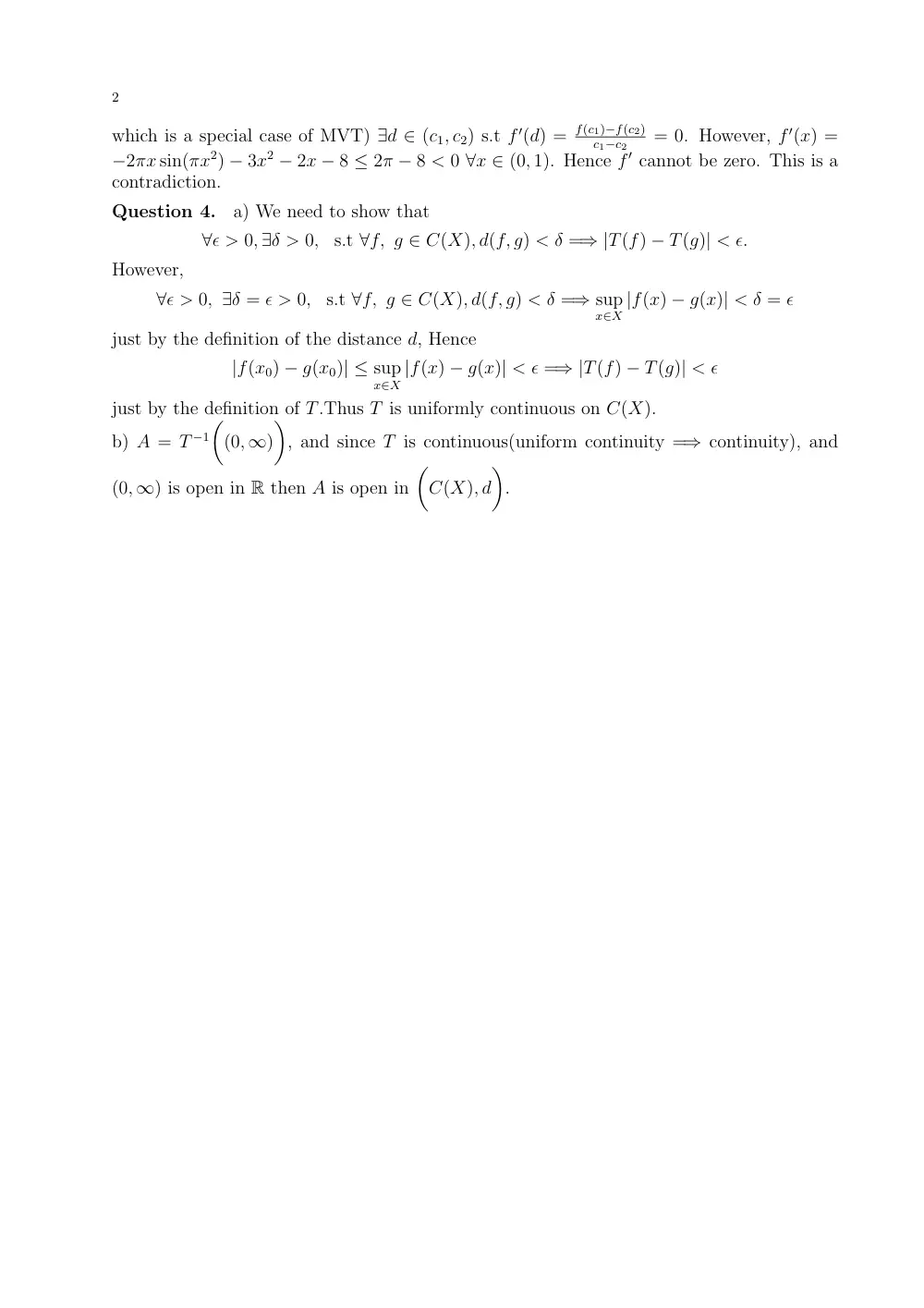
2
which is a special case of MVT) ∃d ∈ (c1, c2) s.t f ′(d) = f(c1)−f(c2)
c1−c2
= 0. However, f ′(x) =
−2πx sin(πx2) − 3x2 − 2x − 8 ≤ 2π − 8 < 0 ∀x ∈ (0, 1). Hence f ′ cannot be zero. This is a
contradiction.
Question 4.
a) We need to show that
∀ϵ > 0, ∃δ > 0,
s.t ∀f, g ∈ C(X), d(f, g) < δ =⇒ |T(f) − T(g)| < ϵ.
However,
∀ϵ > 0, ∃δ = ϵ > 0,
s.t ∀f, g ∈ C(X), d(f, g) < δ =⇒ sup
x∈X
|f(x) − g(x)| < δ = ϵ
just by the definition of the distance d, Hence
|f(x0) − g(x0)| ≤ sup
x∈X
|f(x) − g(x)| < ϵ =⇒ |T(f) − T(g)| < ϵ
just by the definition of T.Thus T is uniformly continuous on C(X).
b) A = T −1
�
(0, ∞)
�
, and since T is continuous(uniform continuity =⇒ continuity), and
(0, ∞) is open in R then A is open in
�
C(X), d
�
.