
MATH 211 Exam 1, Fall 2005
American University of Beirut · Discrete Structures · 3 pages
More MATH 211 files
Show the text of this exam
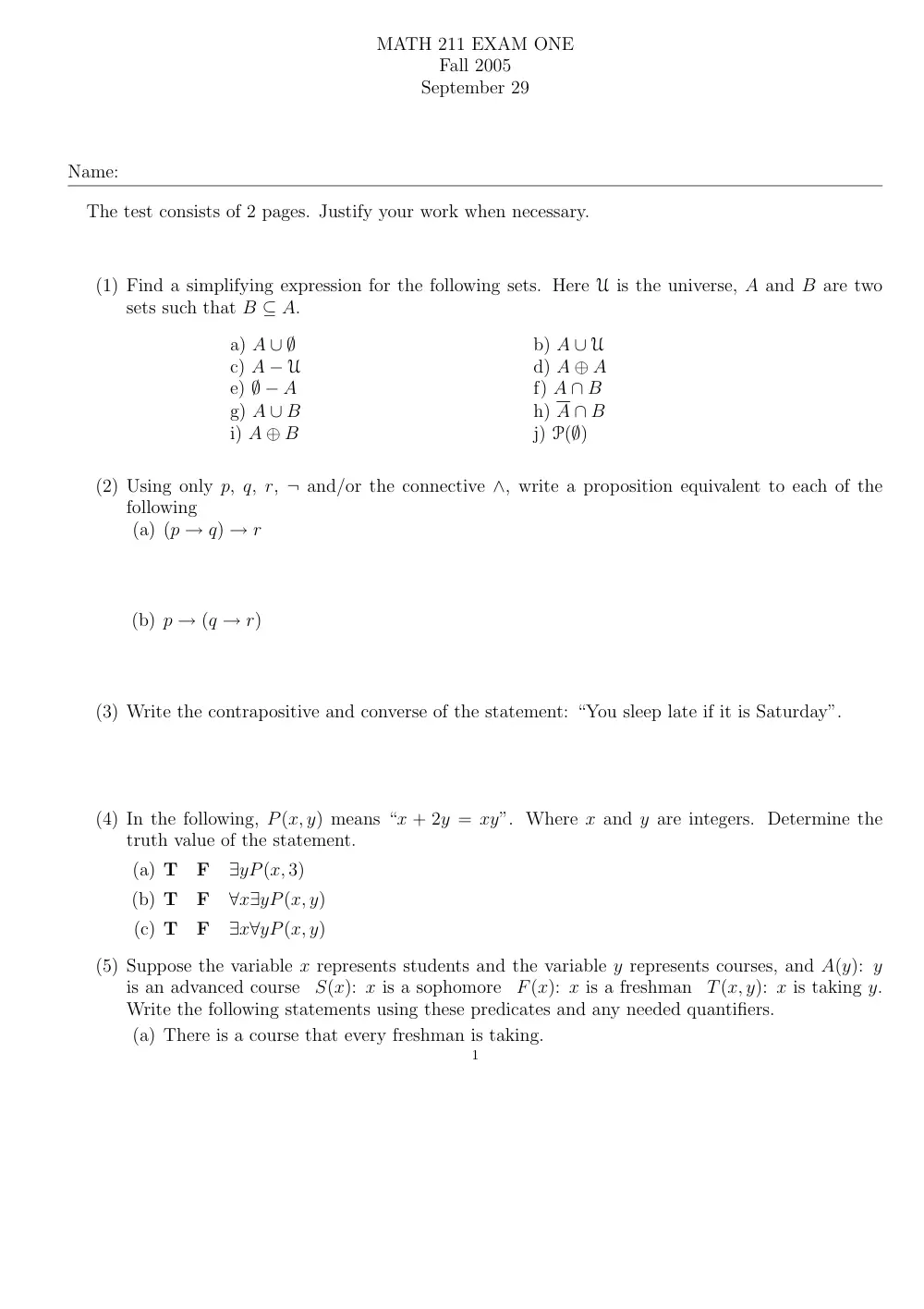
MATH 211 EXAM ONE
Fall 2005
September 29
Name:
The test consists of 2 pages. Justify your work when necessary.
(1) Find a simplifying expression for the following sets. Here U is the universe, A and B are two
sets such that B ⊆ A.
a) A ∪ ∅
b) A ∪ U
c) A − U
d) A ⊕ A
e) ∅ − A
f) A ∩ B
g) A ∪ B
h) A ∩ B
i) A ⊕ B
j) P(∅)
(2) Using only p, q, r, ¬ and/or the connective ∧, write a proposition equivalent to each of the
following
(a) (p → q) → r
(b) p → (q → r)
(3) Write the contrapositive and converse of the statement: “You sleep late if it is Saturday”.
(4) In the following, P(x, y) means “x + 2y = xy”. Where x and y are integers. Determine the
truth value of the statement.
(a) T
F
∃yP(x, 3)
(b) T
F
∀x∃yP(x, y)
(c) T
F
∃x∀yP(x, y)
(5) Suppose the variable x represents students and the variable y represents courses, and A(y): y
is an advanced course
S(x): x is a sophomore
F(x): x is a freshman
T(x, y): x is taking y.
Write the following statements using these predicates and any needed quantifiers.
(a) There is a course that every freshman is taking.
1
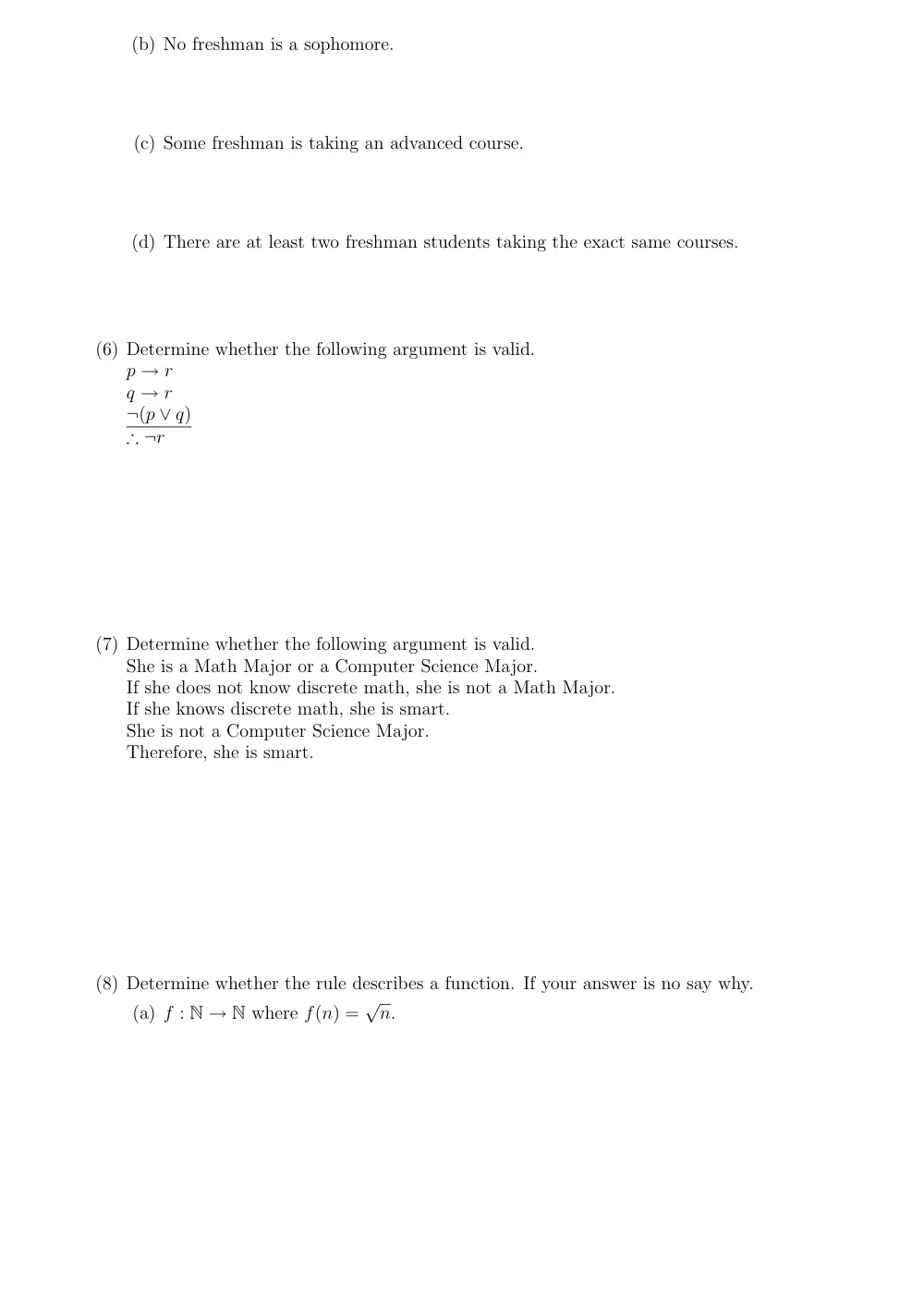
(b) No freshman is a sophomore.
(c) Some freshman is taking an advanced course.
(d) There are at least two freshman students taking the exact same courses.
(6) Determine whether the following argument is valid.
p → r
q → r
¬(p ∨ q)
∴ ¬r
(7) Determine whether the following argument is valid.
She is a Math Major or a Computer Science Major.
If she does not know discrete math, she is not a Math Major.
If she knows discrete math, she is smart.
She is not a Computer Science Major.
Therefore, she is smart.
(8) Determine whether the rule describes a function. If your answer is no say why.
(a) f : N → N where f(n) = √n.
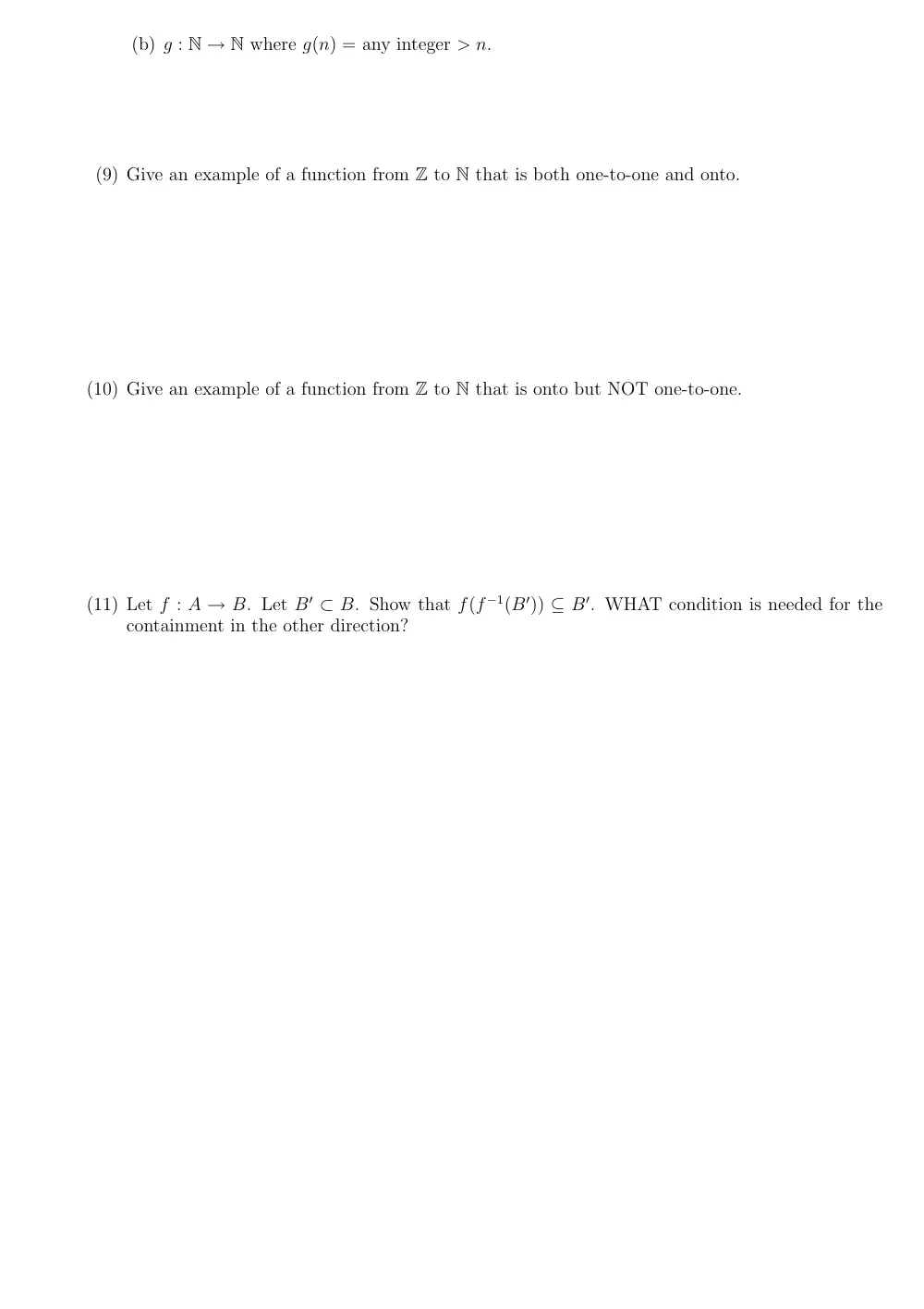
(b) g : N → N where g(n) = any integer > n.
(9) Give an example of a function from Z to N that is both one-to-one and onto.
(10) Give an example of a function from Z to N that is onto but NOT one-to-one.
(11) Let f : A → B. Let B′ ⊂ B. Show that f(f −1(B′)) ⊆ B′. WHAT condition is needed for the
containment in the other direction?