
MATH 211 Exam 2, Fall 2006
American University of Beirut · Discrete Structures · 2 pages
More MATH 211 files
Show the text of this exam
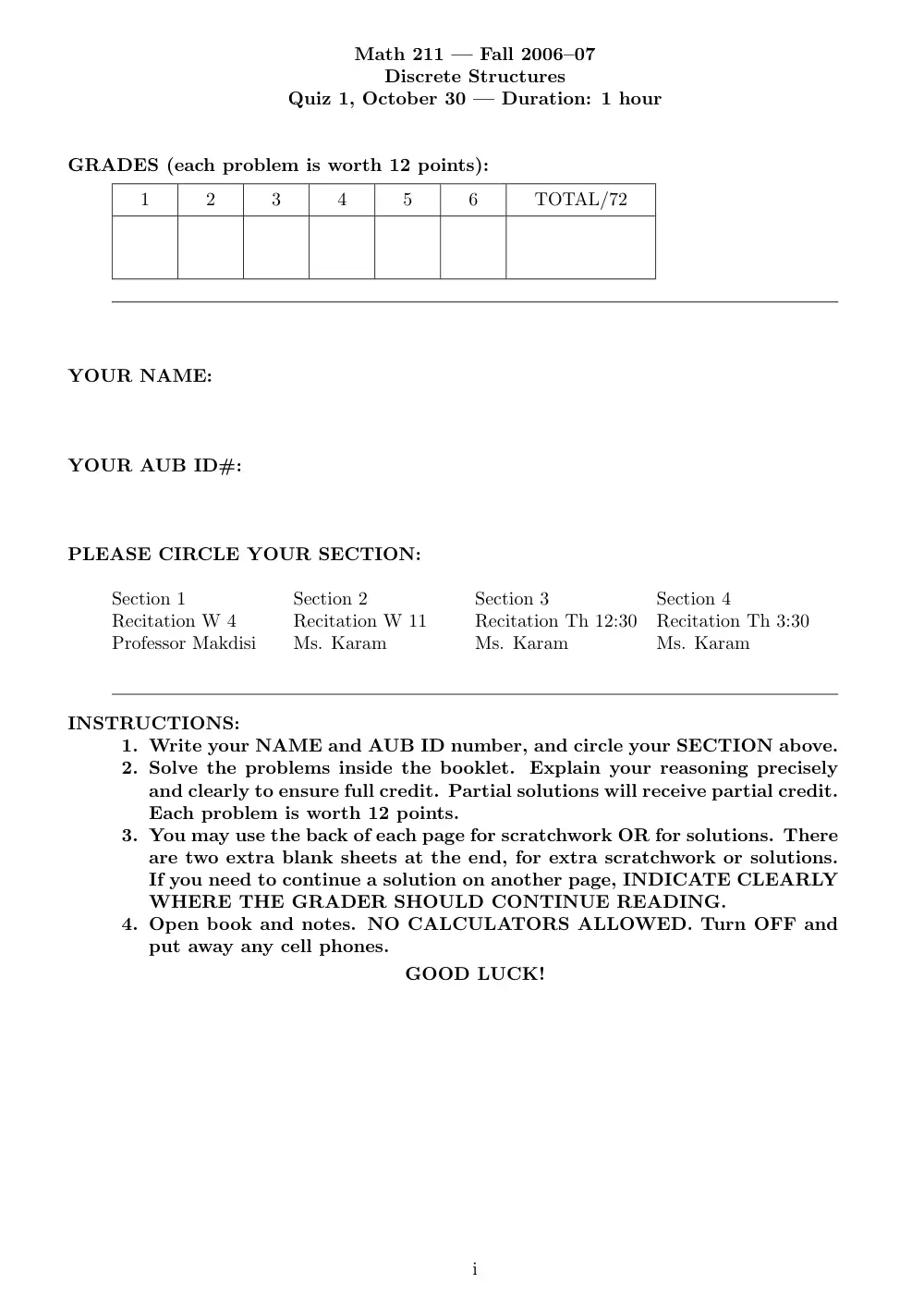
Math 211 — Fall 2006–07
Discrete Structures
Quiz 1, October 30 — Duration: 1 hour
GRADES (each problem is worth 12 points):
1
2
3
4
5
6
TOTAL/72
YOUR NAME:
YOUR AUB ID#:
PLEASE CIRCLE YOUR SECTION:
Section 1
Section 2
Section 3
Section 4
Recitation W 4
Recitation W 11
Recitation Th 12:30
Recitation Th 3:30
Professor Makdisi
Ms. Karam
Ms. Karam
Ms. Karam
INSTRUCTIONS:
1. Write your NAME and AUB ID number, and circle your SECTION above.
2. Solve the problems inside the booklet. Explain your reasoning precisely
and clearly to ensure full credit. Partial solutions will receive partial credit.
Each problem is worth 12 points.
3. You may use the back of each page for scratchwork OR for solutions. There
are two extra blank sheets at the end, for extra scratchwork or solutions.
If you need to continue a solution on another page, INDICATE CLEARLY
WHERE THE GRADER SHOULD CONTINUE READING.
4. Open book and notes. NO CALCULATORS ALLOWED. Turn OFF and
put away any cell phones.
GOOD LUCK!
i
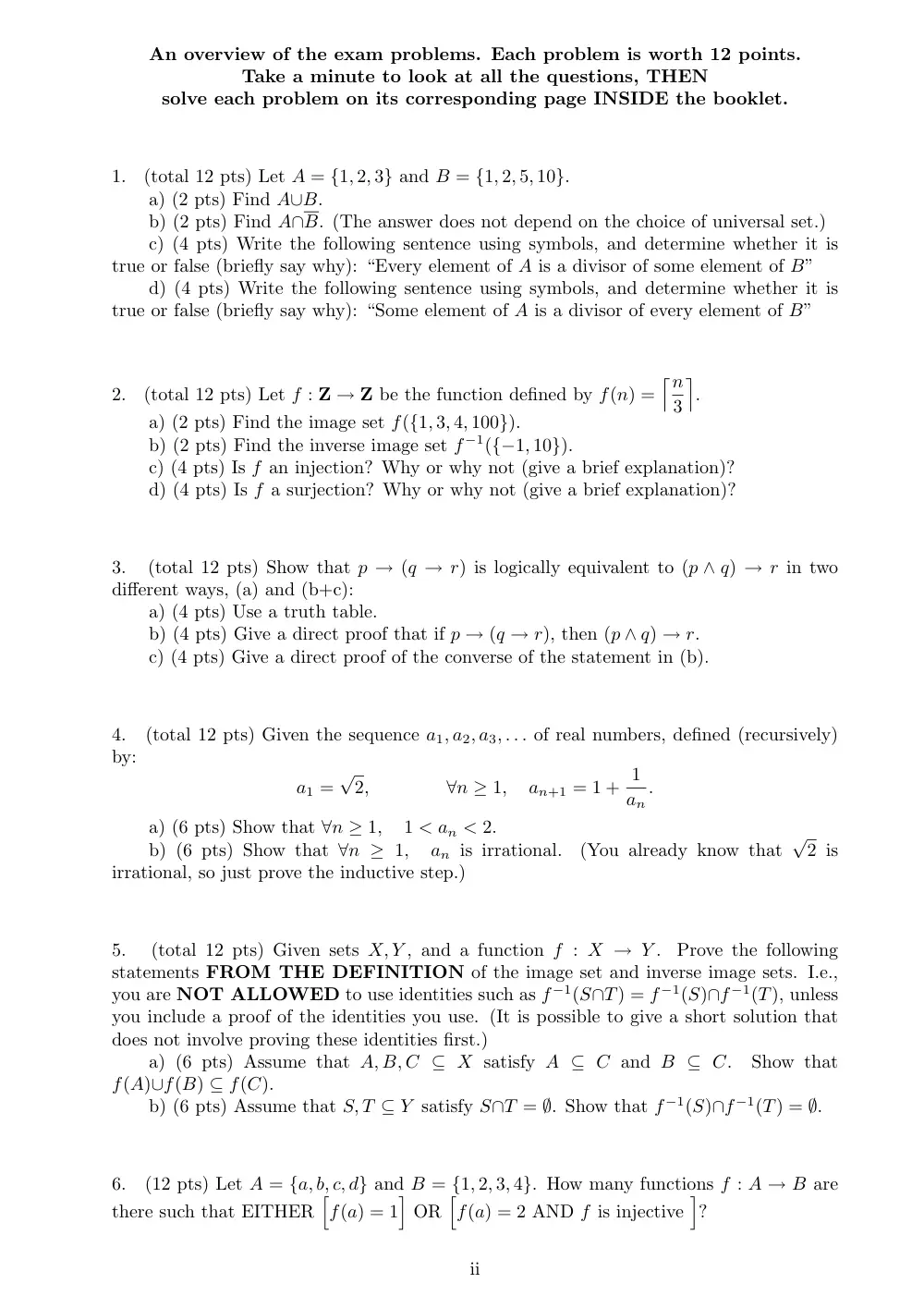
An overview of the exam problems. Each problem is worth 12 points.
Take a minute to look at all the questions, THEN
solve each problem on its corresponding page INSIDE the booklet.
1.
(total 12 pts) Let A = {1, 2, 3} and B = {1, 2, 5, 10}.
a) (2 pts) Find A∪B.
b) (2 pts) Find A∩B. (The answer does not depend on the choice of universal set.)
c) (4 pts) Write the following sentence using symbols, and determine whether it is
true or false (briefly say why): “Every element of A is a divisor of some element of B”
d) (4 pts) Write the following sentence using symbols, and determine whether it is
true or false (briefly say why): “Some element of A is a divisor of every element of B”
2.
(total 12 pts) Let f : Z → Z be the function defined by f(n) =
�n
3
�
.
a) (2 pts) Find the image set f({1, 3, 4, 100}).
b) (2 pts) Find the inverse image set f −1({−1, 10}).
c) (4 pts) Is f an injection? Why or why not (give a brief explanation)?
d) (4 pts) Is f a surjection? Why or why not (give a brief explanation)?
3.
(total 12 pts) Show that p → (q → r) is logically equivalent to (p ∧ q) → r in two
different ways, (a) and (b+c):
a) (4 pts) Use a truth table.
b) (4 pts) Give a direct proof that if p → (q → r), then (p ∧ q) → r.
c) (4 pts) Give a direct proof of the converse of the statement in (b).
4.
(total 12 pts) Given the sequence a1, a2, a3, . . . of real numbers, defined (recursively)
by:
a1 =
√
2,
∀n ≥ 1,
an+1 = 1 + 1
an
.
a) (6 pts) Show that ∀n ≥ 1,
1 < an < 2.
b) (6 pts) Show that ∀n ≥ 1,
an is irrational.
(You already know that
√
2 is
irrational, so just prove the inductive step.)
5.
(total 12 pts) Given sets X, Y , and a function f : X → Y .
Prove the following
statements FROM THE DEFINITION of the image set and inverse image sets. I.e.,
you are NOT ALLOWED to use identities such as f −1(S∩T) = f −1(S)∩f −1(T), unless
you include a proof of the identities you use. (It is possible to give a short solution that
does not involve proving these identities first.)
a) (6 pts) Assume that A, B, C ⊆ X satisfy A ⊆ C and B ⊆ C.
Show that
f(A)∪f(B) ⊆ f(C).
b) (6 pts) Assume that S, T ⊆ Y satisfy S∩T = ∅. Show that f −1(S)∩f −1(T) = ∅.
6.
(12 pts) Let A = {a, b, c, d} and B = {1, 2, 3, 4}. How many functions f : A → B are
there such that EITHER
�
f(a) = 1
�
OR
�
f(a) = 2 AND f is injective
�
?
ii