
MATH 211 Exam 2 With Solution, Fall 2005
American University of Beirut · Discrete Structures · 3 pages · with solution
More MATH 211 files
Show the text of this exam
MATH 346-06S
TEST I
NAME: KEY
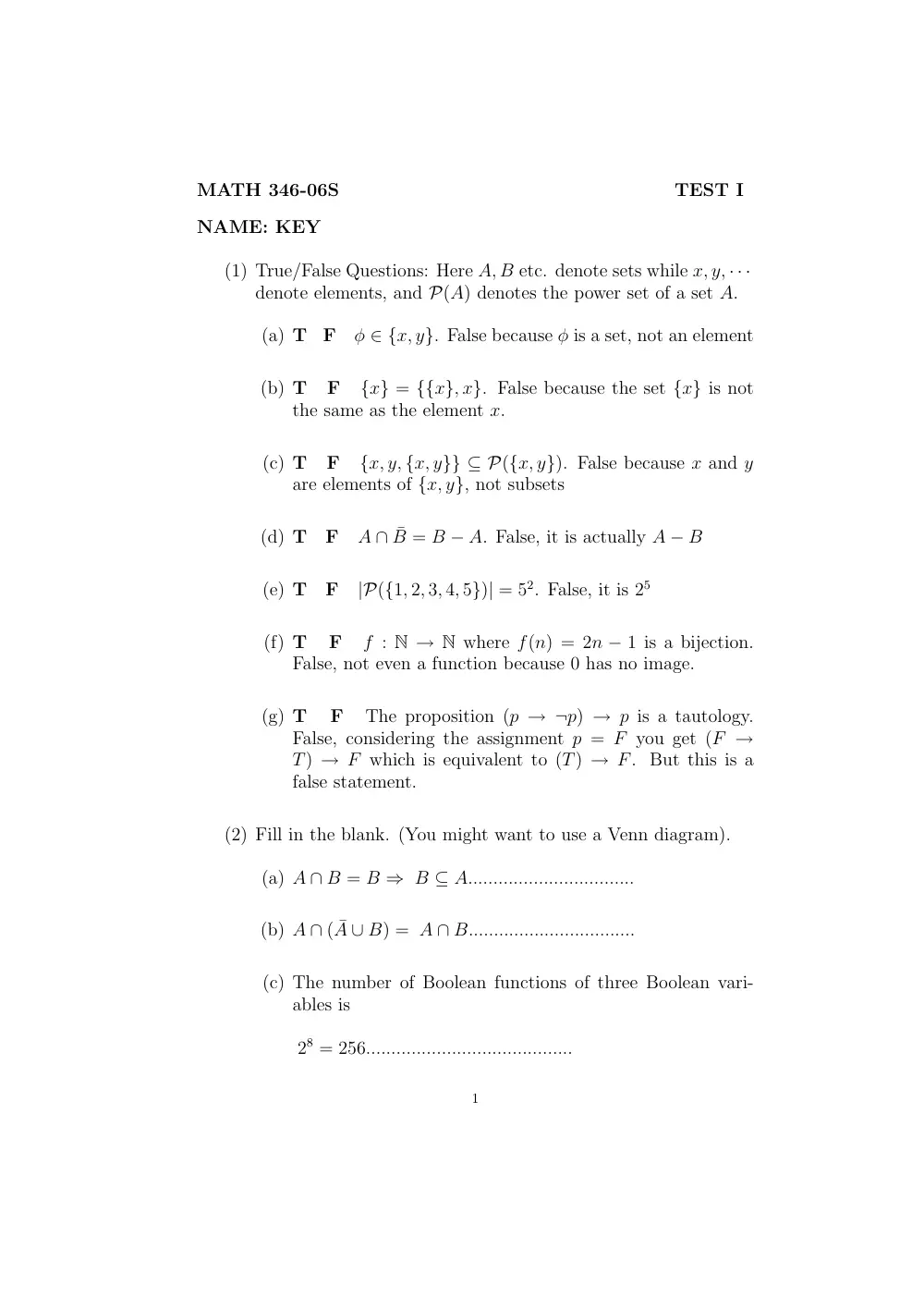
(1) True/False Questions: Here A, B etc. denote sets while x, y, · · ·
denote elements, and P(A) denotes the power set of a set A.
(a) T
F
φ ∈ {x, y}. False because φ is a set, not an element
(b) T
F
{x} = {{x}, x}. False because the set {x} is not
the same as the element x.
(c) T
F
{x, y, {x, y}} ⊆ P({x, y}). False because x and y
are elements of {x, y}, not subsets
(d) T
F
A ∩ ¯B = B − A. False, it is actually A − B
(e) T
F
|P({1, 2, 3, 4, 5})| = 52. False, it is 25
(f) T
F
f : N → N where f(n) = 2n − 1 is a bijection.
False, not even a function because 0 has no image.
(g) T
F
The proposition (p → ¬p) → p is a tautology.
False, considering the assignment p = F you get (F →
T) → F which is equivalent to (T) → F. But this is a
false statement.
(2) Fill in the blank. (You might want to use a Venn diagram).
(a) A ∩ B = B ⇒ B ⊆ A.................................
(b) A ∩ ( ¯A ∪ B) = A ∩ B.................................
(c) The number of Boolean functions of three Boolean vari-
ables is
28 = 256.........................................
1
2
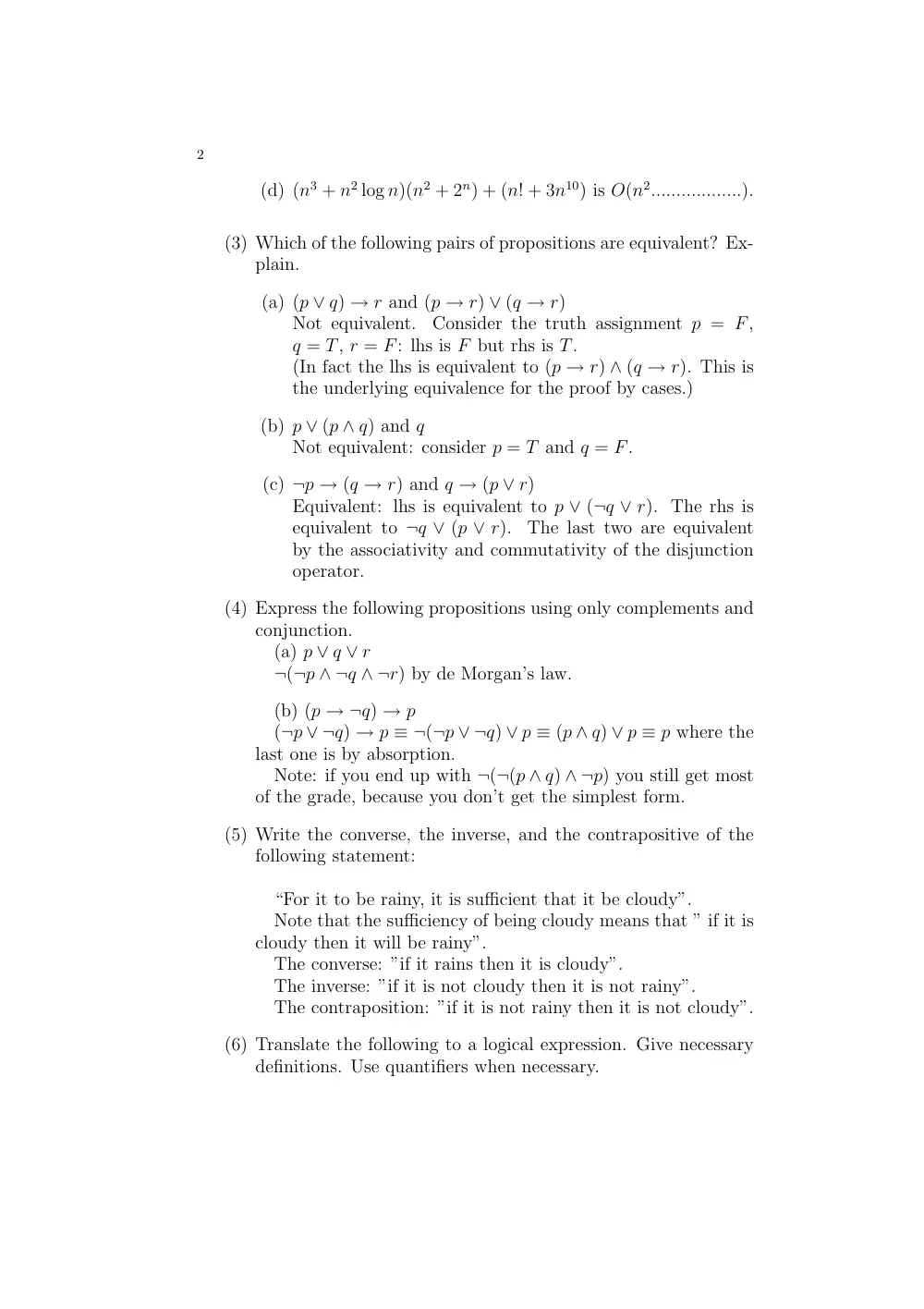
(d) (n3 + n2 log n)(n2 + 2n) + (n! + 3n10) is O(n2..................).
(3) Which of the following pairs of propositions are equivalent? Ex-
plain.
(a) (p ∨ q) → r and (p → r) ∨ (q → r)
Not equivalent.
Consider the truth assignment p = F,
q = T, r = F: lhs is F but rhs is T.
(In fact the lhs is equivalent to (p → r) ∧ (q → r). This is
the underlying equivalence for the proof by cases.)
(b) p ∨ (p ∧ q) and q
Not equivalent: consider p = T and q = F.
(c) ¬p → (q → r) and q → (p ∨ r)
Equivalent: lhs is equivalent to p ∨ (¬q ∨ r). The rhs is
equivalent to ¬q ∨ (p ∨ r).
The last two are equivalent
by the associativity and commutativity of the disjunction
operator.
(4) Express the following propositions using only complements and
conjunction.
(a) p ∨ q ∨ r
¬(¬p ∧ ¬q ∧ ¬r) by de Morgan’s law.
(b) (p → ¬q) → p
(¬p ∨ ¬q) → p ≡ ¬(¬p ∨ ¬q) ∨ p ≡ (p ∧ q) ∨ p ≡ p where the
last one is by absorption.
Note: if you end up with ¬(¬(p ∧ q) ∧ ¬p) you still get most
of the grade, because you don’t get the simplest form.
(5) Write the converse, the inverse, and the contrapositive of the
following statement:
“For it to be rainy, it is sufficient that it be cloudy”.
Note that the sufficiency of being cloudy means that ” if it is
cloudy then it will be rainy”.
The converse: ”if it rains then it is cloudy”.
The inverse: ”if it is not cloudy then it is not rainy”.
The contraposition: ”if it is not rainy then it is not cloudy”.
(6) Translate the following to a logical expression. Give necessary
definitions. Use quantifiers when necessary.
3
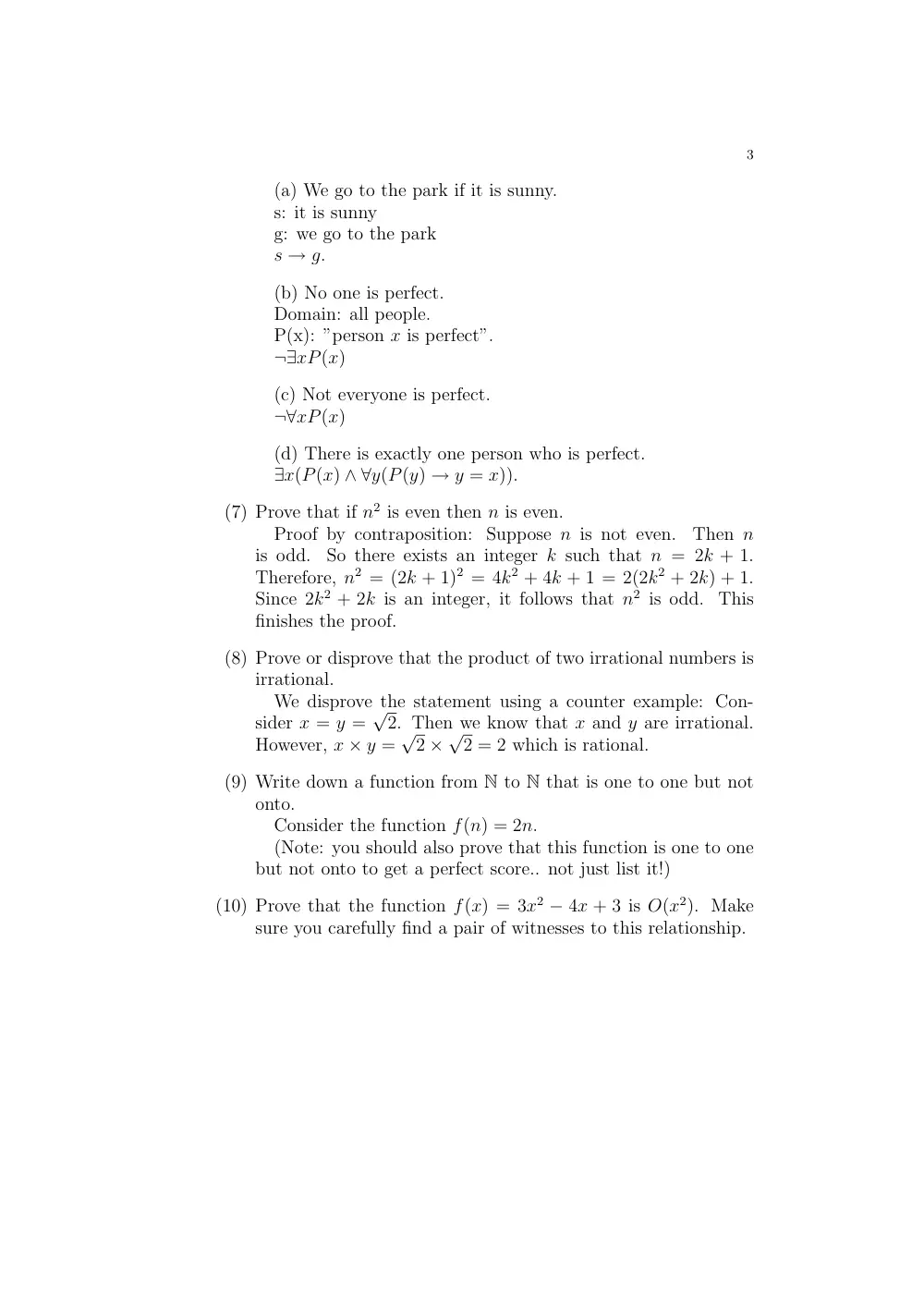
(a) We go to the park if it is sunny.
s: it is sunny
g: we go to the park
s → g.
(b) No one is perfect.
Domain: all people.
P(x): ”person x is perfect”.
¬∃xP(x)
(c) Not everyone is perfect.
¬∀xP(x)
(d) There is exactly one person who is perfect.
∃x(P(x) ∧ ∀y(P(y) → y = x)).
(7) Prove that if n2 is even then n is even.
Proof by contraposition: Suppose n is not even.
Then n
is odd.
So there exists an integer k such that n = 2k + 1.
Therefore, n2 = (2k + 1)2 = 4k2 + 4k + 1 = 2(2k2 + 2k) + 1.
Since 2k2 + 2k is an integer, it follows that n2 is odd. This
finishes the proof.
(8) Prove or disprove that the product of two irrational numbers is
irrational.
We disprove the statement using a counter example: Con-
sider x = y =
√
2. Then we know that x and y are irrational.
However, x × y =
√
2 ×
√
2 = 2 which is rational.
(9) Write down a function from N to N that is one to one but not
onto.
Consider the function f(n) = 2n.
(Note: you should also prove that this function is one to one
but not onto to get a perfect score.. not just list it!)
(10) Prove that the function f(x) = 3x2 − 4x + 3 is O(x2). Make
sure you carefully find a pair of witnesses to this relationship.