
MATH 218 Final, Fall 2005
American University of Beirut · Elementary Linear Algebra with Applications · 9 pages · Ms. Zeinab Mouzeihim



More MATH 218 files
- Final 218 2018 · Spring 2019Final examView
- Final Collection Finals with Solution · Spring 2017Final exam · with solutionView
- Final Collection Finals with Solution · Spring 2017Final exam · with solutionView
- Final with Solution · Spring 2017Final exam · with solutionView
- Final Collection Finals with Solution · Spring 2017Final exam · with solutionView
- Final 08 · Spring 2017Final examView
- Final 2014 with Solution · Spring 2017Final exam · with solutionView
- Final · Summer 2016Final examView
Show the text of this final exam
AMERICAN UNIVERSITY OF BEIRUT
Mathematics Department
Math 218 - Final Exam
Fall 2005-2006
Name:..................................
ID:................................
Section 1
Section 2
Section 3
Mrs. Z. Mouzeihem
Ms. M. Houri
Ms. D. Audi
Time: 120 min
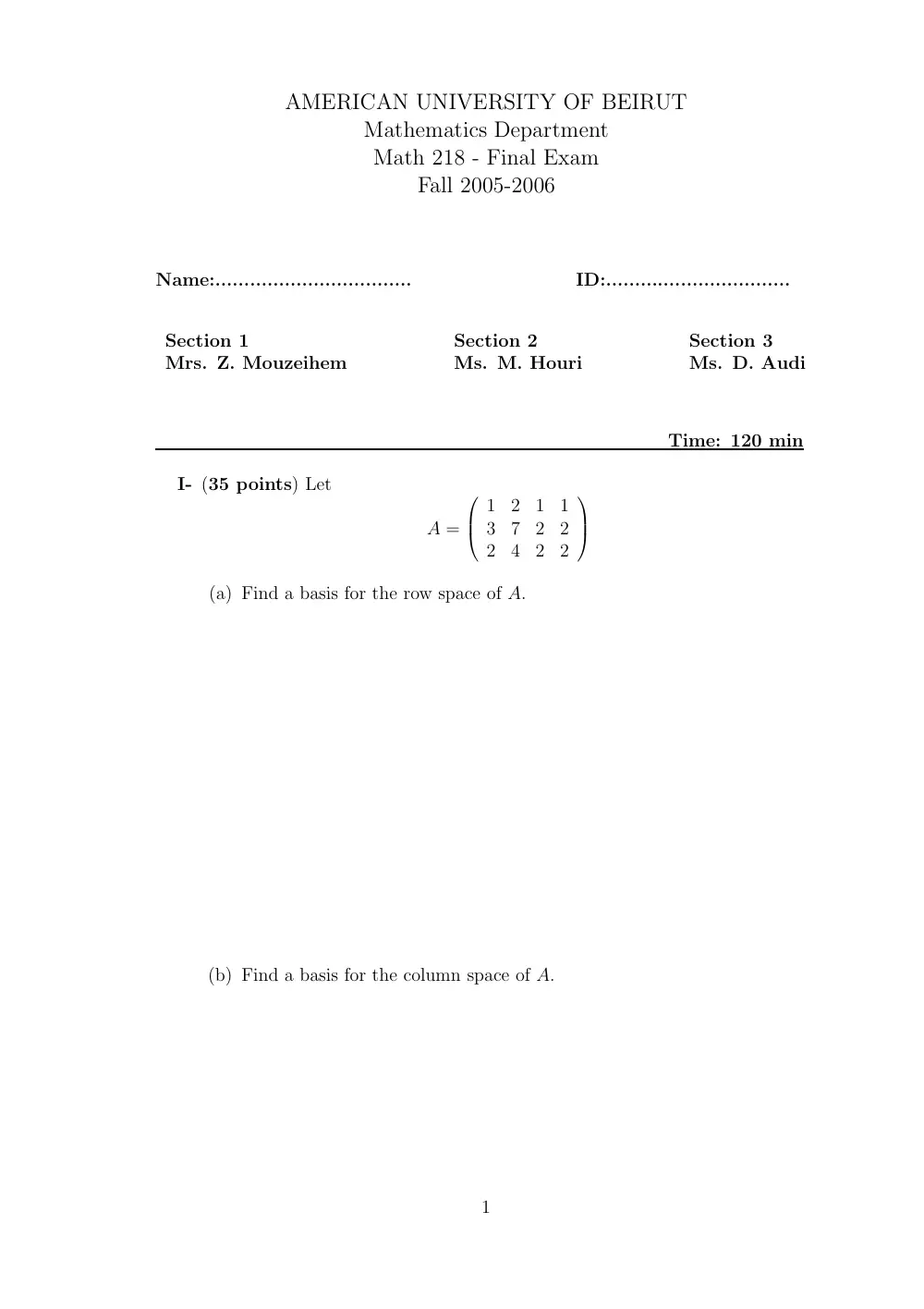
I- (35 points) Let
A =
1
2
1
1
3
7
2
2
2
4
2
2
(a) Find a basis for the row space of A.
(b) Find a basis for the column space of A.
1
(c) Find a basis for the null space of A.
(d) Find a basis for the null space of AT.
(e) If W ⊥ is the column space of A deduce a basis for W.
2
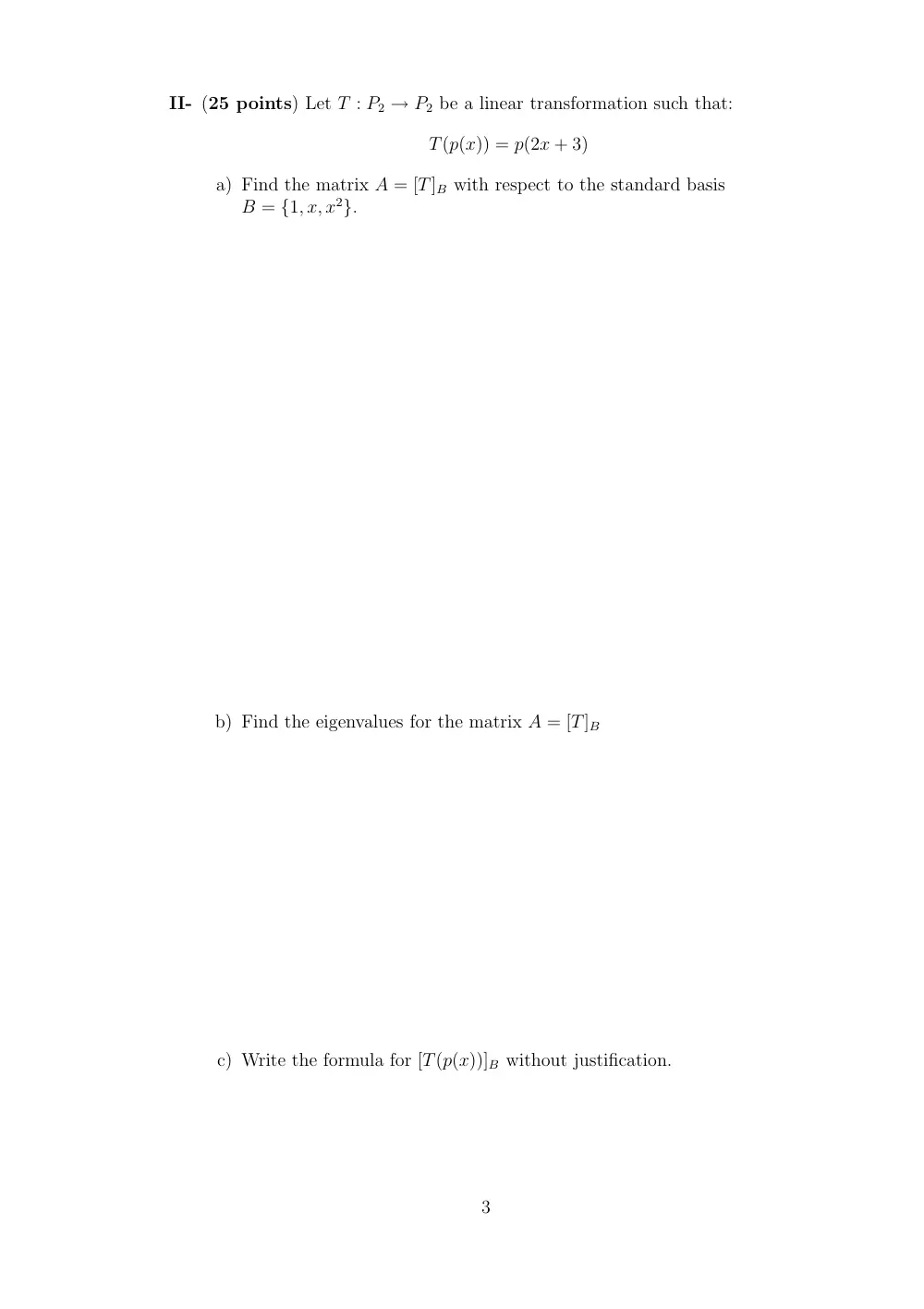
II- (25 points) Let T : P2 → P2 be a linear transformation such that:
T(p(x)) = p(2x + 3)
a) Find the matrix A = [T]B with respect to the standard basis
B = {1, x, x2}.
b) Find the eigenvalues for the matrix A = [T]B
c) Write the formula for [T(p(x))]B without justification.
3
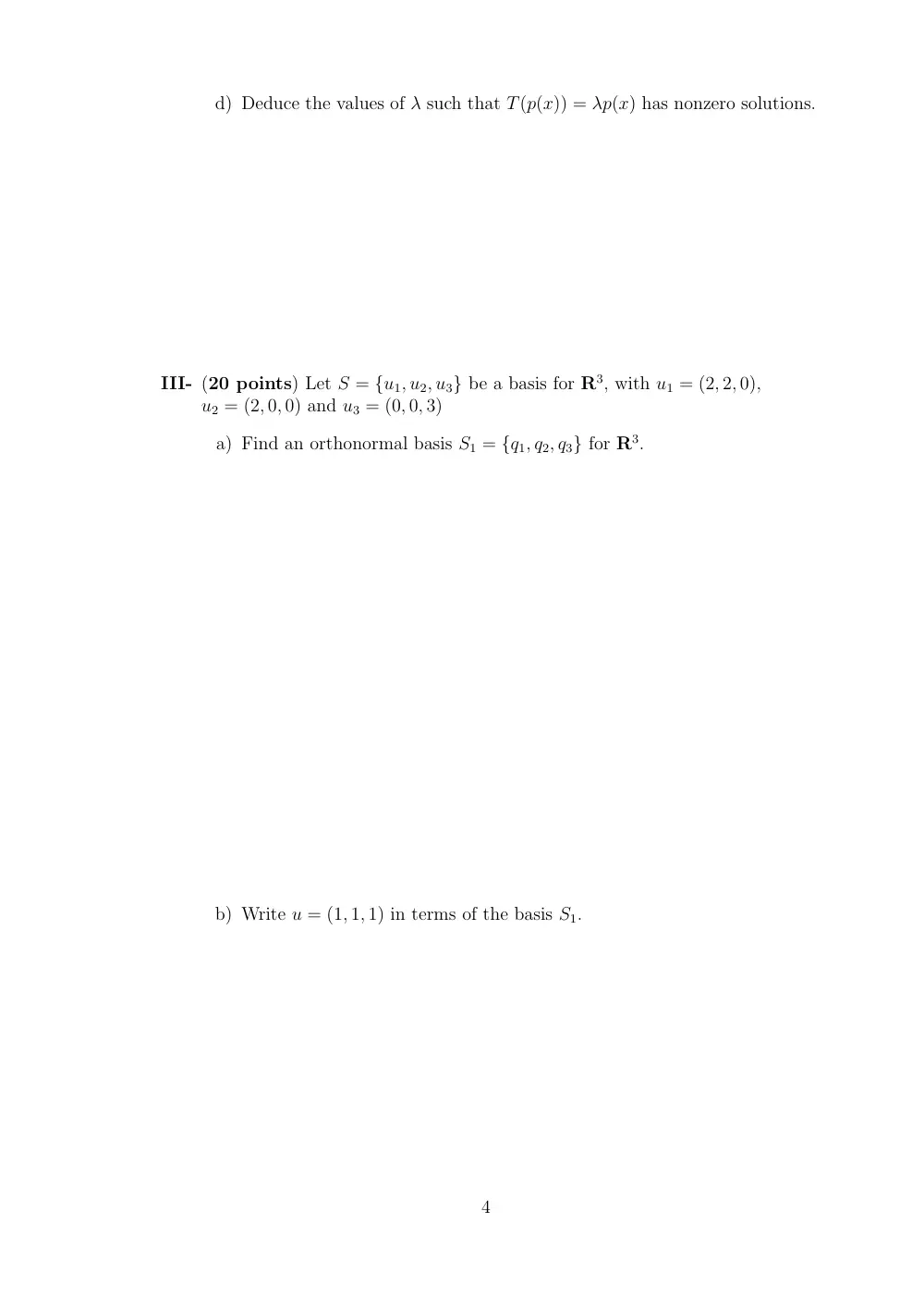
d) Deduce the values of λ such that T(p(x)) = λp(x) has nonzero solutions.
III- (20 points) Let S = {u1, u2, u3} be a basis for R3, with u1 = (2, 2, 0),
u2 = (2, 0, 0) and u3 = (0, 0, 3)
a) Find an orthonormal basis S1 = {q1, q2, q3} for R3.
b) Write u = (1, 1, 1) in terms of the basis S1.
4
IV- (20 points) Let T : R3 → R4 be defined by:
T(x, y, z) = (x + 2y, x + 3z, z − x, 0)
a) Show that T is a linear transformation.
b) Is T one-to-one? Justify
c) Find the rank of T.
d) Find a basis for the range of T.
5
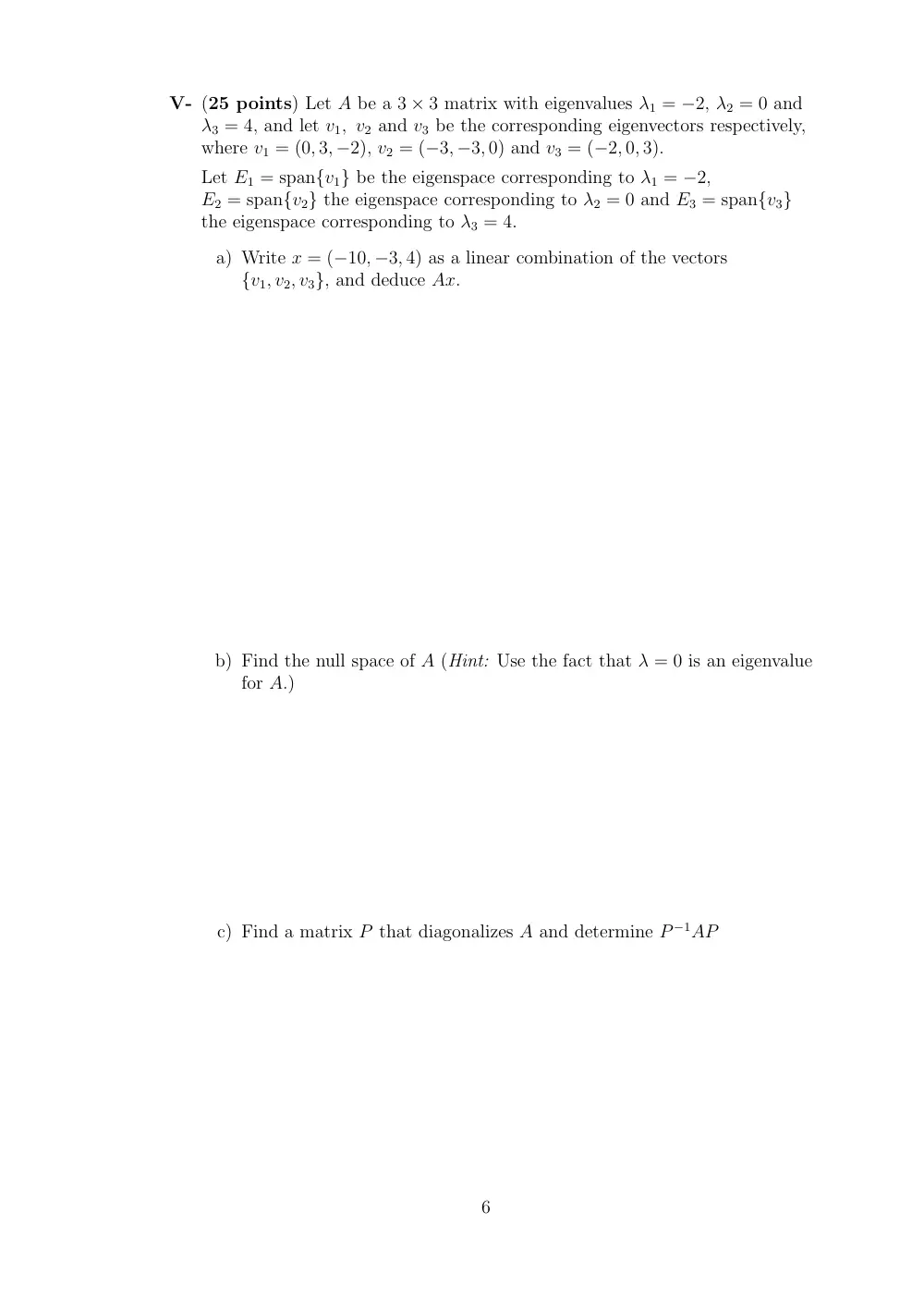
V- (25 points) Let A be a 3 × 3 matrix with eigenvalues λ1 = −2, λ2 = 0 and
λ3 = 4, and let v1, v2 and v3 be the corresponding eigenvectors respectively,
where v1 = (0, 3, −2), v2 = (−3, −3, 0) and v3 = (−2, 0, 3).
Let E1 = span{v1} be the eigenspace corresponding to λ1 = −2,
E2 = span{v2} the eigenspace corresponding to λ2 = 0 and E3 = span{v3}
the eigenspace corresponding to λ3 = 4.
a) Write x = (−10, −3, 4) as a linear combination of the vectors
{v1, v2, v3}, and deduce Ax.
b) Find the null space of A (Hint: Use the fact that λ = 0 is an eigenvalue
for A.)
c) Find a matrix P that diagonalizes A and determine P −1AP
6
VI- (15 points) Short Proofs
1) Show that if A is an orthogonal matrix then det(A) = ±1.
2) State and prove the theorem of Pythagoras for an inner product space
V .
3) Let T : V → W be a linear transformation, show that Ker(T) is a
subspace of V.
7
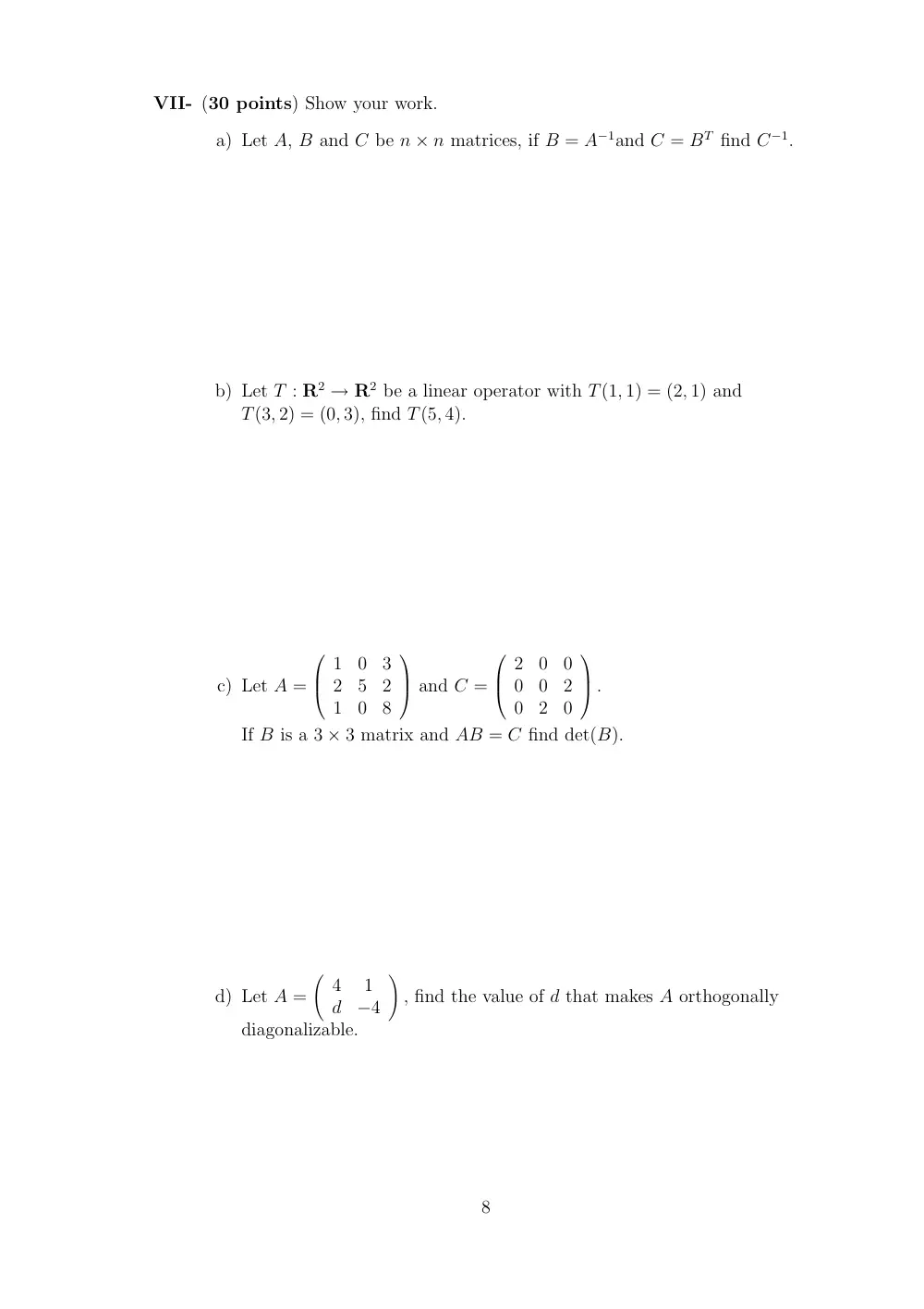
VII- (30 points) Show your work.
a) Let A, B and C be n × n matrices, if B = A−1and C = BT find C−1.
b) Let T : R2 → R2 be a linear operator with T(1, 1) = (2, 1) and
T(3, 2) = (0, 3), find T(5, 4).
c) Let A =
1
0
3
2
5
2
1
0
8
and C =
2
0
0
0
0
2
0
2
0
.
If B is a 3 × 3 matrix and AB = C find det(B).
d) Let A =
�
4
1
d
−4
�
, find the value of d that makes A orthogonally
diagonalizable.
8
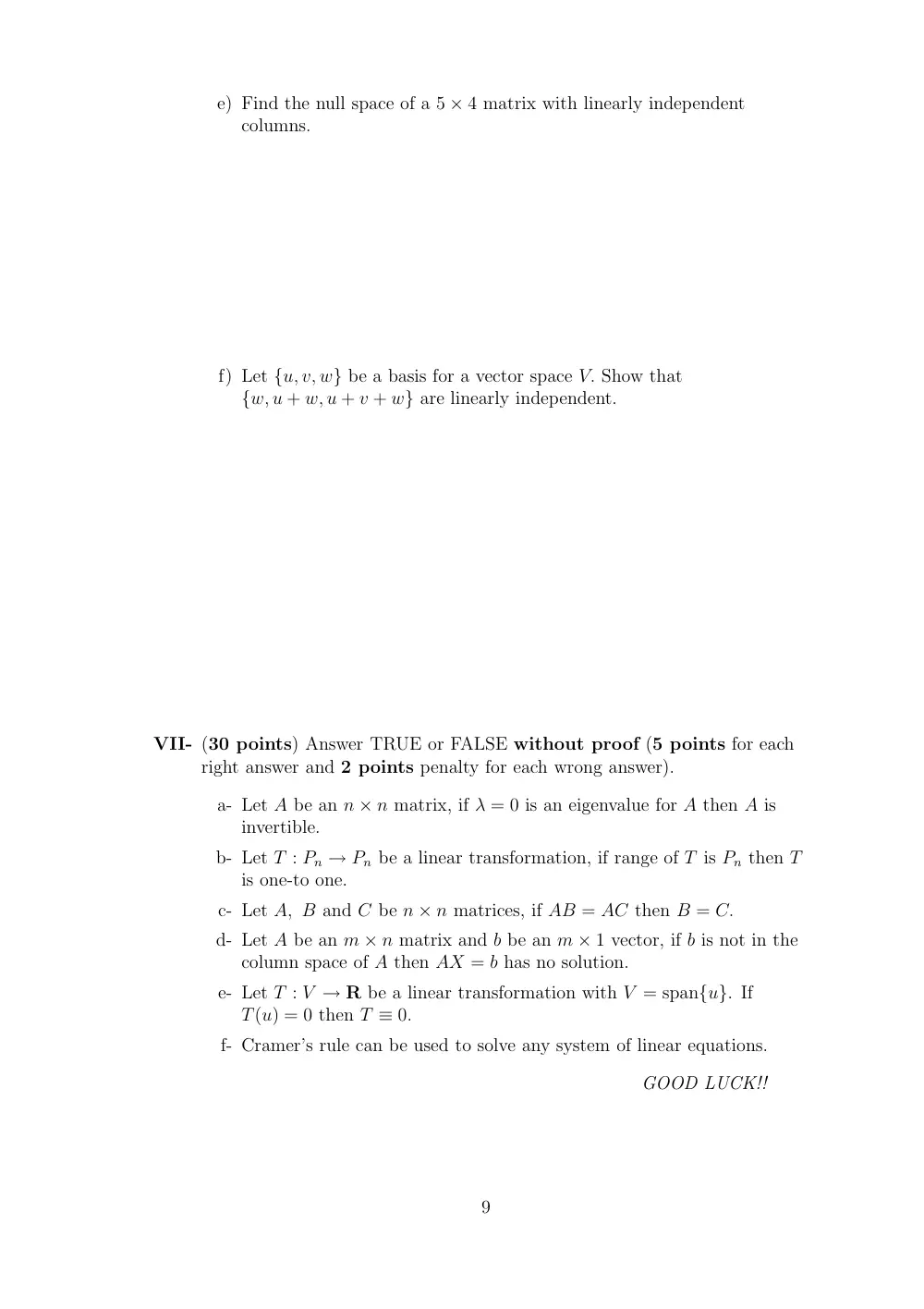
e) Find the null space of a 5 × 4 matrix with linearly independent
columns.
f) Let {u, v, w} be a basis for a vector space V. Show that
{w, u + w, u + v + w} are linearly independent.
VII- (30 points) Answer TRUE or FALSE without proof (5 points for each
right answer and 2 points penalty for each wrong answer).
a- Let A be an n × n matrix, if λ = 0 is an eigenvalue for A then A is
invertible.
b- Let T : Pn → Pn be a linear transformation, if range of T is Pn then T
is one-to one.
c- Let A, B and C be n × n matrices, if AB = AC then B = C.
d- Let A be an m × n matrix and b be an m × 1 vector, if b is not in the
column space of A then AX = b has no solution.
e- Let T : V → R be a linear transformation with V = span{u}. If
T(u) = 0 then T ≡ 0.
f- Cramer’s rule can be used to solve any system of linear equations.
GOOD LUCK!!
9