
MATH 218 Final, Fall 2006
American University of Beirut · Elementary Linear Algebra with Applications · 11 pages


Showing the first 10 of 11 pages. Download the PDF to see all of it.
More MATH 218 files
- Final 218 2018 · Spring 2019Final examView
- Final Collection Finals with Solution · Spring 2017Final exam · with solutionView
- Final Collection Finals with Solution · Spring 2017Final exam · with solutionView
- Final with Solution · Spring 2017Final exam · with solutionView
- Final Collection Finals with Solution · Spring 2017Final exam · with solutionView
- Final 08 · Spring 2017Final examView
- Final 2014 with Solution · Spring 2017Final exam · with solutionView
- Final · Summer 2016Final examView
Show the text of this final exam
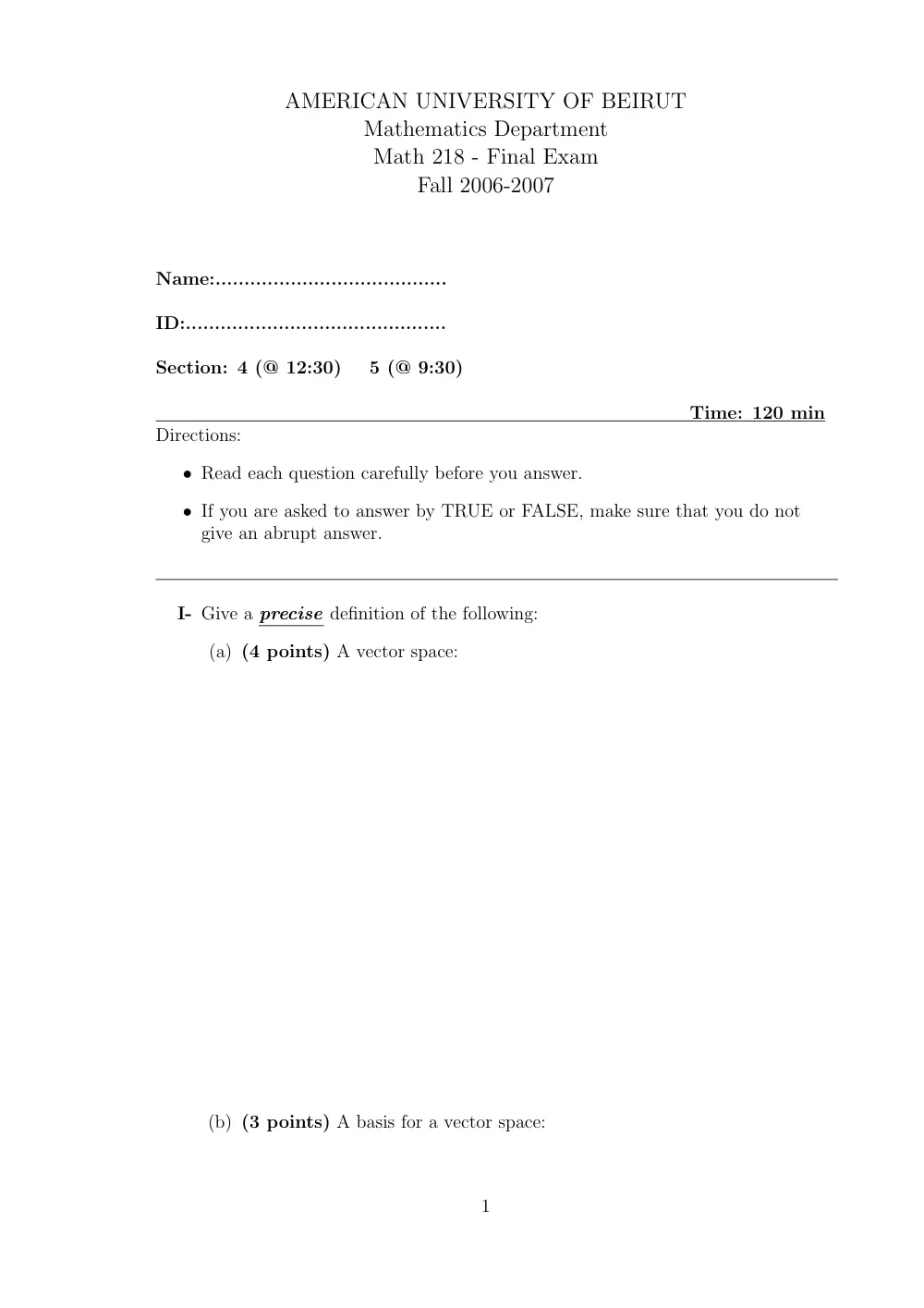
AMERICAN UNIVERSITY OF BEIRUT
Mathematics Department
Math 218 - Final Exam
Fall 2006-2007
Name:........................................
ID:.............................................
Section: 4 (@ 12:30)
5 (@ 9:30)
Time: 120 min
Directions:
• Read each question carefully before you answer.
• If you are asked to answer by TRUE or FALSE, make sure that you do not
give an abrupt answer.
I- Give a precise definition of the following:
(a) (4 points) A vector space:
(b) (3 points) A basis for a vector space:
1
(c) (3 points) The rank of a matrix:
(d) (3 points) A linear transformation between two vector spaces:
(e) (3 points) The nullity of a linear transformation:
II- Let
A =
1
4
−3
0
2
10
0
4
3
13
−7
3
(a) (2.5 points)Find a basis for the row space of A.
2
(continue your answer here)
(b) (2.5 points) Find a basis for the column space of A.
3
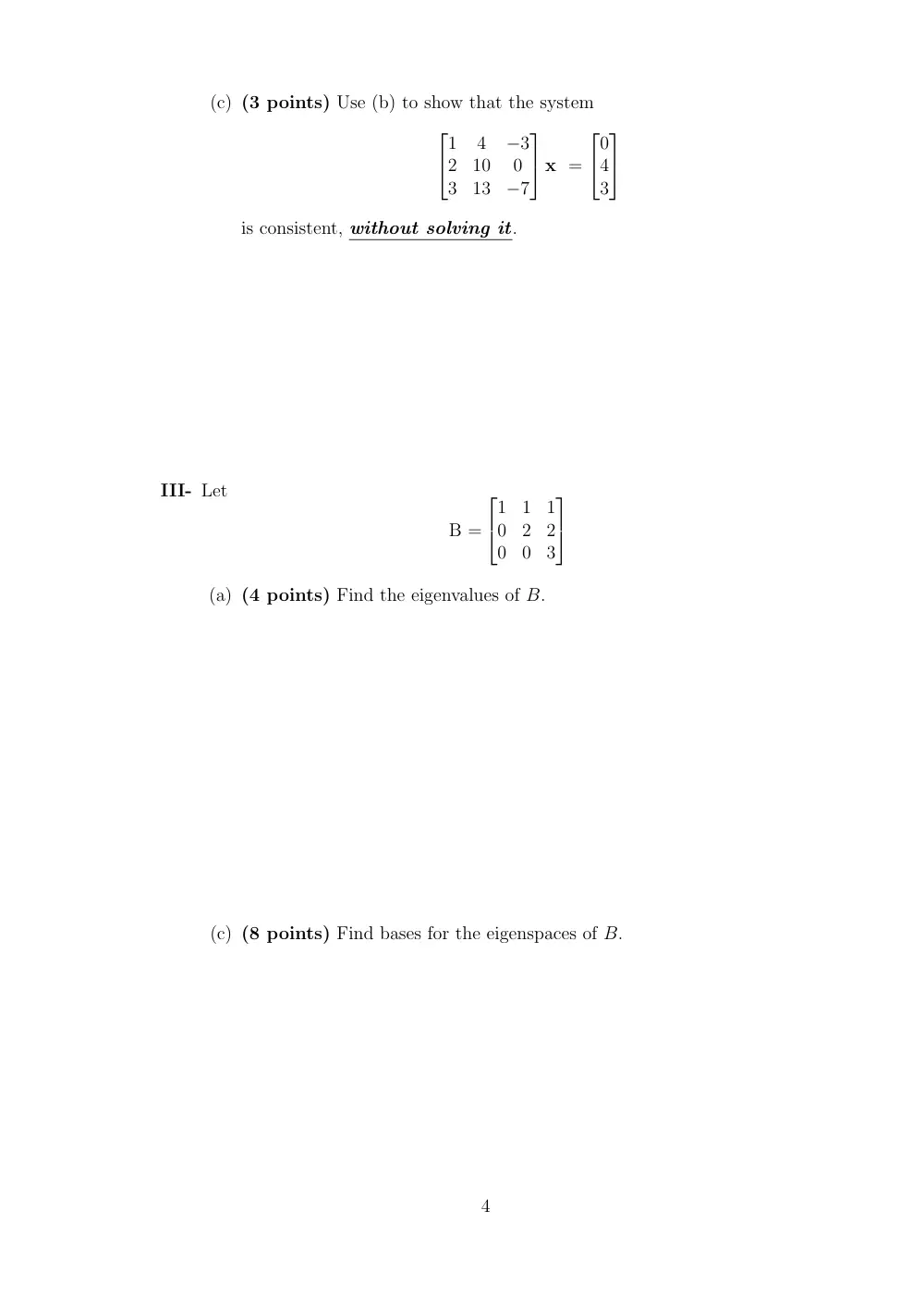
(c) (3 points) Use (b) to show that the system
1
4
−3
2
10
0
3
13
−7
x =
0
4
3
is consistent, without solving it.
III- Let
B =
1
1
1
0
2
2
0
0
3
(a) (4 points) Find the eigenvalues of B.
(c) (8 points) Find bases for the eigenspaces of B.
4
(Continue your answer here)
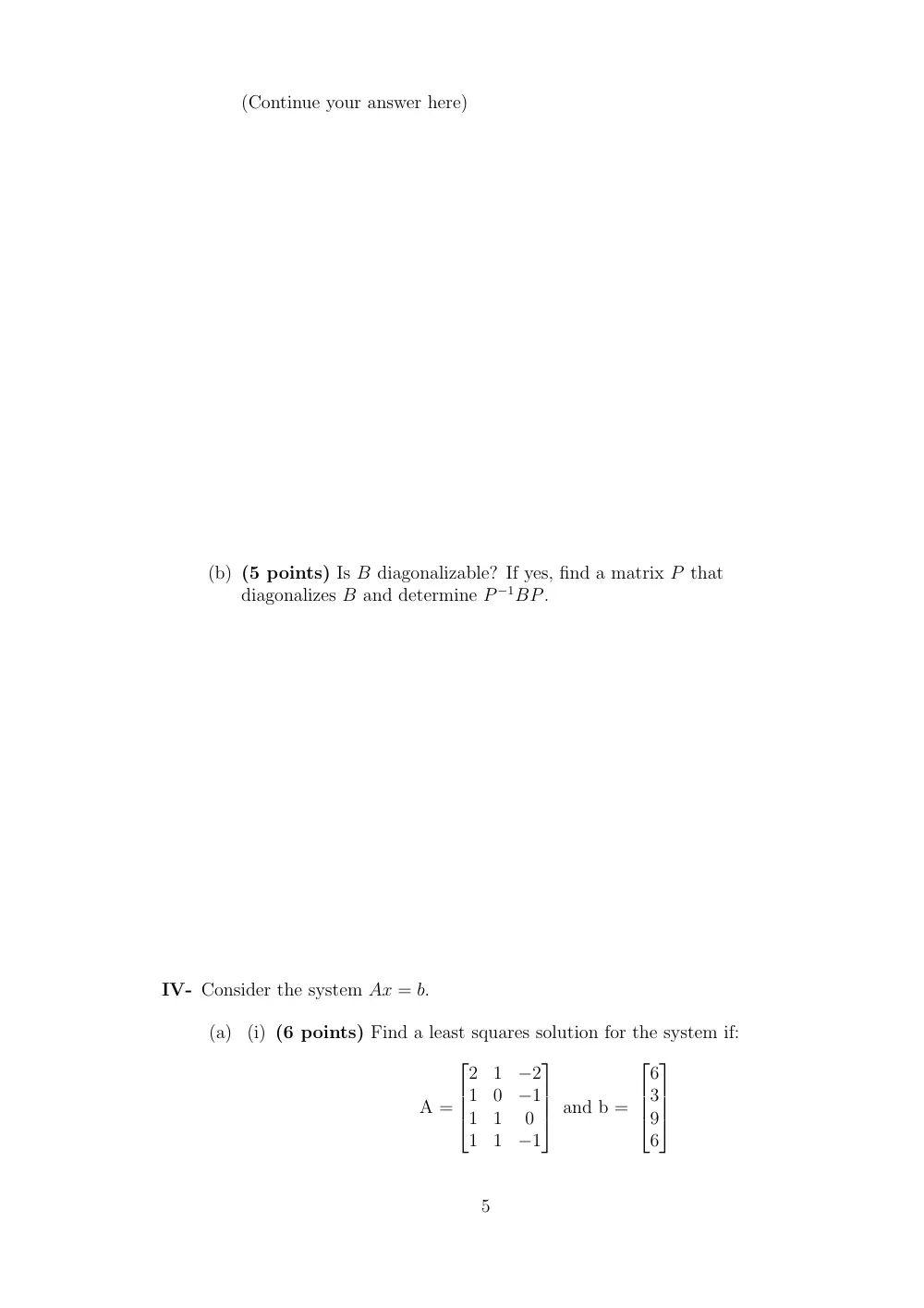
(b) (5 points) Is B diagonalizable? If yes, find a matrix P that
diagonalizes B and determine P −1BP.
IV- Consider the system Ax = b.
(a) (i) (6 points) Find a least squares solution for the system if:
A =
2
1
−2
1
0
−1
1
1
0
1
1
−1
and b =
6
3
9
6
5
(Continue your answer here)
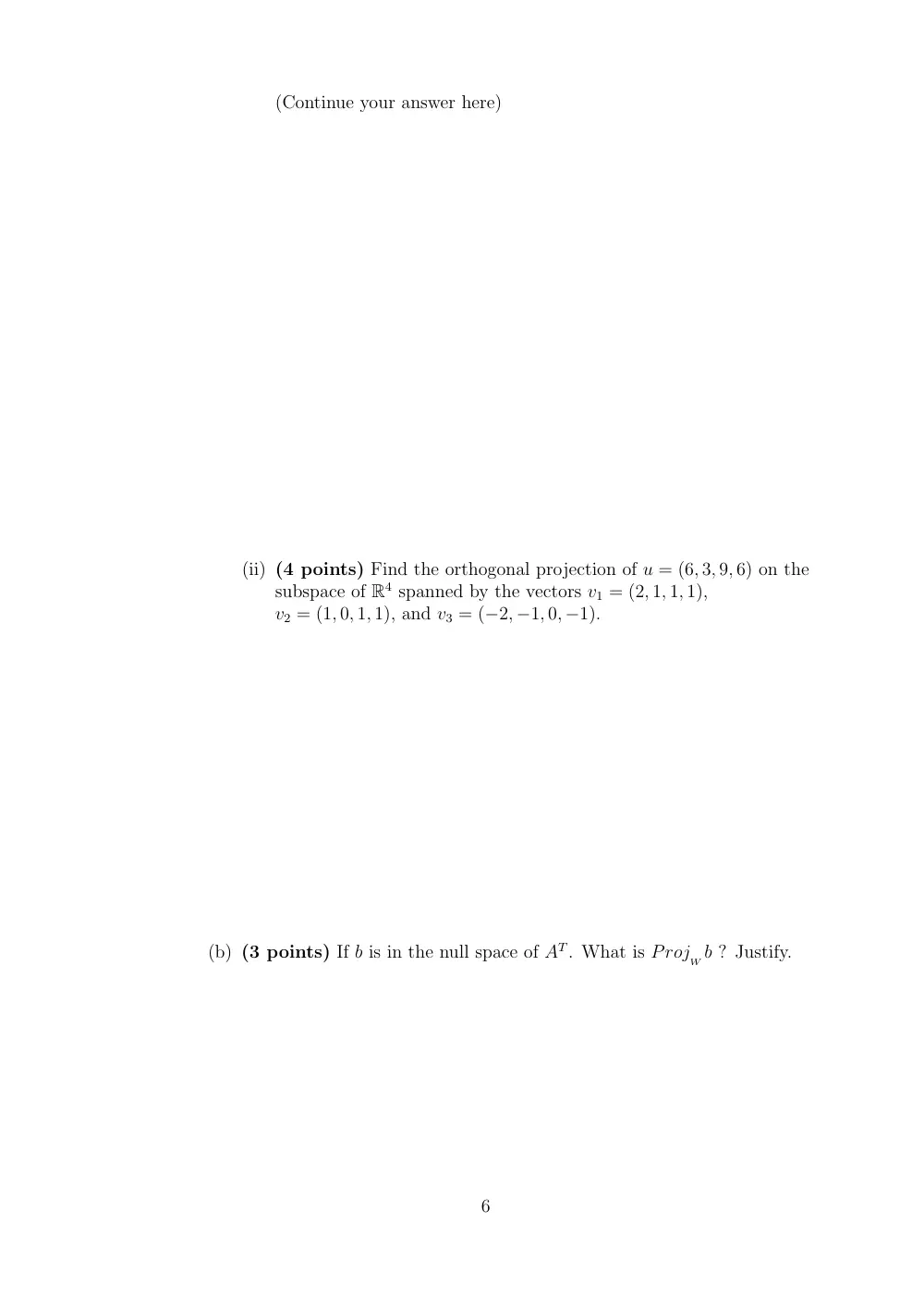
(ii) (4 points) Find the orthogonal projection of u = (6, 3, 9, 6) on the
subspace of R4 spanned by the vectors v1 = (2, 1, 1, 1),
v2 = (1, 0, 1, 1), and v3 = (−2, −1, 0, −1).
(b) (3 points) If b is in the null space of AT. What is Proj
W b ? Justify.
6
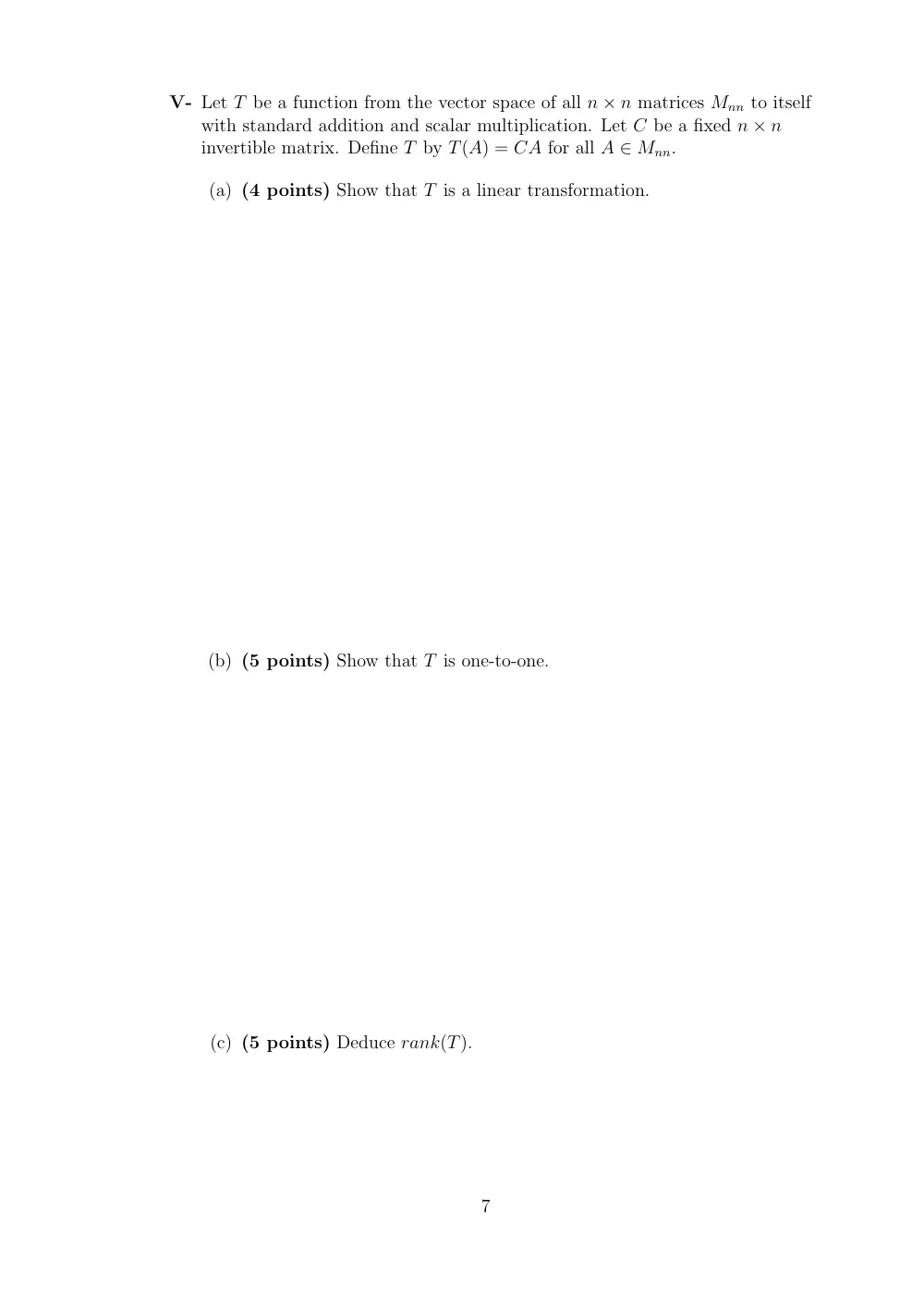
V- Let T be a function from the vector space of all n × n matrices Mnn to itself
with standard addition and scalar multiplication. Let C be a fixed n × n
invertible matrix. Define T by T(A) = CA for all A ∈ Mnn.
(a) (4 points) Show that T is a linear transformation.
(b) (5 points) Show that T is one-to-one.
(c) (5 points) Deduce rank(T).
7
(Continue your answer here)
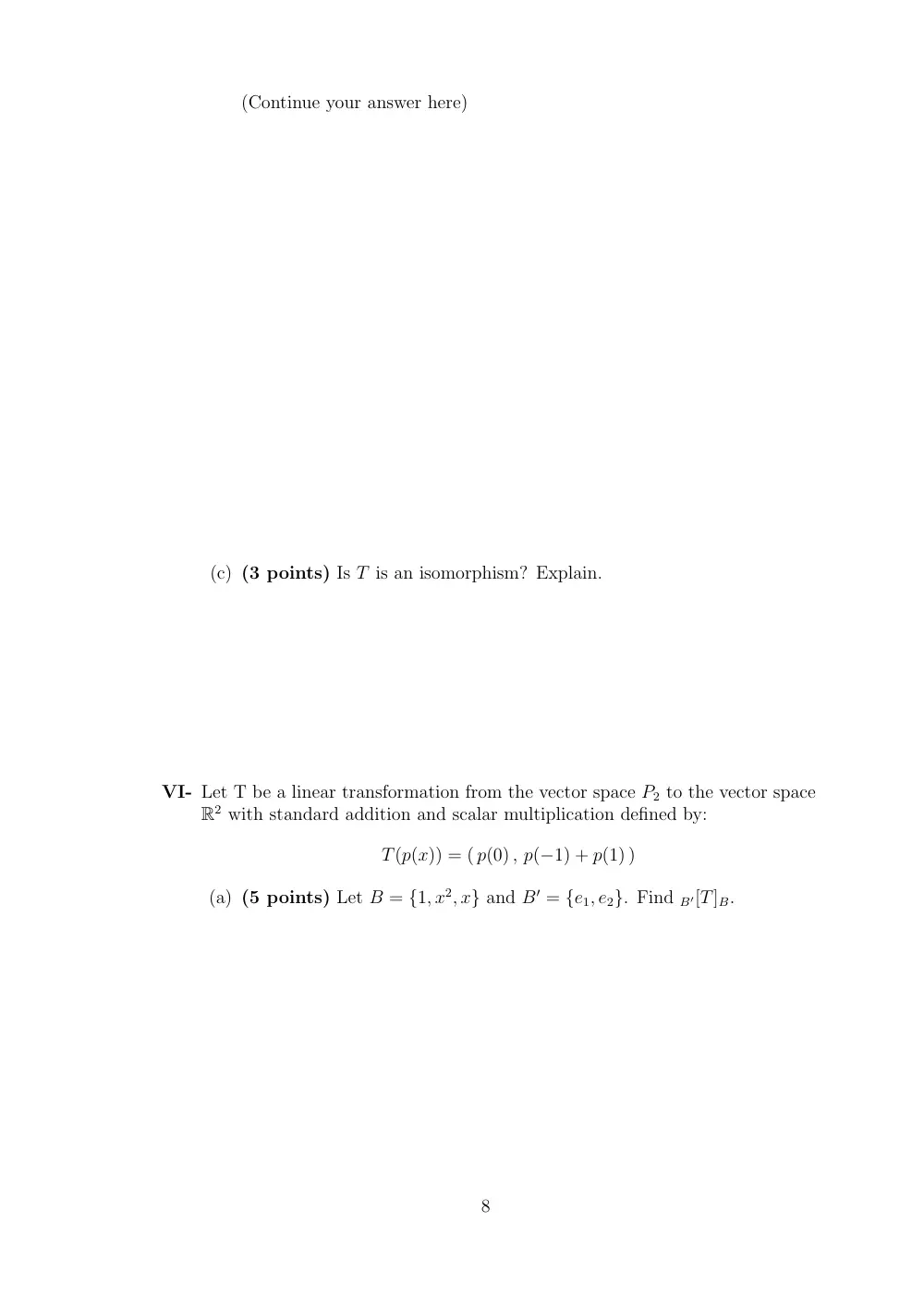
(c) (3 points) Is T is an isomorphism? Explain.
VI- Let T be a linear transformation from the vector space P2 to the vector space
R2 with standard addition and scalar multiplication defined by:
T(p(x)) = ( p(0) , p(−1) + p(1) )
(a) (5 points) Let B = {1, x2, x} and B′ = {e1, e2}. Find B′[T]B.
8
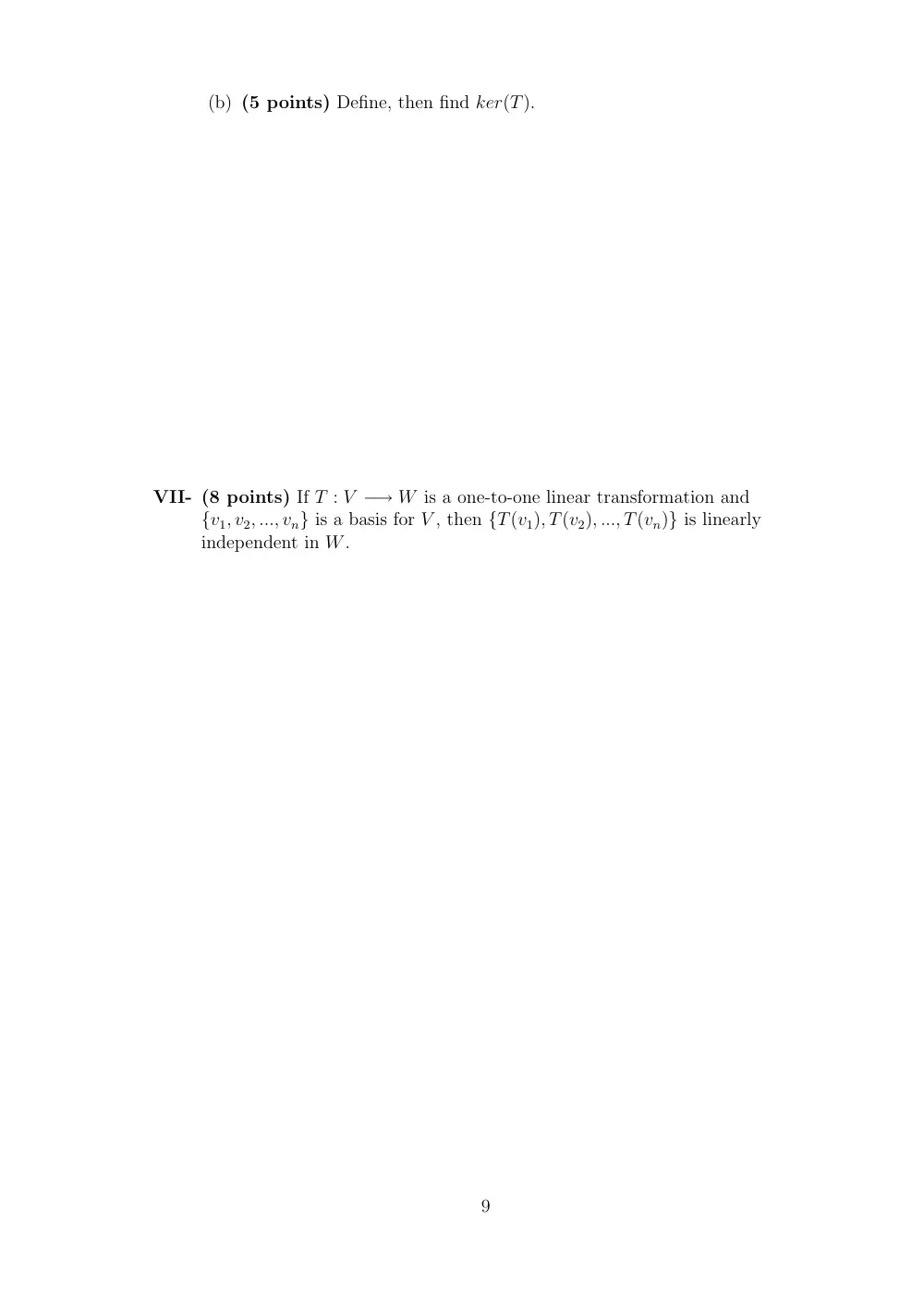
(b) (5 points) Define, then find ker(T).
VII- (8 points) If T : V −→ W is a one-to-one linear transformation and
{v1, v2, ..., vn} is a basis for V , then {T(v1), T(v2), ..., T(vn)} is linearly
independent in W.
9
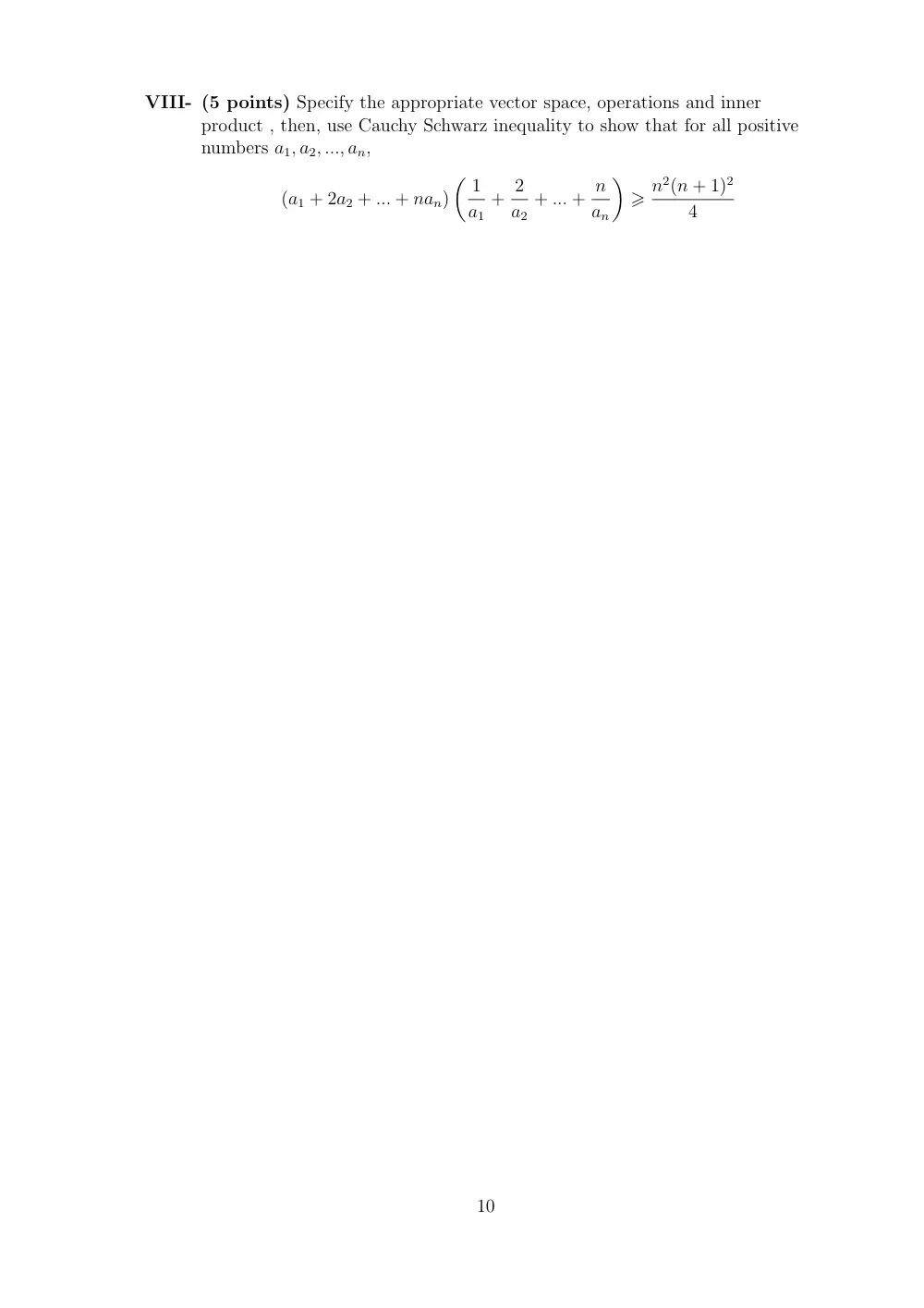
VIII- (5 points) Specify the appropriate vector space, operations and inner
product , then, use Cauchy Schwarz inequality to show that for all positive
numbers a1, a2, ..., an,
(a1 + 2a2 + ... + nan)
� 1
a1
+ 2
a2
+ ... + n
an
�
⩾ n2(n + 1)2
4
10
IX- (6 points) Write TRUE or FALSE.
1- If λ is an eigenvalue of an invertible matrix A, then 1
λ is an eigenvalue
of A−1.
2- If v is an eigenvector of a square matrix A, then it is also an eigenvector
of A5.
3- If det(A) =
√
3 then λ = 0 is an eigenvalue of A.
4- If T : R5 −→ M33 and rank(T) = 5 then T is not one-to-one.
5- The matrix ATA − 3I is orthogonally diagonalizable for any matrix A.
6- If {v1, v2, ..., vn} is an orthogonal set of nonzero vectors in an inner
product space V such that dim(V ) = m , then m ⩽ n.
GOOD LUCK
If you have any comments or requests, please write them here:
11