
MATH 218 Final, Fall 2007
American University of Beirut · Elementary Linear Algebra with Applications · 2 pages
More MATH 218 files
- Final 218 2018 · Spring 2019Final examView
- Final Collection Finals with Solution · Spring 2017Final exam · with solutionView
- Final Collection Finals with Solution · Spring 2017Final exam · with solutionView
- Final Collection Finals with Solution · Spring 2017Final exam · with solutionView
- Final 08 · Spring 2017Final examView
- Final 2014 with Solution · Spring 2017Final exam · with solutionView
- Final with Solution · Spring 2017Final exam · with solutionView
- Final · Summer 2016Final examView
Show the text of this final exam
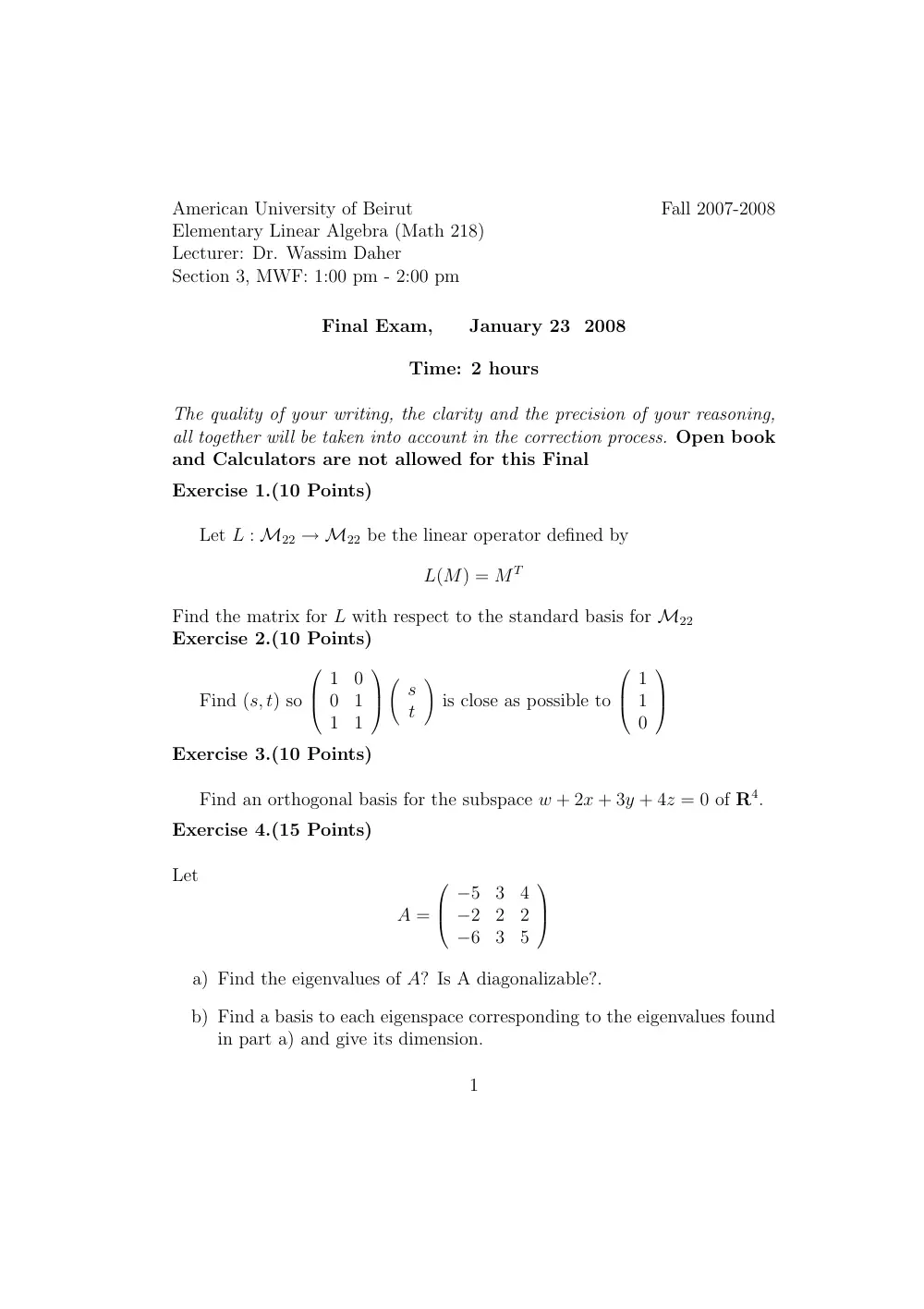
American University of Beirut
Fall 2007-2008
Elementary Linear Algebra (Math 218)
Lecturer: Dr. Wassim Daher
Section 3, MWF: 1:00 pm - 2:00 pm
Final Exam,
January 23 2008
Time: 2 hours
The quality of your writing, the clarity and the precision of your reasoning,
all together will be taken into account in the correction process. Open book
and Calculators are not allowed for this Final
Exercise 1.(10 Points)
Let L : M22 → M22 be the linear operator defined by
L(M) = M T
Find the matrix for L with respect to the standard basis for M22
Exercise 2.(10 Points)
Find (s, t) so
1
0
0
1
1
1
�
s
t
�
is close as possible to
1
1
0
Exercise 3.(10 Points)
Find an orthogonal basis for the subspace w + 2x + 3y + 4z = 0 of R4.
Exercise 4.(15 Points)
Let
A =
−5
3
4
−2
2
2
−6
3
5
a) Find the eigenvalues of A? Is A diagonalizable?.
b) Find a basis to each eigenspace corresponding to the eigenvalues found
in part a) and give its dimension.
1
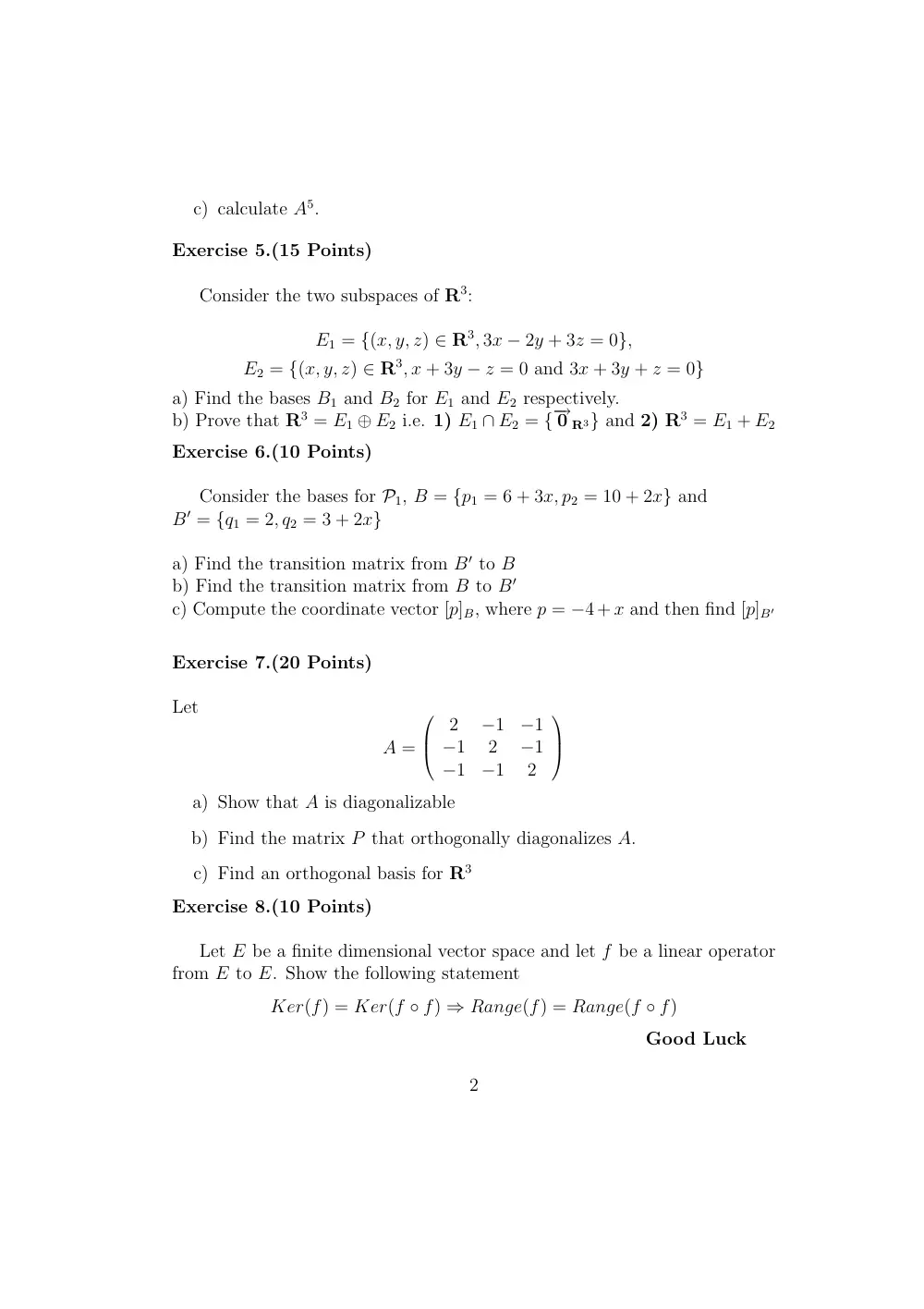
c) calculate A5.
Exercise 5.(15 Points)
Consider the two subspaces of R3:
E1 = {(x, y, z) ∈ R3, 3x − 2y + 3z = 0},
E2 = {(x, y, z) ∈ R3, x + 3y − z = 0 and 3x + 3y + z = 0}
a) Find the bases B1 and B2 for E1 and E2 respectively.
b) Prove that R3 = E1 ⊕ E2 i.e. 1) E1 ∩ E2 = {−→0 R3} and 2) R3 = E1 + E2
Exercise 6.(10 Points)
Consider the bases for P1, B = {p1 = 6 + 3x, p2 = 10 + 2x} and
B′ = {q1 = 2, q2 = 3 + 2x}
a) Find the transition matrix from B′ to B
b) Find the transition matrix from B to B′
c) Compute the coordinate vector [p]B, where p = −4+ x and then find [p]B′
Exercise 7.(20 Points)
Let
A =
2
−1
−1
−1
2
−1
−1
−1
2
a) Show that A is diagonalizable
b) Find the matrix P that orthogonally diagonalizes A.
c) Find an orthogonal basis for R3
Exercise 8.(10 Points)
Let E be a finite dimensional vector space and let f be a linear operator
from E to E. Show the following statement
Ker(f) = Ker(f ◦ f) ⇒ Range(f) = Range(f ◦ f)
Good Luck
2