
MATH 218 Final, Fall 2008
American University of Beirut · Elementary Linear Algebra with Applications · 2 pages · Dr. Michel Egeileh
More MATH 218 files
- Final 218 2018 · Spring 2019Final examView
- Final Collection Finals with Solution · Spring 2017Final exam · with solutionView
- Final Collection Finals with Solution · Spring 2017Final exam · with solutionView
- Final with Solution · Spring 2017Final exam · with solutionView
- Final Collection Finals with Solution · Spring 2017Final exam · with solutionView
- Final 08 · Spring 2017Final examView
- Final 2014 with Solution · Spring 2017Final exam · with solutionView
- Final · Summer 2016Final examView
Show the text of this final exam
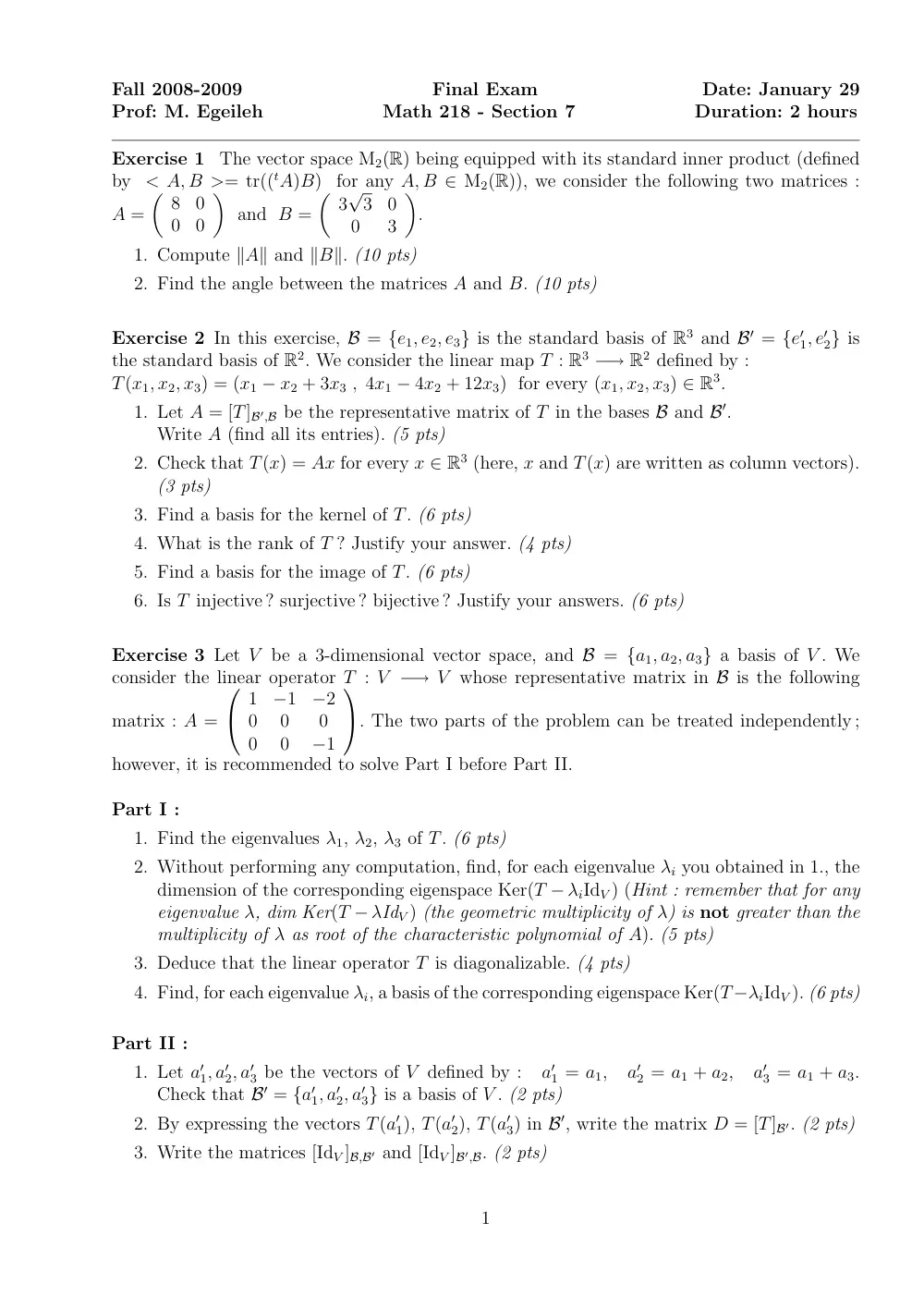
Fall 2008-2009
Final Exam
Date: January 29
Prof: M. Egeileh
Math 218 - Section 7
Duration: 2 hours
Exercise 1 The vector space M2(R) being equipped with its standard inner product (defined
by < A, B >= tr((tA)B) for any A, B ∈ M2(R)), we consider the following two matrices :
A =
� 8
0
0
0
�
and B =
�
3
√
3
0
0
3
�
.
1. Compute ∥A∥ and ∥B∥. (10 pts)
2. Find the angle between the matrices A and B. (10 pts)
Exercise 2 In this exercise, B = {e1, e2, e3} is the standard basis of R3 and B′ = {e′
1, e′
2} is
the standard basis of R2. We consider the linear map T : R3 −→ R2 defined by :
T(x1, x2, x3) = (x1 − x2 + 3x3 , 4x1 − 4x2 + 12x3) for every (x1, x2, x3) ∈ R3.
1. Let A = [T]B′,B be the representative matrix of T in the bases B and B′.
Write A (find all its entries). (5 pts)
2. Check that T(x) = Ax for every x ∈ R3 (here, x and T(x) are written as column vectors).
(3 pts)
3. Find a basis for the kernel of T. (6 pts)
4. What is the rank of T ? Justify your answer. (4 pts)
5. Find a basis for the image of T. (6 pts)
6. Is T injective ? surjective ? bijective ? Justify your answers. (6 pts)
Exercise 3 Let V be a 3-dimensional vector space, and B = {a1, a2, a3} a basis of V . We
consider the linear operator T : V −→ V whose representative matrix in B is the following
matrix : A =
1
−1
−2
0
0
0
0
0
−1
. The two parts of the problem can be treated independently ;
however, it is recommended to solve Part I before Part II.
Part I :
1. Find the eigenvalues λ1, λ2, λ3 of T. (6 pts)
2. Without performing any computation, find, for each eigenvalue λi you obtained in 1., the
dimension of the corresponding eigenspace Ker(T − λiIdV ) (Hint : remember that for any
eigenvalue λ, dim Ker(T −λIdV ) (the geometric multiplicity of λ) is not greater than the
multiplicity of λ as root of the characteristic polynomial of A). (5 pts)
3. Deduce that the linear operator T is diagonalizable. (4 pts)
4. Find, for each eigenvalue λi, a basis of the corresponding eigenspace Ker(T−λiIdV ). (6 pts)
Part II :
1. Let a′
1, a′
2, a′
3 be the vectors of V defined by :
a′
1 = a1,
a′
2 = a1 + a2,
a′
3 = a1 + a3.
Check that B′ = {a′
1, a′
2, a′
3} is a basis of V . (2 pts)
2. By expressing the vectors T(a′
1), T(a′
2), T(a′
3) in B′, write the matrix D = [T]B′. (2 pts)
3. Write the matrices [IdV ]B,B′ and [IdV ]B′,B. (2 pts)
1
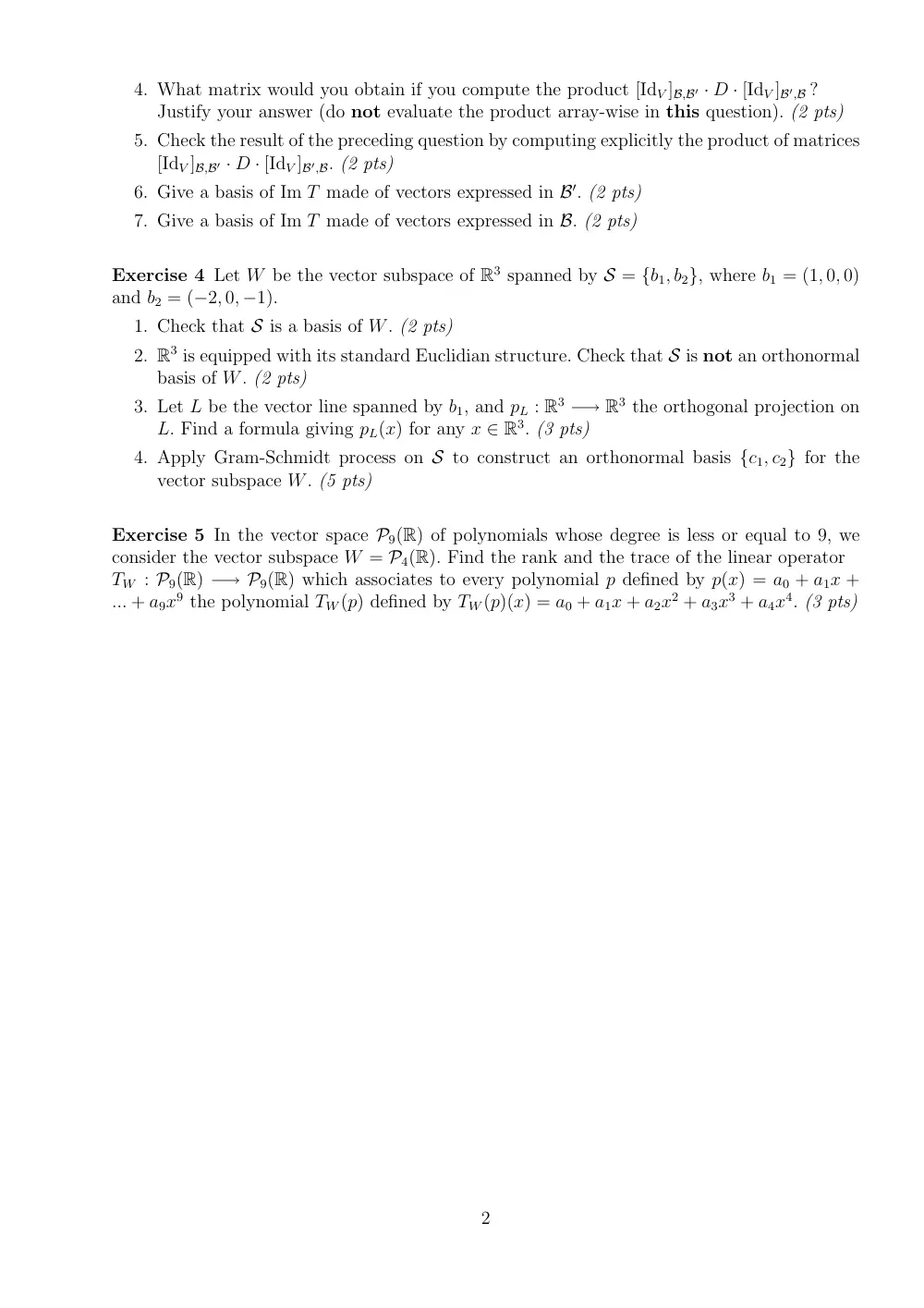
4. What matrix would you obtain if you compute the product [IdV ]B,B′ · D · [IdV ]B′,B ?
Justify your answer (do not evaluate the product array-wise in this question). (2 pts)
5. Check the result of the preceding question by computing explicitly the product of matrices
[IdV ]B,B′ · D · [IdV ]B′,B. (2 pts)
6. Give a basis of Im T made of vectors expressed in B′. (2 pts)
7. Give a basis of Im T made of vectors expressed in B. (2 pts)
Exercise 4 Let W be the vector subspace of R3 spanned by S = {b1, b2}, where b1 = (1, 0, 0)
and b2 = (−2, 0, −1).
1. Check that S is a basis of W. (2 pts)
2. R3 is equipped with its standard Euclidian structure. Check that S is not an orthonormal
basis of W. (2 pts)
3. Let L be the vector line spanned by b1, and pL : R3 −→ R3 the orthogonal projection on
L. Find a formula giving pL(x) for any x ∈ R3. (3 pts)
4. Apply Gram-Schmidt process on S to construct an orthonormal basis {c1, c2} for the
vector subspace W. (5 pts)
Exercise 5 In the vector space P9(R) of polynomials whose degree is less or equal to 9, we
consider the vector subspace W = P4(R). Find the rank and the trace of the linear operator
TW : P9(R) −→ P9(R) which associates to every polynomial p defined by p(x) = a0 + a1x +
... + a9x9 the polynomial TW(p) defined by TW(p)(x) = a0 + a1x + a2x2 + a3x3 + a4x4. (3 pts)
2