
MATH 218 Final, Fall 2010
American University of Beirut · Elementary Linear Algebra with Applications · 2 pages · Dr. Florian Bertrand
More MATH 218 files
- Final 218 2018 · Spring 2019Final examView
- Final Collection Finals with Solution · Spring 2017Final exam · with solutionView
- Final Collection Finals with Solution · Spring 2017Final exam · with solutionView
- Final with Solution · Spring 2017Final exam · with solutionView
- Final Collection Finals with Solution · Spring 2017Final exam · with solutionView
- Final 08 · Spring 2017Final examView
- Final 2014 with Solution · Spring 2017Final exam · with solutionView
- Final · Summer 2016Final examView
Show the text of this final exam
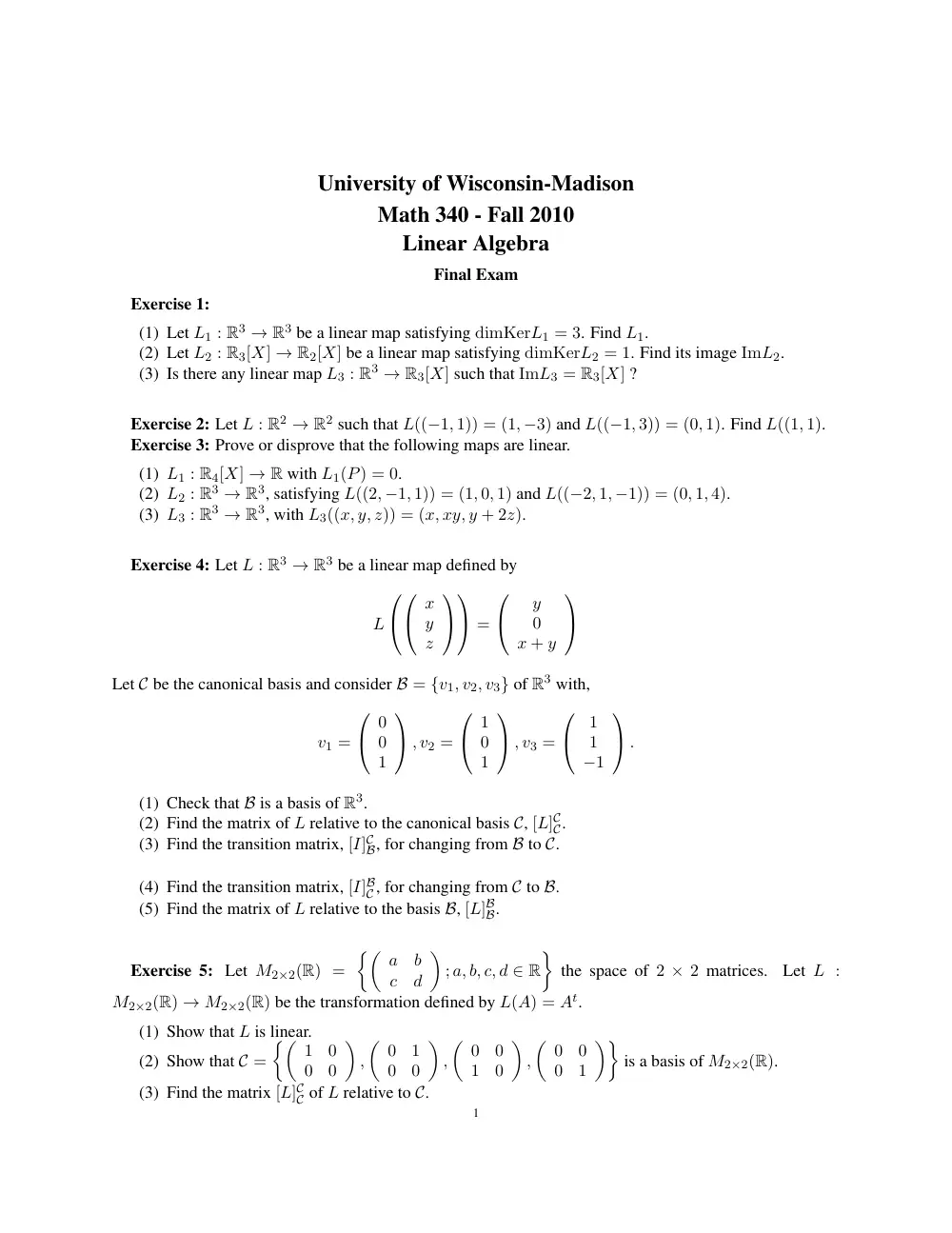
University of Wisconsin-Madison
Math 340 - Fall 2010
Linear Algebra
Final Exam
Exercise 1:
(1) Let L1 : R3 → R3 be a linear map satisfying dimKerL1 = 3. Find L1.
(2) Let L2 : R3[X] → R2[X] be a linear map satisfying dimKerL2 = 1. Find its image ImL2.
(3) Is there any linear map L3 : R3 → R3[X] such that ImL3 = R3[X] ?
Exercise 2: Let L : R2 → R2 such that L((−1, 1)) = (1, −3) and L((−1, 3)) = (0, 1). Find L((1, 1).
Exercise 3: Prove or disprove that the following maps are linear.
(1) L1 : R4[X] → R with L1(P) = 0.
(2) L2 : R3 → R3, satisfying L((2, −1, 1)) = (1, 0, 1) and L((−2, 1, −1)) = (0, 1, 4).
(3) L3 : R3 → R3, with L3((x, y, z)) = (x, xy, y + 2z).
Exercise 4: Let L : R3 → R3 be a linear map defined by
L
x
y
z
=
y
0
x + y
Let C be the canonical basis and consider B = {v1, v2, v3} of R3 with,
v1 =
0
0
1
, v2 =
1
0
1
, v3 =
1
1
−1
.
(1) Check that B is a basis of R3.
(2) Find the matrix of L relative to the canonical basis C, [L]C
C.
(3) Find the transition matrix, [I]C
B, for changing from B to C.
(4) Find the transition matrix, [I]B
C , for changing from C to B.
(5) Find the matrix of L relative to the basis B, [L]B
B.
Exercise 5: Let M2×2(R) =
��
a
b
c
d
�
; a, b, c, d ∈ R
�
the space of 2 × 2 matrices.
Let L :
M2×2(R) → M2×2(R) be the transformation defined by L(A) = At.
(1) Show that L is linear.
(2) Show that C =
��
1
0
0
0
�
,
�
0
1
0
0
�
,
�
0
0
1
0
�
,
�
0
0
0
1
��
is a basis of M2×2(R).
(3) Find the matrix [L]C
C of L relative to C.
1
2
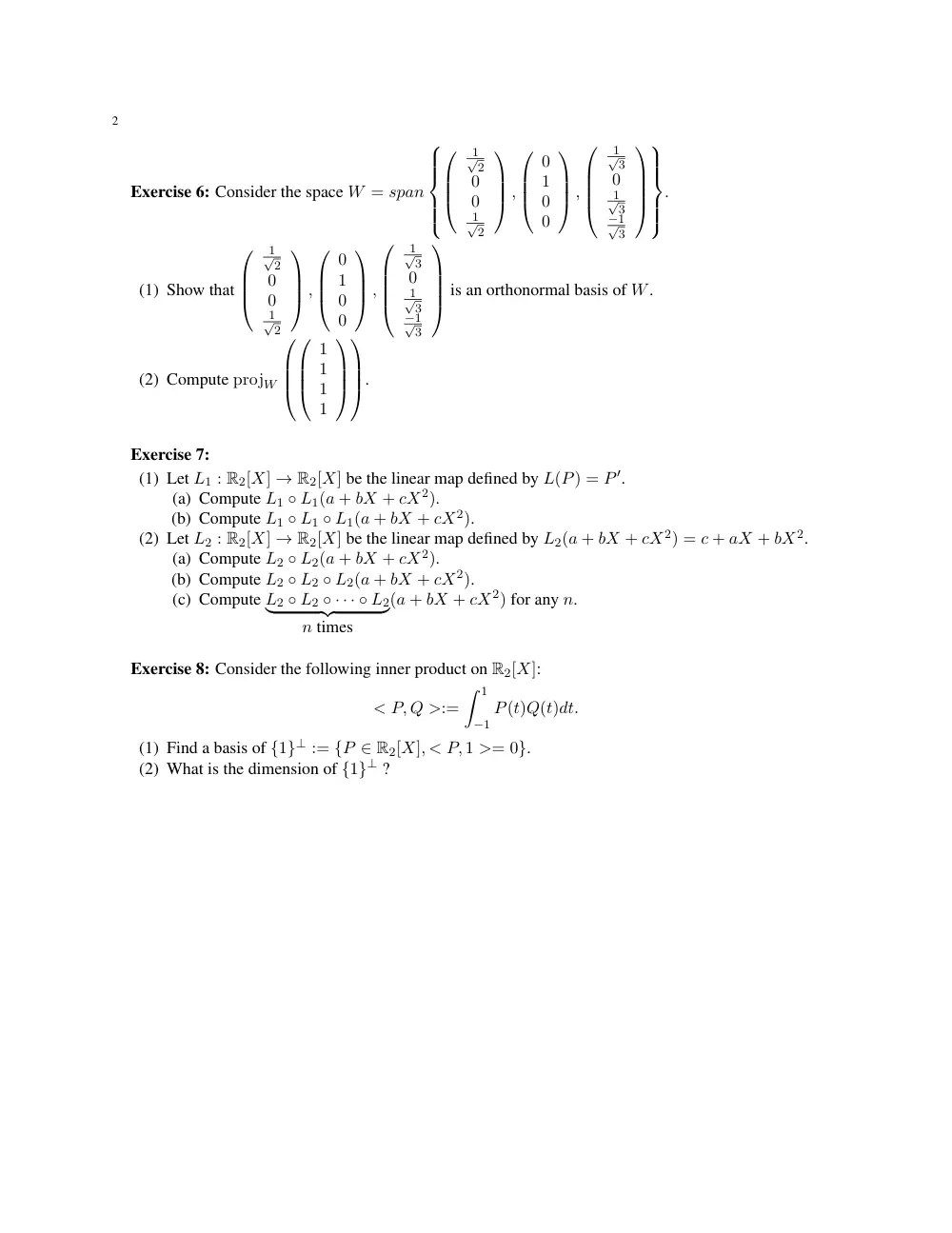
Exercise 6: Consider the space W = span
1
√
2
0
0
1
√
2
,
0
1
0
0
,
1
√
3
0
1
√
3
−1
√
3
.
(1) Show that
1
√
2
0
0
1
√
2
,
0
1
0
0
,
1
√
3
0
1
√
3
−1
√
3
is an orthonormal basis of W.
(2) Compute projW
1
1
1
1
.
Exercise 7:
(1) Let L1 : R2[X] → R2[X] be the linear map defined by L(P) = P ′.
(a) Compute L1 ◦ L1(a + bX + cX2).
(b) Compute L1 ◦ L1 ◦ L1(a + bX + cX2).
(2) Let L2 : R2[X] → R2[X] be the linear map defined by L2(a + bX + cX2) = c + aX + bX2.
(a) Compute L2 ◦ L2(a + bX + cX2).
(b) Compute L2 ◦ L2 ◦ L2(a + bX + cX2).
(c) Compute L2 ◦ L2 ◦ · · · ◦ L2
�
��
�
n times
(a + bX + cX2) for any n.
Exercise 8: Consider the following inner product on R2[X]:
< P, Q >:=
� 1
−1
P(t)Q(t)dt.
(1) Find a basis of {1}⊥ := {P ∈ R2[X], < P, 1 >= 0}.
(2) What is the dimension of {1}⊥ ?