
MATH 218 Final, Fall 2011
American University of Beirut · Elementary Linear Algebra with Applications · 17 pages





Showing the first 10 of 17 pages. Download the PDF to see all of it.
More MATH 218 files
- Final 218 2018 · Spring 2019Final examView
- Final Collection Finals with Solution · Spring 2017Final exam · with solutionView
- Final Collection Finals with Solution · Spring 2017Final exam · with solutionView
- Final Collection Finals with Solution · Spring 2017Final exam · with solutionView
- Final 08 · Spring 2017Final examView
- Final 2014 with Solution · Spring 2017Final exam · with solutionView
- Final with Solution · Spring 2017Final exam · with solutionView
- Final · Summer 2016Final examView
Show the text of this final exam
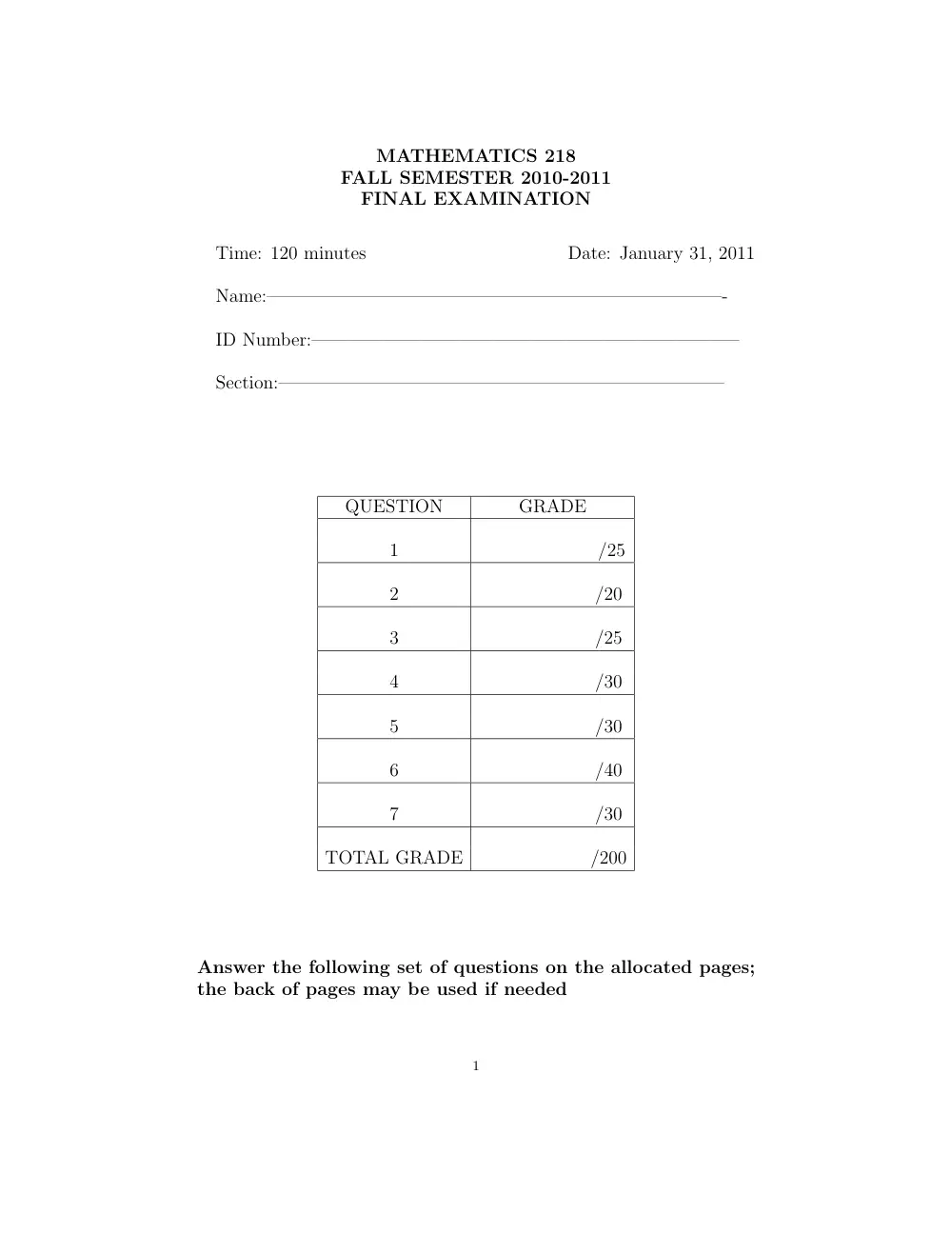
MATHEMATICS 218
FALL SEMESTER 2010-2011
FINAL EXAMINATION
Time: 120 minutes
Date: January 31, 2011
Name:—————————————————————————-
ID Number:———————————————————————–
Section:————————————————————————–
QUESTION
GRADE
1
/25
2
/20
3
/25
4
/30
5
/30
6
/40
7
/30
TOTAL GRADE
/200
Answer the following set of questions on the allocated pages;
the back of pages may be used if needed
1
2
1. Let A =
0
0
−2
1
2
1
1
0
3
(a) Find the eigenvalues of A.
(9 points)
(b) Find a basis for each of the eigenspaces.
(10 points)
(c) Deduce that A is diagonalizable and write a formula calculating
A5.
(6 points)
3
4
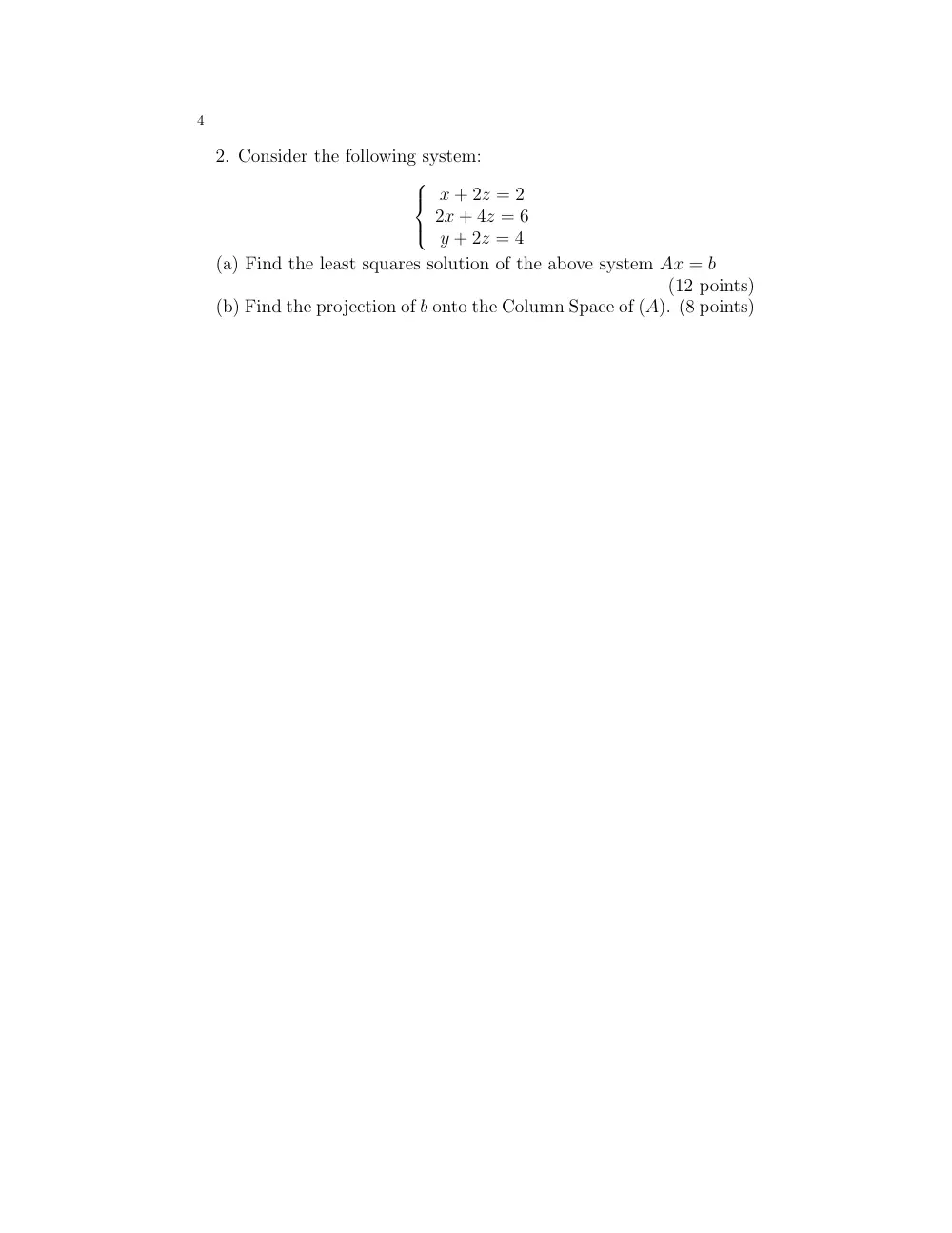
2. Consider the following system:
x + 2z = 2
2x + 4z = 6
y + 2z = 4
(a) Find the least squares solution of the above system Ax = b
(12 points)
(b) Find the projection of b onto the Column Space of (A). (8 points)
5
6
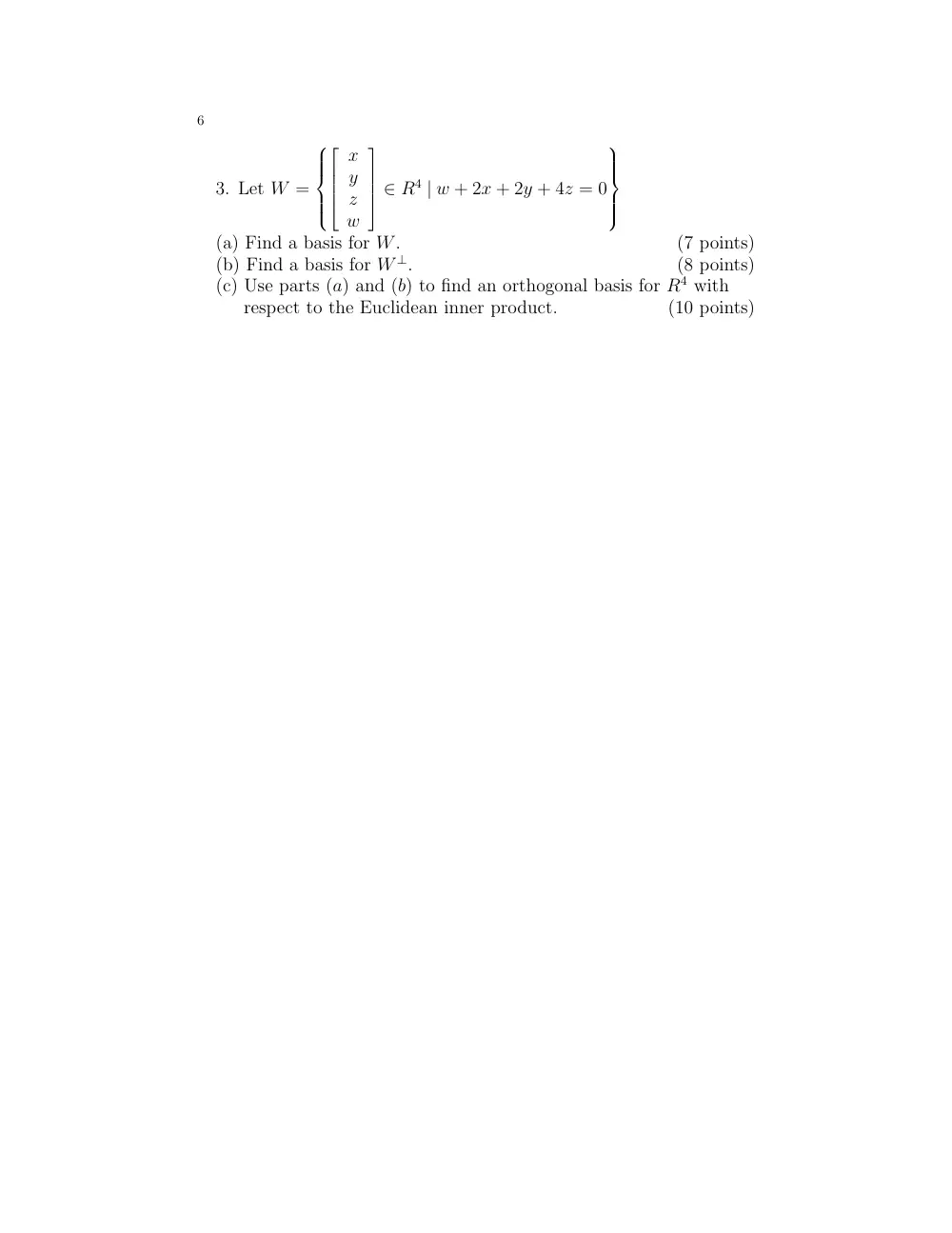
3. Let W =
x
y
z
w
∈ R4 | w + 2x + 2y + 4z = 0
(a) Find a basis for W.
(7 points)
(b) Find a basis for W ⊥.
(8 points)
(c) Use parts (a) and (b) to find an orthogonal basis for R4 with
respect to the Euclidean inner product.
(10 points)
7
8
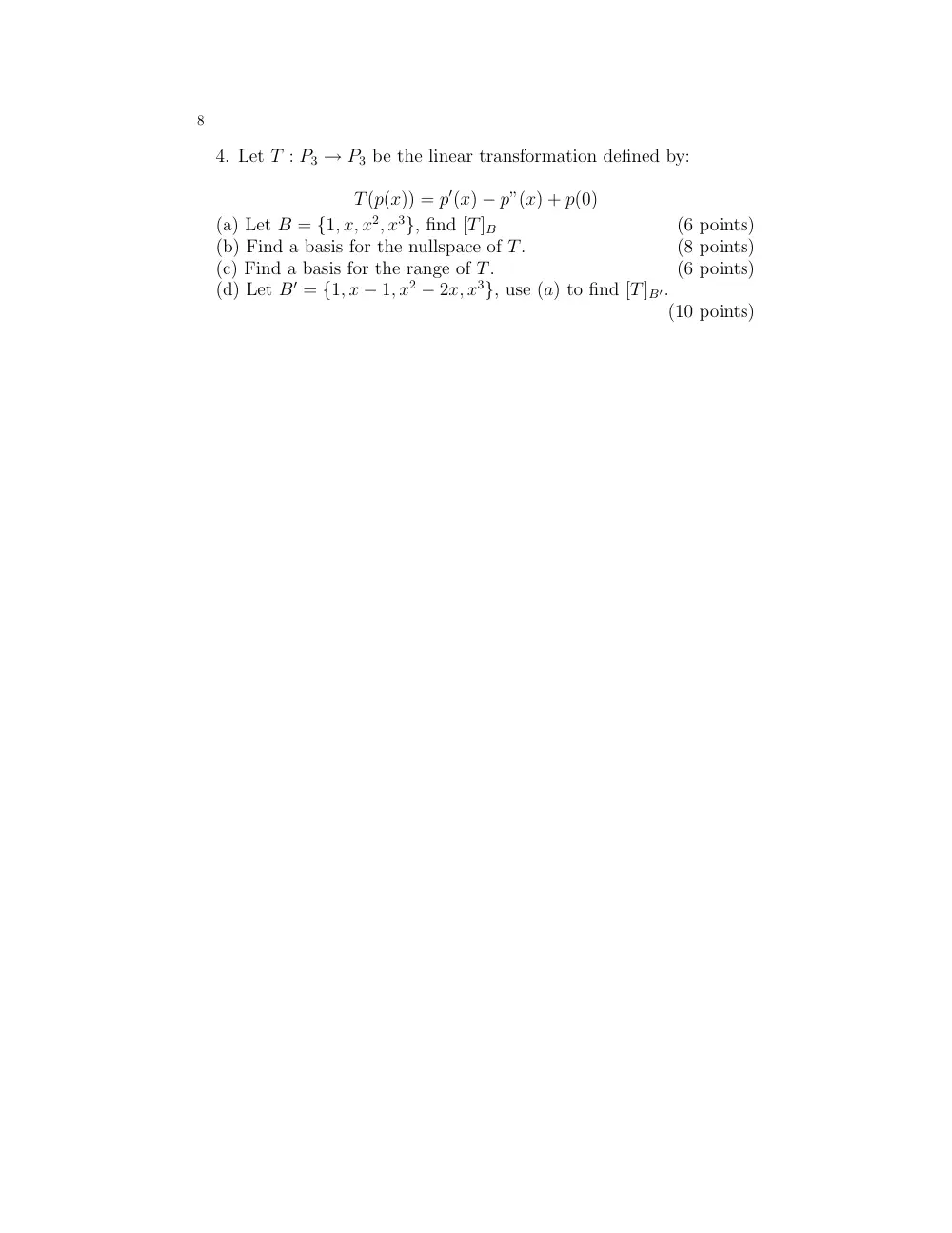
4. Let T : P3 → P3 be the linear transformation defined by:
T(p(x)) = p′(x) − p”(x) + p(0)
(a) Let B = {1, x, x2, x3}, find [T]B
(6 points)
(b) Find a basis for the nullspace of T.
(8 points)
(c) Find a basis for the range of T.
(6 points)
(d) Let B′ = {1, x − 1, x2 − 2x, x3}, use (a) to find [T]B′.
(10 points)
9
10
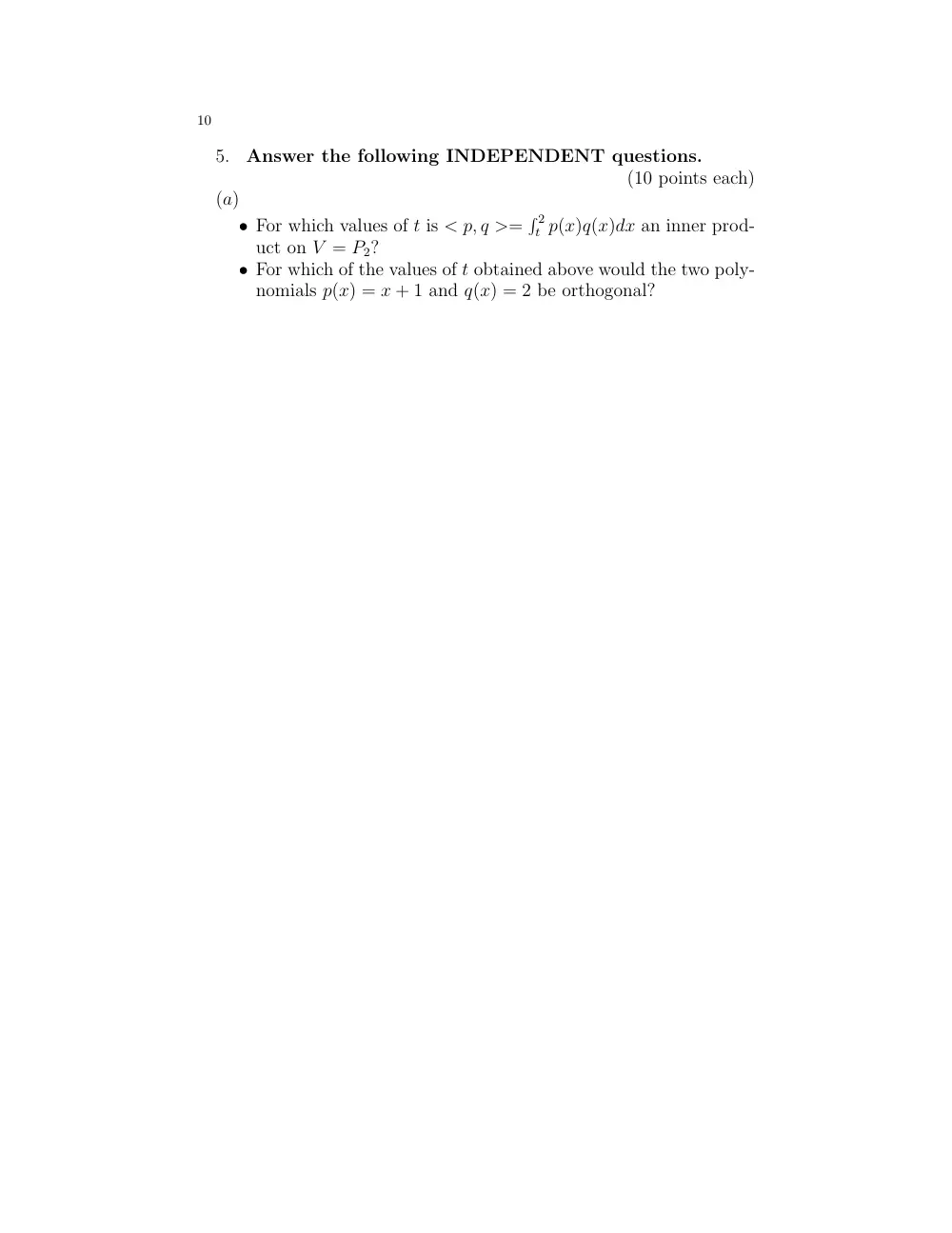
5.
Answer the following INDEPENDENT questions.
(10 points each)
(a)
• For which values of t is < p, q >=
� 2
t p(x)q(x)dx an inner prod-
uct on V = P2?
• For which of the values of t obtained above would the two poly-
nomials p(x) = x + 1 and q(x) = 2 be orthogonal?
11
(b) Let W be a subspace of V = M2×2, with basis B = {I, A}, where
I =
�
1
0
0
1
�
and A =
�
8
4
2
1
�
.
Let T : W → W be given by T(M) = AM.
• Find [T]B
• Use [T]B to compute T(3I − A).
12
(c) For which value(s) of k would the vector v =
�
1
−1
�
be an
eigenvector of the matrix A =
�
k
0
1
−1
�
?
13
6. Prove the following:
(10 points each)
(a) Let W = span {w} be a subspace of an inner product space V .
Let b ∈ V and not in W. Use the Cauchy-Schwartz inequality to prove
that:
||projW(b)|| ≤ ||b||
14
(b) Let V = P2 and p, q ∈ P2. Show that:
< p, q >= p(0)q(0) + p(1
2)q(1
2) + p(1)q(1)
is an inner product in P2.
15
(c) Let A be an n × n matrix.
• Show that if A2 = 0 then Column space of (A) ⊂ Nullspace (A)
• Deduce that if A2 = 0 then rankA ≤ n
2
16
(d) Let T : V → V be a linear transformation such that T ◦ T = T.
Show that Range(T) ∩ Nullspace(T) = 0
17
7. Indicate whether each of the following statements is TRUE (T)
or FALSE (F) without justifying your answer.
(3 points each)
—-(a) The set of all 3 × 3 matrices with det(A) = 0 is a subspace of
M3×3.
—-(b) Let T : P2 → R defined by T(ax2 + bx + c) = |a| is a linear
transformation.
—-(c) Let T : V → W be a linear transformation. If dimV < dimW
then T cannot be onto.
—-(d) Let A, B and C be n × n matrices, if AB = AC then B = C.
—-(e) The dimension of the vector space of the n×n upper triangular
matrices is n2−n
2
.
—-(f) T : V → W be a linear transformation with {v1 . . . vn} linearly
independent in V , then {T(v1) . . . T(vn)} are linearly independent.
—-(g) If λ is an eigenvalue of an idempotent matrix A ( i.e: A2 = A)
then λ = 0 or λ = 1.
—-(h) In R2 with the standard inner product, the orthogonal com-
plement of y = 2x is y = 1
2x.
—-(i) If T : Rn → Rm is a linear transformation and m = n then T
is an isomorphism.
—-(j) If λ is an eigenvalue for A then λn is an eigenvalue for An for
all n ∈ Z.