
MATH 218 Final, Fall 2015
American University of Beirut · Elementary Linear Algebra with Applications · 2 pages · Dr. Florian Bertrand

More MATH 218 files
- Final 218 2018 · Spring 2019Final examView
- Final Collection Finals with Solution · Spring 2017Final exam · with solutionView
- Final with Solution · Spring 2017Final exam · with solutionView
- Final Collection Finals with Solution · Spring 2017Final exam · with solutionView
- Final Collection Finals with Solution · Spring 2017Final exam · with solutionView
- Final 08 · Spring 2017Final examView
- Final 2014 with Solution · Spring 2017Final exam · with solutionView
- Final · Summer 2016Final examView
Show the text of this final exam
MATH 218: Elementary Linear Algebra with Applications
Fall 2015-2016, Final, Duration: 120 min.
Exercise 1. Prove or disprove that the following transformations are linear:
(a) (10 points) T1 : M2×2(R) → M2×2(R) defined by T1(A) = AAt.
(b) (10 points) T2 : R2[X] → R defined by T2(P) = 2P ′(0).
(c) (10 points) T3 : R1[X] → R1[X] with T3(1 + X) = X, T3(1 − X) = 1 + X and T3(2) = 2 − X.
Exercise 2. Let T : R2[X] → R3[X] be the linear map defined by
T(a + bX + cX2) = b − c + (a + c)X + (a + b)X2 + (a + b)X3.
Consider the canonical bases C2 = {1, X, X2} and C3 = {1, X, X2, X3}.
(a) (5 points) Explain briefly and with no computation why T cannot be onto.
(b) (10 points) Find a basis of kerT.
(c) (10 points) Find a basis of ImT.
(d) (10 points) Find the matrix [T]C3
C2 of T from C2 to C3.
Exercise 3. Let A =
2
0
0
−2
2
1
2
0
1
.
(a) (18 points) Find the eigenvalues and eigenspaces of A.
(b) (5 points) Why is A diagonalizable?
(c) (10 points) Find P invertible and D diagonal such that A = PDP −1 (do not compute P −1).
Exercise 4.
(a) Let A =
�
2
−1
1
0
�
.
i. (5 points) Show that 1 is an eigenvalue of multiplicity two.
ii. (3 points) Without determining the eigenspace V1 nor its dimension, explain why A is not diago-
nalisable (hint: if A was diagonalisable then there would be P, D such that...).
(b) (5 points) Let A be a 2 × 2 matrix. Assume that A has two distinct eigenvalues 1 and −1. Prove that
A2 = I.
(c) (4 points) Find a 3 × 3 matrix A with only two eigenvalues 1 and −1 and such that that A2 ̸= I.
(d) (5 points) Determine one eigenvalue of A =
−1
1
1
0
2
3
2
−3
1
0
2
5
−2
0
3
−1
0
1
1
−2
2
2
−2
−1
1
.
Exercise 5. Let B =
1
0
1
,
2
−1
0
,
0
2
1
.
(a) (10 points) Show that B is a basis of R3.
(b) (15 points) Using the Gram-Schmidt process to transform B into an orthonormal basis.
2
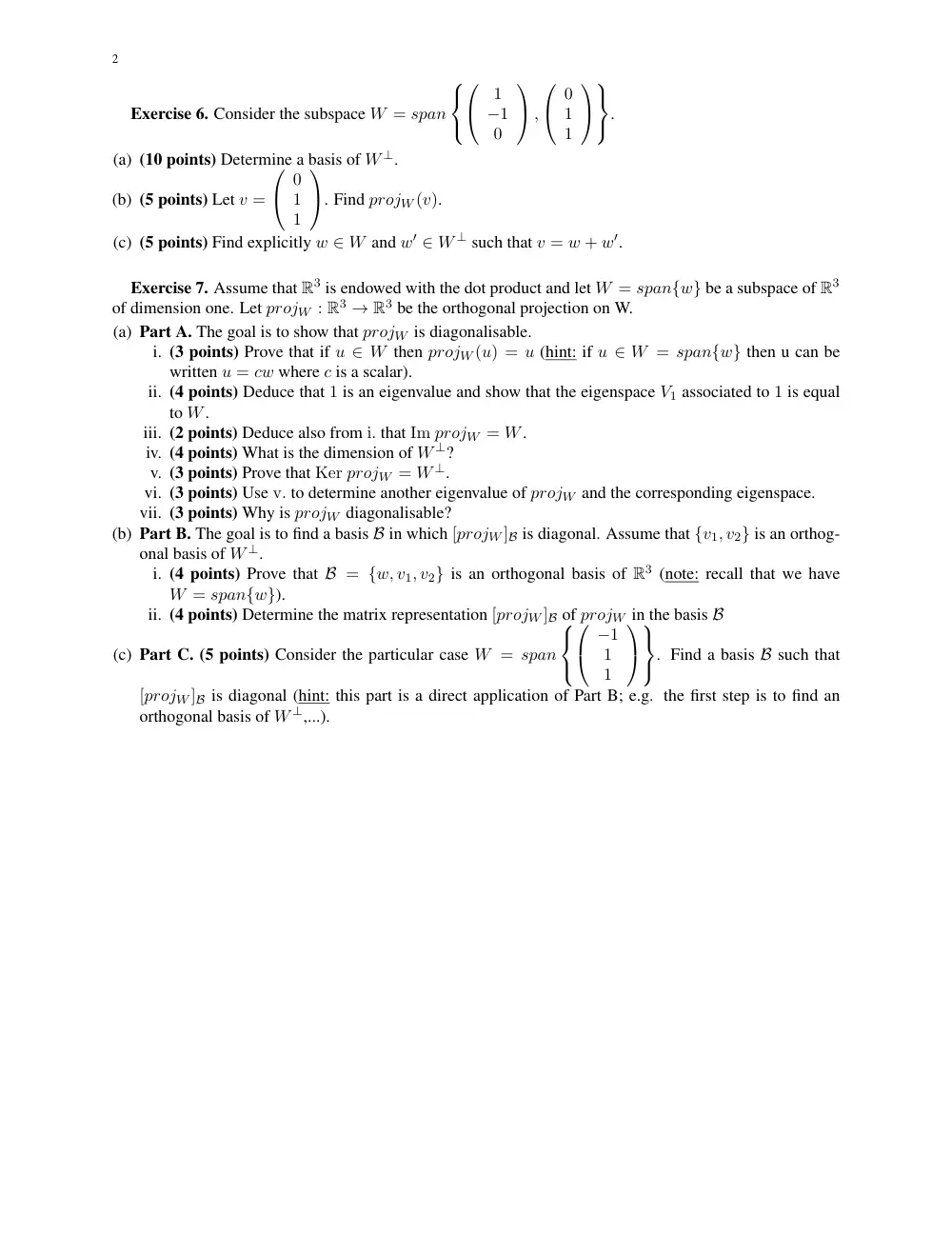
Exercise 6. Consider the subspace W = span
1
−1
0
,
0
1
1
.
(a) (10 points) Determine a basis of W ⊥.
(b) (5 points) Let v =
0
1
1
. Find projW (v).
(c) (5 points) Find explicitly w ∈ W and w′ ∈ W ⊥ such that v = w + w′.
Exercise 7. Assume that R3 is endowed with the dot product and let W = span{w} be a subspace of R3
of dimension one. Let projW : R3 → R3 be the orthogonal projection on W.
(a) Part A. The goal is to show that projW is diagonalisable.
i. (3 points) Prove that if u ∈ W then projW (u) = u (hint: if u ∈ W = span{w} then u can be
written u = cw where c is a scalar).
ii. (4 points) Deduce that 1 is an eigenvalue and show that the eigenspace V1 associated to 1 is equal
to W.
iii. (2 points) Deduce also from i. that Im projW = W.
iv. (4 points) What is the dimension of W ⊥?
v. (3 points) Prove that Ker projW = W ⊥.
vi. (3 points) Use v. to determine another eigenvalue of projW and the corresponding eigenspace.
vii. (3 points) Why is projW diagonalisable?
(b) Part B. The goal is to find a basis B in which [projW ]B is diagonal. Assume that {v1, v2} is an orthog-
onal basis of W ⊥.
i. (4 points) Prove that B = {w, v1, v2} is an orthogonal basis of R3 (note: recall that we have
W = span{w}).
ii. (4 points) Determine the matrix representation [projW ]B of projW in the basis B
(c) Part C. (5 points) Consider the particular case W = span
−1
1
1
. Find a basis B such that
[projW ]B is diagonal (hint: this part is a direct application of Part B; e.g. the first step is to find an
orthogonal basis of W ⊥,...).