
MATH 218 Final, Spring 2005
American University of Beirut · Elementary Linear Algebra with Applications · 10 pages







More MATH 218 files
- Final 218 2018 · Spring 2019Final examView
- Final Collection Finals with Solution · Spring 2017Final exam · with solutionView
- Final Collection Finals with Solution · Spring 2017Final exam · with solutionView
- Final Collection Finals with Solution · Spring 2017Final exam · with solutionView
- Final 08 · Spring 2017Final examView
- Final 2014 with Solution · Spring 2017Final exam · with solutionView
- Final with Solution · Spring 2017Final exam · with solutionView
- Final · Summer 2016Final examView
Show the text of this final exam
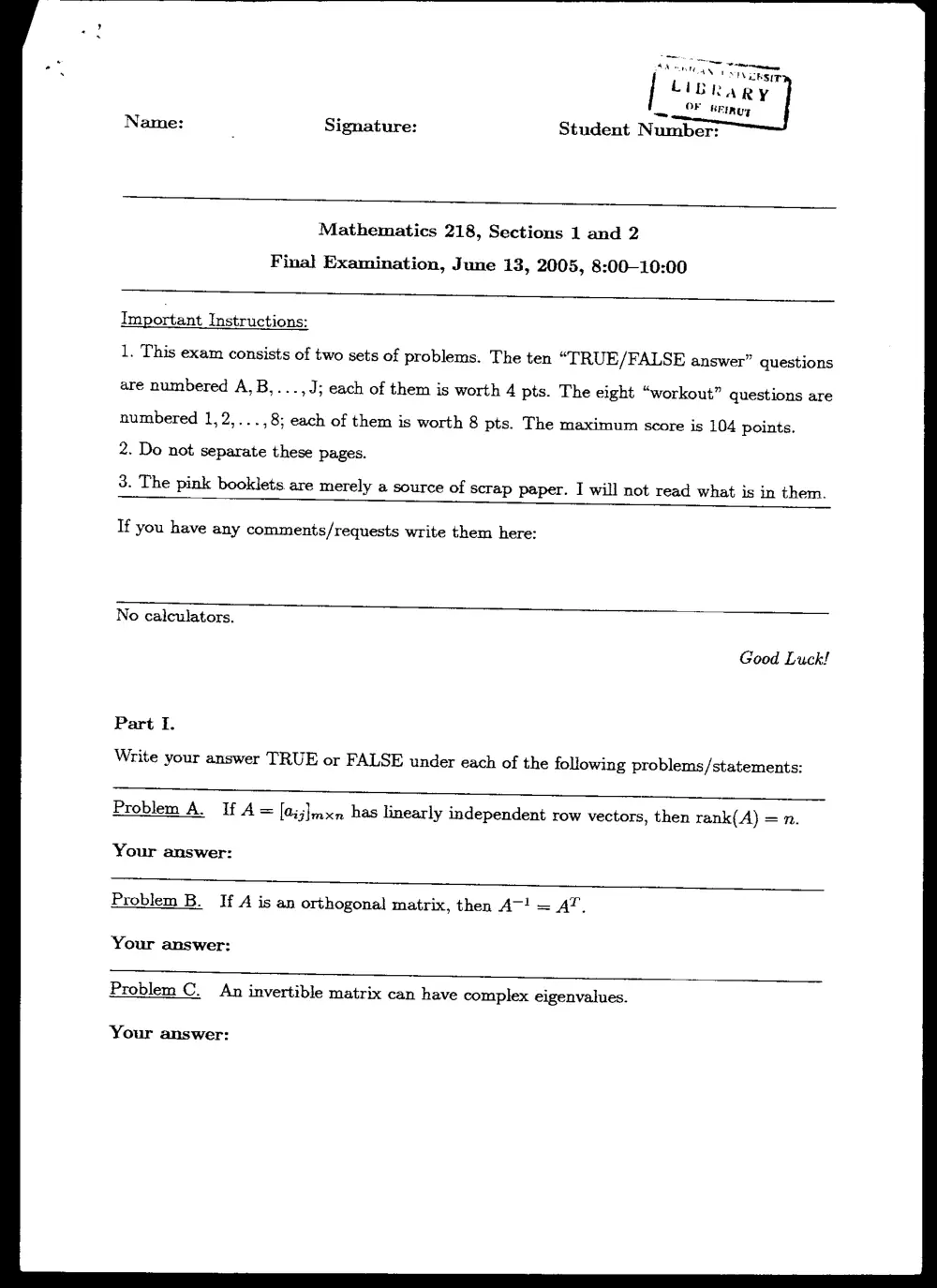
Signature:
Mathematics 218, Sections 1 and 2
Final Examination, June 13, 2005, 8:00—10:00
Important Instructions:
1. This exam consists of two sets of problems. The ten “TRUE/FALSE answer” questions
are numbered A,B,...,J; each of them is worth 4 pts. The eight “workout” questions are
numbered 1,2,...,8; each of them is worth 8 pts. The maximum score is 104 points.
2. Do not separate these pages.
3. The pink booklets are merely a source of scrap paper. I will not read what is in them.
If you have any comments/requests write them here:
No calculators.
Good Luck!
Part I.
Write your answer TRUE or FALSE under each of the following problems/statements:
Problem A. If A= laij]mxn bas linearly independent row vectors, then rank(A) = n.
Your answer:
Problem B. If A is an orthogonal matrix, then A7! = AT.
‘Your answer:
Problem C. An invertible matrix can have complex eigenvalues.
Your answer:
Problem D. ‘Two planes in R® can have exactly one common point.
Your answer:
Problem E. If @ is an eigenvector of a matrix A, then —3d is also an eigenvector of A.
Your answer:
Problem F. A consistent system of 5 linear equations with 7 unknowns must have in-
finitely many solutions.
Your answer:
Problem G. V and W are vector spaces, and T': V — W is a linear transformation. If
ker(T) # {0}, then T is one-to-one.
Your answer:
Problem H. If A and B are square matrices of the same size and A is singular, then AB
can be invertible.
Your answer:
>
Problem I. AZ = 6 is a system of linear equations. If A and [Alb] have the same rank,
then the system is inconsistent.
Your answer:
Problem J. Each singular matrix can be diagonalized.
Your answer:
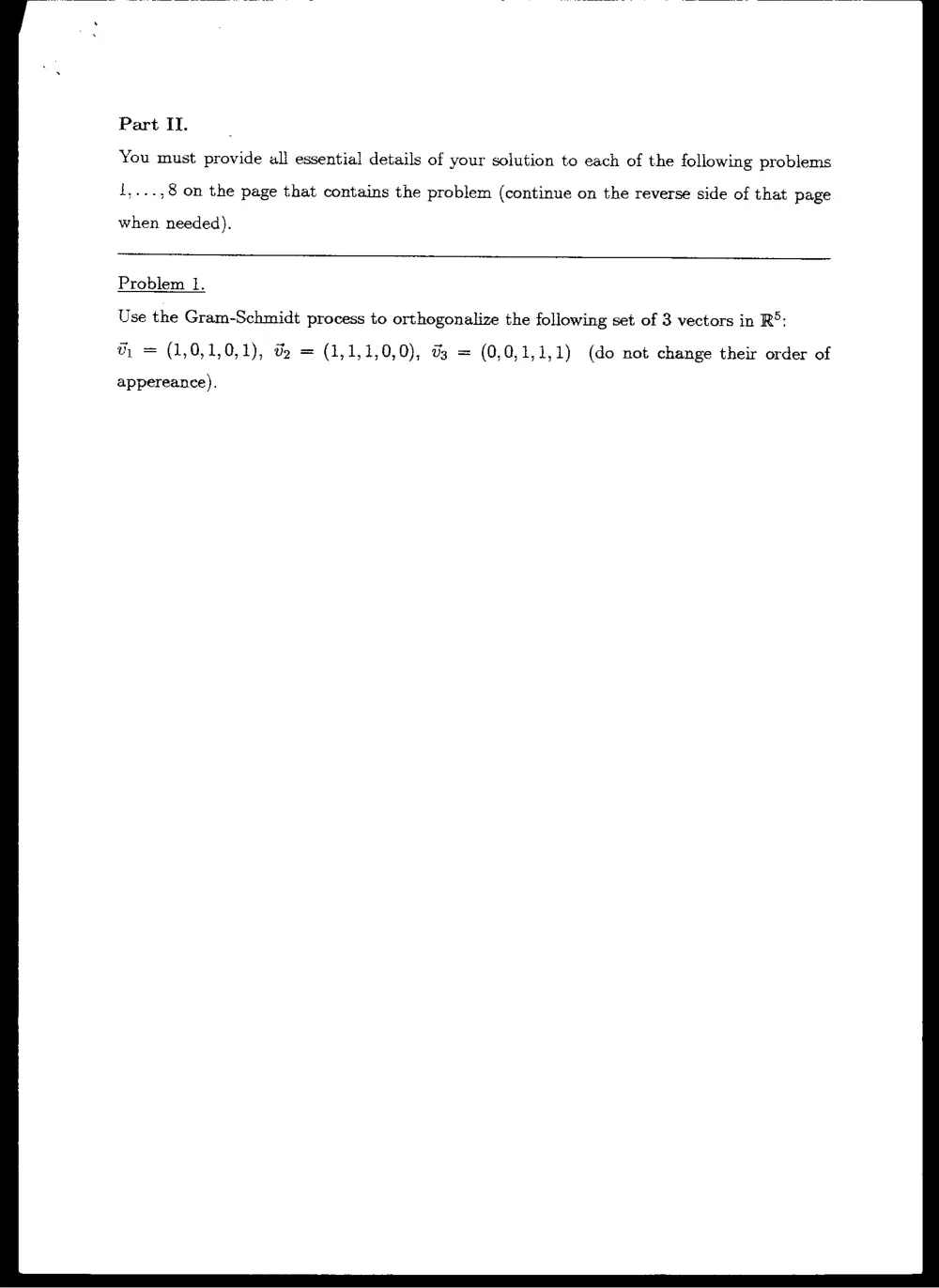
Part II.
You must provide all essential details of your solution to each of the following problems
1,...,8 on the page that contains the problem (continue on the reverse side of that page
when needed).
Problem 1.
Use the Gram-Schmidt process to orthogonalize the following set of 3 vectors in R°:
vy = (1,0,1,0,1), d = (1,1,1,0,0), % = (0,0,1,1,1) (do not change their order of
appereance).
Problem 2.
Find a matrix P that diagonalizes the following matrix A. Then find P~!AP.
3-1 0
A=f{-1 2 -1
0 -1 3
Problem 3.
Find the least squares solution of the linear system
Problem 5.
Let V and W be vector spaces, T : V — W be a linear transformation, and S =
{v1, V2,-..,U%} be a linearly independent set of vectors in V.
Prove that if T is one-to-one, then {T'(v1),T(v2),...,T(vx)} is a linearly independent set
of vectors in W.
Problem 6.
Let A be a matrix of size m x n. Prove that AA” is always a symmetric matrix.
Problem 7.
Let A = [aij]nxn be a lower triangular matrix. Write a proof that det(A) = a;1-a29-...-@nn-
J
Problem 8.
Write a detailed explanation how the angle between two non-zero vectors u,v € R” is
defined and why this definition makes sense.