
MATH 218 Final, Spring 2010
American University of Beirut · Elementary Linear Algebra with Applications · 11 pages · Dr. Sabine El Khoury
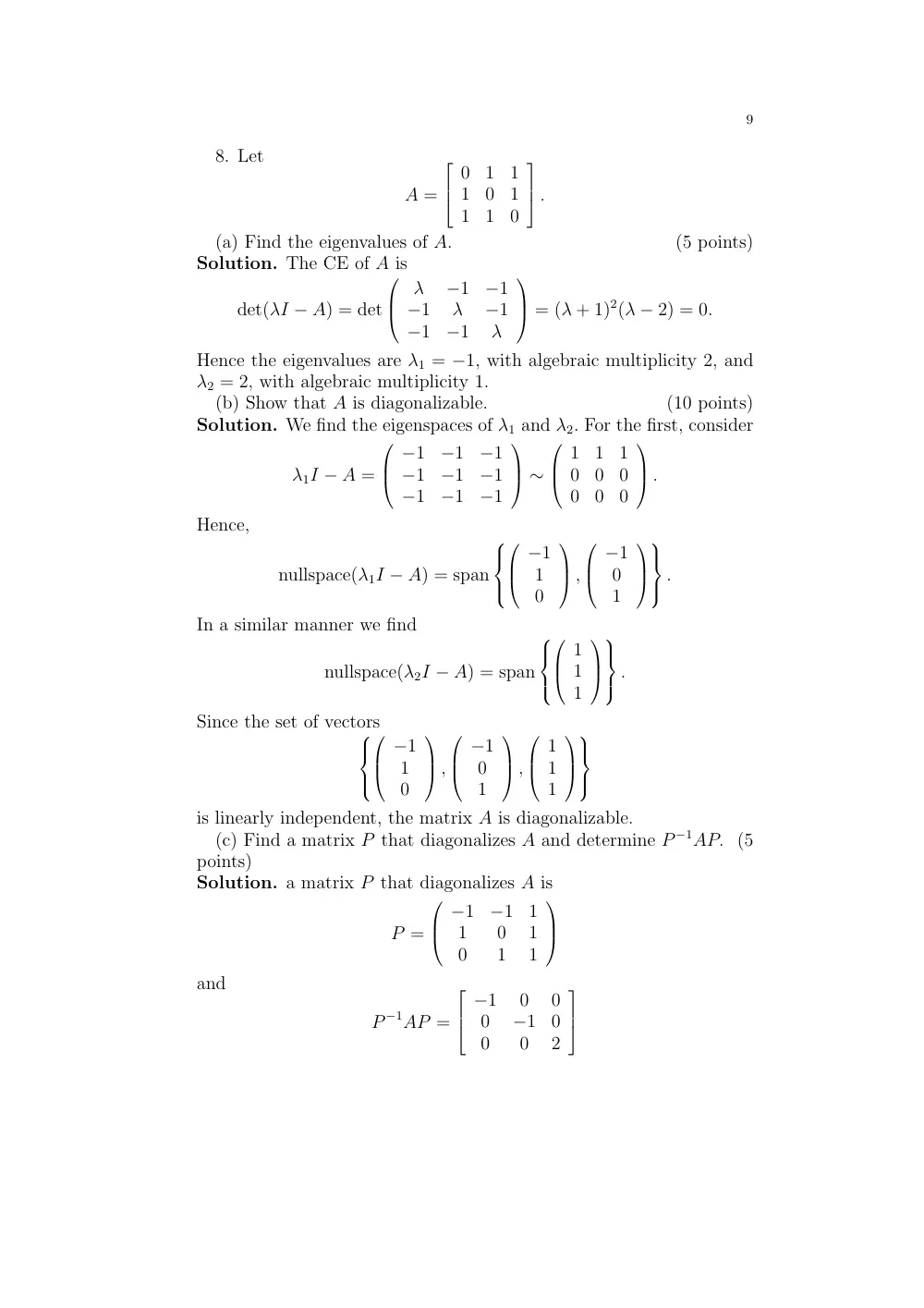

Showing the first 10 of 11 pages. Download the PDF to see all of it.
More MATH 218 files
- Final 218 2018 · Spring 2019Final examView
- Final Collection Finals with Solution · Spring 2017Final exam · with solutionView
- Final Collection Finals with Solution · Spring 2017Final exam · with solutionView
- Final Collection Finals with Solution · Spring 2017Final exam · with solutionView
- Final 08 · Spring 2017Final examView
- Final 2014 with Solution · Spring 2017Final exam · with solutionView
- Final with Solution · Spring 2017Final exam · with solutionView
- Final · Summer 2016Final examView
Show the text of this final exam
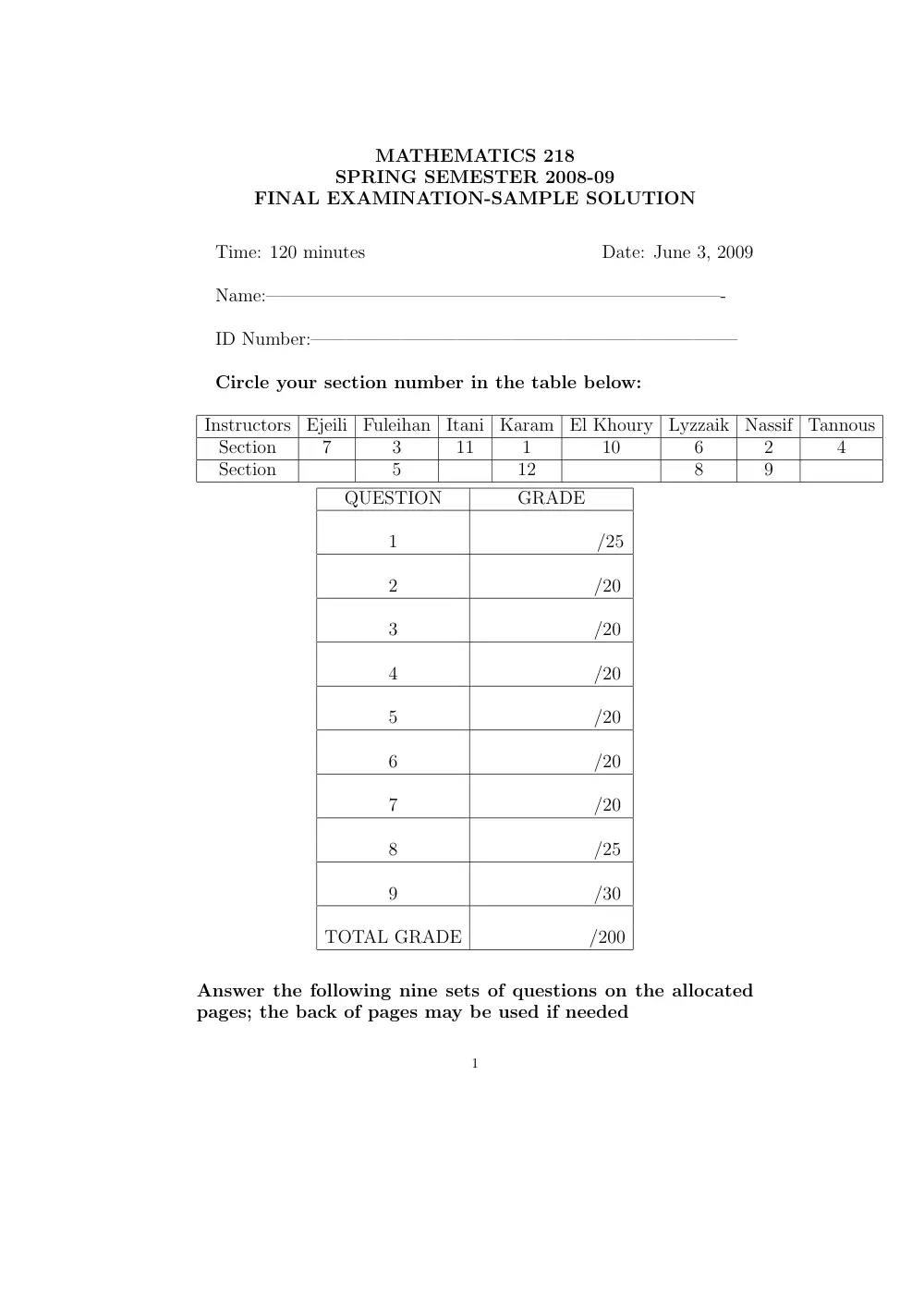
MATHEMATICS 218
SPRING SEMESTER 2008-09
FINAL EXAMINATION-SAMPLE SOLUTION
Time: 120 minutes
Date: June 3, 2009
Name:—————————————————————————-
ID Number:———————————————————————–
Circle your section number in the table below:
Instructors
Ejeili
Fuleihan
Itani
Karam
El Khoury
Lyzzaik
Nassif
Tannous
Section
7
3
11
1
10
6
2
4
Section
5
12
8
9
QUESTION
GRADE
1
/25
2
/20
3
/20
4
/20
5
/20
6
/20
7
/20
8
/25
9
/30
TOTAL GRADE
/200
Answer the following nine sets of questions on the allocated
pages; the back of pages may be used if needed
1
2
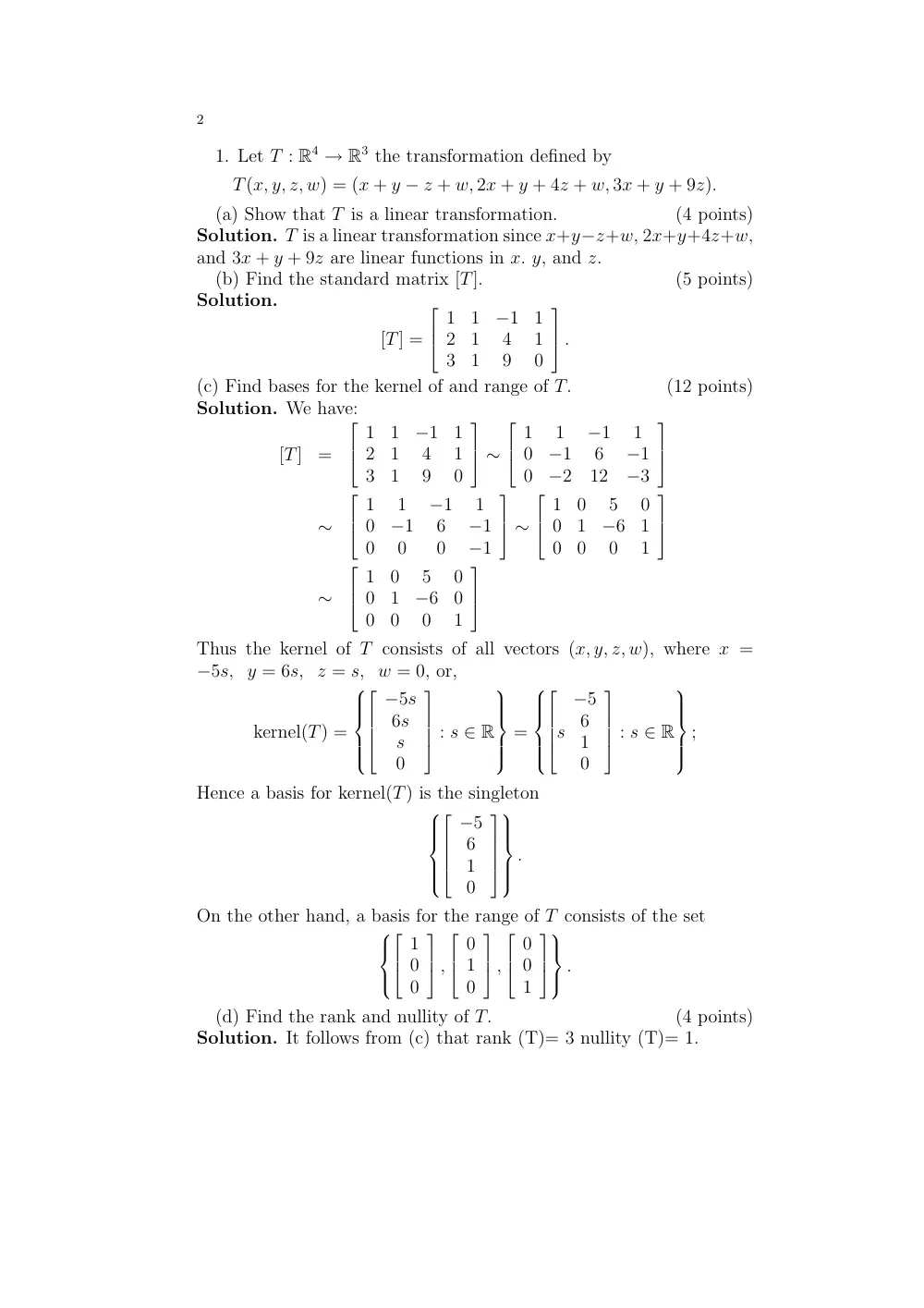
1. Let T : R4 → R3 the transformation defined by
T(x, y, z, w) = (x + y − z + w, 2x + y + 4z + w, 3x + y + 9z).
(a) Show that T is a linear transformation.
(4 points)
Solution. T is a linear transformation since x+y−z+w, 2x+y+4z+w,
and 3x + y + 9z are linear functions in x. y, and z.
(b) Find the standard matrix [T].
(5 points)
Solution.
[T] =
1
1
−1
1
2
1
4
1
3
1
9
0
.
(c) Find bases for the kernel of and range of T.
(12 points)
Solution. We have:
[T]
=
1
1
−1
1
2
1
4
1
3
1
9
0
∼
1
1
−1
1
0
−1
6
−1
0
−2
12
−3
∼
1
1
−1
1
0
−1
6
−1
0
0
0
−1
∼
1
0
5
0
0
1
−6
1
0
0
0
1
∼
1
0
5
0
0
1
−6
0
0
0
0
1
Thus the kernel of T consists of all vectors (x, y, z, w), where x =
−5s, y = 6s, z = s, w = 0, or,
kernel(T) =
−5s
6s
s
0
: s ∈ R
=
s
−5
6
1
0
: s ∈ R
;
Hence a basis for kernel(T) is the singleton
−5
6
1
0
.
On the other hand, a basis for the range of T consists of the set
1
0
0
,
0
1
0
,
0
0
1
.
(d) Find the rank and nullity of T.
(4 points)
Solution. It follows from (c) that rank (T)= 3 nullity (T)= 1.
3
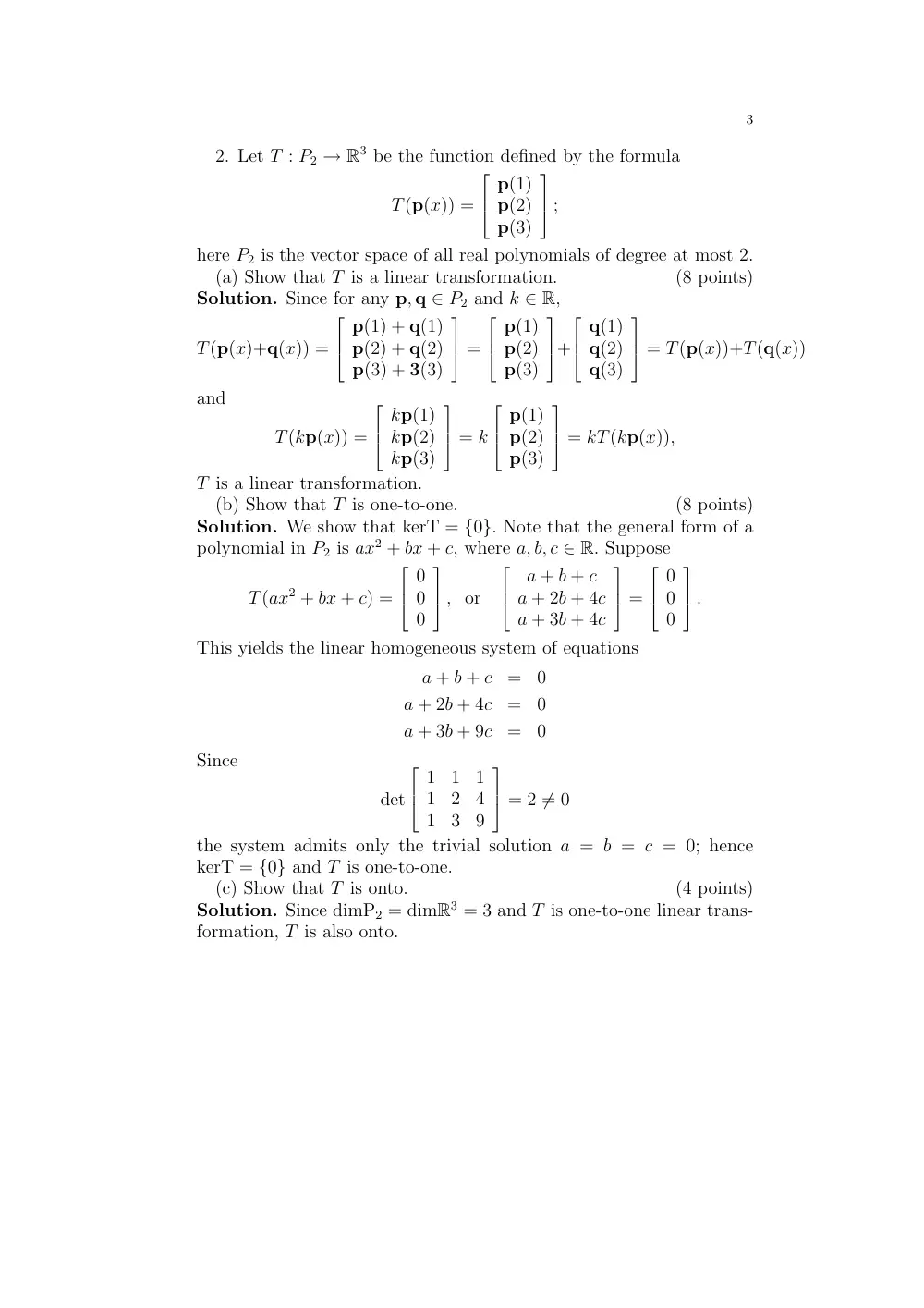
2. Let T : P2 → R3 be the function defined by the formula
T(p(x)) =
p(1)
p(2)
p(3)
;
here P2 is the vector space of all real polynomials of degree at most 2.
(a) Show that T is a linear transformation.
(8 points)
Solution. Since for any p, q ∈ P2 and k ∈ R,
T(p(x)+q(x)) =
p(1) + q(1)
p(2) + q(2)
p(3) + 3(3)
=
p(1)
p(2)
p(3)
+
q(1)
q(2)
q(3)
= T(p(x))+T(q(x))
and
T(kp(x)) =
kp(1)
kp(2)
kp(3)
= k
p(1)
p(2)
p(3)
= kT(kp(x)),
T is a linear transformation.
(b) Show that T is one-to-one.
(8 points)
Solution. We show that kerT = {0}. Note that the general form of a
polynomial in P2 is ax2 + bx + c, where a, b, c ∈ R. Suppose
T(ax2 + bx + c) =
0
0
0
, or
a + b + c
a + 2b + 4c
a + 3b + 4c
=
0
0
0
.
This yields the linear homogeneous system of equations
a + b + c
=
0
a + 2b + 4c
=
0
a + 3b + 9c
=
0
Since
det
1
1
1
1
2
4
1
3
9
= 2 ̸= 0
the system admits only the trivial solution a = b = c = 0; hence
kerT = {0} and T is one-to-one.
(c) Show that T is onto.
(4 points)
Solution. Since dimP2 = dimR3 = 3 and T is one-to-one linear trans-
formation, T is also onto.
4
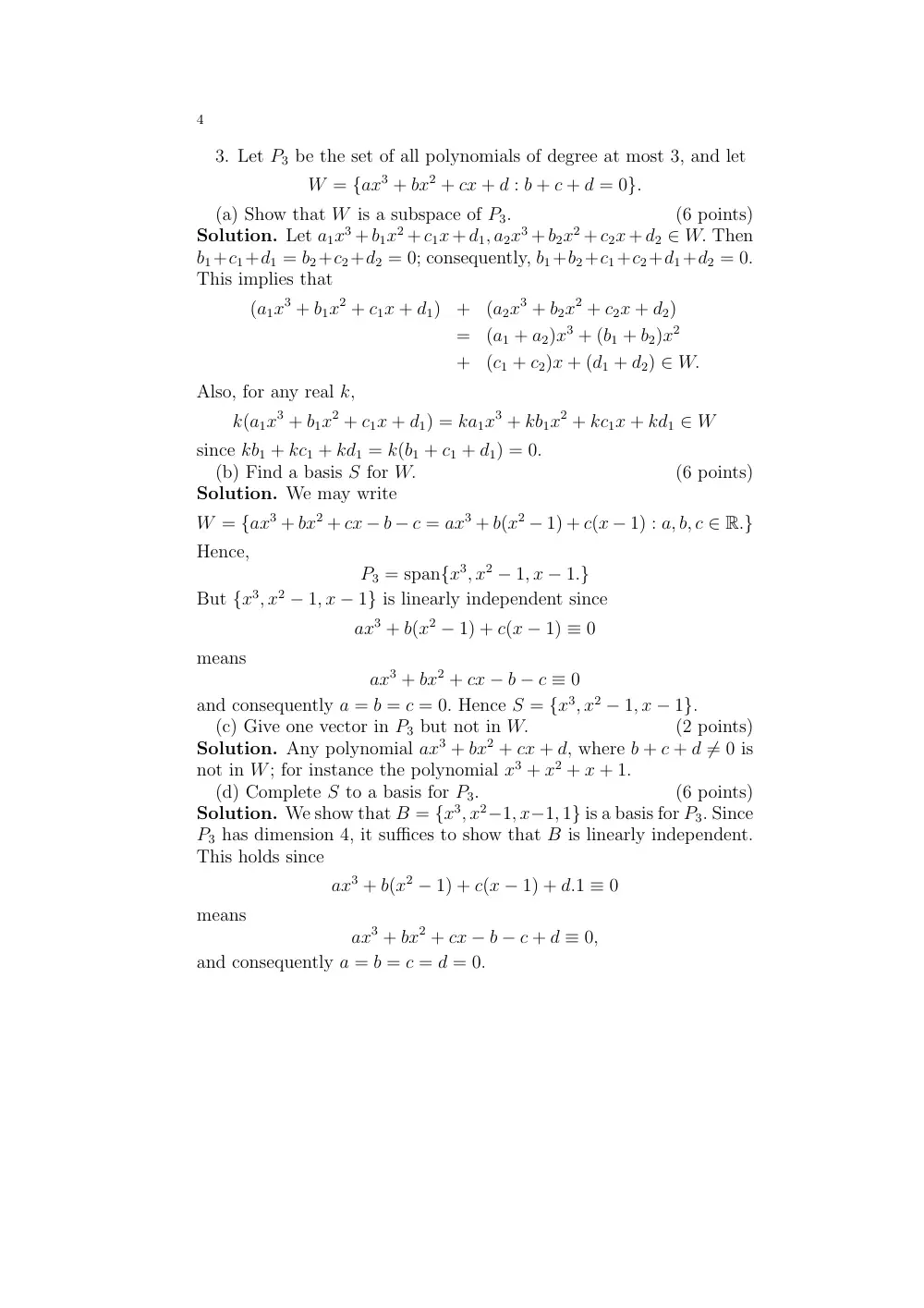
3. Let P3 be the set of all polynomials of degree at most 3, and let
W = {ax3 + bx2 + cx + d : b + c + d = 0}.
(a) Show that W is a subspace of P3.
(6 points)
Solution. Let a1x3 +b1x2 +c1x+d1, a2x3 +b2x2 +c2x+d2 ∈ W. Then
b1+c1+d1 = b2+c2+d2 = 0; consequently, b1+b2+c1+c2+d1+d2 = 0.
This implies that
(a1x3 + b1x2 + c1x + d1)
+
(a2x3 + b2x2 + c2x + d2)
=
(a1 + a2)x3 + (b1 + b2)x2
+
(c1 + c2)x + (d1 + d2) ∈ W.
Also, for any real k,
k(a1x3 + b1x2 + c1x + d1) = ka1x3 + kb1x2 + kc1x + kd1 ∈ W
since kb1 + kc1 + kd1 = k(b1 + c1 + d1) = 0.
(b) Find a basis S for W.
(6 points)
Solution. We may write
W = {ax3 + bx2 + cx − b − c = ax3 + b(x2 − 1) + c(x − 1) : a, b, c ∈ R.}
Hence,
P3 = span{x3, x2 − 1, x − 1.}
But {x3, x2 − 1, x − 1} is linearly independent since
ax3 + b(x2 − 1) + c(x − 1) ≡ 0
means
ax3 + bx2 + cx − b − c ≡ 0
and consequently a = b = c = 0. Hence S = {x3, x2 − 1, x − 1}.
(c) Give one vector in P3 but not in W.
(2 points)
Solution. Any polynomial ax3 + bx2 + cx + d, where b + c + d ̸= 0 is
not in W; for instance the polynomial x3 + x2 + x + 1.
(d) Complete S to a basis for P3.
(6 points)
Solution. We show that B = {x3, x2−1, x−1, 1} is a basis for P3. Since
P3 has dimension 4, it suffices to show that B is linearly independent.
This holds since
ax3 + b(x2 − 1) + c(x − 1) + d.1 ≡ 0
means
ax3 + bx2 + cx − b − c + d ≡ 0,
and consequently a = b = c = d = 0.
5
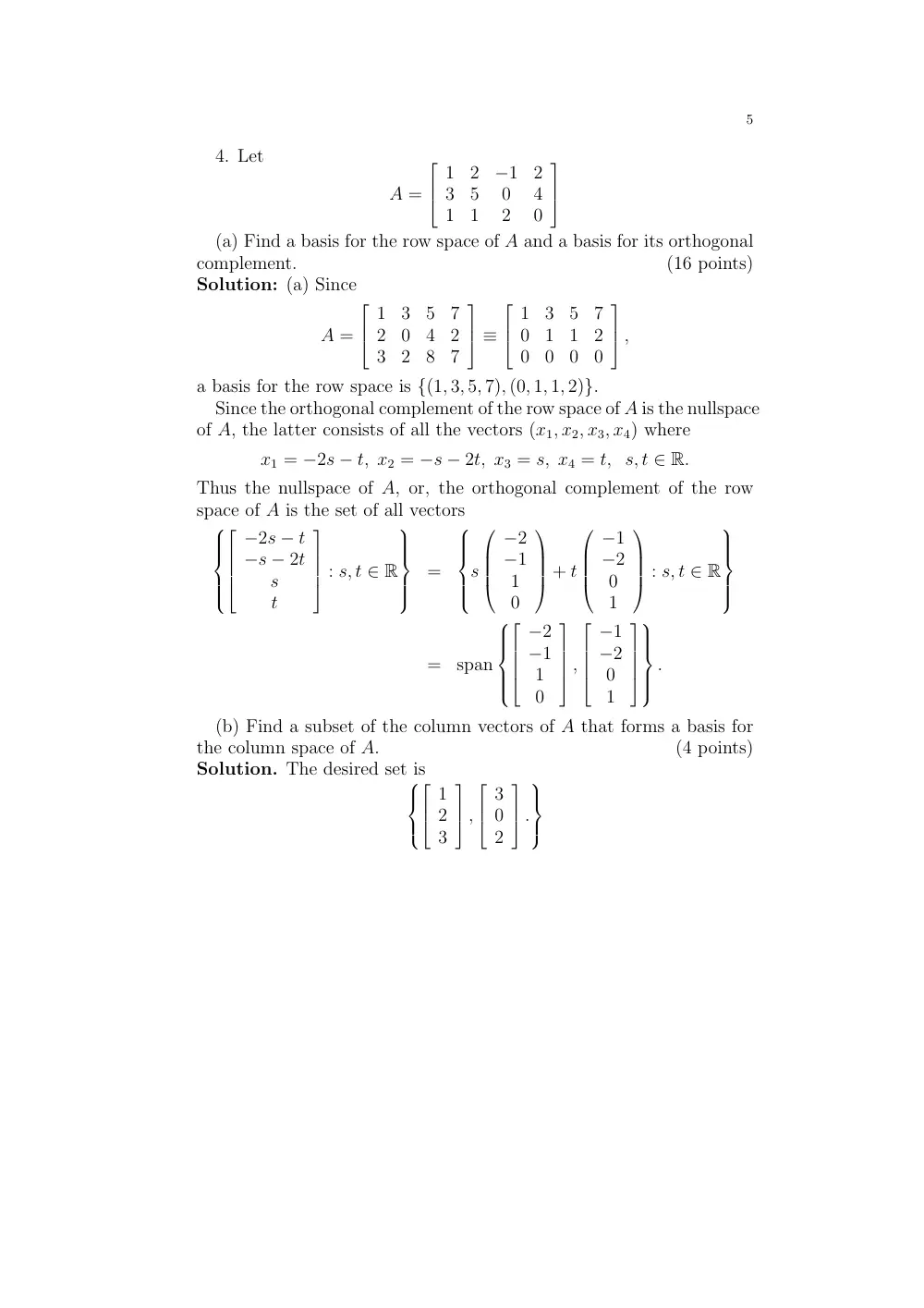
4. Let
A =
1
2
−1
2
3
5
0
4
1
1
2
0
(a) Find a basis for the row space of A and a basis for its orthogonal
complement.
(16 points)
Solution: (a) Since
A =
1
3
5
7
2
0
4
2
3
2
8
7
≡
1
3
5
7
0
1
1
2
0
0
0
0
,
a basis for the row space is {(1, 3, 5, 7), (0, 1, 1, 2)}.
Since the orthogonal complement of the row space of A is the nullspace
of A, the latter consists of all the vectors (x1, x2, x3, x4) where
x1 = −2s − t, x2 = −s − 2t, x3 = s, x4 = t, s, t ∈ R.
Thus the nullspace of A, or, the orthogonal complement of the row
space of A is the set of all vectors
−2s − t
−s − 2t
s
t
: s, t ∈ R
=
s
−2
−1
1
0
+ t
−1
−2
0
1
: s, t ∈ R
=
span
−2
−1
1
0
,
−1
−2
0
1
.
(b) Find a subset of the column vectors of A that forms a basis for
the column space of A.
(4 points)
Solution. The desired set is
1
2
3
,
3
0
2
.
6
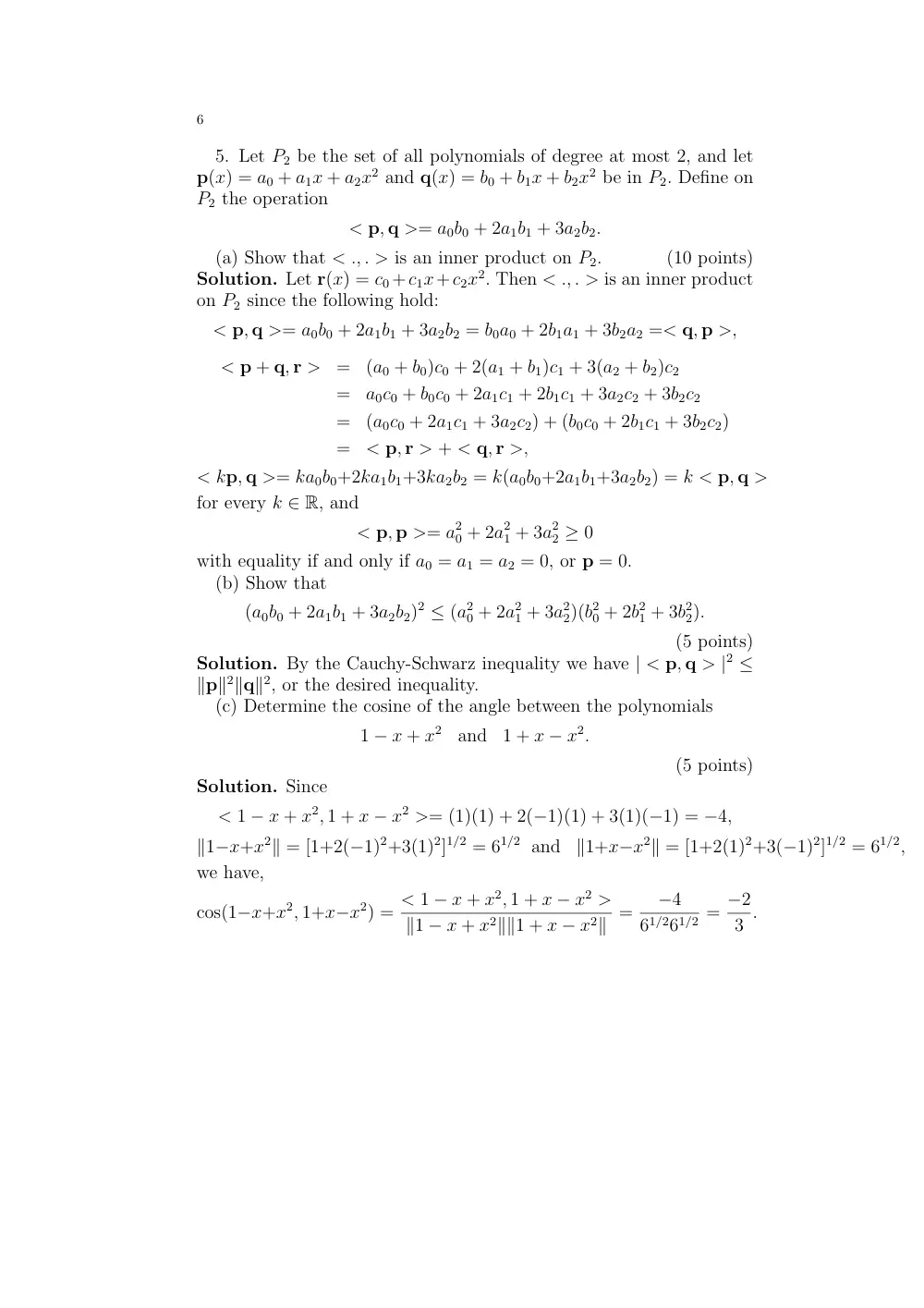
5. Let P2 be the set of all polynomials of degree at most 2, and let
p(x) = a0 + a1x + a2x2 and q(x) = b0 + b1x + b2x2 be in P2. Define on
P2 the operation
< p, q >= a0b0 + 2a1b1 + 3a2b2.
(a) Show that < ., . > is an inner product on P2.
(10 points)
Solution. Let r(x) = c0 +c1x+c2x2. Then < ., . > is an inner product
on P2 since the following hold:
< p, q >= a0b0 + 2a1b1 + 3a2b2 = b0a0 + 2b1a1 + 3b2a2 =< q, p >,
< p + q, r >
=
(a0 + b0)c0 + 2(a1 + b1)c1 + 3(a2 + b2)c2
=
a0c0 + b0c0 + 2a1c1 + 2b1c1 + 3a2c2 + 3b2c2
=
(a0c0 + 2a1c1 + 3a2c2) + (b0c0 + 2b1c1 + 3b2c2)
=
< p, r > + < q, r >,
< kp, q >= ka0b0+2ka1b1+3ka2b2 = k(a0b0+2a1b1+3a2b2) = k < p, q >
for every k ∈ R, and
< p, p >= a2
0 + 2a2
1 + 3a2
2 ≥ 0
with equality if and only if a0 = a1 = a2 = 0, or p = 0.
(b) Show that
(a0b0 + 2a1b1 + 3a2b2)2 ≤ (a2
0 + 2a2
1 + 3a2
2)(b2
0 + 2b2
1 + 3b2
2).
(5 points)
Solution. By the Cauchy-Schwarz inequality we have | < p, q > |2 ≤
∥p∥2∥q∥2, or the desired inequality.
(c) Determine the cosine of the angle between the polynomials
1 − x + x2
and
1 + x − x2.
(5 points)
Solution. Since
< 1 − x + x2, 1 + x − x2 >= (1)(1) + 2(−1)(1) + 3(1)(−1) = −4,
∥1−x+x2∥ = [1+2(−1)2+3(1)2]1/2 = 61/2 and
∥1+x−x2∥ = [1+2(1)2+3(−1)2]1/2 = 61/2,
we have,
cos(1−x+x2, 1+x−x2) = < 1 − x + x2, 1 + x − x2 >
∥1 − x + x2∥∥1 + x − x2∥ =
−4
61/261/2 = −2
3 .
7
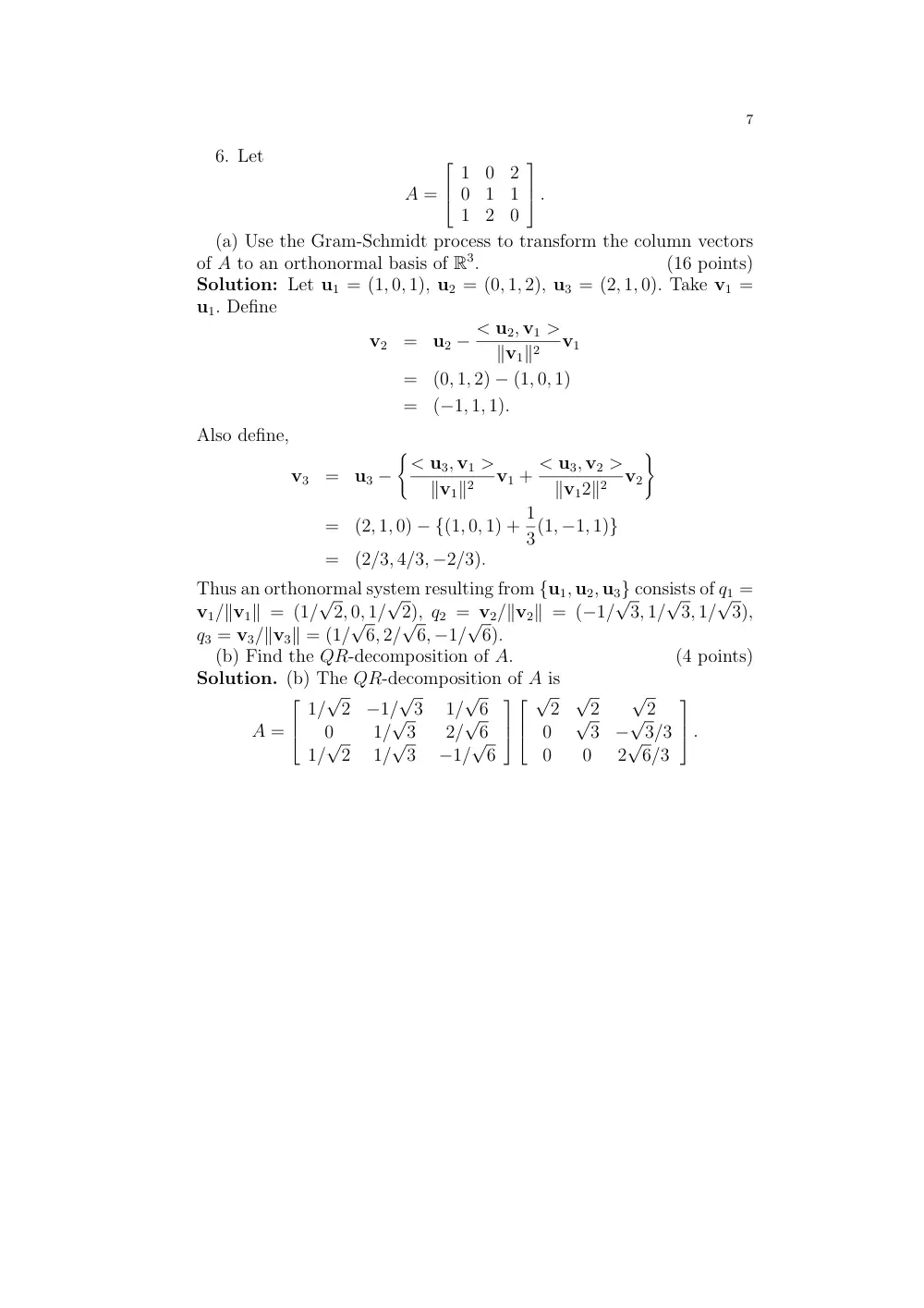
6. Let
A =
1
0
2
0
1
1
1
2
0
.
(a) Use the Gram-Schmidt process to transform the column vectors
of A to an orthonormal basis of R3.
(16 points)
Solution: Let u1 = (1, 0, 1), u2 = (0, 1, 2), u3 = (2, 1, 0). Take v1 =
u1. Define
v2
=
u2 − < u2, v1 >
∥v1∥2
v1
=
(0, 1, 2) − (1, 0, 1)
=
(−1, 1, 1).
Also define,
v3
=
u3 −
�< u3, v1 >
∥v1∥2
v1 + < u3, v2 >
∥v12∥2
v2
�
=
(2, 1, 0) − {(1, 0, 1) + 1
3(1, −1, 1)}
=
(2/3, 4/3, −2/3).
Thus an orthonormal system resulting from {u1, u2, u3} consists of q1 =
v1/∥v1∥ = (1/
√
2, 0, 1/
√
2), q2 = v2/∥v2∥ = (−1/
√
3, 1/
√
3, 1/
√
3),
q3 = v3/∥v3∥ = (1/
√
6, 2/
√
6, −1/
√
6).
(b) Find the QR-decomposition of A.
(4 points)
Solution. (b) The QR-decomposition of A is
A =
1/
√
2
−1/
√
3
1/
√
6
0
1/
√
3
2/
√
6
1/
√
2
1/
√
3
−1/
√
6
√
2
√
2
√
2
0
√
3
−
√
3/3
0
0
2
√
6/3
.
8
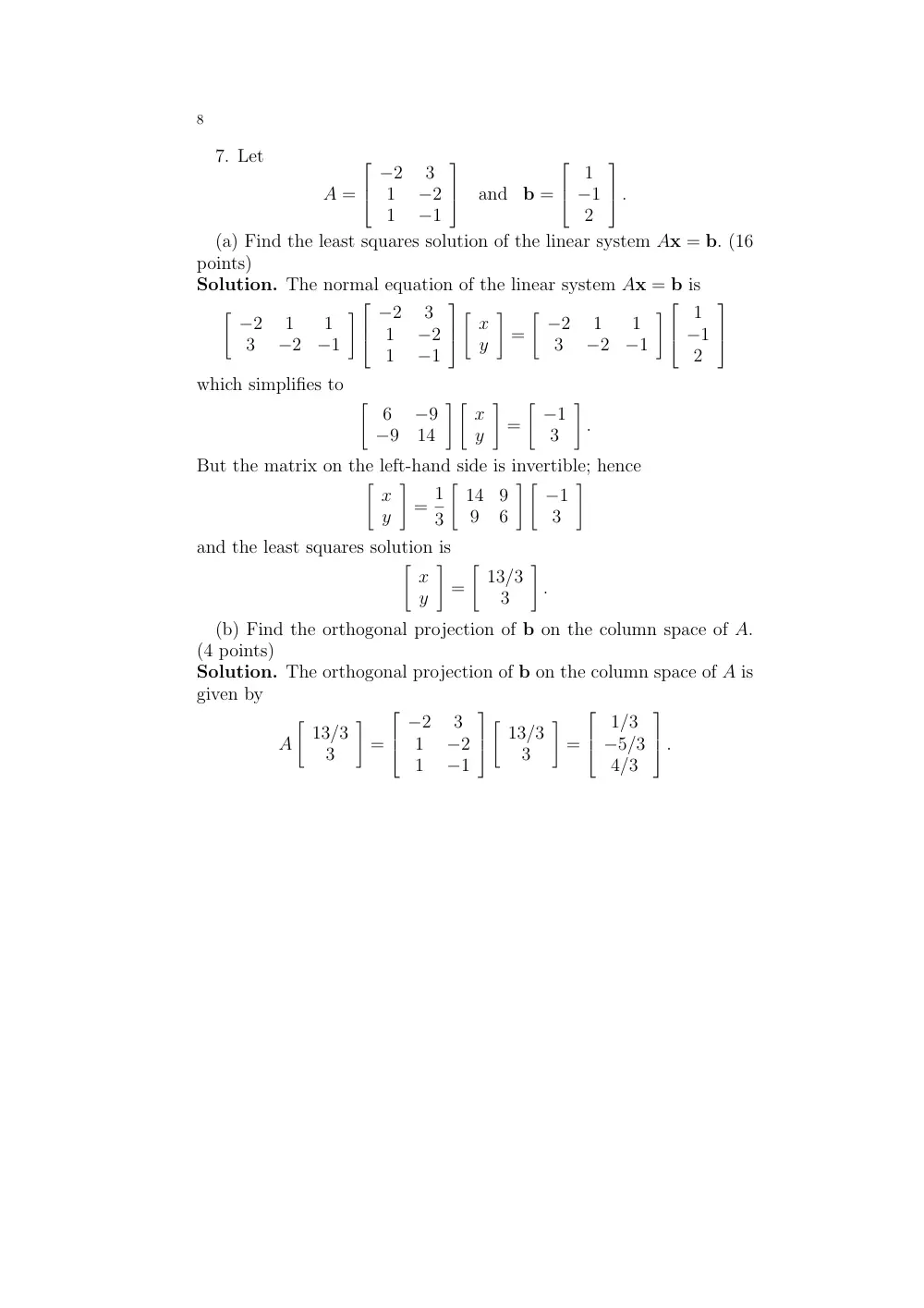
7. Let
A =
−2
3
1
−2
1
−1
and
b =
1
−1
2
.
(a) Find the least squares solution of the linear system Ax = b. (16
points)
Solution. The normal equation of the linear system Ax = b is
�
−2
1
1
3
−2
−1
�
−2
3
1
−2
1
−1
�
x
y
�
=
�
−2
1
1
3
−2
−1
�
1
−1
2
which simplifies to
�
6
−9
−9
14
� �
x
y
�
=
�
−1
3
�
.
But the matrix on the left-hand side is invertible; hence
�
x
y
�
= 1
3
�
14
9
9
6
� �
−1
3
�
and the least squares solution is
�
x
y
�
=
�
13/3
3
�
.
(b) Find the orthogonal projection of b on the column space of A.
(4 points)
Solution. The orthogonal projection of b on the column space of A is
given by
A
�
13/3
3
�
=
−2
3
1
−2
1
−1
�
13/3
3
�
=
1/3
−5/3
4/3
.
9
8. Let
A =
0
1
1
1
0
1
1
1
0
.
(a) Find the eigenvalues of A.
(5 points)
Solution. The CE of A is
det(λI − A) = det
λ
−1
−1
−1
λ
−1
−1
−1
λ
= (λ + 1)2(λ − 2) = 0.
Hence the eigenvalues are λ1 = −1, with algebraic multiplicity 2, and
λ2 = 2, with algebraic multiplicity 1.
(b) Show that A is diagonalizable.
(10 points)
Solution. We find the eigenspaces of λ1 and λ2. For the first, consider
λ1I − A =
−1
−1
−1
−1
−1
−1
−1
−1
−1
∼
1
1
1
0
0
0
0
0
0
.
Hence,
nullspace(λ1I − A) = span
−1
1
0
,
−1
0
1
.
In a similar manner we find
nullspace(λ2I − A) = span
1
1
1
.
Since the set of vectors
−1
1
0
,
−1
0
1
,
1
1
1
is linearly independent, the matrix A is diagonalizable.
(c) Find a matrix P that diagonalizes A and determine P −1AP. (5
points)
Solution. a matrix P that diagonalizes A is
P =
−1
−1
1
1
0
1
0
1
1
and
P −1AP =
−1
0
0
0
−1
0
0
0
2
10
(d) Find A10
(5 points)
Solution. We have
A
=
P
−1
0
0
0
−1
0
0
0
2
P −1
=
11
9. Indicate whether each of the following statements is TRUE (T)
or FALSE (F) without justifying your answer.
(3 points each)
—-(a) If A is an n×n matrix that satisfies AAT = I, then det(A) = 1.
—-(b) If A2 = A and λ is an eigenvalue of A, then λ = 0 or λ = 1.
—-(c) If A is an n × n matrix invertible matrix, then the orthogonal
complement of its nullspace is Rn.
—-(d) A square matrix is diagonalizable if and only if λ = 0 is an
eigenvalue.
—-(e) Any linear system Ax = b satisfies rank[A|b] = rank(A).
—-(f) Any matrix A can be expressed as a product of elementary
matrices.
—-(g) If dim V < dim W < ∞, then there exists a one-to-one linear
transformation T : V → W.
—-(h) If a linear transformation T : R2 → R satisfies T(2, −1) ̸= 0,
then it is onto.
—-(i) The dimension of the vector space of 3 × 3 matrices is 10.
—-(j) If A is an m × n matrix, then ATA is invertible if and only if
the set of column vectors of A is linearly independent.