
MATH 218 Final, Spring 2011
American University of Beirut · Elementary Linear Algebra with Applications · 2 pages · Dr. Florian Bertrand
More MATH 218 files
- Final 218 2018 · Spring 2019Final examView
- Final Collection Finals with Solution · Spring 2017Final exam · with solutionView
- Final Collection Finals with Solution · Spring 2017Final exam · with solutionView
- Final Collection Finals with Solution · Spring 2017Final exam · with solutionView
- Final 08 · Spring 2017Final examView
- Final 2014 with Solution · Spring 2017Final exam · with solutionView
- Final with Solution · Spring 2017Final exam · with solutionView
- Final · Summer 2016Final examView
Show the text of this final exam
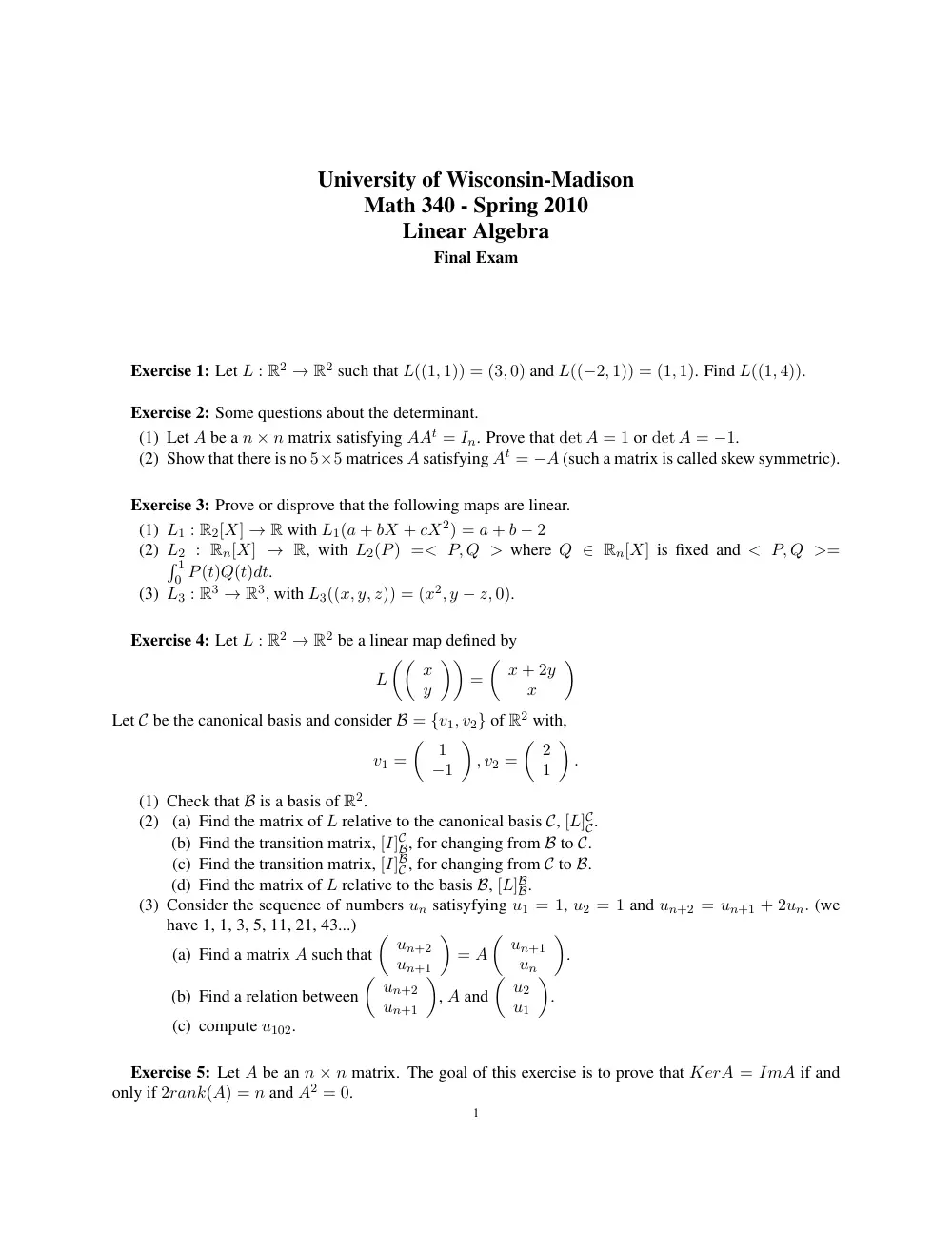
University of Wisconsin-Madison
Math 340 - Spring 2010
Linear Algebra
Final Exam
Exercise 1: Let L : R2 → R2 such that L((1, 1)) = (3, 0) and L((−2, 1)) = (1, 1). Find L((1, 4)).
Exercise 2: Some questions about the determinant.
(1) Let A be a n × n matrix satisfying AAt = In. Prove that det A = 1 or det A = −1.
(2) Show that there is no 5×5 matrices A satisfying At = −A (such a matrix is called skew symmetric).
Exercise 3: Prove or disprove that the following maps are linear.
(1) L1 : R2[X] → R with L1(a + bX + cX2) = a + b − 2
(2) L2 : Rn[X] → R, with L2(P) =< P, Q > where Q ∈ Rn[X] is fixed and < P, Q >=
� 1
0 P(t)Q(t)dt.
(3) L3 : R3 → R3, with L3((x, y, z)) = (x2, y − z, 0).
Exercise 4: Let L : R2 → R2 be a linear map defined by
L
��
x
y
��
=
�
x + 2y
x
�
Let C be the canonical basis and consider B = {v1, v2} of R2 with,
v1 =
�
1
−1
�
, v2 =
�
2
1
�
.
(1) Check that B is a basis of R2.
(2) (a) Find the matrix of L relative to the canonical basis C, [L]C
C.
(b) Find the transition matrix, [I]C
B, for changing from B to C.
(c) Find the transition matrix, [I]B
C , for changing from C to B.
(d) Find the matrix of L relative to the basis B, [L]B
B.
(3) Consider the sequence of numbers un satisyfying u1 = 1, u2 = 1 and un+2 = un+1 + 2un. (we
have 1, 1, 3, 5, 11, 21, 43...)
(a) Find a matrix A such that
�
un+2
un+1
�
= A
�
un+1
un
�
.
(b) Find a relation between
�
un+2
un+1
�
, A and
�
u2
u1
�
.
(c) compute u102.
Exercise 5: Let A be an n × n matrix. The goal of this exercise is to prove that KerA = ImA if and
only if 2rank(A) = n and A2 = 0.
1
2
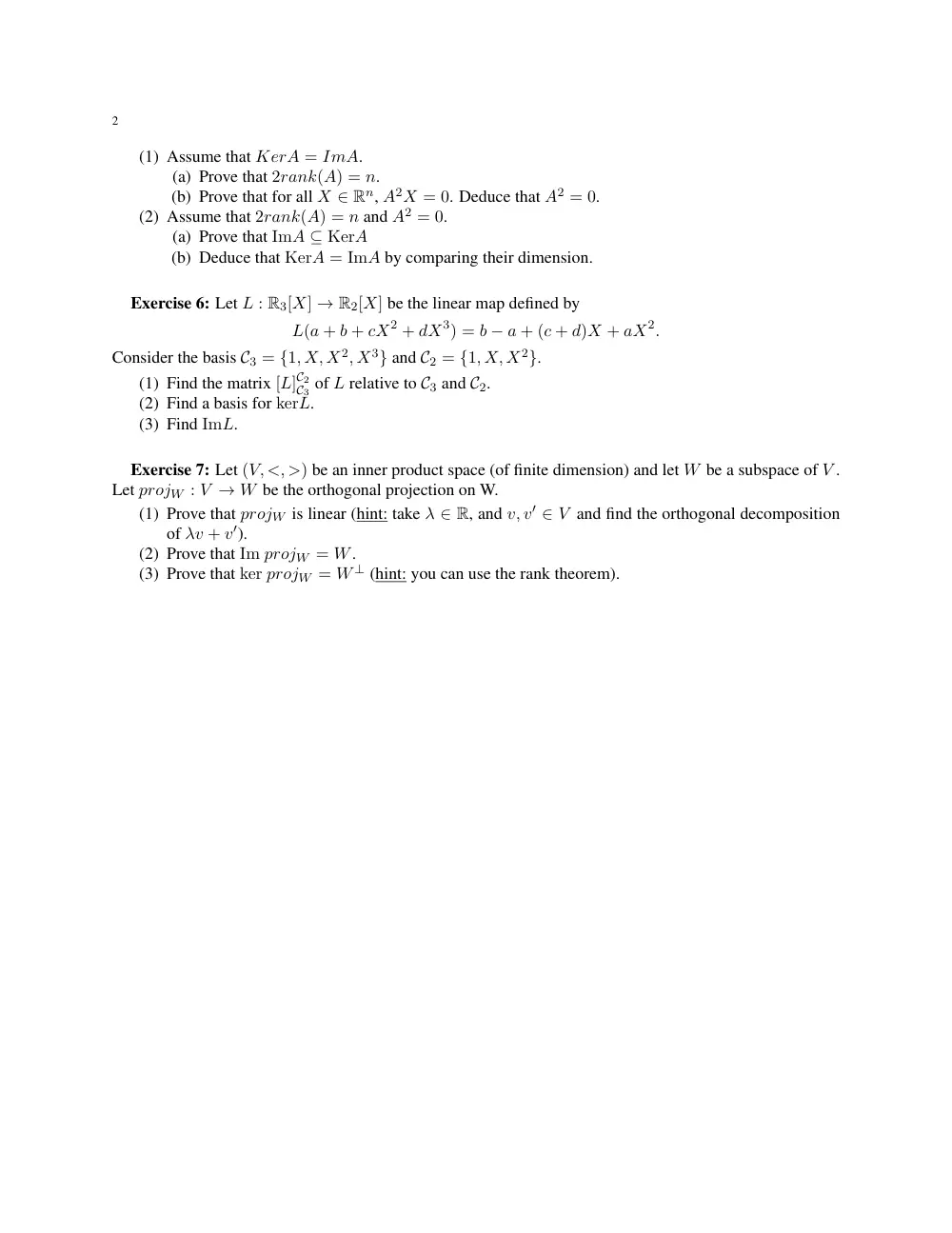
(1) Assume that KerA = ImA.
(a) Prove that 2rank(A) = n.
(b) Prove that for all X ∈ Rn, A2X = 0. Deduce that A2 = 0.
(2) Assume that 2rank(A) = n and A2 = 0.
(a) Prove that ImA ⊆ KerA
(b) Deduce that KerA = ImA by comparing their dimension.
Exercise 6: Let L : R3[X] → R2[X] be the linear map defined by
L(a + b + cX2 + dX3) = b − a + (c + d)X + aX2.
Consider the basis C3 = {1, X, X2, X3} and C2 = {1, X, X2}.
(1) Find the matrix [L]C2
C3 of L relative to C3 and C2.
(2) Find a basis for kerL.
(3) Find ImL.
Exercise 7: Let (V, <, >) be an inner product space (of finite dimension) and let W be a subspace of V .
Let projW : V → W be the orthogonal projection on W.
(1) Prove that projW is linear (hint: take λ ∈ R, and v, v′ ∈ V and find the orthogonal decomposition
of λv + v′).
(2) Prove that Im projW = W.
(3) Prove that ker projW = W ⊥ (hint: you can use the rank theorem).