
MATH 218 Final, Spring 2014
American University of Beirut · Elementary Linear Algebra with Applications · 11 pages






Showing the first 10 of 11 pages. Download the PDF to see all of it.
More MATH 218 files
- Final 218 2018 · Spring 2019Final examView
- Final Collection Finals with Solution · Spring 2017Final exam · with solutionView
- Final Collection Finals with Solution · Spring 2017Final exam · with solutionView
- Final Collection Finals with Solution · Spring 2017Final exam · with solutionView
- Final 08 · Spring 2017Final examView
- Final 2014 with Solution · Spring 2017Final exam · with solutionView
- Final with Solution · Spring 2017Final exam · with solutionView
- Final · Summer 2016Final examView
Show the text of this final exam
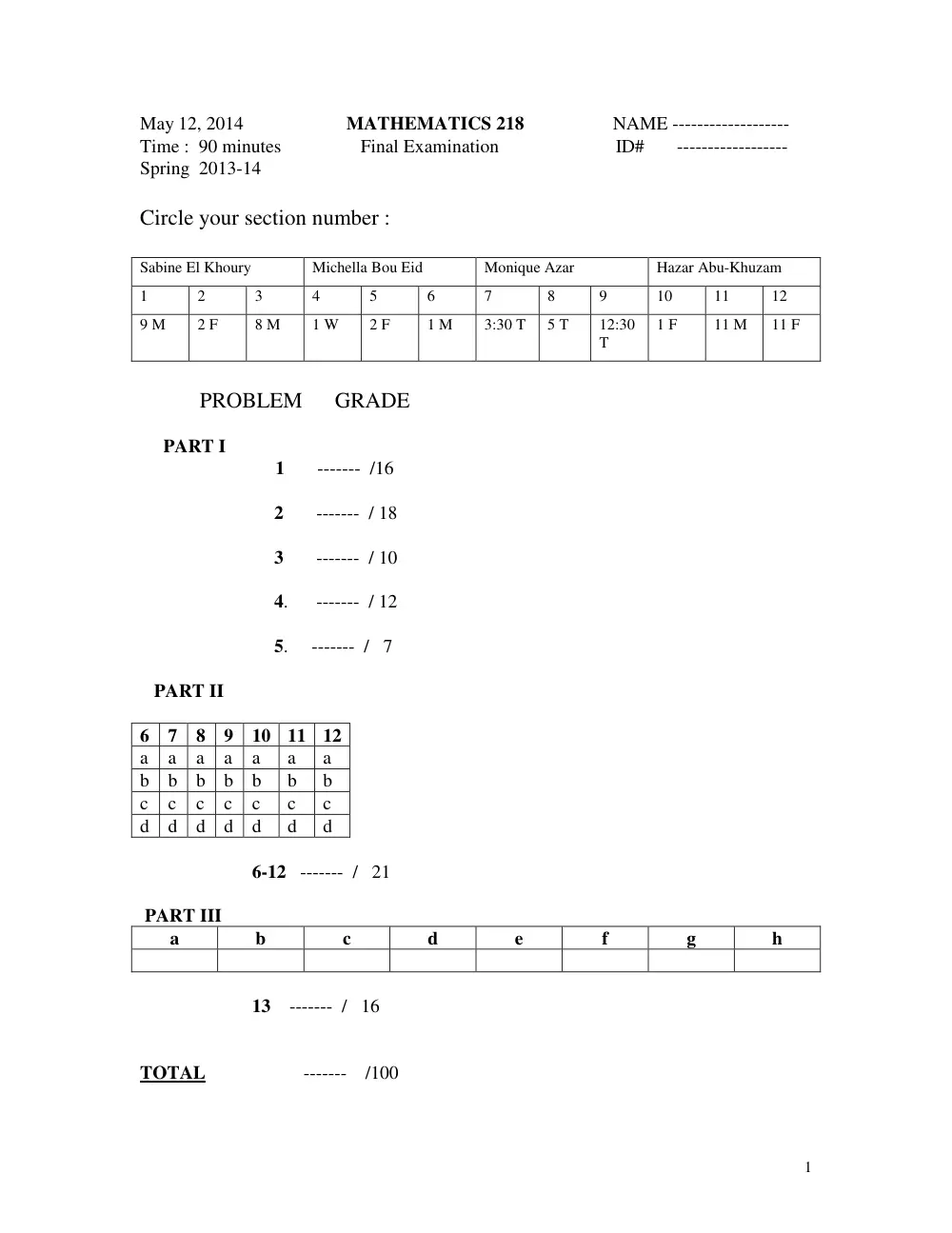
May 12, 2014 MATHEMATICS 218 NAME -------------------
Time : 90 minutes Final Examination ID# ------------------
Spring 2013-14
Circle your section number :
Sabine El Khoury
Michella Bou Eid
Monique Azar
Hazar Abu-Khuzam
1
2
3
4
5
6
7
8
9
10
11
12
9 M
2 F
8 M
1 W
2 F
1 M
3:30 T
5 T
12:30
T
1 F
11 M
11 F
PROBLEM GRADE
PART I
1 ------- /16
2 ------- / 18
3 ------- / 10
4. ------- / 12
5. ------- / 7
PART II
6 7 8 9 10 11 12
a
a
a
a
a
a
a
b b b b b
b
b
c
c
c
c
c
c
c
d d d d d
d
d
6-12 ------- / 21
PART III
a
b
c
d
e
f
g
h
13 ------- / 16
TOTAL ------- /100
1
PART I. Answer each of the following problems in the space provided for each
problem ( Problem 1 to Problem 5).
1. Let A=
6
0
0
0
5
1
0
1
5
(a) Find the eigenvalues and a basis for each eigenspace of A.
[ 10 points]
2
1(b) Show that A is diagonalizable. Find an invertible matrix P and a diagonal matrix
D such that P-1AP=D. ( Do not verify)
[ 6 points]
3
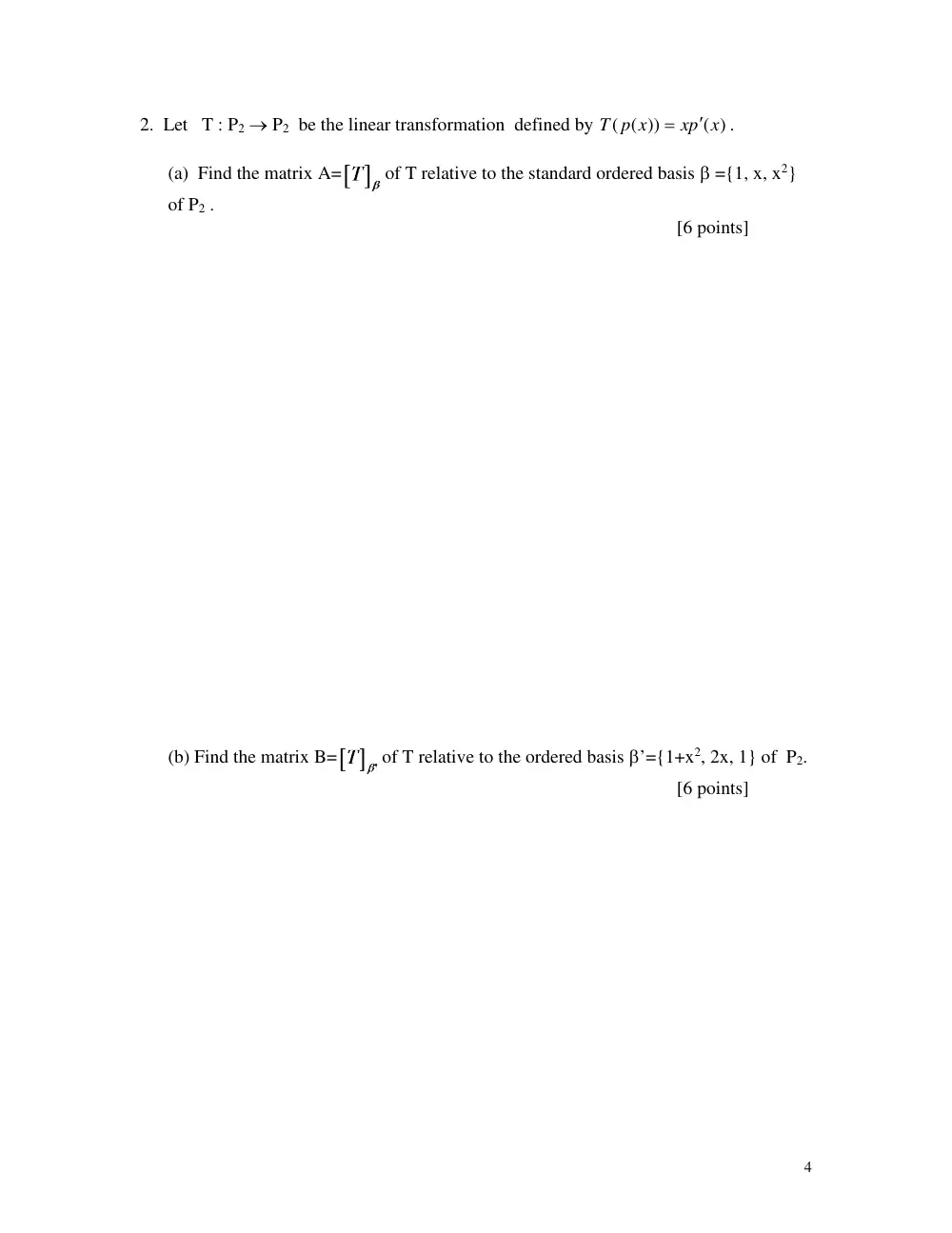
2. Let T : P2 → P2 be the linear transformation defined by
( )
( ( ))
xp x
T p x
′
=
.
(a) Find the matrix A=
of T relative to the standard ordered basis β ={1, x, x2}
of P2 .
[6 points]
(b) Find the matrix B=
of T relative to the ordered basis β’={1+x2, 2x, 1} of P2.
[6 points]
4
(c) Find the transition matrix P=[ ]
β
I β '
from β’ to β such that B=P-1AP ( Do not
verify).
[6 points]
3. Prove that an orthogonal set of nonzero vectors in an inner product space V is linearly
independent.
[ 10 points]
5
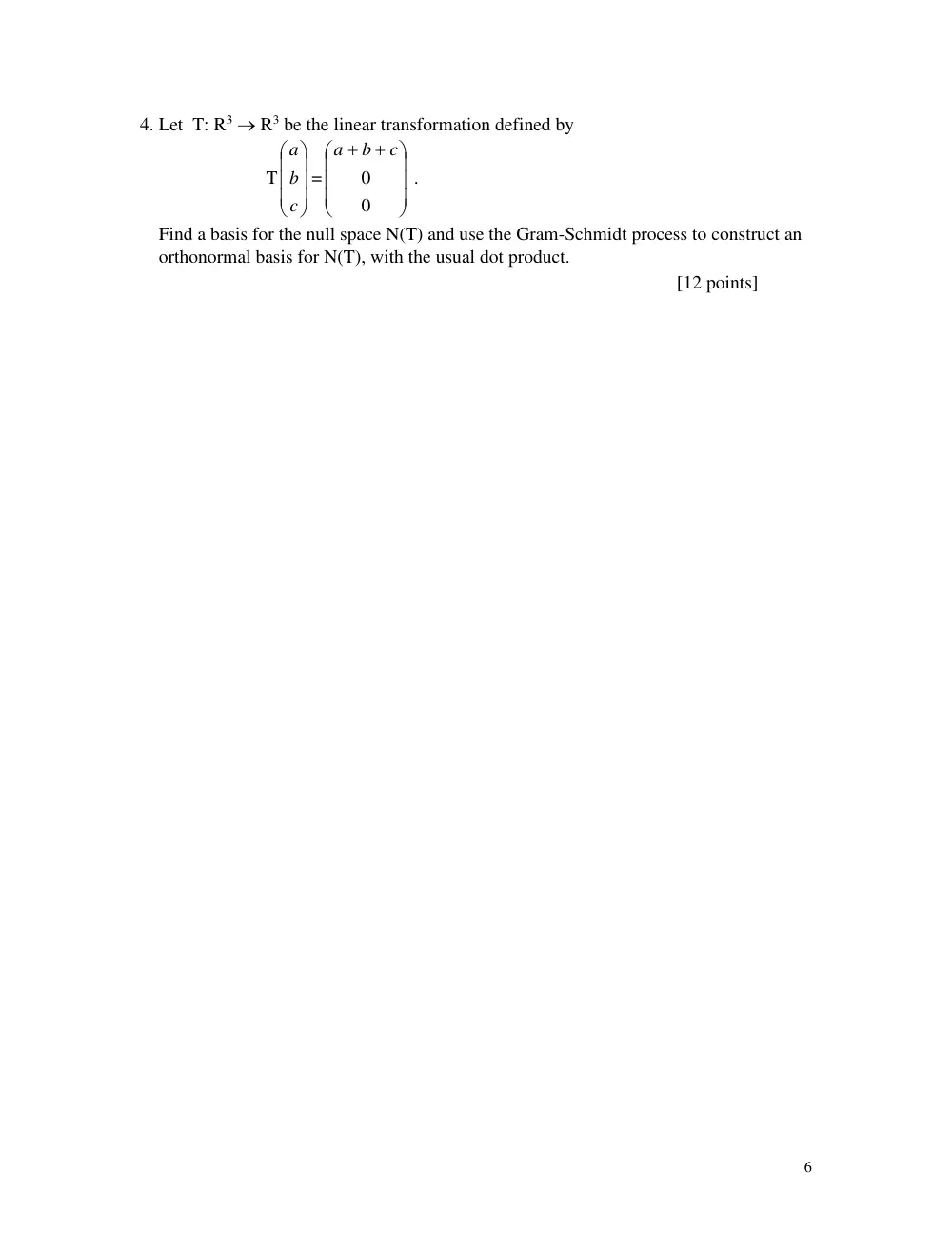
4. Let T: R3 → R3 be the linear transformation defined by
T
c
b
a
=
+
+
0
0
c
b
a
.
Find a basis for the null space N(T) and use the Gram-Schmidt process to construct an
orthonormal basis for N(T), with the usual dot product.
[12 points]
6
5. Let T: R3 → R4 and S: R4 → R2 be two linear transformations such that the
composition SοT =0. Show that if S is onto then T cannot be one-to-one.
[7 points]
7
PART II. Circle the correct answer for each of the following problems
( Problem 6 to Problem 12). IN THE TABLE IN THE FRONT PAGE
[3 points for each correct answer]
6. Let T : R3 → R3 be the linear map defined by
T
z
y
x
=
−
+
0
2
3
x
y
x
.
Then dim ( Range T) is :
a.
3
b. 2
c.
1
d. none of the above.
[ 3 points]
7. Let S be the subspace defined by
S={M is a 3x3 skew-symmetric matrix with the sum of the entries of each row is zero}.
Then dim S=
a.
1
b. 2
c.
3
d. none of the above.
[ 3 points]
8. If T: R2→ R is a linear transformation such that T(v)≠0 for some v in R2, then
a.
T is one-to-one.
b. T is onto.
c.
Dim (Nullspace T)=0.
d. none of the above.
[ 3 points]
8
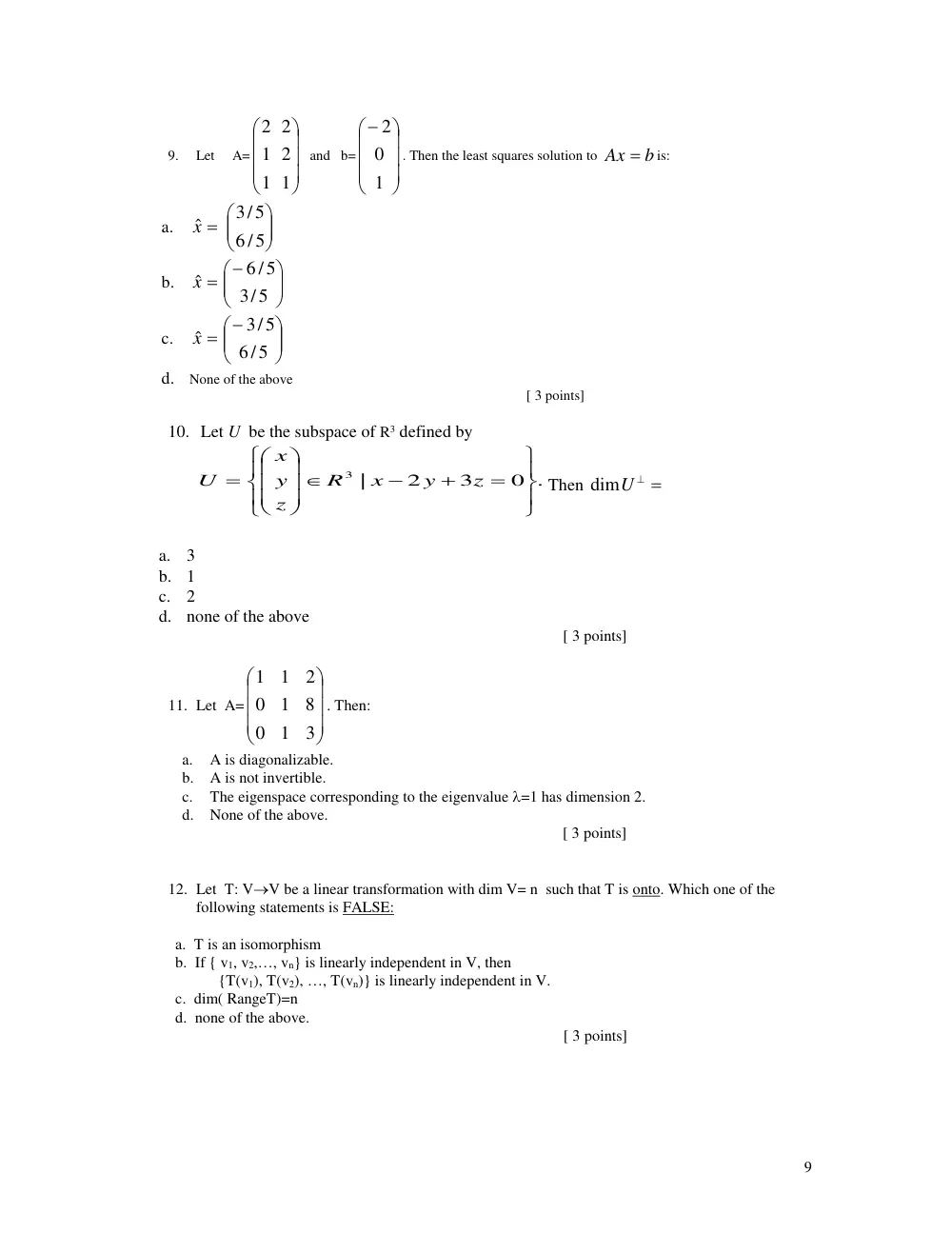
9.
Let A=
1
2
2
1
1
2
and b=
−
1
0
2
. Then the least squares solution to
Ax = b
is:
a.
xˆ =
/5
6
/5
3
b.
xˆ =
−
/5
3
/5
6
c.
xˆ =
−
/5
6
/5
3
d. None of the above
[ 3 points]
10. Let U be the subspace of R3 defined by
0 .
3
2
3 |
=
+
−
∈
=
z
y
x
R
z
y
x
U
Then
dimU ⊥ =
a. 3
b. 1
c. 2
d. none of the above
[ 3 points]
11. Let A=
3
1
0
8
1
0
2
1
1
. Then:
a.
A is diagonalizable.
b. A is not invertible.
c.
The eigenspace corresponding to the eigenvalue λ=1 has dimension 2.
d. None of the above.
[ 3 points]
12. Let T: V→V be a linear transformation with dim V= n such that T is onto. Which one of the
following statements is FALSE:
a. T is an isomorphism
b. If { v1, v2,…, vn} is linearly independent in V, then
{T(v1), T(v2), …, T(vn)} is linearly independent in V.
c. dim( RangeT)=n
d. none of the above.
[ 3 points]
9
PART III. Answer TRUE or FALSE only IN THE TABLE IN THE
FRONT PAGE ( 2 points for each correct answer)
a. ----- If A is a 3×3 matrix such that A2=0, then rank A ≠3.
b. ----- Let V be a finite dimensional vector space and let W be a subspace of V. If
dim W= dim V, then W=V.
c. ----- If A is a 2×5 matrix, then dim (Column space of A) ≤ 2
d. ------ Let V be a finite dimensional inner product space and let W be a subspace of V.
Then the orthogonal complement of
W ⊥
is equal to W.
e. ------- Let V be a finite-dimensional vector space and let T: V→V be a linear
transformation. If T is one-to-one, then T is onto.
f. ----- The matrices A=
−
4
3
2
1
and B=
−
3
4
1
2
are similar.
g. ---- Let T: R2→ R3 be a linear transformation such that
T
0
1 =
1
1
1
, and T
1
0 =
−
3
2
1
.
Then T
−1
5
=
− 2
7
4
.
h. ----- The set of all 2×2 noninvertible matrices is a subspace of M2×2.
[16 points].
.
10
11