
MATH 220 Final, Spring 2004
American University of Beirut · Linear Algebra II · 2 pages

More MATH 220 files
Show the text of this final exam
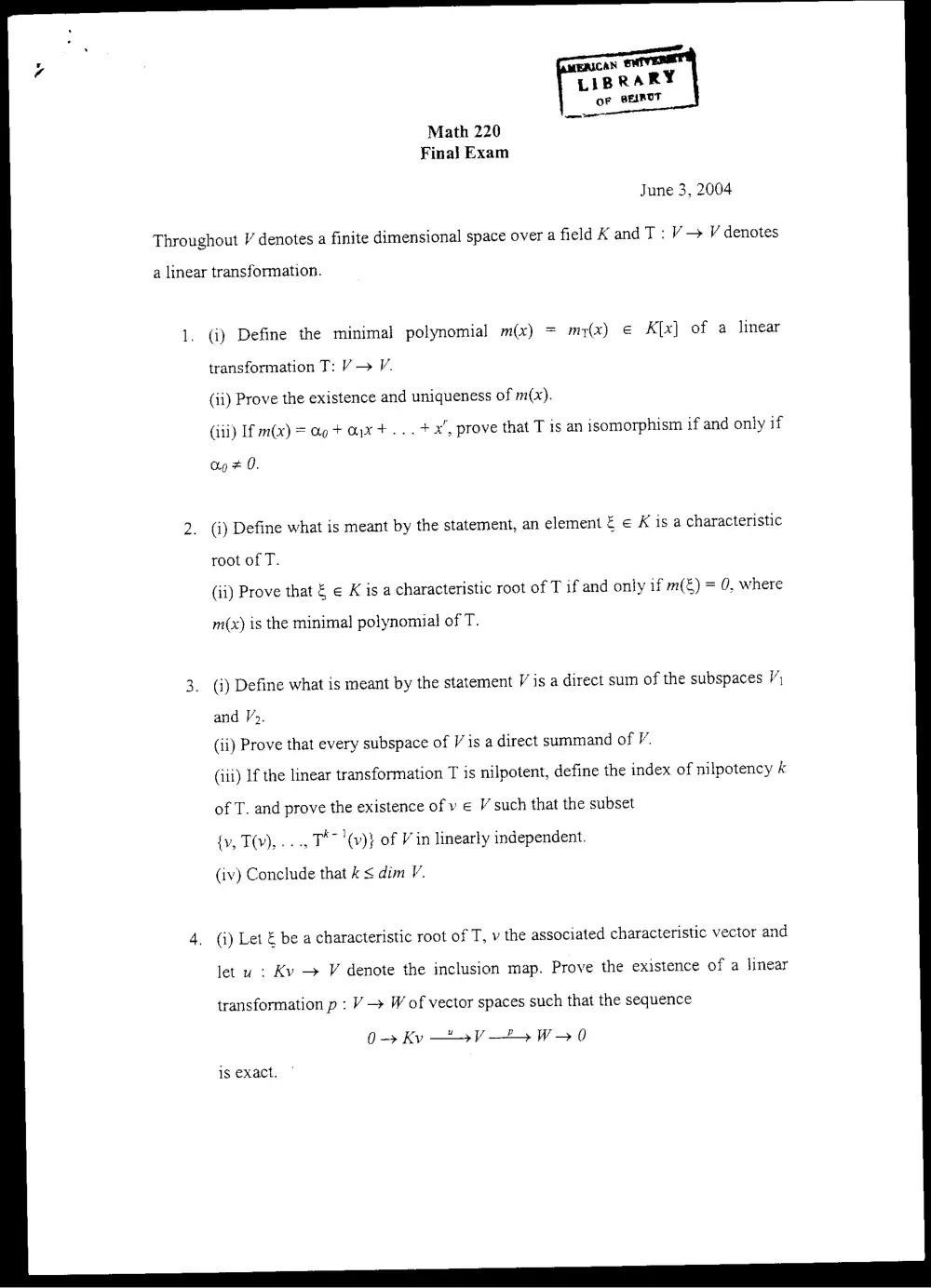
Math 220
Fina} Exam
June 3, 2004
Throughout V denotes a finite dimensional space over a field K and T: V— V denotes
a linear transformation.
1. (i) Define the minimal polynomial m(x) = mr(x) € K[x] of a linear
transformation T: V > V.
(ii) Prove the existence and uniqueness of m(x).
(iii) Lf m(x) = ag + uxt... +2", prove that T is an isomorphism if and only if
ag # 0.
(i) Define what is meant by the statement, an element & € K is a characteristic
root of T.
(ii) Prove that & € K is a characteristic root of T if and only if m(&) = 0, where
m(x) is the minimal polynomial of T.
(i) Define what is meant by the statement V is a direct sum of the subspaces
and Vo.
(ii) Prove that every subspace of Vis a direct summand of V.
(iii) If the linear transformation T is nilpotent, define the index of nilpotency k
of T. and prove the existence of v € V such that the subset
{v, TO), .... T'7'(@)} of Vin linearly independent.
(iv) Conclude that k < dim V.
(i) Let & be a characteristic root of T, v the associated characteristic vector and
let vu . Kv > V denote the inclusion map. Prove the existence of a linear
transformation p : V + W of vector spaces such that the sequence
0+ Ky »V~“~> W- 0
is exact.
Gi) Let S : ¥ - W* be a linear transformation of vector spaces such that
Su = 0. Prove the existence of one and only one linear transformation
S* : W— W* such that S*p = S.
State the primary decomposition Theorem associated with the minimal
polynomial m(x) of T.
(i) If T is nilpotent, prove that the minimal polynomial of T is of the form
m(x) = x‘ where & is the index of nilpotency of T
(11) Make a brief account without proofs why there exists a basis of V such that
the matrix of T consists of square matrix blocks each having the entry 1 along
the lower super diagonal and 0 entries elsewhere.
State the Jordan decomposition theorem of a linear transformation T : V+ V.
Describe briefly without proofs the Jordan matrix form of a linear
transformation.