
MATH 251 Homework, Fall 2012
American University of Beirut · Numerical Computing · 9 pages
More MATH 251 files
Show the text of this homework
1
Math 251- Fall 2011-2012
MATLAB ASSIGNMENT 1
Exercise 1
Question 1: 15 points
Question 2: 15 points
: Conversion methods
30 Points
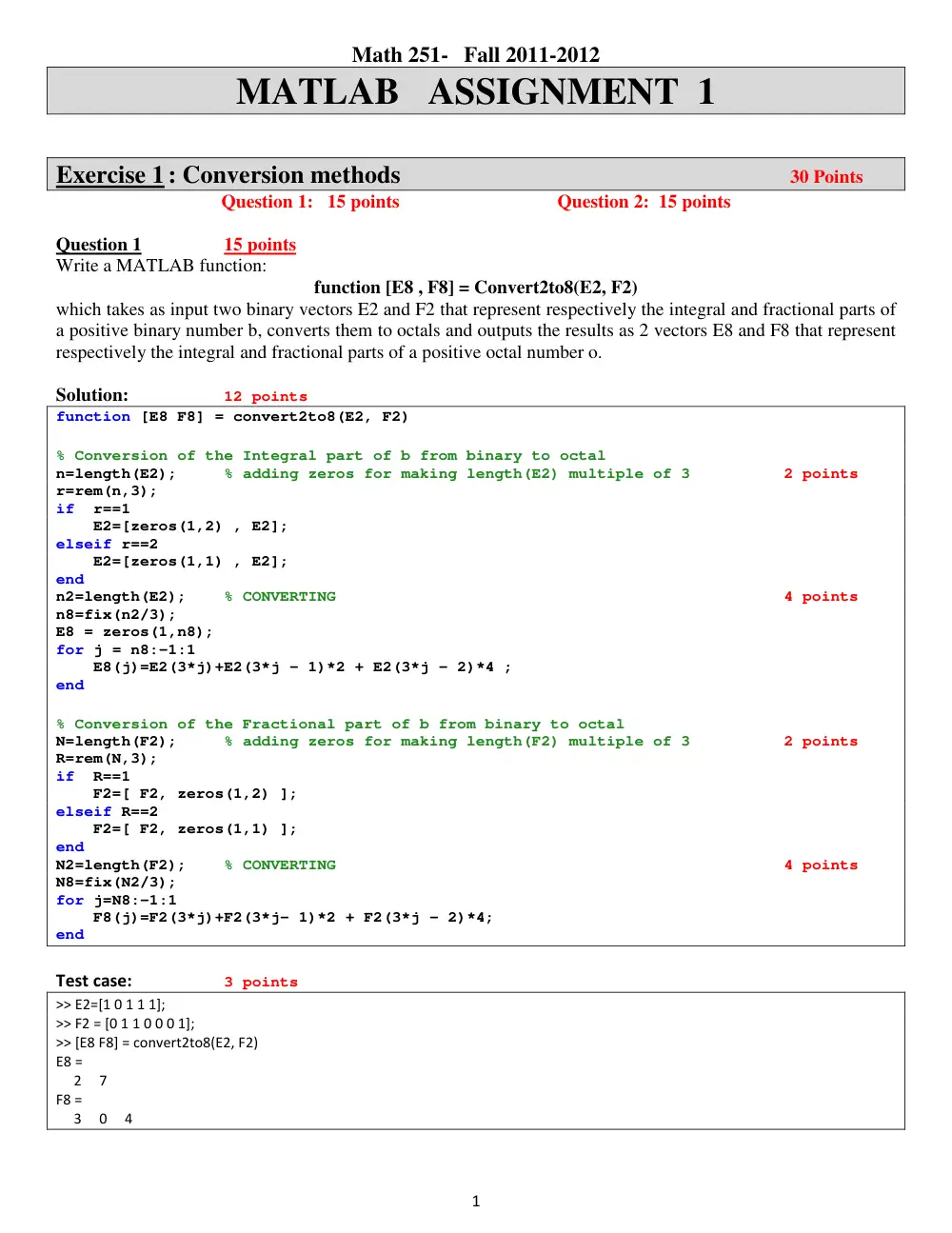
Question 1
Write a MATLAB function:
15 points
function [E8 , F8] = Convert2to8(E2, F2)
which takes as input two binary vectors E2 and F2 that represent respectively the integral and fractional parts of
a positive binary number b, converts them to octals and outputs the results as 2 vectors E8 and F8 that represent
respectively the integral and fractional parts of a positive octal number o.
Solution:
12 points
function [E8 F8] = convert2to8(E2, F2)
% Conversion of the Integral part of b from binary to octal
n=length(E2);
% adding zeros for making length(E2) multiple of 3
2 points
r=rem(n,3);
if r==1
E2=[zeros(1,2) , E2];
elseif r==2
E2=[zeros(1,1) , E2];
end
n2=length(E2);
% CONVERTING
4 points
n8=fix(n2/3);
E8 = zeros(1,n8);
for j = n8:-1:1
E8(j)=E2(3*j)+E2(3*j - 1)*2 + E2(3*j - 2)*4 ;
end
% Conversion of the Fractional part of b from binary to octal
N=length(F2);
% adding zeros for making length(F2) multiple of 3
2 points
R=rem(N,3);
if R==1
F2=[ F2, zeros(1,2) ];
elseif R==2
F2=[ F2, zeros(1,1) ];
end
N2=length(F2);
% CONVERTING
4 points
N8=fix(N2/3);
for j=N8:-1:1
F8(j)=F2(3*j)+F2(3*j- 1)*2 + F2(3*j - 2)*4;
end
Test case:
3 points
>> E2=[1 0 1 1 1];
>> F2 = [0 1 1 0 0 0 1];
>> [E8 F8] = convert2to8(E2, F2)
E8 =
2 7
F8 =
3 0 4
2
Question 2
15 points
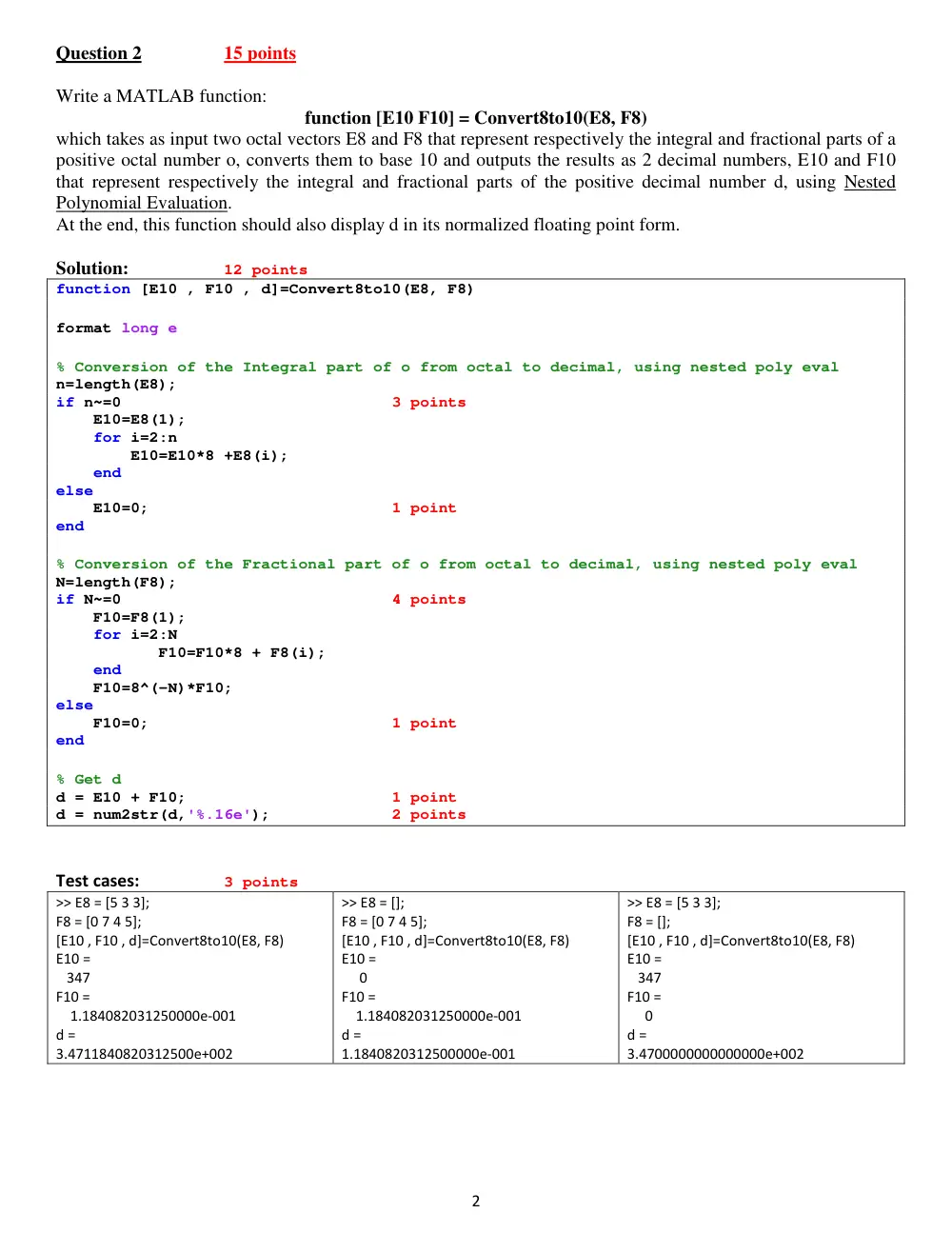
Write a MATLAB function:
function [E10 F10] = Convert8to10(E8, F8)
which takes as input two octal vectors E8 and F8 that represent respectively the integral and fractional parts of a
positive octal number o, converts them to base 10 and outputs the results as 2 decimal numbers, E10 and F10
that represent respectively the integral and fractional parts of the positive decimal number d, using Nested
Polynomial Evaluation.
At the end, this function should also display d in its normalized floating point form.
Solution:
12 points
function [E10 , F10 , d]=Convert8to10(E8, F8)
format long e
% Conversion of the Integral part of o from octal to decimal, using nested poly eval
n=length(E8);
if n~=0
3 points
E10=E8(1);
for i=2:n
E10=E10*8 +E8(i);
end
else
E10=0;
1 point
end
% Conversion of the Fractional part of o from octal to decimal, using nested poly eval
N=length(F8);
if N~=0
4 points
F10=F8(1);
for i=2:N
F10=F10*8 + F8(i);
end
F10=8^(-N)*F10;
else
F10=0;
1 point
end
% Get d
d = E10 + F10;
1 point
d = num2str(d,'%.16e');
2 points
Test cases:
3 points
>> E8 = [5 3 3];
F8 = [0 7 4 5];
[E10 , F10 , d]=Convert8to10(E8, F8)
E10 =
347
F10 =
1.184082031250000e-001
d =
3.4711840820312500e+002
>> E8 = [];
F8 = [0 7 4 5];
[E10 , F10 , d]=Convert8to10(E8, F8)
E10 =
0
F10 =
1.184082031250000e-001
d =
1.1840820312500000e-001
>> E8 = [5 3 3];
F8 = [];
[E10 , F10 , d]=Convert8to10(E8, F8)
E10 =
347
F10 =
0
d =
3.4700000000000000e+002
3
Exercise 2 : Successors and Rounding Procedures
35 points
Question 1: 11 points
Question 2: 6 points
Question 3: 13 points
Let
ex
m
x
×10
= +
be a positive decimal number in F(10, p, emin, emax), written in normalized floating point
form, with
20
20
< +
≤
−
ex
and
p < 15
.
Question 1
11 points
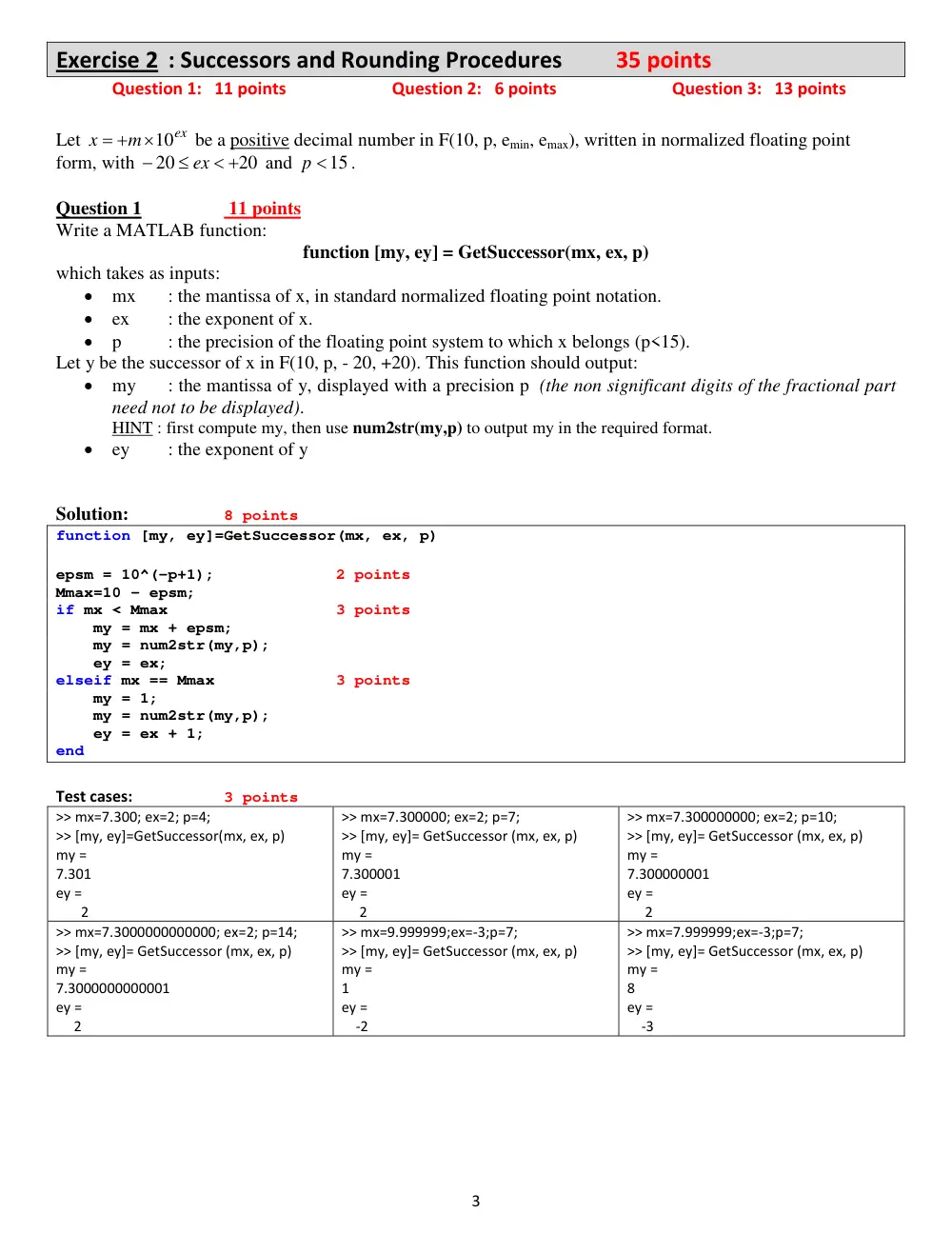
Write a MATLAB function:
function [my, ey] = GetSuccessor(mx, ex, p)
which takes as inputs:
• mx
: the mantissa of x, in standard normalized floating point notation.
• ex
: the exponent of x.
• p
: the precision of the floating point system to which x belongs (p<15).
Let y be the successor of x in F(10, p, - 20, +20). This function should output:
• my
: the mantissa of y, displayed with a precision p (the non significant digits of the fractional part
need not to be displayed).
HINT : first compute my, then use num2str(my,p) to output my in the required format.
• ey
: the exponent of y
Solution:
8 points
function [my, ey]=GetSuccessor(mx, ex, p)
epsm = 10^(-p+1);
2 points
Mmax=10 - epsm;
if mx < Mmax
3 points
my = mx + epsm;
my = num2str(my,p);
ey = ex;
elseif mx == Mmax
3 points
my = 1;
my = num2str(my,p);
ey = ex + 1;
end
Test cases:
3 points
>> mx=7.300; ex=2; p=4;
>> [my, ey]=GetSuccessor(mx, ex, p)
my =
7.301
ey =
2
>> mx=7.300000; ex=2; p=7;
>> [my, ey]= GetSuccessor (mx, ex, p)
my =
7.300001
ey =
2
>> mx=7.300000000; ex=2; p=10;
>> [my, ey]= GetSuccessor (mx, ex, p)
my =
7.300000001
ey =
2
>> mx=7.3000000000000; ex=2; p=14;
>> [my, ey]= GetSuccessor (mx, ex, p)
my =
7.3000000000001
ey =
2
>> mx=9.999999;ex=-3;p=7;
>> [my, ey]= GetSuccessor (mx, ex, p)
my =
1
ey =
-2
>> mx=7.999999;ex=-3;p=7;
>> [my, ey]= GetSuccessor (mx, ex, p)
my =
8
ey =
-3
4
Question 2
6 points
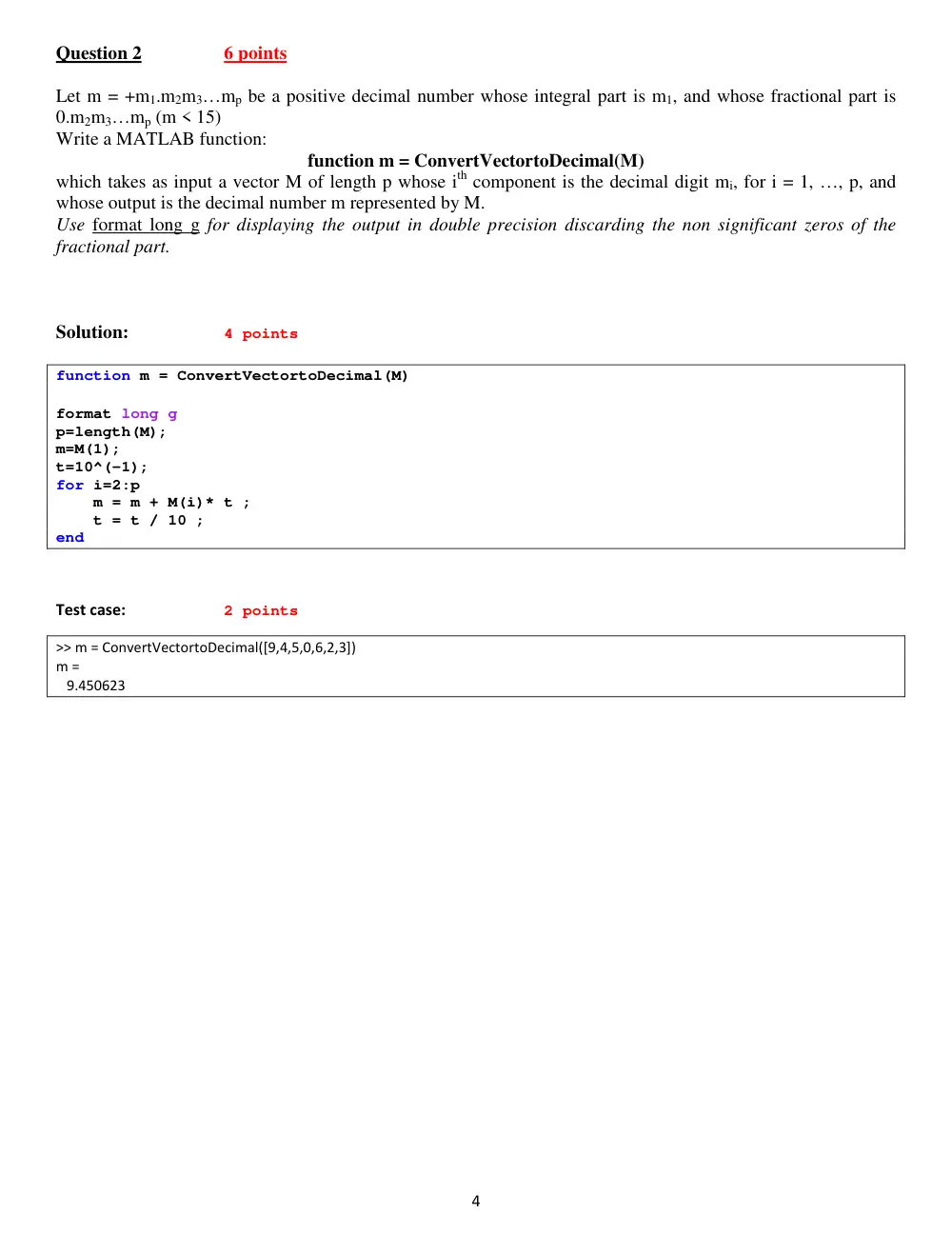
Let m = +m1.m2m3…mp be a positive decimal number whose integral part is m1, and whose fractional part is
0.m2m3…mp (m < 15)
Write a MATLAB function:
function m = ConvertVectortoDecimal(M)
which takes as input a vector M of length p whose ith component is the decimal digit mi, for i = 1, …, p, and
whose output is the decimal number m represented by M.
Use format long g for displaying the output in double precision discarding the non significant zeros of the
fractional part.
Solution:
4 points
function m = ConvertVectortoDecimal(M)
format long g
p=length(M);
m=M(1);
t=10^(-1);
for i=2:p
m = m + M(i)* t ;
t = t / 10 ;
end
Test case:
2 points
>> m = ConvertVectortoDecimal([9,4,5,0,6,2,3])
m =
9.450623
5
Question 3
13 points
Write a MATLAB function :
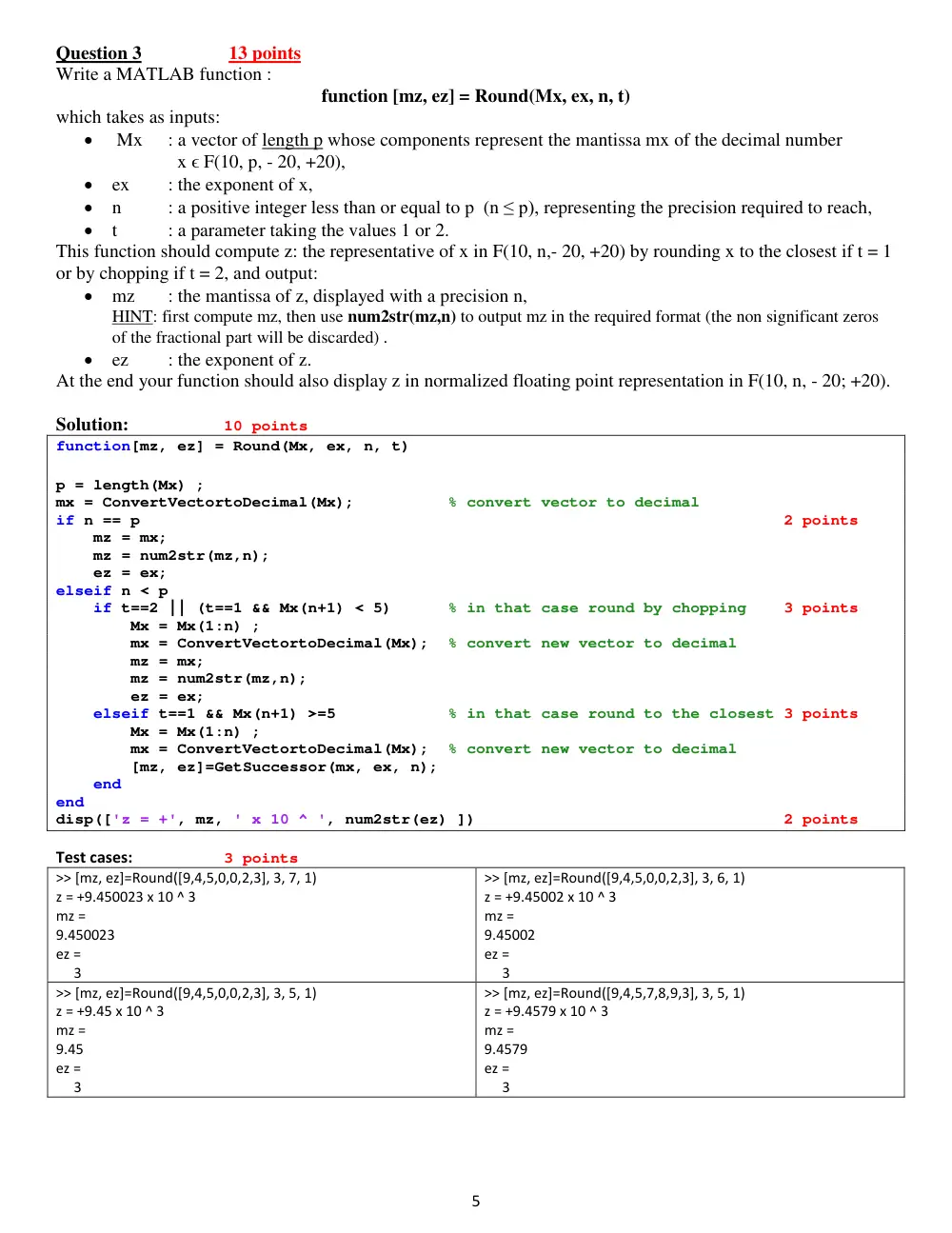
function [mz, ez] = Round(Mx, ex, n, t)
which takes as inputs:
• Mx
: a vector of length p whose components represent the mantissa mx of the decimal number
x ϵ F(10, p, - 20, +20),
• ex
: the exponent of x,
• n
: a positive integer less than or equal to p (n ≤ p), representing the precision required to reach,
• t
: a parameter taking the values 1 or 2.
This function should compute z: the representative of x in F(10, n,- 20, +20) by rounding x to the closest if t = 1
or by chopping if t = 2, and output:
• mz
: the mantissa of z, displayed with a precision n,
HINT: first compute mz, then use num2str(mz,n) to output mz in the required format (the non significant zeros
of the fractional part will be discarded) .
• ez
: the exponent of z.
At the end your function should also display z in normalized floating point representation in F(10, n, - 20; +20).
Solution:
10 points
function[mz, ez] = Round(Mx, ex, n, t)
p = length(Mx) ;
mx = ConvertVectortoDecimal(Mx);
% convert vector to decimal
if n == p
2 points
mz = mx;
mz = num2str(mz,n);
ez = ex;
elseif n < p
if t==2 || (t==1 && Mx(n+1) < 5)
% in that case round by chopping
3 points
Mx = Mx(1:n) ;
mx = ConvertVectortoDecimal(Mx); % convert new vector to decimal
mz = mx;
mz = num2str(mz,n);
ez = ex;
elseif t==1 && Mx(n+1) >=5
% in that case round to the closest 3 points
Mx = Mx(1:n) ;
mx = ConvertVectortoDecimal(Mx); % convert new vector to decimal
[mz, ez]=GetSuccessor(mx, ex, n);
end
end
disp(['z = +', mz, ' x 10 ^ ', num2str(ez) ])
2 points
Test cases:
3 points
>> [mz, ez]=Round([9,4,5,0,0,2,3], 3, 7, 1)
z = +9.450023 x 10 ^ 3
mz =
9.450023
ez =
3
>> [mz, ez]=Round([9,4,5,0,0,2,3], 3, 6, 1)
z = +9.45002 x 10 ^ 3
mz =
9.45002
ez =
3
>> [mz, ez]=Round([9,4,5,0,0,2,3], 3, 5, 1)
z = +9.45 x 10 ^ 3
mz =
9.45
ez =
3
>> [mz, ez]=Round([9,4,5,7,8,9,3], 3, 5, 1)
z = +9.4579 x 10 ^ 3
mz =
9.4579
ez =
3
6
Exercise 3 : Root finding methods
40 points
Question 1: 18 points
Question 2: 12 points
Question 3: 10 points
The aim of this exercise is to approximate π by computing the root of f(x) = sin(x) in the interval (3, 4),
based on Newton's method. For that purpose:
Question 1
18 points
Write 2 MATLAB functions:
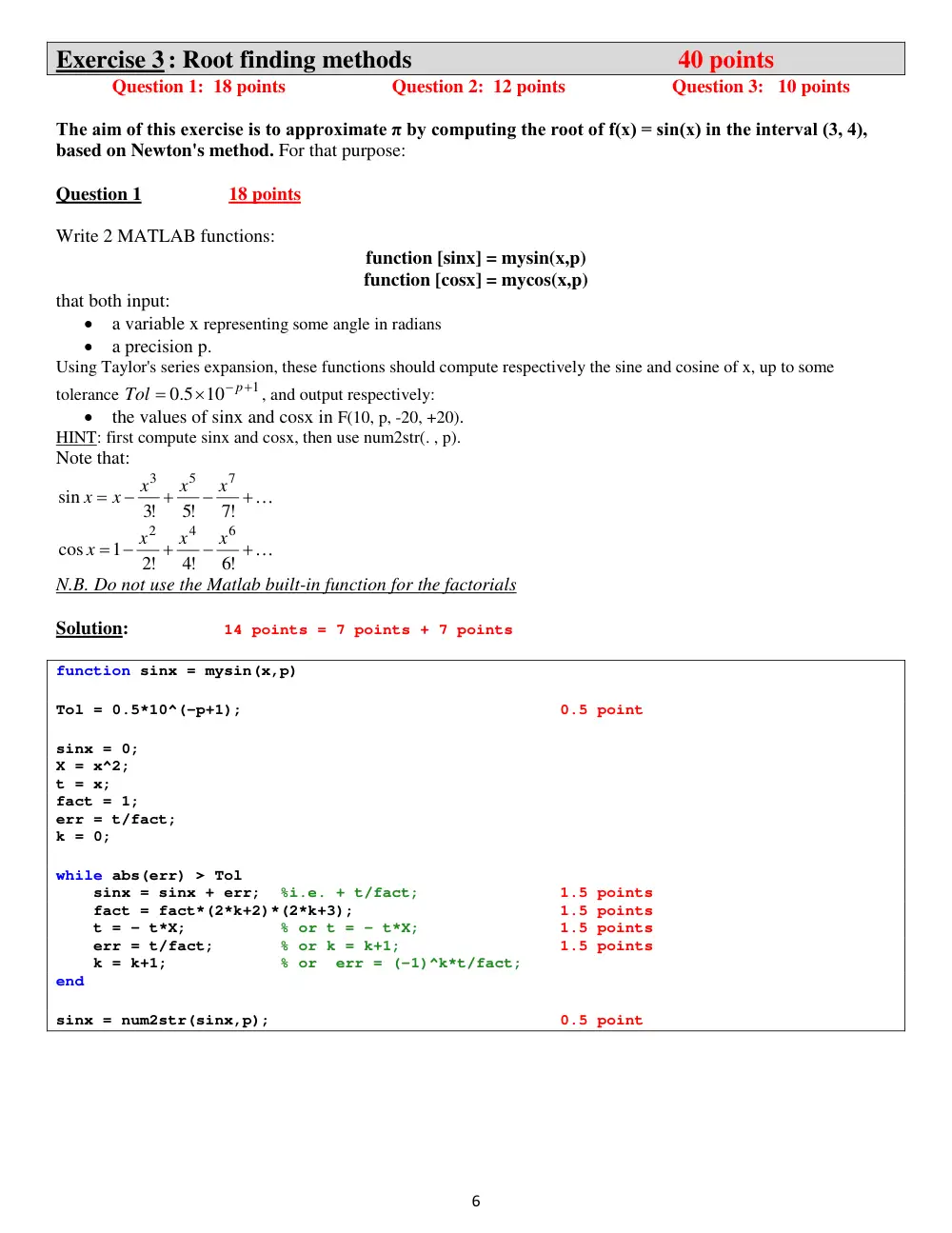
function [sinx] = mysin(x,p)
function [cosx] = mycos(x,p)
that both input:
• a variable x representing some angle in radians
• a precision p.
Using Taylor's series expansion, these functions should compute respectively the sine and cosine of x, up to some
tolerance
1
10
5.0
− +
×
=
p
Tol
, and output respectively:
• the values of sinx and cosx in F(10, p, -20, +20).
HINT: first compute sinx and cosx, then use num2str(. , p).
Note that:
+
−
+
−
=
!7
!5
!3
sin
7
5
3
x
x
x
x
x
+
−
+
= −
!6
!4
!2
1
cos
6
4
2
x
x
x
x
N.B. Do not use the Matlab built-in function for the factorials
Solution:
14 points = 7 points + 7 points
function sinx = mysin(x,p)
Tol = 0.5*10^(-p+1);
0.5 point
sinx = 0;
X = x^2;
t = x;
fact = 1;
err = t/fact;
k = 0;
while abs(err) > Tol
sinx = sinx + err; %i.e. + t/fact;
1.5 points
fact = fact*(2*k+2)*(2*k+3);
1.5 points
t = - t*X; % or t = - t*X;
1.5 points
err = t/fact; % or k = k+1;
1.5 points
k = k+1; % or err = (-1)^k*t/fact;
end
sinx = num2str(sinx,p);
0.5 point
7
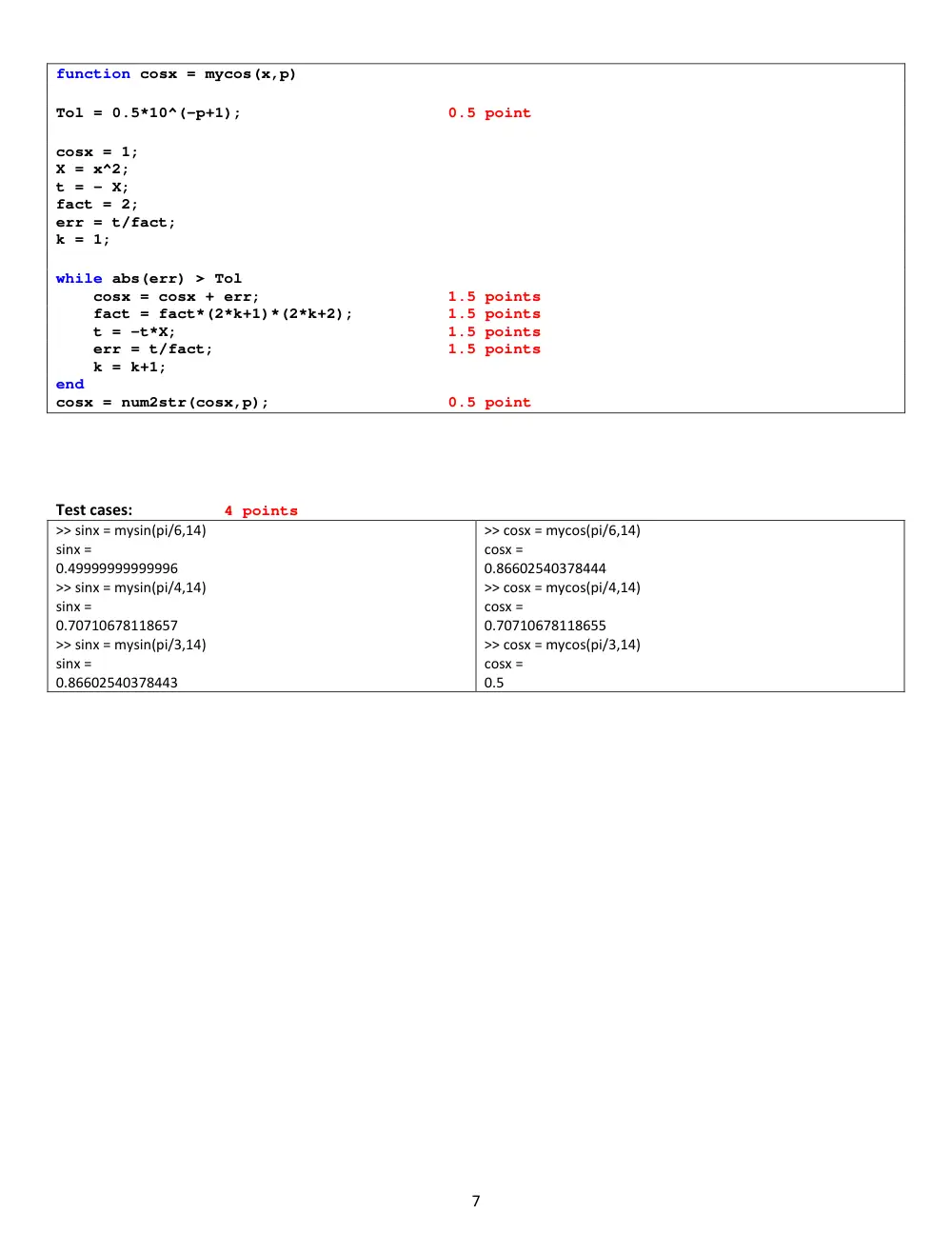
function cosx = mycos(x,p)
Tol = 0.5*10^(-p+1);
0.5 point
cosx = 1;
X = x^2;
t = - X;
fact = 2;
err = t/fact;
k = 1;
while abs(err) > Tol
cosx = cosx + err;
1.5 points
fact = fact*(2*k+1)*(2*k+2);
1.5 points
t = -t*X;
1.5 points
err = t/fact;
1.5 points
k = k+1;
end
cosx = num2str(cosx,p);
0.5 point
Test cases:
4 points
>> sinx = mysin(pi/6,14)
sinx =
0.49999999999996
>> sinx = mysin(pi/4,14)
sinx =
0.70710678118657
>> sinx = mysin(pi/3,14)
sinx =
0.86602540378443
>> cosx = mycos(pi/6,14)
cosx =
0.86602540378444
>> cosx = mycos(pi/4,14)
cosx =
0.70710678118655
>> cosx = mycos(pi/3,14)
cosx =
0.5
8
Question 2
12 points
Write a MATLAB function:
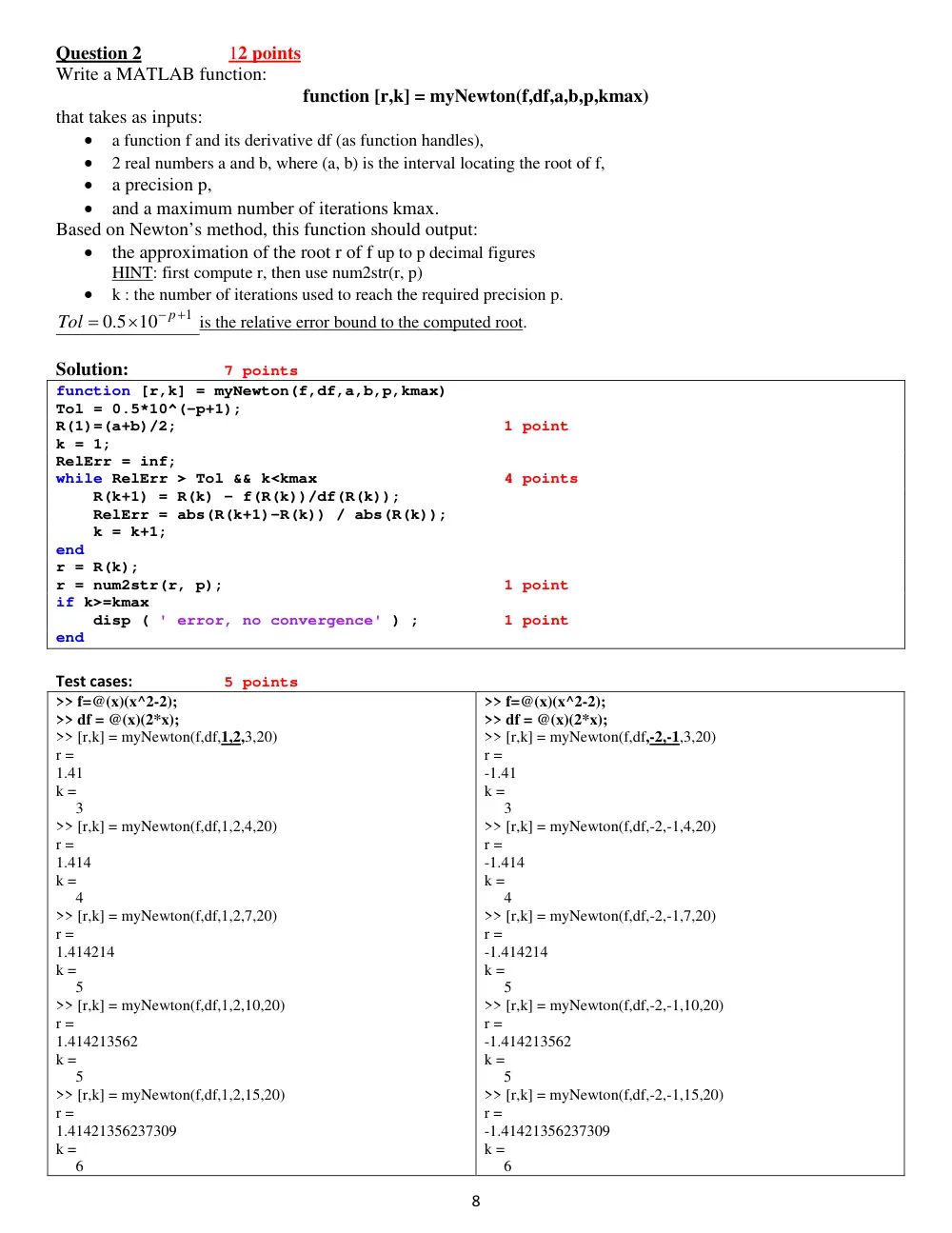
function [r,k] = myNewton(f,df,a,b,p,kmax)
that takes as inputs:
•
a function f and its derivative df (as function handles),
•
2 real numbers a and b, where (a, b) is the interval locating the root of f,
• a precision p,
• and a maximum number of iterations kmax.
Based on Newton’s method, this function should output:
• the approximation of the root r of f up to p decimal figures
HINT: first compute r, then use num2str(r, p)
•
k : the number of iterations used to reach the required precision p.
1
10
5.0
− +
×
=
p
Tol
is the relative error bound to the computed root.
Solution:
7 points
function [r,k] = myNewton(f,df,a,b,p,kmax)
Tol = 0.5*10^(-p+1);
R(1)=(a+b)/2;
1 point
k = 1;
RelErr = inf;
while RelErr > Tol && k<kmax
4 points
R(k+1) = R(k) - f(R(k))/df(R(k));
RelErr = abs(R(k+1)-R(k)) / abs(R(k));
k = k+1;
end
r = R(k);
r = num2str(r, p);
1 point
if k>=kmax
disp ( ' error, no convergence' ) ;
1 point
end
Test cases:
5 points
>> f=@(x)(x^2-2);
>> df = @(x)(2*x);
>> [r,k] = myNewton(f,df,1,2,3,20)
r =
1.41
k =
3
>> [r,k] = myNewton(f,df,1,2,4,20)
r =
1.414
k =
4
>> [r,k] = myNewton(f,df,1,2,7,20)
r =
1.414214
k =
5
>> [r,k] = myNewton(f,df,1,2,10,20)
r =
1.414213562
k =
5
>> [r,k] = myNewton(f,df,1,2,15,20)
r =
1.41421356237309
k =
6
>> f=@(x)(x^2-2);
>> df = @(x)(2*x);
>> [r,k] = myNewton(f,df,-2,-1,3,20)
r =
-1.41
k =
3
>> [r,k] = myNewton(f,df,-2,-1,4,20)
r =
-1.414
k =
4
>> [r,k] = myNewton(f,df,-2,-1,7,20)
r =
-1.414214
k =
5
>> [r,k] = myNewton(f,df,-2,-1,10,20)
r =
-1.414213562
k =
5
>> [r,k] = myNewton(f,df,-2,-1,15,20)
r =
-1.41421356237309
k =
6
9
Question 3
10 points
Write a MATLAB function:
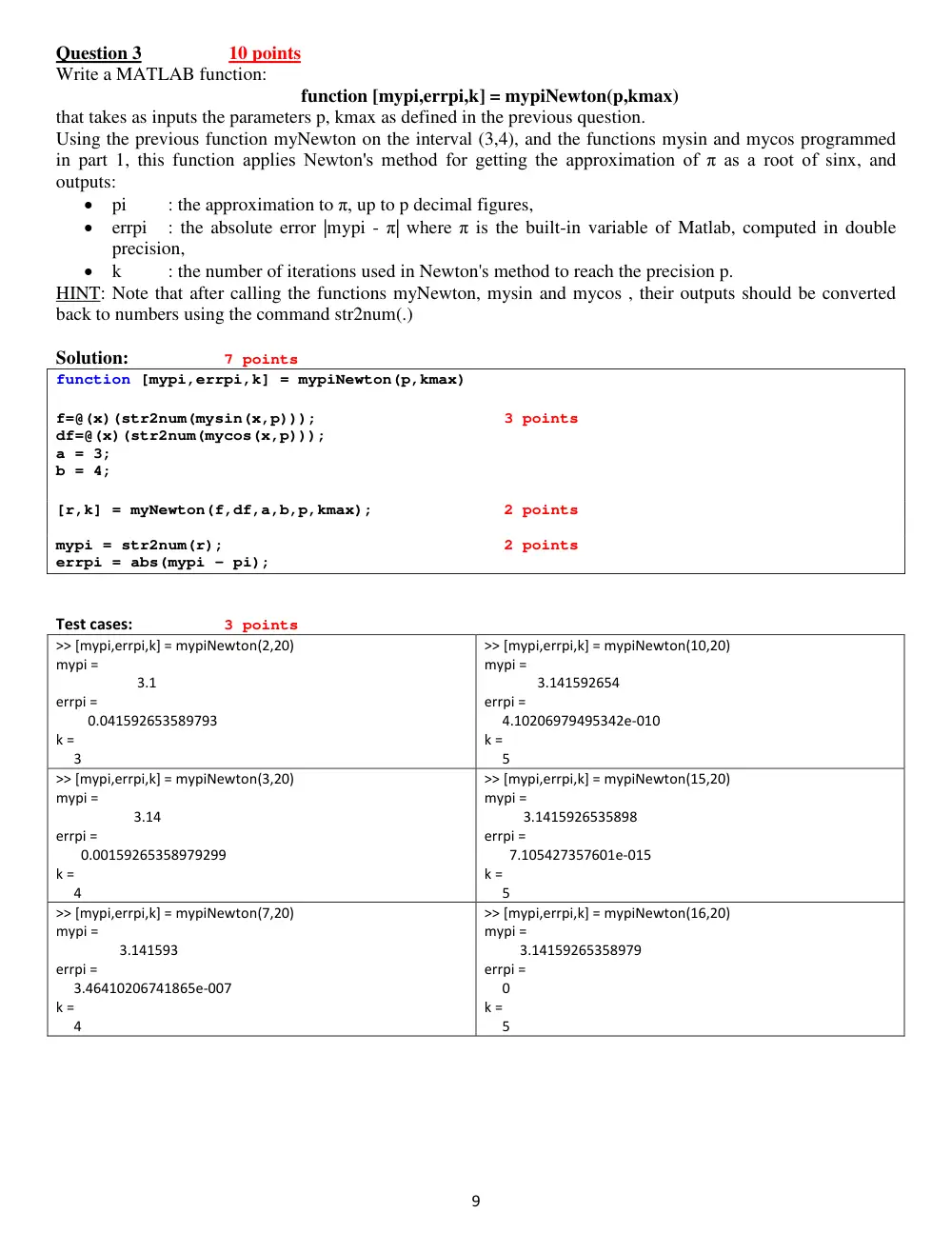
function [mypi,errpi,k] = mypiNewton(p,kmax)
that takes as inputs the parameters p, kmax as defined in the previous question.
Using the previous function myNewton on the interval (3,4), and the functions mysin and mycos programmed
in part 1, this function applies Newton's method for getting the approximation of π as a root of sinx, and
outputs:
• pi
: the approximation to π, up to p decimal figures,
• errpi : the absolute error |mypi - π| where π is the built-in variable of Matlab, computed in double
precision,
• k
: the number of iterations used in Newton's method to reach the precision p.
HINT: Note that after calling the functions myNewton, mysin and mycos , their outputs should be converted
back to numbers using the command str2num(.)
Solution:
7 points
function [mypi,errpi,k] = mypiNewton(p,kmax)
f=@(x)(str2num(mysin(x,p)));
3 points
df=@(x)(str2num(mycos(x,p)));
a = 3;
b = 4;
[r,k] = myNewton(f,df,a,b,p,kmax);
2 points
mypi = str2num(r);
2 points
errpi = abs(mypi - pi);
Test cases:
3 points
>> [mypi,errpi,k] = mypiNewton(2,20)
mypi =
3.1
errpi =
0.041592653589793
k =
3
>> [mypi,errpi,k] = mypiNewton(10,20)
mypi =
3.141592654
errpi =
4.10206979495342e-010
k =
5
>> [mypi,errpi,k] = mypiNewton(3,20)
mypi =
3.14
errpi =
0.00159265358979299
k =
4
>> [mypi,errpi,k] = mypiNewton(15,20)
mypi =
3.1415926535898
errpi =
7.105427357601e-015
k =
5
>> [mypi,errpi,k] = mypiNewton(7,20)
mypi =
3.141593
errpi =
3.46410206741865e-007
k =
4
>> [mypi,errpi,k] = mypiNewton(16,20)
mypi =
3.14159265358979
errpi =
0
k =
5