
MATH 304 Final, Fall 2007
American University of Beirut · Complex Analysis · 2 pages
More MATH 304 files
Show the text of this final exam
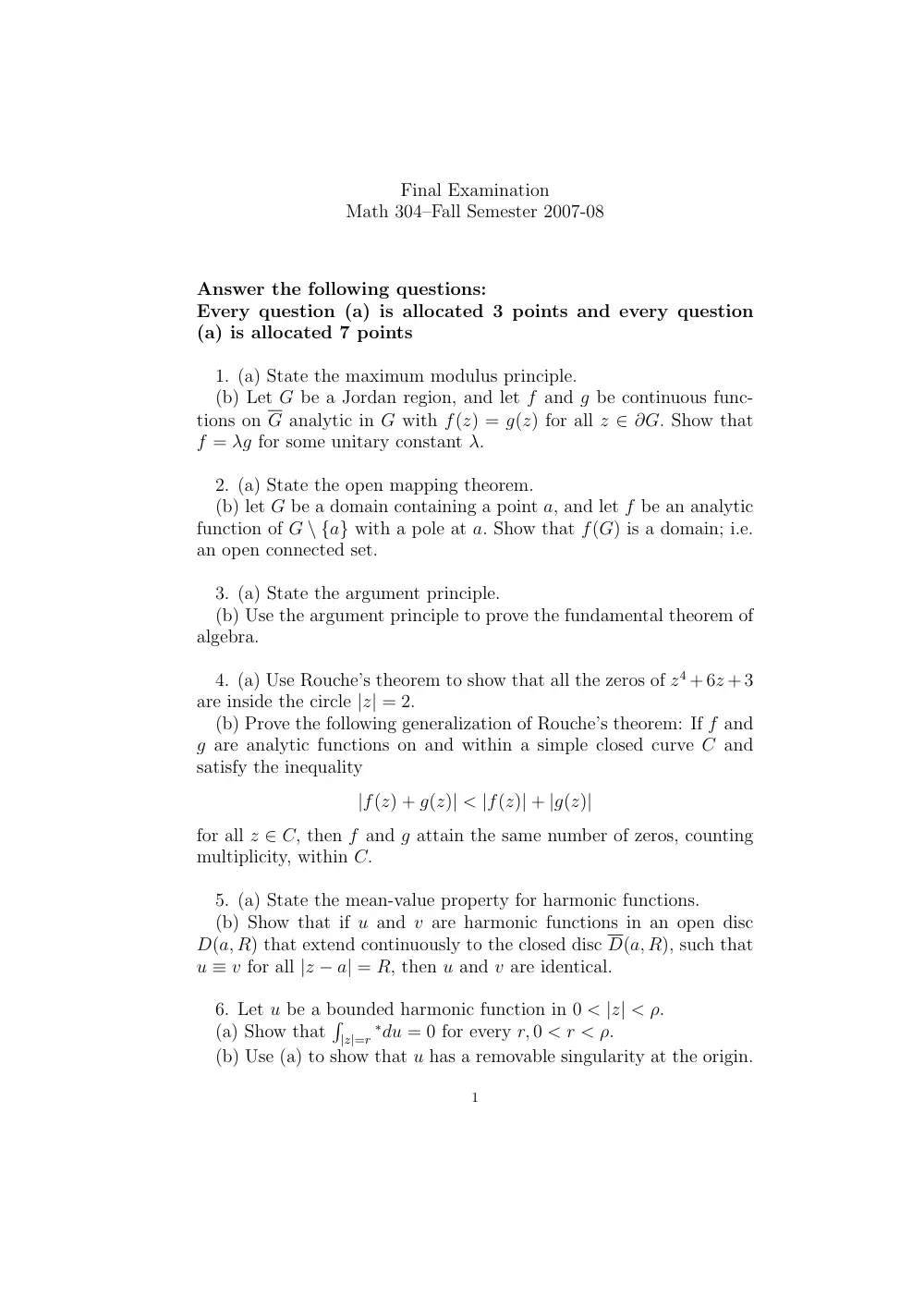
Final Examination
Math 304–Fall Semester 2007-08
Answer the following questions:
Every question (a) is allocated 3 points and every question
(a) is allocated 7 points
1. (a) State the maximum modulus principle.
(b) Let G be a Jordan region, and let f and g be continuous func-
tions on G analytic in G with f(z) = g(z) for all z ∈ ∂G. Show that
f = λg for some unitary constant λ.
2. (a) State the open mapping theorem.
(b) let G be a domain containing a point a, and let f be an analytic
function of G \ {a} with a pole at a. Show that f(G) is a domain; i.e.
an open connected set.
3. (a) State the argument principle.
(b) Use the argument principle to prove the fundamental theorem of
algebra.
4. (a) Use Rouche’s theorem to show that all the zeros of z4 +6z +3
are inside the circle |z| = 2.
(b) Prove the following generalization of Rouche’s theorem: If f and
g are analytic functions on and within a simple closed curve C and
satisfy the inequality
|f(z) + g(z)| < |f(z)| + |g(z)|
for all z ∈ C, then f and g attain the same number of zeros, counting
multiplicity, within C.
5. (a) State the mean-value property for harmonic functions.
(b) Show that if u and v are harmonic functions in an open disc
D(a, R) that extend continuously to the closed disc D(a, R), such that
u ≡ v for all |z − a| = R, then u and v are identical.
6. Let u be a bounded harmonic function in 0 < |z| < ρ.
(a) Show that
�
|z|=r
∗du = 0 for every r, 0 < r < ρ.
(b) Use (a) to show that u has a removable singularity at the origin.
1
2
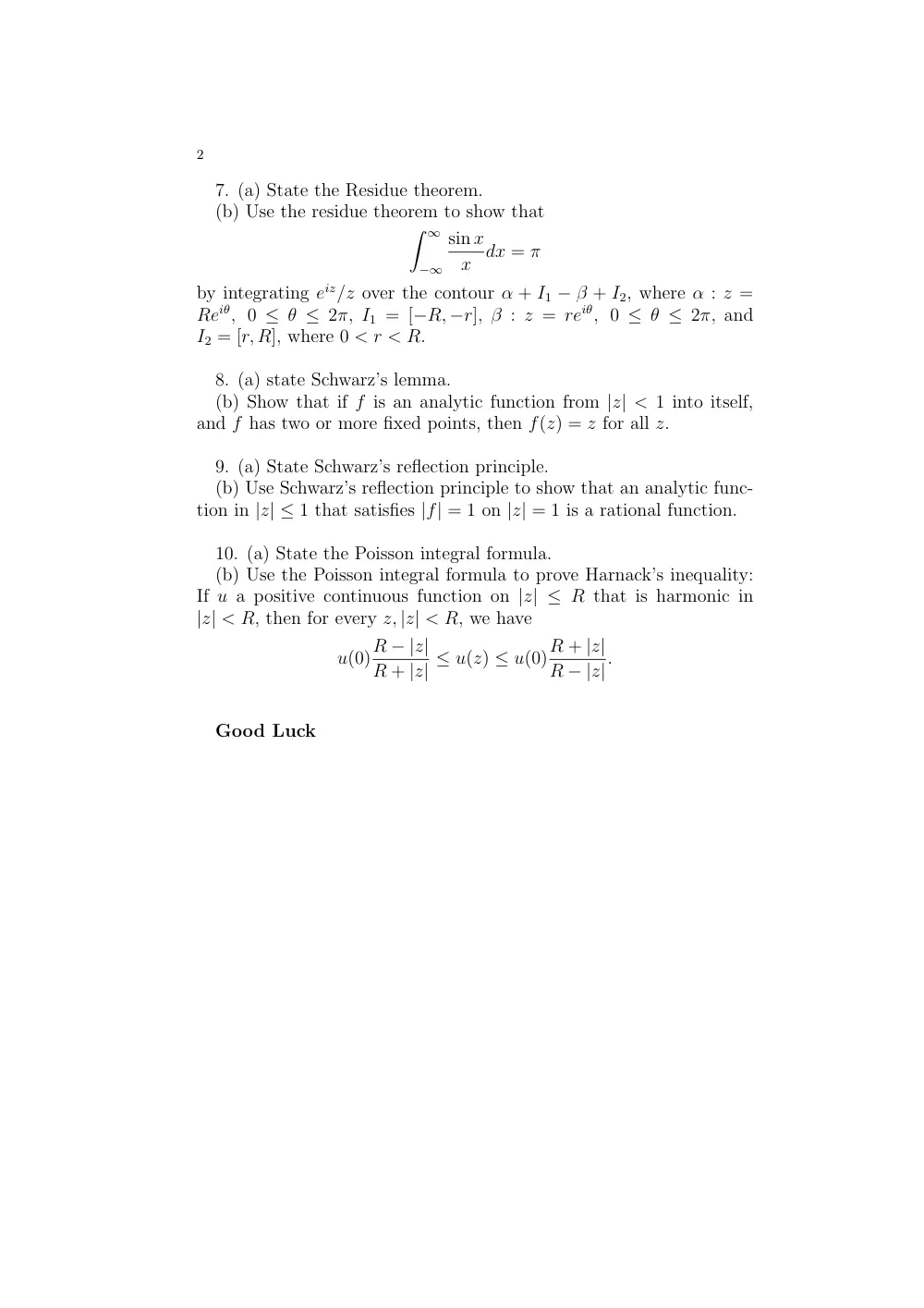
7. (a) State the Residue theorem.
(b) Use the residue theorem to show that
� ∞
−∞
sin x
x dx = π
by integrating eiz/z over the contour α + I1 − β + I2, where α : z =
Reiθ, 0 ≤ θ ≤ 2π, I1 = [−R, −r], β : z = reiθ, 0 ≤ θ ≤ 2π, and
I2 = [r, R], where 0 < r < R.
8. (a) state Schwarz’s lemma.
(b) Show that if f is an analytic function from |z| < 1 into itself,
and f has two or more fixed points, then f(z) = z for all z.
9. (a) State Schwarz’s reflection principle.
(b) Use Schwarz’s reflection principle to show that an analytic func-
tion in |z| ≤ 1 that satisfies |f| = 1 on |z| = 1 is a rational function.
10. (a) State the Poisson integral formula.
(b) Use the Poisson integral formula to prove Harnack’s inequality:
If u a positive continuous function on |z| ≤ R that is harmonic in
|z| < R, then for every z, |z| < R, we have
u(0)R − |z|
R + |z| ≤ u(z) ≤ u(0)R + |z|
R − |z|.
Good Luck