
MATH 341 Final, Fall 2005
American University of Beirut · Modules and Rings I · 2 pages

More MATH 341 files
Show the text of this final exam
Math 341 — Fall 2005-06
Modules and Rings I
Take-home final exam, due Monday, January 30, at 5pm
in my mailbox at the mathematics department
http://people.aub.edu.1b/~kmakdisi/
Remark: Make sure to solve the problems from both sides of the sheet. This take-home
exam is not a problem set: you may not discuss the problems with any person until every
student has handed in the exam. You may consult any books or other written references
you like for this exam, but the course texts and your lecture notes ought to be sufficient.
If you use a result not in the course texts or in your lecture notes, be sure to include a
proof of that result, with a reference to the source.
All nine problems are equally weighted, even though they vary in difficulty.
I will be available TTh 3-5 in my office if you are unsure about the meaning of the
statements in the problems for this quiz. I will not give hints about how to solve these
problems below, however I will be happy to answer any questions you may have about
the lecture notes, previous problem sets, and course texts.
Good luck!
Problem 1: If R is a Noetherian integral domain, show that every nonzero element of R
is either a unit or factors into a product of irreducible elements. (N.B., the factorization
need not be unique.)
Problem 2: Let A,B,C be R-modules, and assume given homomorphisms f : A ~ B
and g: B + C such that for every R-module P, the following sequence is exact:
0 > Homa,(C, P)s Homa(B, pyts Homa(A, P).
Show that the sequence A-‘sB°5C — 0 must be exact.
Hints: (i) to show that g is surjective, take P = coker g, (ii) to show that gf = 0, take
P =C, (iii) to show that ker g C Image f, take P = coker f.
Problem 3: Let R be a ring in which every ideal is projective {this is a weaker condition
than being a PID). Show (by imitating the corresponding proof for PIDs) that every
submodule of the free module R” is isomorphic to a direct. sum J, @ 2 @- +: @ I of ideals
Iy,...,Ip with k <n.
Problem 4: Let V be a five-dimensional vector space over Q with basis {e1,..., es}.
We are given a linear transformation J’: V > V such that
a) Write the matrix of T with respect to the given basis, and use it to show that the
characteristic polynomial pr() is equal to A° + 4,3.
b) Find a Q-basis for each of the two (nonzero) primary components of V, viewed
as a module over R = QA] in the usual way. (The first component corresponds to the
irreducible polynomial A, and the second corresponds to the irreducible polynomial 4? +4.)
sat To Se vexca C8
Reaaarve Ragadine FO
c) Decompose each primary component into a direct sum of primary cyclic modules,
and use this to find the primary rational canonical form of T. (This is the rational
canonical form as used in Hungerford, not Jacobson.)
d) Find the Jordan canonical form of T.
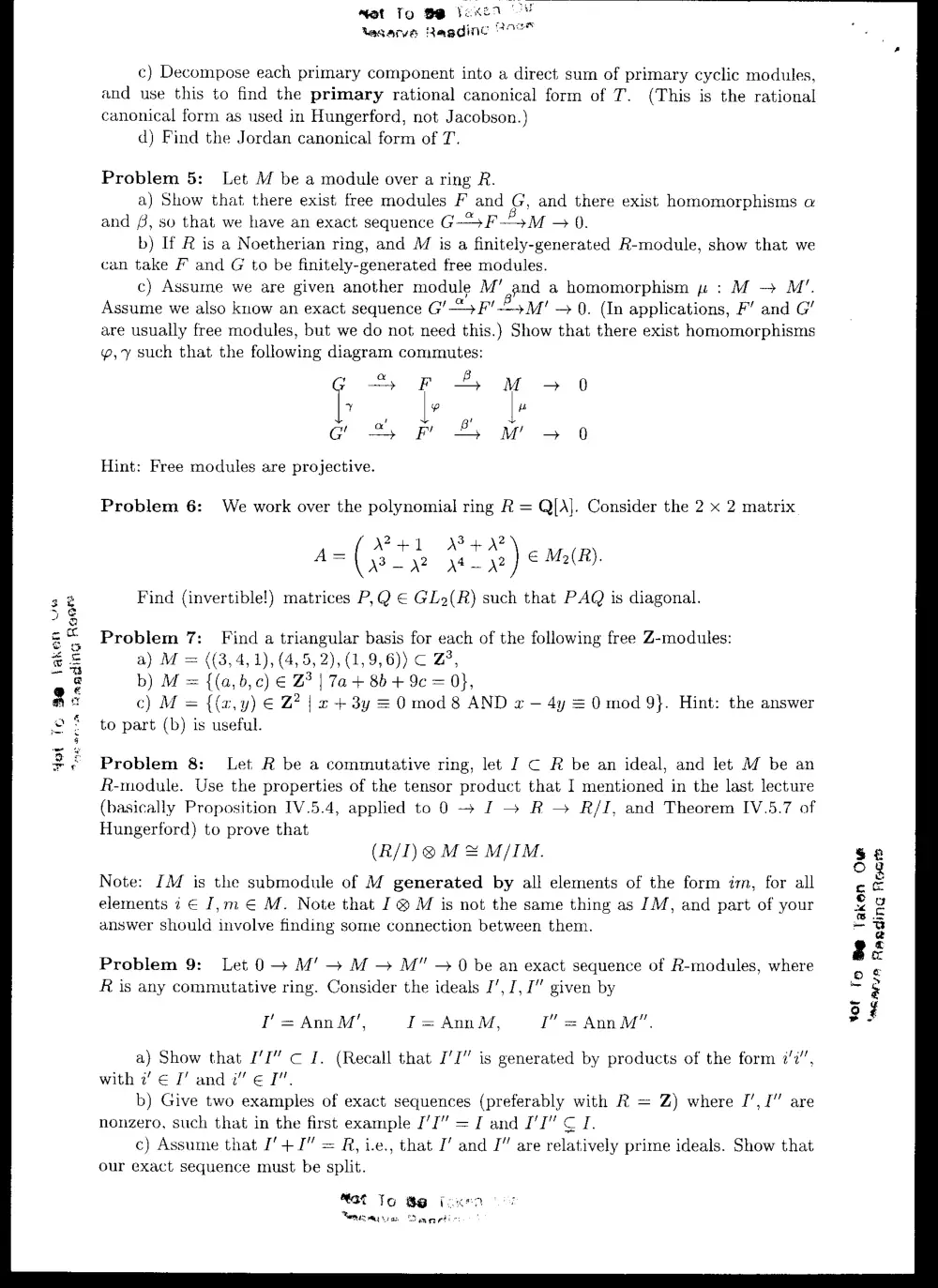
Problem 5: Let M be a module over a ring R.
a) Show that there exist free modules F and G, and there exist homomorphisms a
and £, so that we have an exact sequence GSP 4M = 0.
b) If R is a Noetherian ring, and M is a finitely-generated R-module, show that we
can take F and G to be finitely-generated free modules.
c) Assume we are given another module M’ and a homomorphism p : M — M’.
Assume we also know an exact sequence G!3R' 25M! 0. (In applications, F’ and G’
are usually free modules, but we do not need this.) Show that there exist homomorphisms
y,y such that the following diagram commutes:
*, pF 4, uw 0
bo
' B' .
Gi Sy FF M’ 0
Hint: Free modules are projective.
Problem 6: We work over the polynomial ring R = Q[A]. Consider the 2 x 2 matrix
+1 A+?
A= (32% 4 — 2 € M2(R).
Find (invertible!) matrices P,Q € GL2(R) such that PAQ is diagonal.
3
7
Rear
Problem 7: Find a triangular basis for each of the following free Z-modules:
a) M = ((3,4, 1), (4,5, 2), (1,9, 6)) C Z,
b) M = {(a,b,c) € Z | 7a + 8b + 9c = OF,
c) M = {(2,y) € Z? | x +3y = 0 mod8 AND zx — 4y = 0 mod 9}. Hint: the answer
to part (b) is useful.
8
ej
=
as}
e
€
"
&
§
Hot (co
Problem 8: Let R be a commutative ring, let J C R be an ideal, and let M be an
f-module. Use the properties of the tensor product that I mentioned in the last lecture
(basically Proposition IV.5.4, applied to 0 + I > R —> R/I, and Theorem IV.5.7 of
Hungerford) to prove that
(R/1I)®M = M/IM. se
Note: IM is the submodule of M generated by all elements of the form im, for all ce
elements 7 € I,m € M. Note that J @ M is not the same thing as 7M, and part of your £ 2
answer should involve finding some connection between them. - 3
cs
x
Problem 9: Let 0 ~ M' —= M > M” — 0 be an exact sequence of R-modules, where a ©
Ris any commutative ring. Consider the ideals I’, 7,1’ given by - 5
3}
a
I’ = AnnM’, I= AnnM, I” = Ann M”.
a) Show that I” c I. (Recall that I’I” is generated by products of the form 7’i”,
with ? € I’ and i” € I”.
b) Give two examples of exact sequences (preferably with R = Z) where I’, I” are
nonzero, such that in the first example J’7” = J and I’I” CI.
c) Assume that J’+/" = R, ie., that I’ and J” are relatively prime ideals. Show that
our exact sequence must be split.